


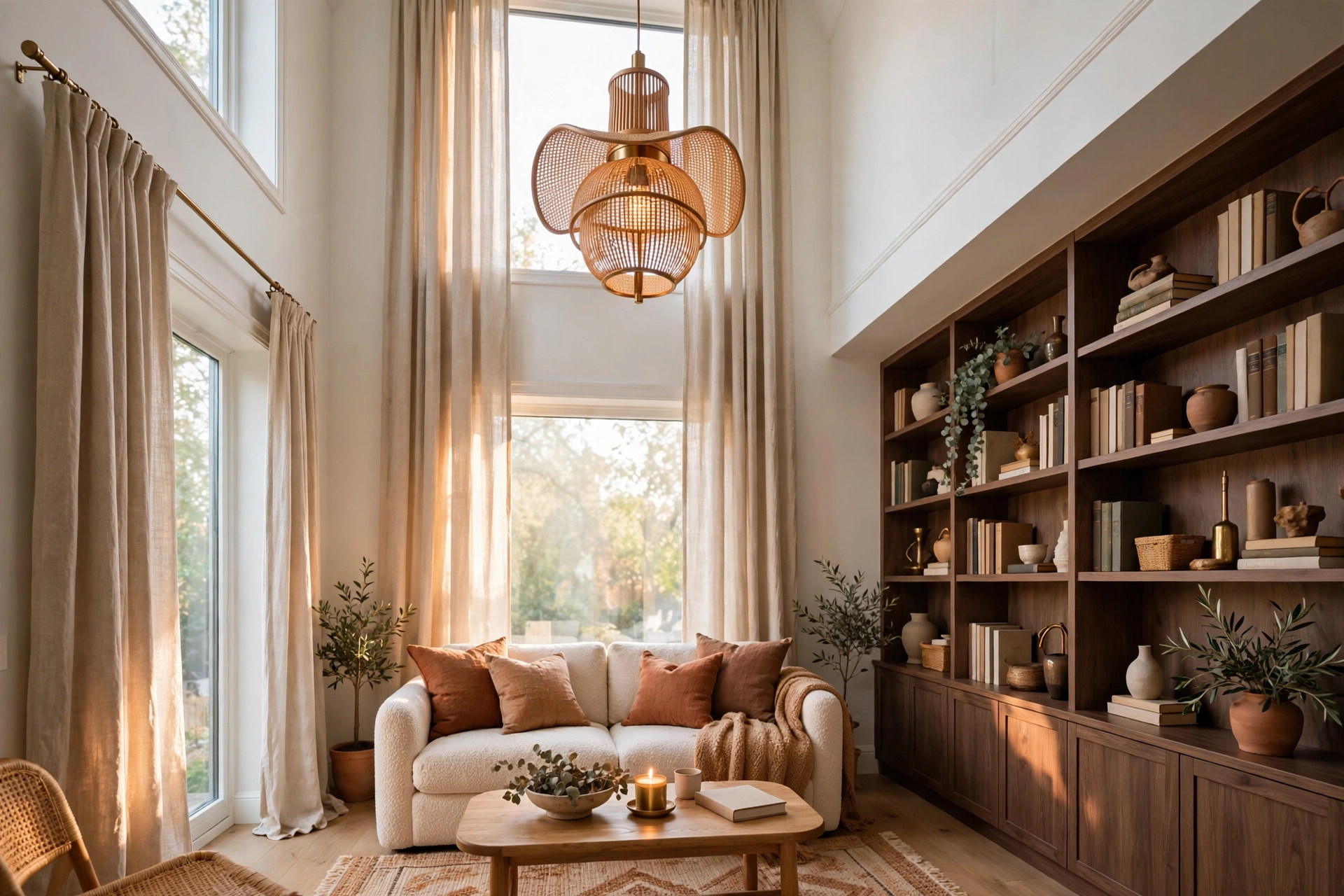
Our first apartment had twelve-foot ceilings and about as much floor space as a two-car garage. The height was gorgeous and the room felt like a shoebox with a cathedral on top — every piece of furniture looked like it was drowning, and the top six feet of wall were just… empty. Sound familiar?
It took me two years of experimenting (and one chandelier hung so low my husband nearly took it out with a pool cue) to figure out the real secret: small high-ceiling rooms don’t need less furniture, they need vertical thinking. Once you learn to decorate the air above you — not just the floor below — the whole room clicks.
These 25 beautiful small high ceiling living room ideas are the tricks that actually worked: ways to fill that soaring vertical space without spending a fortune, keep the room cozy instead of echoey, and make a small footprint feel like a much bigger room.
- Decorate the air, not just the floor — ceiling-height curtains and tall shelving make the height feel intentional.
- One oversized pendant fills the middle of the room and brings a tall ceiling down to human scale.
- Layer your lighting: pendant + floor lamps + table lamps, never a single small flush mount.
- Contrast tall walls with low-profile furniture — the horizontal line makes ceilings feel even higher.
- A large rug anchors the room so the eye doesn’t float away with the ceiling.
1. Hang Curtains From the Ceiling, Not the Window

The single fastest fix. Mount your curtain rod 2–4 inches below the ceiling and let the fabric fall all the way to the floor. The eye reads the full height of the drape, and suddenly your window looks twice as tall. Use light, airy fabric so it doesn’t eat the light.
Try this: buy curtains one size longer than you think you need — a slight puddle on the floor reads luxurious; too-short curtains read like a mistake.
Difficulty: Easy | Cost: $40-$120
2. One Oversized Pendant Instead of a Small Flush Mount

A tiny ceiling light in a tall room looks like a lost balloon. Go big: a statement pendant or chandelier with real presence fills the middle air of the room and pulls the ceiling down to a human scale. Woven rattan, drum shades, and sculptural metal all work.
If you want to get the layering right, these hidden lighting ideas for a cozy home are full of pendant and lamp tricks that work beautifully in tall rooms too.
Try this: hang it so the bottom sits 7–8 feet off the floor — low enough to matter, high enough to walk under.
Difficulty: Moderate | Cost: $80-$250
3. Run Bookshelves Floor to Ceiling

Tall built-in or freestanding bookcases turn dead wall height into the room’s best feature. Style the lower shelves with books and the upper ones with baskets and objects you don’t need daily. The vertical lines make the ceiling feel intentional, not accidental.
For shelving that goes all the way up with style, these beautiful bookshelves built-in ideas show how floor-to-ceiling shelving can anchor an entire wall.
Try this: anchor tall bookcases to studs — a top-heavy shelf full of books is a tipping hazard, especially with kids around.
Difficulty: Moderate | Cost: $100-$300
4. Hang One Large-Scale Art Piece

Big walls swallow small frames. One oversized canvas — roughly two-thirds the width of the sofa — anchors the wall and gives the eye a destination. Abstract landscapes and large photography prints are the safest bets.
Try this: center the art’s middle at about 57–60 inches off the floor (gallery height), even if the wall keeps going up. Floating it too high disconnects it from the furniture.
Difficulty: Easy | Cost: $50-$200
5. Build a Gallery Wall That Climbs

If one big piece feels too serious, stack frames vertically: start at eye level and work up toward the ceiling in a loose column or grid. A climbing gallery wall fills the height with personality and lets you add to it over time.
Try this: mock the layout on the floor first with painter’s tape outlines on the wall — climbing walls go crooked fast without a plan.
Difficulty: Easy | Cost: $30-$100
6. Add a Tall Arched Floor Lamp

An arc floor lamp is made for high ceilings: it throws light down into the seating area from seven feet up, fills the vertical space with a sculptural curve, and costs a fraction of rewiring for a pendant. Marble-base arcs look expensive and steady.
Try this: position the arc so the shade hangs over the coffee table, not the sofa back — the light lands where you actually sit.
Difficulty: Easy | Cost: $60-$180
7. Carve Out a Lofted Reading Nook

If your ceiling is truly tall (10+ feet), the air above a hallway or corner can become a tiny mezzanine or lofted reading platform. Even a simple raised platform with a railing, reached by a ship’s ladder, adds usable square footage and storybook charm.
Try this: check local code and joist capacity before building anything overhead — this is a pro-or-engineer job, not a weekend whim.
Difficulty: Involved | Cost: $200-$600
8. Paint the Ceiling a Color

White ceilings in tall rooms push the ceiling away and make the room feel like a well. A soft color — warm greige, pale blue, even a muted terracotta — brings the ceiling visually closer and makes the room feel wrapped and cozy. The fifth wall deserves paint too.
Try this: carry the wall color up and over the ceiling in the same shade for a cocoon effect, or go one shade darker than the walls for subtle drama.
Difficulty: Moderate | Cost: $40-$120
9. Add Beams or Wood Cladding Overhead

Exposed beams (real or faux) break a tall ceiling into human-scale sections and add warmth no paint can match. Faux wood beams are lightweight, affordable, and install in a weekend. They also give pendant lights something to hang from.
Try this: stain beams a tone darker than your floor so they read as architecture, not decoration.
Difficulty: Involved | Cost: $300-$800
10. Layer Rugs to Anchor the Floor

High ceilings pull the eye up; a generous rug pulls it back down. In a small room, go as large as the floor allows — front legs of all seating on the rug — and layer a smaller patterned rug over a big jute base for texture and zone definition.
Try this: an 8×10 rug in a small living room almost always beats a 5×8. Small rugs make small rooms look smaller.
Difficulty: Easy | Cost: $60-$200
11. Contrast with Low-Profile Furniture

Here’s the counterintuitive move: pair tall walls with low, leggy furniture. A low sofa and streamlined chairs create a strong horizontal line that makes the ceiling feel even higher by contrast — and seeing floor under the furniture keeps a small room airy.
Try this: keep the sofa back under 32 inches. Anything taller starts competing with the wall height.
Difficulty: Easy | Cost: $200-$600
12. Lean a Tall Mirror Against the Wall

A full-length mirror leaned at a slight angle does triple duty: it bounces light around, doubles the sense of space, and fills vertical wall real estate with zero effort. Opposite a window is the magic spot — it throws daylight deep into the room.
Try this: secure the top to the wall with a discreet bracket. Leaning mirrors and toddlers are a bad combination unsecured.
Difficulty: Easy | Cost: $80-$250
13. Stack Floating Shelves High

Three or four floating shelves climbing one wall give you display space where built-ins won’t fit. Style the top shelves with trailing plants and lightweight objects (nothing you need to grab daily), and keep everyday items at arm’s reach.
Try this: use a laser level and hit studs — a shelf of books 7 feet up is not where you want a drywall anchor failing.
Difficulty: Moderate | Cost: $40-$120
14. Run a Shiplap Accent Wall to the Ceiling

Vertical shiplap boards draw the eye straight up and add texture that flat drywall lacks. Running it floor-to-ceiling behind the sofa or TV turns the tallest wall into the room’s feature instead of its problem.
If you’ve never installed shiplap before, these shiplap accent wall ideas for beginners walk through boards, spacing, and finishing step by step.
Try this: paint it the same color as the other walls for texture without visual noise, or go bold navy/forest for drama.
Difficulty: Moderate | Cost: $100-$300
15. Dress Tall Windows in Layers

Tall windows are a gift — treat them like it. Layer sheer curtains for daytime privacy under full-length drapes, and add a woven roman shade for texture. The layered treatment fills the window wall with softness and makes the height feel dressed, not bare.
Try this: mount the roman shade inside the frame and the drapes at ceiling height — the double line emphasizes the window’s full height.
Difficulty: Easy | Cost: $60-$180
16. Go Big with One Tall Plant

A six-foot fiddle leaf fig, olive tree, or bird of paradise fills a dead corner with living height. One large plant beats five small ones in a tall room — it holds its own against the scale of the walls and softens all the hard vertical lines.
Try this: put it on a low plant stand or in a basket so the foliage starts around furniture height and climbs from there.
Difficulty: Easy | Cost: $30-$100
17. Take the Fireplace Surround to the Ceiling

If you have a fireplace, run its surround — stone, tile, or shiplap — all the way up. A floor-to-ceiling fireplace wall becomes the room’s exclamation point and gives the tall wall a purpose. The vertical emphasis makes the whole room feel grander.
Try this: keep the mantel simple and low; the height of the surround is the statement, not the mantel styling.
Difficulty: Involved | Cost: $300-$900
18. Install Picture Ledge Molding in Rows

Stacked picture ledges (two or three rows) let you lean art, frames, and small objects up the wall without committing to nail holes everywhere. You can restyle seasonally in minutes, and the horizontal ledges break the vertical wall into pleasing bands.
Try this: keep each ledge’s styling simple — one ledge crowded with tiny frames reads as clutter from across the room.
Difficulty: Moderate | Cost: $50-$150
19. Color-Block the Walls (High Dado Line)

Paint the lower third or half of the walls a rich color and keep the upper walls light — or reverse it. The horizontal break at an unexpected height (higher than a traditional chair rail) makes the ceiling feel lower and the room cozier while looking completely current.
Try this: run the dividing line at door-frame height (around 80 inches) so it aligns with architecture already in the room.
Difficulty: Moderate | Cost: $40-$120
20. Hang Plants from the Ceiling

Trailing pothos, spider plants, and ferns in hanging planters occupy the middle air of the room — the exact zone that usually sits empty. A cluster of three at staggered heights over a corner chair or beside a window fills vertical space with life.
Try this: use ceiling hooks rated for the wet weight of the plant (soil + water adds up) and hang where drips won’t land on the sofa.
Difficulty: Easy | Cost: $20-$80
21. Style a Library Ladder Moment

Even without full built-ins, a leaning library ladder against a tall shelf wall adds vertical charm and makes upper storage reachable. It’s part tool, part sculpture — and it tells the eye the height is meant to be used.
Try this: a rolling rail is overkill for one shelf; a simple wooden leaning ladder with rubber feet is enough and looks great.
Difficulty: Moderate | Cost: $150-$400
22. Choose a Sofa Scaled to the Room’s Volume

A tiny loveseat in a tall room looks like doll furniture. Choose seating with real presence — a full-size sofa with a substantial silhouette — even in a small footprint. One well-scaled piece anchors better than three undersized ones crammed in.
Try this: measure doorways and stairwells before ordering. Big sofas and small apartments have ended friendships at the staircase.
Difficulty: Easy | Cost: $400-$1200
23. Add a Ceiling Medallion (Even Without a Chandelier)

A large ceiling medallion gives the eye something to land on when it travels up — and it makes even a simple pendant look intentional and finished. Oversized medallions (24+ inches) suit tall ceilings; the standard small ones disappear.
Try this: paint the medallion the ceiling color for subtle architecture, or the trim color to tie it to the room’s woodwork.
Difficulty: Moderate | Cost: $30-$100
24. Wallpaper One Wall, Floor to Ceiling

A bold wallpaper on the tallest wall turns height into the main event. Large-scale patterns — oversized florals, dramatic murals, grasscloth texture — thrive on tall walls where small rooms’ other walls would feel busy. One wall is enough; four is a commitment.
If you’re renting or just commitment-shy, these creative renter-friendly upgrades include peel-and-stick wallpaper tricks that give you the look without the permanence.
Try this: paste-the-wall wallpaper is renter-friendlier and far more forgiving to hang on a tall wall than traditional paste-the-paper.
Difficulty: Moderate | Cost: $80-$250
25. Build a Window Seat Under Tall Windows

A built-in window seat with storage beneath turns the base of a tall window wall into the room’s favorite spot. The low horizontal seat contrasts beautifully with the soaring glass above, and the storage swallows blankets, games, and clutter.
Try this: make the seat 18–20 inches deep with a 4-inch cushion — deep enough to curl up on, shallow enough to sit upright comfortably.
Difficulty: Involved | Cost: $200-$600
Quick-Pick Cheat Sheet
Not sure where to start? Match your situation to the right approach:
| Your Situation | Start With This | Why It Wins | Rough Cost |
|---|---|---|---|
| Feels empty and echoey | Ceiling-height curtains + big rug | Fills top and bottom at once | $150–$400 |
| Tall blank walls | Oversized art or climbing gallery | Gives the eye a destination | $80–$500 |
| No overhead light box | Arc floor lamp | Sculptural light, no wiring | $120–$300 |
| Wasted vertical space | Floor-to-ceiling shelves | Storage + architecture | $200–$900 |
| Cold, cathedral vibe | Paint the ceiling | Brings height down visually | $50–$150 |
| Dead corner | One tall plant | Living height, softens lines | $60–$150 |
Frequently Asked Questions
How do you decorate a small living room with high ceilings?
Start by decorating vertically: hang curtains at ceiling height, add tall shelving or oversized art, and use layered lighting (a statement pendant plus floor and table lamps). Anchor the floor with a large rug and low-profile furniture so the room feels balanced — decorated top to bottom instead of empty in the middle.
What color should I paint a small living room with high ceilings?
Light, warm neutrals — warm white, greige, soft beige — keep a small footprint feeling open while the height adds drama. Painting the ceiling a soft color, or carrying the wall color up over it, brings tall ceilings down visually and makes the room feel cozy instead of cavernous.
What kind of lighting works best for high ceilings in a small room?
Layer it: one statement pendant or chandelier hung 7–8 feet off the floor, plus floor lamps and table lamps at seating level. Avoid relying on a single small flush mount — it gets visually lost in the height and leaves the seating area underlit.
How do you make a tall small living room feel cozy?
Add softness at every level: ceiling-height curtains, a large layered rug, warm lighting at seating height, and texture everywhere (throws, baskets, wood). Painting the ceiling or adding beams breaks the height into human scale, and furniture arranged in a tight conversation zone keeps the focus intimate.
Where should you hang curtains with high ceilings?
Mount the rod 2–4 inches below the ceiling — not at the window frame — and use curtains long enough to just kiss or slightly puddle on the floor. This draws the eye up the full height of the wall and makes windows look dramatically taller.
Final Thoughts
Here’s what two years in that shoebox-cathedral taught me: the ceiling isn’t the problem — ignoring it is. The moment we hung the curtains at the ceiling, brought in a real pendant light, and ran shelves up instead of out, the room stopped feeling like a mistake and started feeling like the best seat in the house. Guests would walk in and say “this room feels so much bigger than it is,” which is the whole game.
You don’t need all 25 ideas. Pick the one that bugs you most — the bare walls, the echo, the lost light — and fix that first. Live with it a week. Then pick the next. Small rooms with big height reward patience more than budgets.
For more ideas on using color to make the most of vertical space, Sherwin-Williams’ guide to single-hue rooms explains how one color can make high ceilings feel even loftier.
And for tall-wall strategies specifically, Sherwin-Williams’ room-painting guide walks through ceiling painting, extension-pole technique, and treating the ceiling as a fifth wall.


