


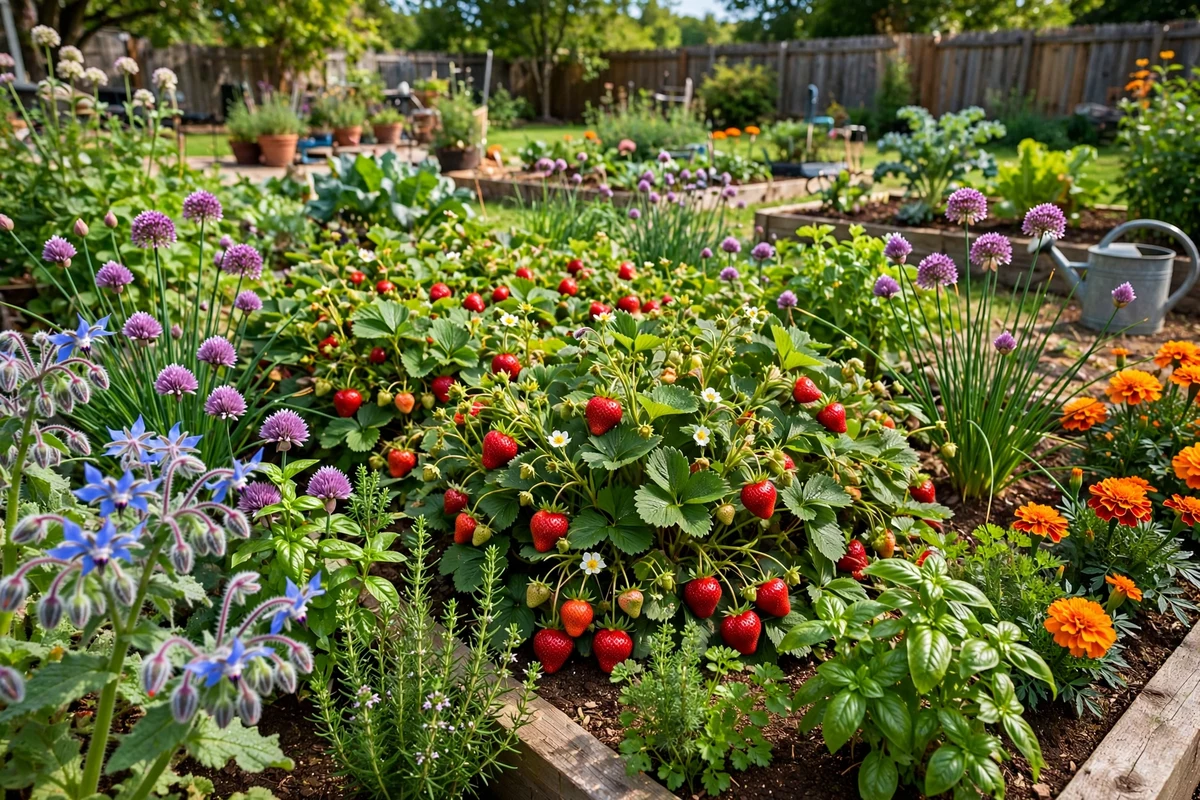
Strawberries are the garden’s sweetest reward — and they are picky about their neighbors. The right companions bring bees to every blossom, keep aphids and slugs off your berries, shade the soil so it stays moist, and even feed the bed with nitrogen. The wrong neighbors, on the other hand, share soil diseases, hog the sun, or quietly stunt your plants. This guide rounds up the 12 companions most consistently recommended by garden writers and horticultural references, with exact spacing, kid-friendly tips, and an honest list of what to keep out of the bed.
One thing to know before you dig: companion planting supports good growing — it does not replace the basics. Strawberries still need full sun (at least 6 hours), well-drained soil, and crowns planted at soil level, never buried. Think of companions as the bed’s support crew, not its substitute for care.
- Borage, thyme, and marigolds are the hardest workers: more pollinators, fewer pests.
- Nasturtiums act as a trap crop, pulling aphids away from your berries.
- Bush beans and white clover fix nitrogen that hungry strawberries use.
- Keep brassicas, fennel, nightshades, roses, and chrysanthemums away from the bed.
- Plant companions at the same time as your strawberries, then mulch.
How Companion Planting Helps a Strawberry Bed
A strawberry bed works best when every plant earns its spot. Good companions do one or more of four jobs: they feed pollinators so blossoms set into plump, well-shaped berries; they host or confuse the insects that prey on aphids, mites, and caterpillars; they cover bare soil so moisture lasts longer and berries stay clean; or they add nitrogen to feed hungry plants. For a research-backed walkthrough of strawberry planting and bed care, see the University of Minnesota Extension’s strawberry growing guide, covering planting, spacing, and harvest.
The layout rule that keeps everything working: plant in ribbons and pockets, not solid carpets. Low herbs tuck between strawberry plants, taller flowers line the bed edges, and nothing ever covers the strawberry crowns — that tight spot where leaves meet roots must stay exposed to light and air.
1. Borage — The Pollinator Magnet

If you plant only one companion, make it borage. Its starry blue flowers produce nectar almost constantly, drawing bumblebees and honeybees straight to the strawberry blossoms nearby — and fully pollinated blossoms develop into larger, better-shaped berries. Borage self-seeds freely, so one corner planting often returns on its own for years.
How to plant it: Sow seeds 12–18 inches from strawberry crowns, at bed corners or the north edge. Borage grows 2–3 feet tall, so keep it where it cannot shade the berries. Kids love the vivid blue stars, and the flowers are edible as a pretty garnish — just rinse them first. Note: the leaves are scratchy, so little hands should pick flowers, not foliage.
Try this: plant 2 to 3 borage at the corners of the bed so bees work the whole row.
Difficulty: Easy | Cost: $
2. Thyme — The Slug Barrier

Thyme’s aromatic oil (thymol) is unwelcome to slugs at ground level, and a low edging of thyme around a strawberry bed works as a living barrier where berries sit closest to the soil. It doubles as a living mulch, cooling the soil and slowing evaporation, and its tiny flowers feed hoverflies whose larvae devour aphids.
How to plant it: Tuck creeping thyme plugs between strawberry plants, 4–6 inches from each crown. It tolerates the same sunny, well-drained conditions strawberries love. Snip it back with scissors after flowering to keep the mat tight — an easy, safe job for kids.
Try this: let thyme sprawl as a living edge along the bed border to crowd out weeds.
Difficulty: Easy | Cost: $
3. Chives — The Aphid Deterrent

Chives belong to the onion family, and their mild sulfur scent discourages aphids and thrips from settling on strawberry leaves. As a bonus, their round purple pom-pom flowers are excellent bee forage — so let some bloom. Chives are perennial, dividing easily, and their hollow leaves are fun (and safe) for kids to snip for scrambled eggs.
How to plant it: Set clumps 6–12 inches from strawberry crowns along bed edges. Divide every 2–3 years to keep them vigorous. Unlike garlic, chives have no reported growth-inhibiting effect on strawberries, which makes them the safer allium choice.
Try this: snip chive flowers before they set seed to keep the clump tidy and blooming.
Difficulty: Easy | Cost: $
4. Sweet Alyssum — The Hoverfly Habitat

Sweet alyssum looks delicate, but it is one of the hardest-working flowers in a berry bed. Its honey-scented blooms feed hoverflies and tiny parasitic wasps all season, and those beneficial insects patrol the bed for aphids and caterpillars. It stays low (4–8 inches), so it never competes with the berries.
How to plant it: Edge the bed paths with a ribbon of alyssum, 8–12 inches from the strawberry row. When flowering slows in midsummer, shear the plants back by half — they rebloom within weeks. Kids can help with the shearing using blunt kids’ scissors.
Try this: sow alyssum in a thin ribbon along bed edges; it blooms until frost.
Difficulty: Easy | Cost: $
5. French Marigolds — The Nematode Fighters

French marigolds (Tagetes patula) are the one companion with the strongest research backing: their roots release compounds that suppress root-knot nematodes in the surrounding soil. Their pungent scent also discourages aphids and whiteflies. Note that this applies specifically to French marigolds, not the taller African types.
How to plant them: Interplant in the same bed, 8–12 inches from strawberry crowns, or use them as a colorful border. Deadhead spent blooms to keep them flowering until frost. Food-safety note: French marigold flowers are not edible — admire them, don’t garnish with them. (Pot marigold, or calendula, is the edible one.)
Try this: interplant one marigold every 2 feet and pull them at season’s end to avoid reseeding chaos.
Difficulty: Easy | Cost: $
6. Nasturtiums — The Aphid Trap Crop

Nasturtiums work as a sacrificial trap crop: aphids prefer them over strawberries, so the pests gather on the nasturtiums while your berries stay clean. Their peppery scent may also help mask the strawberries from other pests. They are a kid-gardening superstar — the seeds are big enough for small fingers to sow, and both the flowers and leaves are edible with a radish-like bite (wash well before tasting).
How to plant them: Sow at the bed front or let them trail over a container edge, 10–12 inches from strawberry crowns. If aphids colonize them heavily, pull the worst vines and compost them — the trap did its job. Keep them off the crowns so airflow stays high.
Try this: plant nasturtiums a foot away from the berries so aphids stop there first.
Difficulty: Easy | Cost: $
7. Bush Beans — The Nitrogen Fixers

Beans host bacteria on their roots that convert nitrogen from the air into a form plants can use — free fertilizer for the bed. Bush beans stay compact (12–18 inches) and finish in about two months, making them a perfect seasonal neighbor.
How to plant them: Use bush beans, not pole beans — pole beans need trellises that shade the berries. Plant a row along the north or east edge of the bed so any shade falls away from the strawberries. After harvest, chop the spent vines and leave the roots in the soil to release their nitrogen. Another great reason for kids to help: bean seeds are big, fast, and satisfying to plant.
Try this: sow beans between strawberry rows in spring; cut (don’t pull) plants at season’s end to leave nitrogen nodules in the soil.
Difficulty: Easy | Cost: $
8. Lettuce — The Living Mulch

Lettuce tucked between strawberry plants shades the soil surface, holds in moisture, and — most usefully — keeps developing berries off bare dirt, which reduces the rain splash that spreads gray mold. It matures fast and barely competes for nutrients.
How to plant it: Sow or transplant leaf lettuce 6–8 inches from strawberry crowns in early spring. Harvest outer leaves progressively, and pull the whole plant before it bolts in summer heat — a bolted lettuce blocks airflow, which invites disease. This is an ideal cool-season slot: lettuce comes out just as strawberry harvest peaks.
Try this: tuck leaf lettuce between plants for a living mulch you can eat.
Difficulty: Easy | Cost: $
9. Spinach — The Cool-Season Groundcover

Spinach does the same living-mulch job as lettuce — cooling soil, suppressing weeds, keeping fruit clean — and it grows quickly in the cool weeks of spring and fall when strawberries are establishing or winding down. Its shallow roots do not compete with the strawberry crowns.
How to plant it: Sow in early spring or late summer, 6–8 inches from crowns. Harvest regularly to keep plants productive, and clear them out before hot weather turns them bitter and floppy. In fall, a fresh sowing can hold the bed tidy through the shoulder season.
Try this: sow spinach early; it finishes before strawberries need the space.
Difficulty: Easy | Cost: $
10. White Clover — The Pathway Partner

White clover fixes nitrogen like beans do, suppresses weeds, and its flowers feed pollinators. But it has strong roots, so placement matters: keep it in the paths around the bed, not between the strawberry plants, where it would compete for water.
How to plant it: Sow clover seed in walkways and bed margins in fall or early spring. Mow it before it sets heavy seed. Kids love spotting bees on clover flowers — a built-in pollinator lesson right beside the berry patch.
Try this: seed clover on pathways, not in the bed, so it never competes with the berries.
Difficulty: Easy | Cost: $
11. Caraway — The Wasp Welcomer

Caraway’s lacy white flower umbels attract parasitic wasps and flies — tiny, stingless beneficial insects that hunt grubs, cutworms, and caterpillars. It is a biennial, so it flowers in its second year, and its deep taproot loosens the soil without crowding shallow strawberry roots.
How to plant it: Sow in border pockets 12 inches or more from crowns; its airy foliage will not shade the bed. Let a few plants self-seed so you always have second-year bloomers coming along.
Try this: let one caraway plant flower; its umbels draw parasitic wasps that eat aphids.
Difficulty: Easy | Cost: $
12. Sage — The Aromatic Confuser

Sage’s strong scent disrupts the chemical signals pests use to locate strawberry plants — a phenomenon gardeners call “aromatic confusion.” Its purple flower spikes also draw bees in late spring, right when strawberries are blooming. Keep plants tidy with a yearly trim so they do not sprawl over the crowns.
How to plant it: One sage plant per bed corner, 12–18 inches from the nearest crown. It is a woody perennial that appreciates the same sunny, well-drained soil. Rub a leaf with the kids and guess the scent — it is unmistakable.
Try this: keep sage in a pot sunk at the bed’s end so it never takes over.
Difficulty: Easy | Cost: $
Companion Planting Quick-Reference Table
| Companion Plant | Main Benefit | How Far from Strawberry Crowns | Best Placement |
|---|---|---|---|
| Borage | Attracts bees; better pollination | 12–18 inches | Bed corners, north edge |
| Thyme | Slug barrier; living mulch | 4–6 inches | Between plants, bed edging |
| Chives | Deters aphids and thrips | 6–12 inches | Bed edges, in clumps |
| Sweet Alyssum | Feeds hoverflies that eat aphids | 8–12 inches | Path edging ribbons |
| French Marigolds | Suppress root-knot nematodes | 8–12 inches | In-bed borders |
| Nasturtiums | Trap crop for aphids | 10–12 inches | Bed front, container edges |
| Bush Beans | Fix nitrogen in soil | 12 inches | North/east edge row |
| Lettuce | Living mulch; keeps berries clean | 6–8 inches | Between plants (spring) |
| Spinach | Cool-season groundcover | 6–8 inches | Between plants (spring/fall) |
| White Clover | Nitrogen; weed suppression | Paths only | Walkways, bed margins |
| Caraway | Attracts parasitic wasps | 12+ inches | Border pockets |
| Sage | Aromatic pest confusion; bee flowers | 12–18 inches | Bed corners |
5 Plants to Keep Away from Strawberries
Companion planting has a flip side. Keep these out of the strawberry bed — and, where noted, out of the rotation for several years:
- Garlic (use with caution): This one is genuinely debated. Many gardeners plant garlic with strawberries to deter pests, but several horticultural references report that garlic can inhibit strawberry growth when planted close. The safe move: get your allium benefits from chives or onions at the bed edges instead, and if you love the garlic pairing, trial a few cloves at a distance before committing a whole row.
- Brassicas (cabbage, broccoli, kale, cauliflower): These heavy feeders compete aggressively for nutrients and release compounds that can stunt strawberry runner development.
- Nightshades (tomatoes, potatoes, peppers, eggplants): They share verticillium wilt, a soil-borne fungus that is fatal to strawberries. If nightshades grew in a spot within the last 4–5 years, plant your strawberries elsewhere.
- Gladiolus: Tall, thirsty, and shade-casting — it competes for water and keeps the bed damp and slow to dry after rain.
- Mint (unless contained): Mint’s underground runners can swallow a strawberry bed in a single season. If you want it nearby, grow it in a sunken pot with the rim above soil level.
For university-backed guidance on the fundamentals — site selection, planting, and ongoing bed care — see Iowa State University Extension’s guide to planting, growing, and maintaining strawberries.
Setting Up the Bed: Soil, Layout, and Timing
Start with soil the strawberries will love, because companions cannot fix a bad foundation. Strawberries want loose, well-drained soil rich in organic matter, ideally slightly acidic (pH 5.8–6.2). If your ground is heavy clay that stays soggy, it is worth fixing the drainage first — raised beds are the classic solution. For help choosing what actually survives in difficult ground, here is a practical rundown of the best plants for clay soil with poor drainage.
Raised beds also make the “ribbons and pockets” layout easy to manage, since every edge is reachable. If you like the idea of building beds from inexpensive materials, these creative cinder block garden bed ideas show sturdy, budget-friendly designs that suit a strawberry-and-companions layout perfectly.
Timing-wise, plant strawberries and cool-season companions (lettuce, spinach, alyssum) in early spring after the soil can be worked. Warm-season flowers like marigolds and nasturtiums go in after the last frost. Perennial herbs — thyme, chives, sage — can be tucked in any time the ground is workable.
Make It a Family Project
A strawberry bed is one of the best first gardens for kids because the payoff — actual berries — arrives fast. Hand them the big-seed jobs: sowing bush beans and nasturtiums, tucking lettuce transplants between the crowns, and hunting for ripe berries (the official quality-control role). Older kids can manage the thyme trimming and the alyssum shearing. One rule to set early: wash everything before eating, and ask before tasting any flower — nasturtium and borage blooms are edible, but French marigolds are not.
And if the berry patch inspires a bigger edible landscape, berries pair beautifully with other fruits too. For a look at how blueberries — strawberries’ classic patch neighbor — team up with their own companions, read our guide to the best blueberry companion plants and plan a berry corner that mostly takes care of itself.
The flowering companions in this guide — alyssum, marigolds, nasturtiums — also earn their keep in ornamental beds, not just the vegetable patch. If you want to carry that cottage-garden look to the front of the house, these front yard flower bed ideas show how to mix edibles and ornamentals for curb appeal.
Food-safety note: Always wash homegrown produce and edible flowers thoroughly before eating. Only eat flowers you have positively identified as edible (nasturtium, borage, and chive blossoms are; French marigold blooms are not). If anyone in the family has plant allergies, introduce new edible flowers in small amounts first.
Frequently Asked Questions
Can I plant garlic next to strawberries?
You can, but keep it at a distance and watch the results. Many gardeners use garlic to deter pests around strawberries, yet several horticultural sources report that garlic planted close to strawberries can inhibit their growth. Chives and onions deliver similar pest-deterring benefits without the reported downside, so they are the safer allium choice for the bed edges.
What should you not plant next to strawberries?
Avoid brassicas (cabbage, broccoli, kale, cauliflower), which compete hard for nutrients; nightshades (tomatoes, potatoes, peppers, eggplants), which share the soil-borne disease verticillium wilt; tall shade-casters like gladiolus and corn; and uncontained mint, which will overrun the bed.
Do companion plants actually make strawberries sweeter?
Honest answer: the “sweeter berries” claim is mostly gardener anecdote, not measured science. What companions reliably do is bring more pollinators, which improves fruit set and berry shape, and reduce pest and disease pressure — and a healthy, fully pollinated plant produces the best-tasting fruit it is capable of.
Can I grow strawberries and companions in containers?
Yes. Strawberries thrive in pots, and compact companions — thyme, chives, lettuce, sweet alyssum, and trailing nasturtiums — fit beautifully around them. Skip borage in small pots (it grows 2–3 feet tall) and give the container at least 12 inches of depth with drainage holes.
Will beans shade my strawberries?
Bush beans will not, as long as you place them on the north or east edge of the bed where any shade falls away from the berries. Avoid pole beans near strawberries — their trellises cast exactly the kind of shade that slows ripening and keeps foliage damp.
How far should companion plants be from strawberry crowns?
It depends on the plant’s size: 4–8 inches for low groundcovers like thyme and lettuce, 8–12 inches for mid-size plants like chives, marigolds, and nasturtiums, and 12–18 inches for larger plants like borage and sage. The golden rule: nothing should ever cover or bury the crown where the leaves meet the roots.
The Bottom Line
You do not need all twelve companions to transform a strawberry bed — three or four well-chosen ones will do. A practical starter trio: borage at the corners for pollinators, thyme between the plants for slugs and soil cover, and chives along the edges for aphids. Add lettuce or spinach in the cool months for living mulch, marigolds for nematode protection, and nasturtiums if aphids show up. Keep the crowns clear, keep nightshades and brassicas out of the rotation, and water at the base in the morning so foliage dries fast. Do that, and the bed largely runs itself — leaving you free for the best part: picking warm berries with the kids.


