


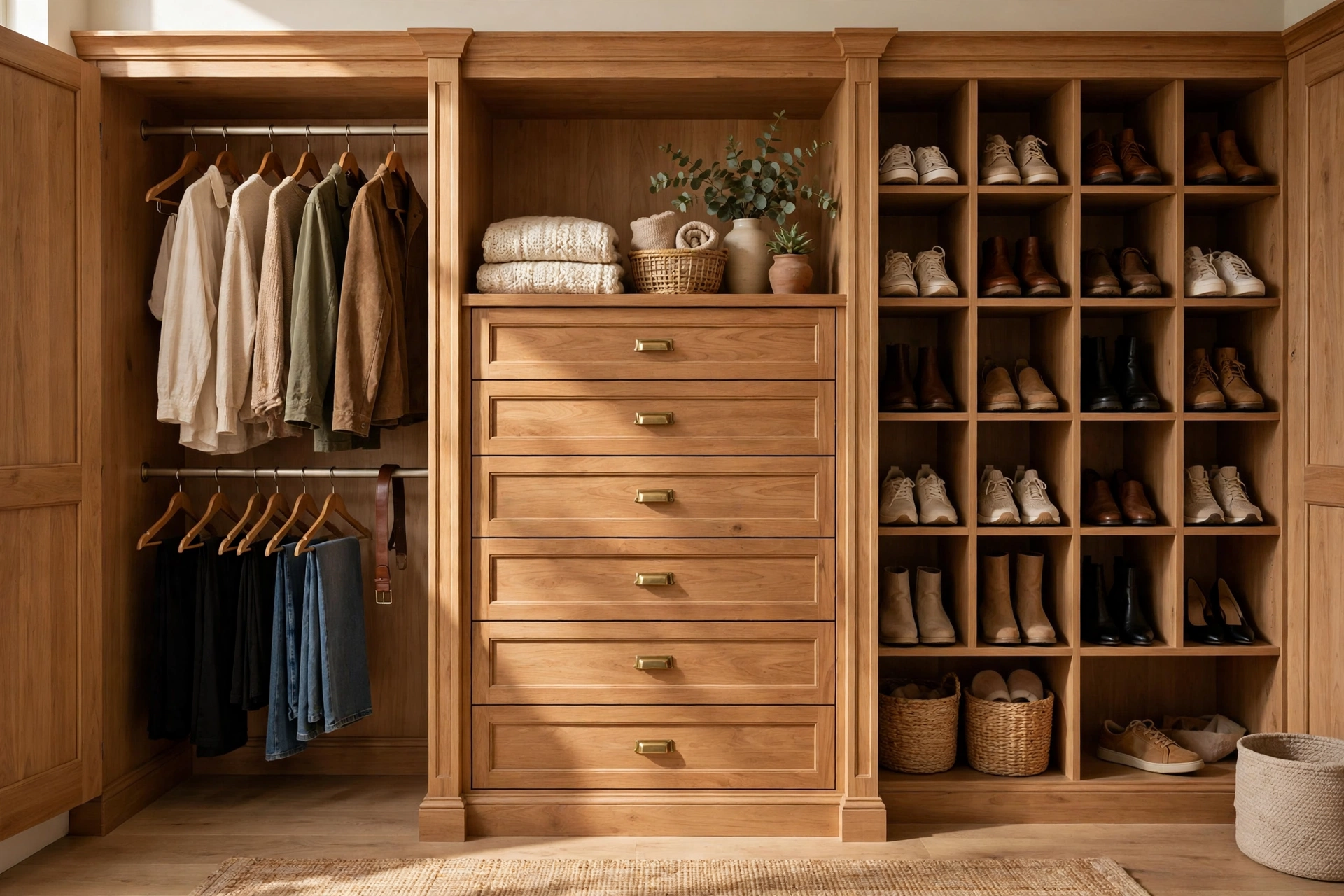
Most closets fail in the same quiet way. One rod, one high shelf, and a floor that slowly turns into a shoe pile, while the top 18 inches of wall sit empty and the back corners hide whatever you pushed there months ago. You do not need a bigger closet. You need the storage inside it to match what you actually own, hung at the right heights, folded where you can reach it, and stored where you can see it.
This guide covers 25 built-in closet storage ideas for reach-in closets, walk-in closets, shared closets, and sloped ceilings, with real costs, difficulty labels, and install notes for each one. I swapped a single rod for a double-hang setup in our reach-in last spring and gained room for a full row of shirts without touching the walls. Use the ideas below the same way: pick the ones that fix your worst bottleneck first, then build out from there.
Quick takeaways
- Measure first: width, depth, ceiling height, and door swing, before buying any unit.
- Double-hang rods at about 40 and 80 inches turn one row of shirts into two.
- Keep daily items between waist and shoulder height, and seasonal items up high.
- Anchor tall towers and drawer units into wall studs with anti-tip kits.
- Light the closet: LED strips make dark corners usable and colors easy to tell apart.
1. Double-hang rod wall
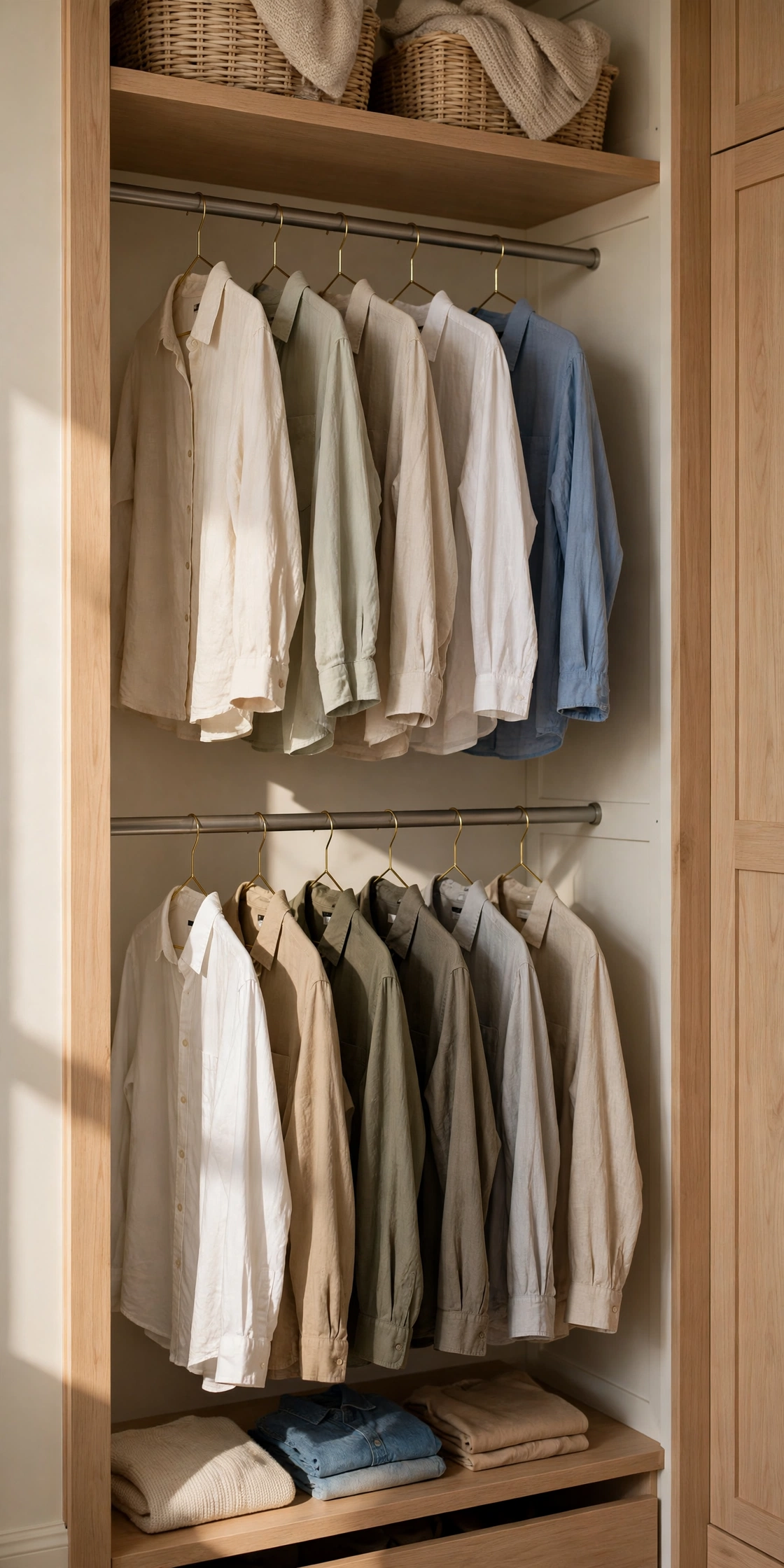
Shirts, blouses, and pants folded over a hanger need only about 40 inches of vertical room, so a single rod wastes the space above and below them. Mount a second rod at about 40 inches and keep the upper rod at about 80 inches, and one wall now holds two full rows of clothes. Leave one section at full height for dresses and coats, or that section turns into a cramped corner where long hems drag on the floor. Slim hangers free extra inches along each rod, and a rod that runs wall to wall beats a short rod with dead space at each end.
Try this: Hang your longest dress first, then set the lower rod height so its hem clears the rod below by 2 inches.
Cost: $$$· Difficulty: Easy · Time: 1 to 2 hours
2. Full-height shelf tower

A tower of shelves that runs from floor to ceiling reclaims the dead space above the old single shelf, which usually sits too high to use well. Shelves about 12 inches deep suit folded sweaters, jeans, and bags, and adjustable shelf pins let you change spacing when bulky knits take over in winter. Put the shelf tower at one end of a reach-in or in the center of a walk-in, and keep the top shelf for luggage and out-of-season bins. A tower built from laminate panels wipes clean, while a painted wood tower takes paint well if you want it to match the bedroom trim.
Try this: Set shelf spacing by your tallest folded stack plus 2 inches, so stacks slide out without toppling.
Cost: $$$· Difficulty: Easy to moderate · Time: 2 to 4 hours
3. Center drawer tower

A drawer tower in the center of the closet takes over the job of a bedroom dresser and frees floor space in the room itself. Three or four drawers at waist height hold socks, underwear, workout clothes, and folded tees, while the counter-height top gives you a folding surface and a spot for a watch tray. Deep drawers suit stacked tees, and shallow top drawers suit belts, sunglasses, and small accessories that vanish in a deep drawer. Full-extension slides matter here: a drawer that only opens halfway hides the back third of everything inside it.
Try this: Fold tees upright in the drawers, file style, so you see every shirt at a glance.
Cost: $$$· Difficulty: Moderate · Time: 3 to 5 hours
4. Angled shoe wall

Shoes piled on the closet floor are hard to find and easy to damage, and flat shelves hide the pair at the back. Angled shelves tilt each pair forward so you see every shoe from the doorway, and shelves 12 to 14 inches deep fit most adult shoes without wasted depth. Run the shoe wall up one side of a walk-in or across the bottom of a reach-in, and leave taller slots at one end for boots. Two or three rows of angled shelving hold a surprising number of pairs, and the wall reads as a display instead of a pile.
Try this: Sort shoes by how often you wear them, with daily pairs at ankle height and occasion pairs higher up.
Cost: $$$· Difficulty: Moderate · Time: 3 to 4 hours
5. Boot cubbies with shapers
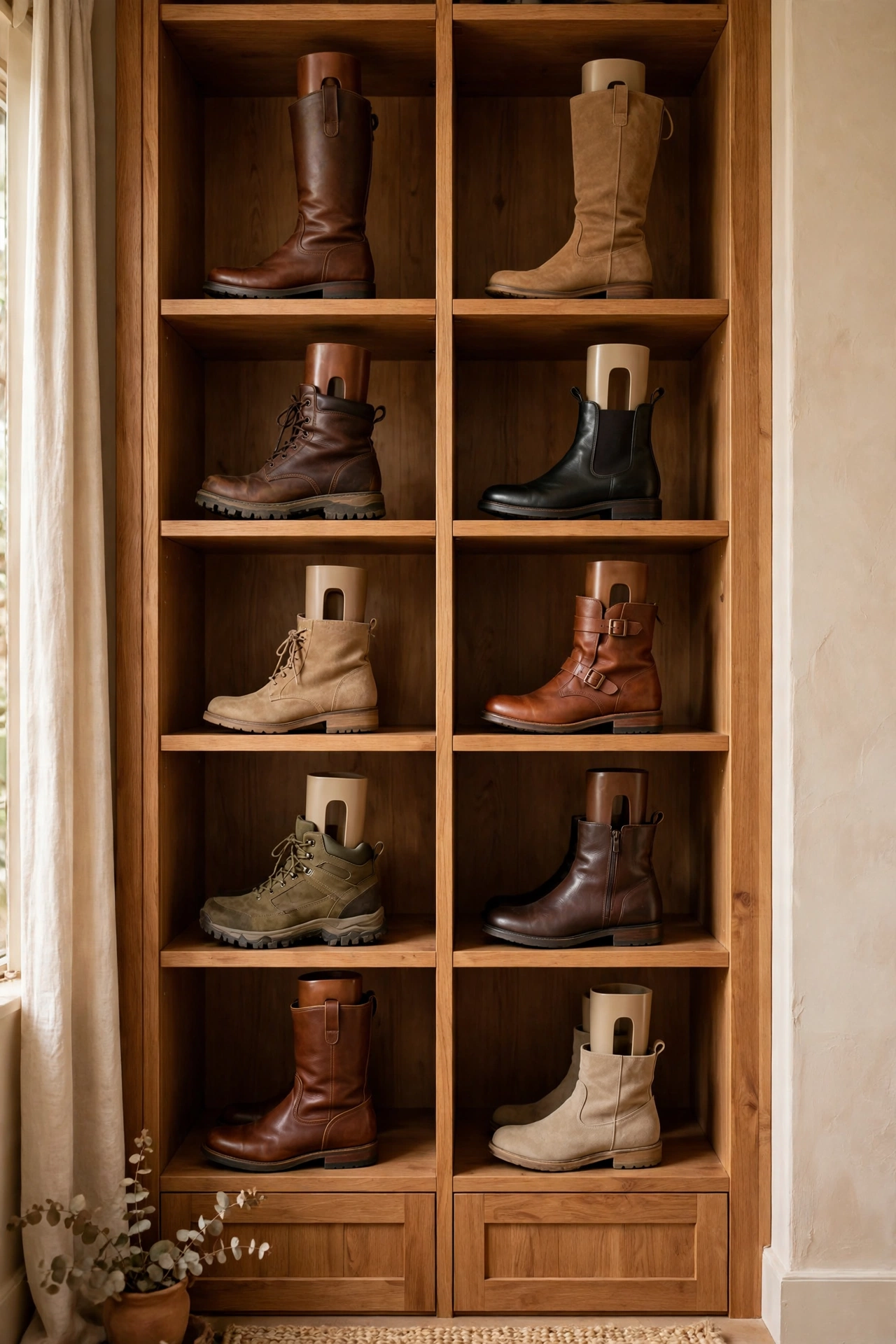
Tall boots flop over in a pile and crease at the ankle, and a flat shelf gives them nowhere to stand. Cubbies 16 to 18 inches tall let each pair stand upright, and a boot shaper inside each boot holds its shape through months of storage. Build the cubbies at the end of a hanging run or under a long-hang section, where the height already exists. One cubby per pair beats one wide cubby for three pairs, since boots lean on each other and slump without dividers between them.
Try this: Stuff a pool noodle cut to height into each boot as a low-cost shaper that keeps the shaft straight.
Cost: $$$· Difficulty: Easy · Time: 1 to 3 hours
6. Pull-out valet rod

A valet rod is a short rod, usually about 12 inches long, that slides out from a closet panel and slides back when you finish with it. It holds tomorrow’s outfit, a jacket that needs airing, or a garment you just steamed, without taking a hanger slot on the main rod. Mount it near the closet opening at shoulder height, where you can reach it without stepping inside. The hardware costs little and installs with a few screws, and it stops the habit of draping tomorrow’s clothes over a chair.
Try this: Pick tomorrow’s outfit the night before and hang it on the valet rod, so mornings start with one less decision.
Cost: $$· Difficulty: Easy · Time: 20 minutes
7. Velvet-lined jewelry drawer
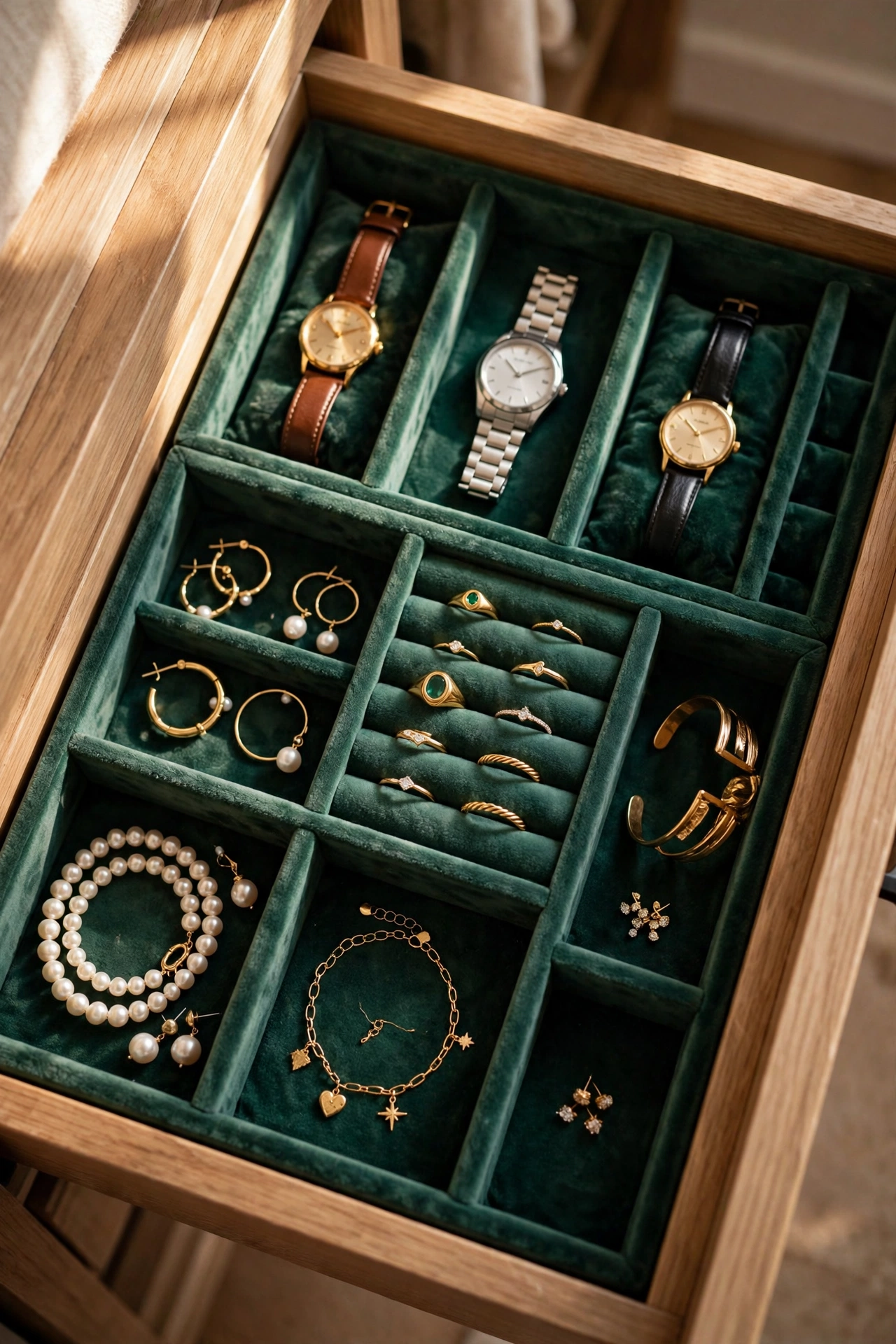
Jewelry tossed in a box tangles, and necklaces knotted together are a slow repair job. A shallow drawer lined with velvet trays gives rings, watches, and necklaces their own compartments, and the soft lining stops metal from scratching. Place the drawer at eye level in a tower or island, where you can see everything without bending. Small dividers beat one open tray, since a single compartment fills fast and turns back into a jumble within a month.
Try this: Give necklaces their own long slot with a hook at each end, so chains hang straight instead of coiling.
Cost: $$$· Difficulty: Easy · Time: 30 minutes to 1 hour
8. Belt and tie pull-out rack
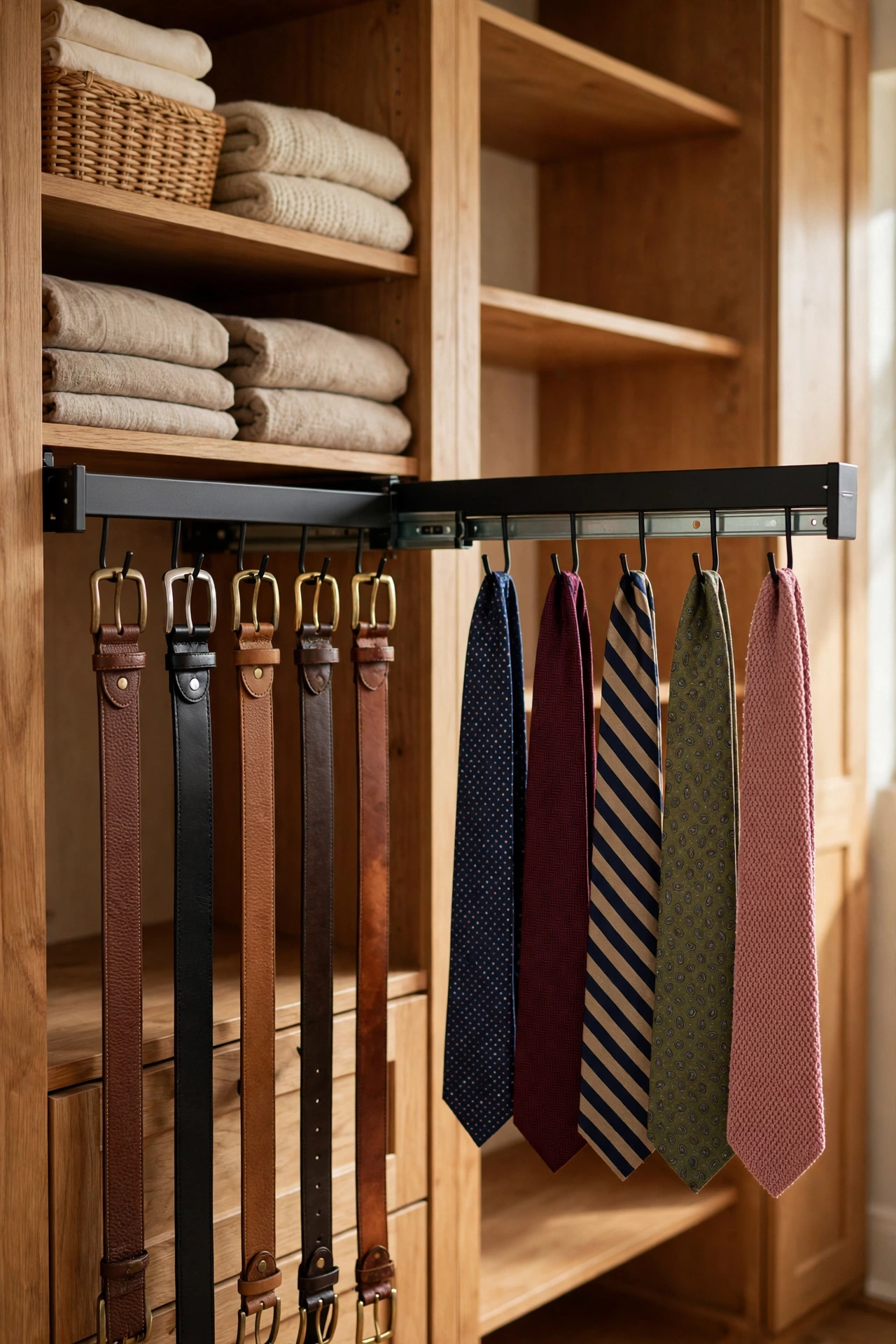
Belts coiled in a drawer crease and crack, and ties folded in a stack wrinkle at the fold line. A pull-out rack mounted to the side of a tower or closet panel hangs each belt and tie on its own hook, and the whole rack slides out so you can see the full set. Side mounting uses wall space that shelves waste, and the rack disappears back into the closet when you close it. One rack holds a dozen or more belts and ties in a strip about 4 inches wide.
Try this: Hang belts by their buckles on the same side, so you can compare colors at a glance.
Cost: $$· Difficulty: Easy · Time: 20 to 40 minutes
9. Scarf and accessory pull-out panel
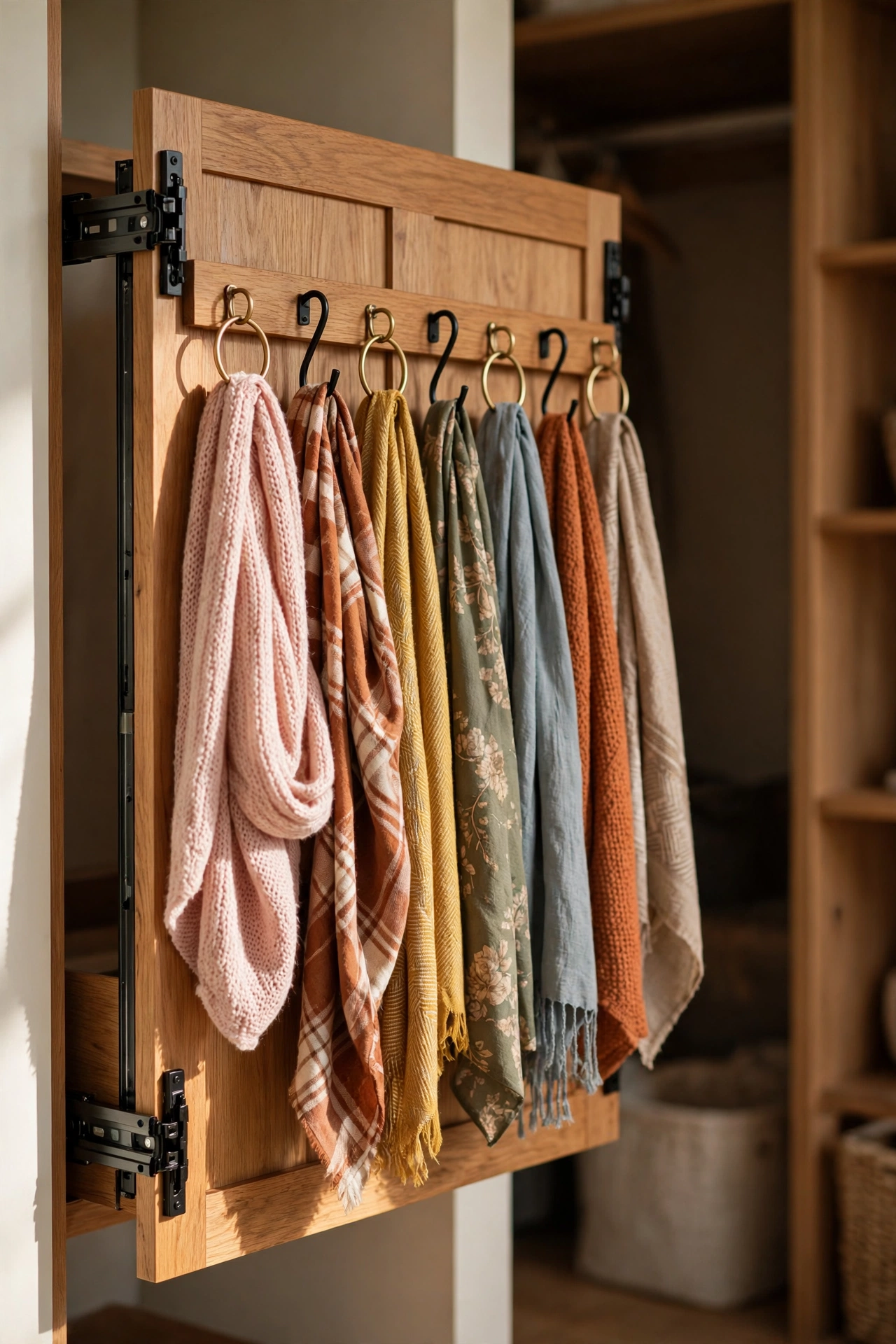
Scarves folded in a drawer vanish under the next layer, and scarves on a single hook slide into a clump. A pull-out panel with rings or hooks gives each scarf its own spot, and the panel slides out of a narrow gap between a tower and the wall. Rings suit silk scarves that slip off hooks, while open hooks suit chunky knit scarves that need air. The panel uses a strip of space too narrow for shelves, and it keeps delicate fabrics visible instead of buried.
Try this: Sort scarves by color on the panel, so you can grab the right one without pulling out five others.
Cost: $$· Difficulty: Easy · Time: 30 minutes to 1 hour
10. Glass-front handbag cubbies
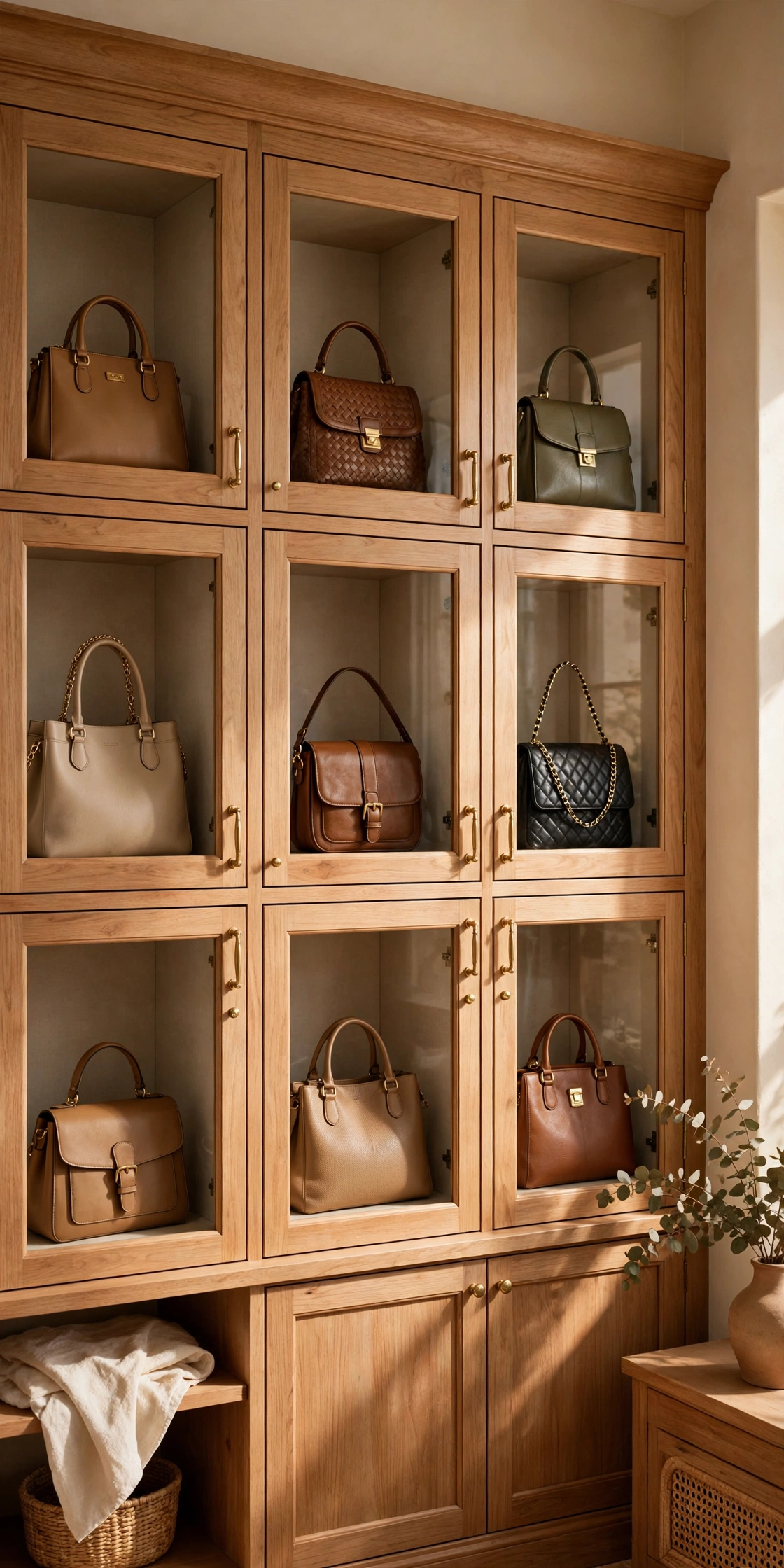
Handbags stacked on a shelf crush each other, and bags in dust covers hide until you forget them. Cubbies sized to one bag each keep structured bags upright, and glass doors keep dust off while leaving the whole collection visible. Size the cubbies by your largest bag plus an inch of clearance, and add a small shelf for clutches at the top. The glass also stops the habit of tossing a new bag on top of the pile, since every cubby has a clear owner.
Try this: Stuff each bag with tissue when you store it, so it holds its shape behind the glass.
Cost: $$$· Difficulty: Moderate · Time: 3 to 5 hours
11. LED strip-lit shelves

A dark closet stays messy because you cannot see what you own, and colors read wrong in dim light: navy looks black, and brown looks gray. LED strips mounted under each shelf wash the shelf below in warm white light, and battery or plug-in strips install without an electrician. Warm white near 3000K flatters clothes and skin tones better than cool white. Motion sensors switch the lights on when the door opens, so no one has to remember a switch. The ENERGY STAR notes that LEDs use at least 75% less energy than incandescent bulbs and last far longer, so a strip left on by mistake costs little.
Try this: Run one strip under the top shelf first, then add strips shelf by shelf where shadows remain.
Cost: $$· Difficulty: Easy · Time: 1 hour
12. Pull-out laundry hamper

A laundry basket on the closet floor eats floor space and trips you in the dark. A pull-out hamper built into the bottom of a tower slides out on rails, holds a full load, and slides back out of sight. Tilt-out versions suit shallow closets, while slide-out bins suit deeper towers. Two bins sort lights and darks at the source, and a removable liner bag means you carry the bag to the washer instead of the whole bin. Vent holes in the bin matter: closed bins trap damp air and smell stale within days.
Try this: Place the hamper near the closet opening, so dirty clothes land in it instead of on the floor.
Cost: $$$· Difficulty: Easy to moderate · Time: 1 to 2 hours
13. Corner carousel unit

Closet corners are dead zones: the back corner of a reach-in hides behind the door frame, and the corner of a walk-in forces you to reach past hanging clothes. A rotating carousel unit with round or pie-cut shelves spins the back of the corner out to the front, so shoes, bags, and folded clothes stored there stay reachable. Check the maker’s weight rating before loading it, since a carousel full of shoes weighs more than it looks. A carousel suits walk-ins and L-shaped closets best, where a fixed corner shelf would waste the deepest part of the run.
Try this: Store rarely used items on the carousel’s back shelves and weekly items on the front, so one spin reaches both.
Cost: $$$· Difficulty: Moderate · Time: 2 to 4 hours
14. Sloped-ceiling built-in shelves
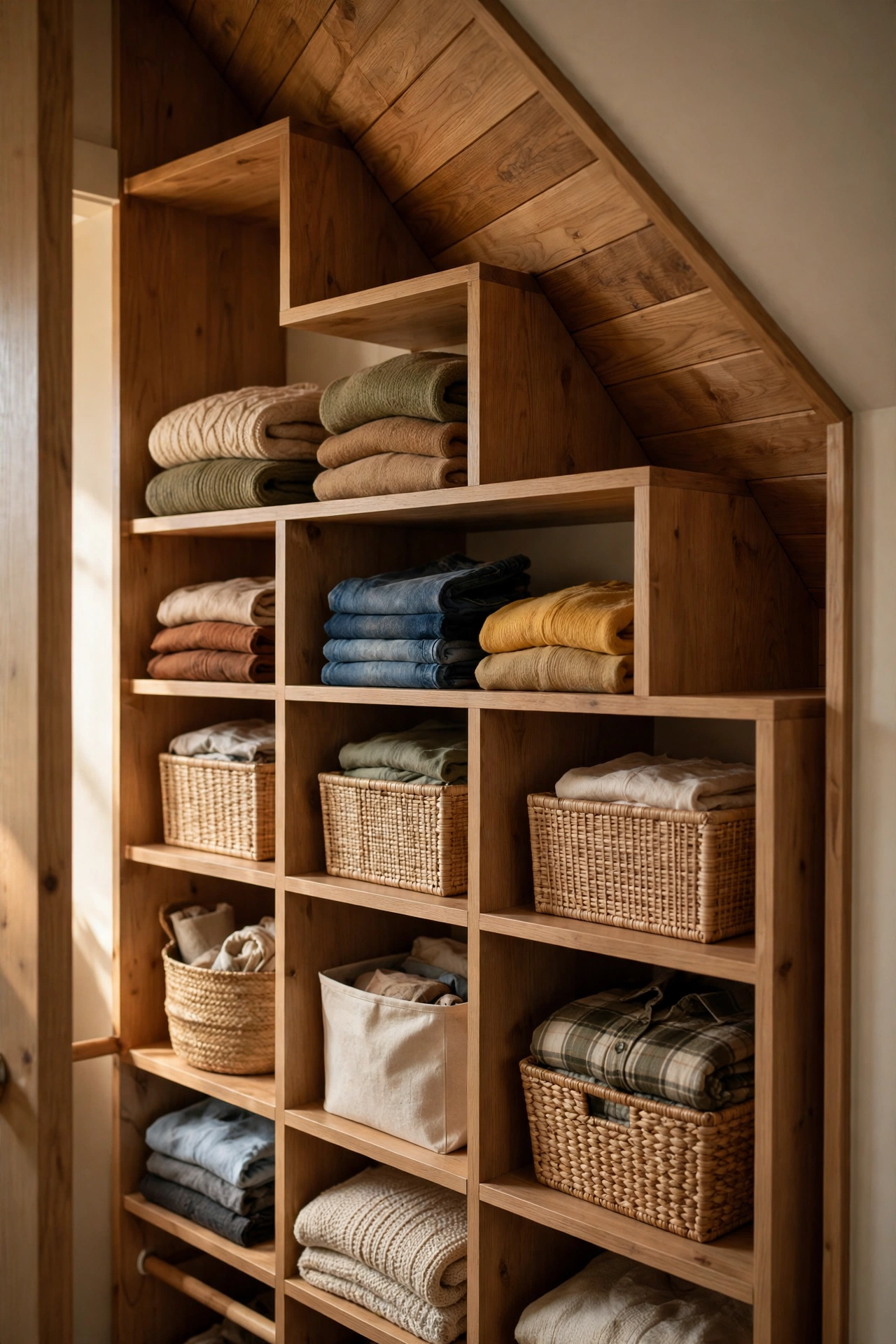
Closets under a sloped ceiling or eave lose their tallest wall to the roofline, and standard rectangular units leave a triangle of wasted space. Stepped shelves that follow the slope turn that triangle into storage: tall cubbies where the ceiling is high, short cubbies where it drops, and a low bench or shoe row at the shortest end. Measure the slope at several points, since rooflines rarely drop in a straight line, and build the unit in sections so each section fits its own height. The result uses the full wall instead of stopping where the ceiling starts to fall.
Try this: Put shoes and low bins at the shortest end, where you reach down anyway, and folded clothes at the tall end.
Cost: $$$· Difficulty: Moderate · Time: 4 to 6 hours
15. Closet island with drawers

A walk-in closet with room to spare gains a work surface and a full bank of drawers from a center island. The top gives you a folding counter and a packing surface, while drawers on one or both sides hold folded clothes, accessories, and out-of-season items. Keep at least 36 inches of walkway on each side of the island, or the closet turns into a squeeze past the drawers. An island also anchors the room: hanging runs on the walls plus drawers in the center reads as a dressing room instead of a storage wall.
Try this: Put a shallow tray on the island top for the watch, keys, and wallet you grab each morning.
Cost: $$$$· Difficulty: Moderate to pro help · Time: 1 day
16. Built-in vanity station

A closet that doubles as a dressing room needs a spot to sit, check a mirror, and store small items. A vanity station fills a gap between two hanging runs with a counter-height shelf, a mirror above it, and small drawers below for jewelry and makeup. A stool or pouf tucks under the counter when you finish, so the station costs no extra floor space. Light the mirror from the sides rather than from above, since overhead light casts shadows on the face. This idea suits walk-ins best, where a 30-inch gap can spare the width.
Try this: Keep the vanity drawers shallow, so small items stay visible instead of sinking to the bottom.
Cost: $$$· Difficulty: Moderate · Time: 4 to 6 hours
17. Mirrored sliding doors

Swing doors need floor space to open, and that space comes straight out of the bedroom. Mirrored sliding doors run on a track and need no swing room, and the mirrors make a small bedroom read larger while giving you a full-length check before you leave. The doors also hide the closet completely, which suits a bedroom where open shelving would look busy. Check the track weight rating and keep the track clear of dust, since a gritty track makes heavy mirrored doors drag within months.
Try this: Clean the track with a vacuum brush head once a month, so the doors keep sliding smoothly.
Cost: $$$· Difficulty: Moderate · Time: 2 to 4 hours
18. Shelf dividers for sweater stacks

Wide shelves let sweater stacks lean, slide, and topple, and one pulled sweater brings the whole stack down. Shelf dividers split a long shelf into short bays, and each bay holds one stack that stays upright on its own. Acrylic dividers suit a clean look, while wood dividers match a painted tower. Set the dividers by stack width, not by even spacing: a bay that fits its stack snugly holds better than a wide bay with room to lean. Dividers also stop the slow creep where stacks migrate across a shelf over weeks.
Try this: Cap each stack at six folded sweaters, so the bottom one pulls out without a collapse.
Cost: $$· Difficulty: Easy · Time: 20 minutes
19. Pull-out pants rack

Pants folded over a hanger crease at the fold, and pants hung one per hanger eat rod space fast. A pull-out pants rack hangs eight to ten pairs on parallel bars that slide out of a tower like a drawer, so each pair hangs straight and stays visible. The rack uses a strip about 10 inches wide and fits under a hanging section or beside a drawer tower. Bars with a soft grip coating stop trousers from sliding off when you pull the rack out, which plain metal bars fail at within a week.
Try this: Hang work pants on the front bars and casual pants on the back bars, so the split matches your morning routine.
Cost: $$$· Difficulty: Easy · Time: 30 minutes to 1 hour
20. Hat shelf with clips

Hats stacked on a shelf crush brims, and hats in a box hide until you forget them. A high shelf with a rail and clips gives each hat its own clip, so caps and wide brims hang in a row you can see from the doorway. The top shelf suits hats well, since you reach up for a hat less often than for a shirt, and the rail keeps hats off the folded clothes below. Clip-style holders beat hooks for soft caps, which slide off a hook and land on the floor.
Try this: Clip hats by season on the rail, with current-season hats at the front end nearest the door.
Cost: $$· Difficulty: Easy · Time: 30 minutes to 1 hour
21. Seasonal top bins

Out-of-season clothes fill prime closet space all year if they have nowhere else to go. Labeled bins on the top shelf hold winter coats in summer and swimwear in winter, and the labels stop the ritual of opening every bin to find one sweater. Clear bins show contents at a glance, while fabric bins with a label window suit a tidier look. Keep the bins light enough to lift down safely, since a heavy bin on a high shelf is a drop risk. One swap each season keeps the closet matched to the weather.
Try this: Label each bin with the season and the contents in plain words, such as “Winter: heavy sweaters, scarves.”
Cost: $$· Difficulty: Easy · Time: 30 minutes
22. Slim hanger swap
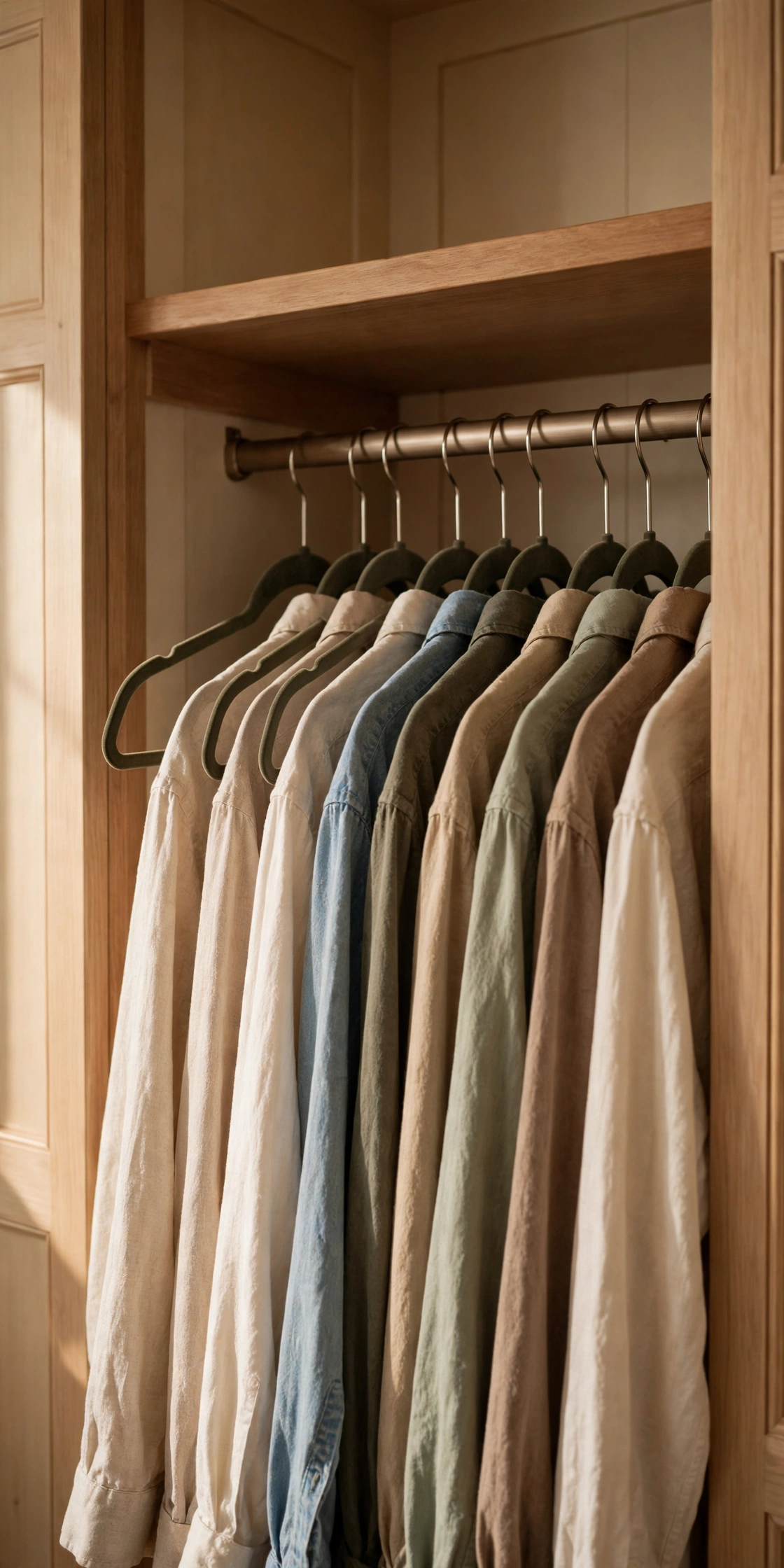
Bulky wood and plastic hangers eat rod space, and a crowded rod wrinkles clothes and hides the garment at the back. Slim velvet hangers hold shirts in a fraction of the width, and the velvet grip stops silk blouses and tank tops from sliding off. Swap one rod at a time and donate the old hangers as you go, so the closet never sits half-converted. Matching hangers also calm the visual noise of a mixed rod, which makes the whole closet read tidier without adding a single shelf.
Try this: Count hangers before you buy, then add ten extra for new clothes that arrive during the year.
Cost: $$· Difficulty: Easy · Time: 30 minutes to 1 hour
23. Door-back hook and pocket panel

The back of the closet door is wall space you already own, and it suits the small items that clutter drawers. Hooks hold bags, robes, and tomorrow’s jacket, while a pocket panel with clear or fabric pockets holds belts, sunglasses, and small accessories. Over-door hooks install without screws and suit rentals, while screw-mounted hooks hold heavier bags without slipping. Keep the panel slim, since a bulky panel stops the door from closing and rubs the frame with every use.
Try this: Reserve the door panel for items you grab on the way out, so the door works as the last stop before you leave.
Cost: $$· Difficulty: Easy · Time: 15 to 30 minutes
24. Kids’ low double-hang zone
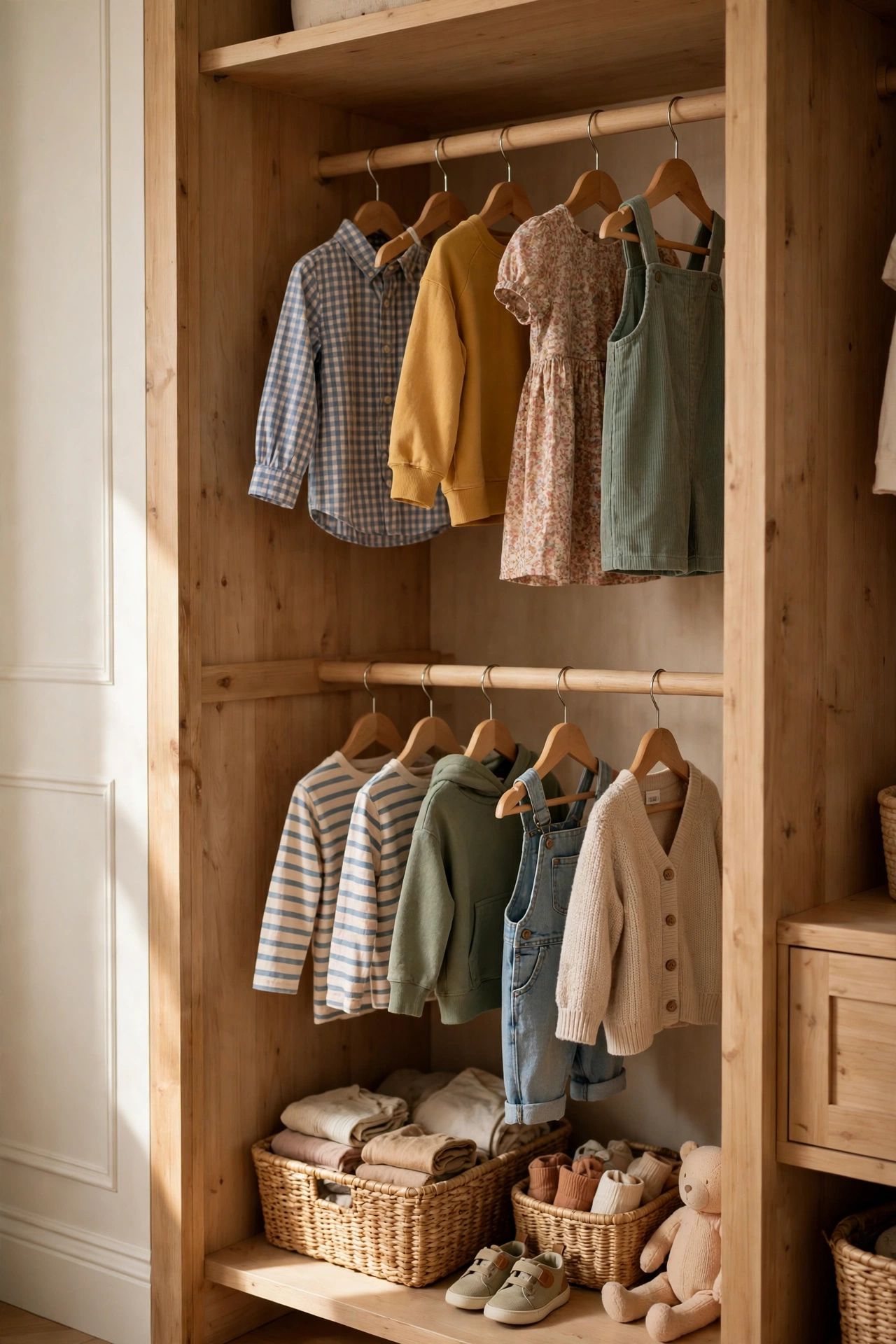
Kids’ clothes are short, so a standard rod height wastes half the wall and puts every shirt out of a child’s reach. A low double-hang zone with rods at about 30 and 50 inches lets kids hang their own clothes and pick their own outfits, and the short garments leave room below for shoes and bins. Adjustable rods matter most here, since kids grow fast and the rod heights need to move up each year. Low rods also cut the morning pile of clothes on the floor, since kids can reach the rod instead of pulling from a high one.
Try this: Let each child pick the order of their own low zone, so the system matches how they actually dress.
Cost: $$$· Difficulty: Easy · Time: 1 to 2 hours
25. Shared closet split zones
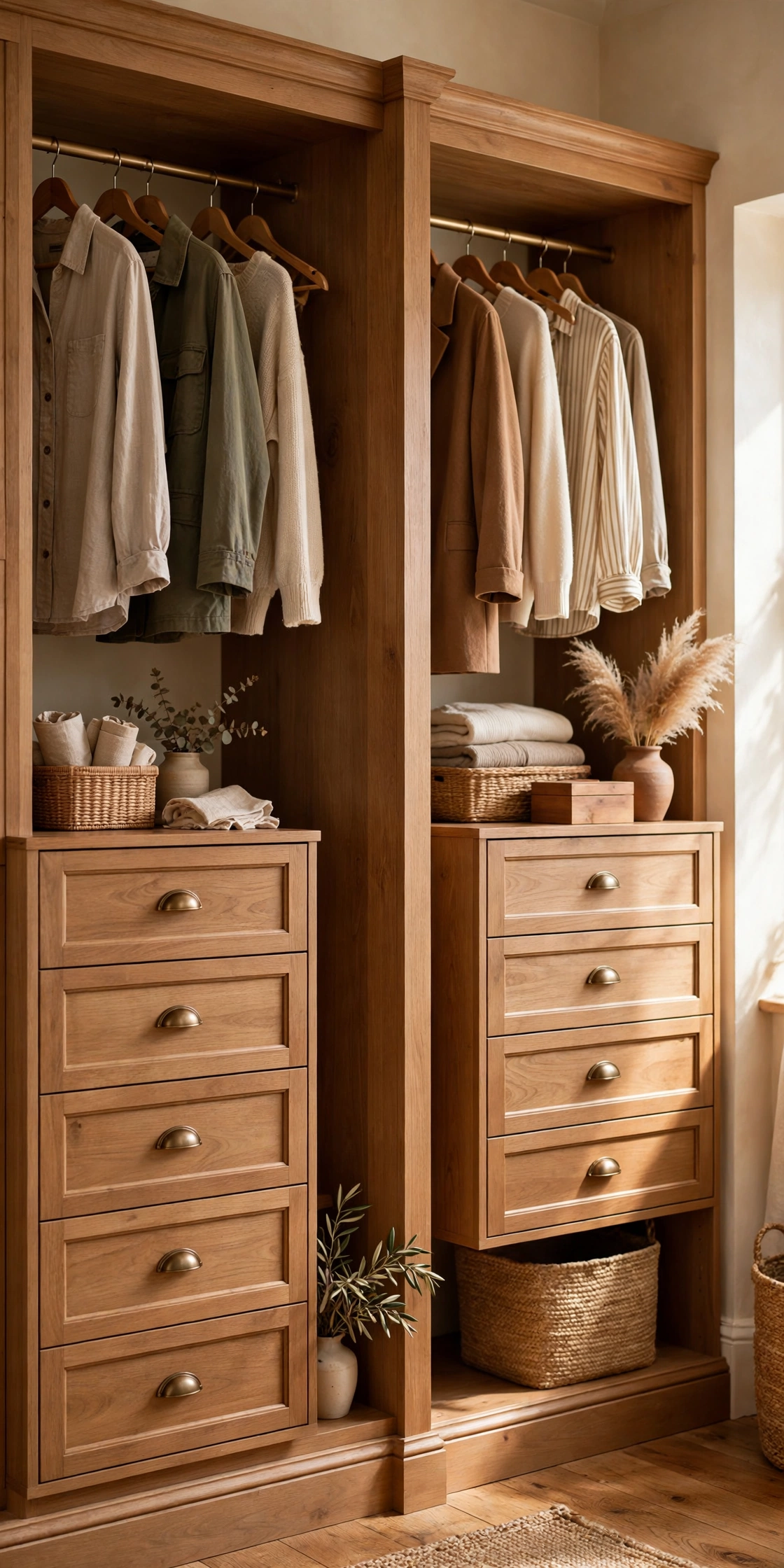
A shared closet fails when two wardrobes mix on one rod and neither person can find their own clothes. Splitting the closet into two zones, one per person, ends the mix: each side gets its own hanging run, its own drawer or shelf stack, and its own shoe row. A center tower or a simple divider panel marks the split, and the split stops the slow takeover where one wardrobe spreads across the whole closet. Agree on the split by wardrobe size, not by half the width, since one person’s hanging clothes may need more rod than the other’s folded stacks.
Try this: Give each zone its own hamper bin, so laundry sorts itself before wash day.
Cost: $$$· Difficulty: Easy to moderate · Time: 2 to 4 hours
How to choose the right built-in setup
Start with measurements, not with a shopping list. Measure the closet width, depth, and ceiling height, and note the door swing and any vents, outlets, or sloped ceilings. A reach-in closet is usually 24 to 30 inches deep, which suits rods and 12-inch shelves but not a deep island. A walk-in needs at least 36 inches of clear walkway, so measure the walkway before adding an island or a wide tower.
Count what you own before you pick a system. Count hanging items versus folded items versus shoes, and give the biggest group the most space. A wardrobe of dresses needs long-hang height, while a wardrobe of tees and sweaters needs shelves and drawers. Buy in tiers: under $150 covers slim hangers, dividers, hooks, and a valet rod; $300 to $800 covers a laminate tower system with drawers and shoe shelving; $1,500 and up buys a custom-built system fitted to the walls. Hire a licensed electrician for hardwired lighting or new outlets, and hire a pro if the job moves walls or cuts into framing.
Built-in closet storage at a glance
| Idea | Cost | Difficulty | Best for |
|---|---|---|---|
| Double-hang rod wall | $60 to $150 | Easy | Shirt-heavy wardrobes |
| Full-height shelf tower | $120 to $300 | Easy to moderate | Folded clothes and bins |
| Center drawer tower | $200 to $500 | Moderate | Replacing a dresser |
| Angled shoe wall | $150 to $400 | Moderate | Large shoe collections |
| Boot cubbies with shapers | $80 to $200 | Easy | Tall boots |
| Pull-out valet rod | $15 to $30 | Easy | Outfit planning |
| Velvet-lined jewelry drawer | $40 to $120 | Easy | Jewelry and watches |
| Belt and tie pull-out rack | $25 to $60 | Easy | Belts and ties |
| Scarf and accessory pull-out panel | $30 to $70 | Easy | Scarves and small accessories |
| Glass-front handbag cubbies | $250 to $600 | Moderate | Structured handbags |
| LED strip-lit shelves | $30 to $90 | Easy | Dark closets |
| Pull-out laundry hamper | $60 to $150 | Easy to moderate | Hiding laundry |
| Corner carousel unit | $150 to $400 | Moderate | Dead corners |
| Sloped-ceiling built-in shelves | $200 to $500 | Moderate | Attics and eaves |
| Closet island with drawers | $400 to $1,200 | Moderate to pro help | Large walk-ins |
| Built-in vanity station | $250 to $700 | Moderate | Dressing rooms |
| Mirrored sliding doors | $200 to $600 | Moderate | Small bedrooms |
| Shelf dividers for sweater stacks | $20 to $50 | Easy | Sweater stacks |
| Pull-out pants rack | $40 to $100 | Easy | Trousers |
| Hat shelf with clips | $30 to $80 | Easy | Hats and caps |
| Seasonal top bins | $30 to $80 | Easy | Out-of-season clothes |
| Slim hanger swap | $25 to $60 | Easy | Crowded rods |
| Door-back hook and pocket panel | $20 to $50 | Easy | Rentals and small items |
| Kids’ low double-hang zone | $60 to $150 | Easy | Children’s closets |
| Shared closet split zones | $100 to $300 | Easy to moderate | Couples sharing a closet |
Common mistakes to avoid
- Buying organizers before measuring. A tower that is 2 inches too wide for a reach-in wastes the whole purchase, so measure width, depth, and height first.
- Hanging everything at one height. One rod height forces short shirts to waste the space below them, while dresses need a full-height section of their own.
- Stacking sweaters too high. Stacks over six folded sweaters topple when you pull the bottom one, so use dividers and cap the stack height.
- Putting daily items out of reach. Clothes you wear weekly belong between waist and shoulder height, not on the top shelf behind seasonal bins.
- Skipping anchoring on tall units. Tall towers and drawer units can tip forward when drawers open, so anchor every tall unit into wall studs with an anti-tip kit. The U.S. Consumer Product Safety Commission’s Anchor It! guidance explains how to anchor furniture and why it matters, especially in homes where children live or visit: CPSC Anchor It! guidance.
- Forgetting a light plan. A closet without light stays messy because you cannot see what you own, so add LED strips before you judge whether the layout works.
More home and storage ideas
If your closet has awkward overhead space, these loft ideas use the top of the closet well: easy DIY closet loft ideas.
For a closet without doors, where everything stays visible by design, see this open-concept approach: easy DIY open concept closet ideas.
The same pull-out logic works in the kitchen, where roll-out shelves end the back-of-cabinet problem: pantry cabinet with pull out shelves ideas.
If the closet project is part of a bigger whole-house update, these budget renovation ideas keep costs in check: creative home renovation on a budget ideas.
For a bedroom that matches a moody, bookish closet in dark green, this bedroom style pairs well with painted built-ins: charming green dark academia bedroom ideas.
Frequently asked questions
How much does a built-in closet system cost?
A simple upgrade with slim hangers, dividers, hooks, and a valet rod costs $20 to $150. A laminate tower system with drawers and shoe shelving runs $300 to $800 for a standard reach-in, while a custom-built system fitted to the walls starts around $1,500 and climbs with size, drawers, glass doors, and lighting. Measure first and price the system by your closet’s width, since most kits price by the foot.
Can I install a built-in closet system myself?
Most modular and laminate systems suit a confident DIYer with a drill, a level, and a stud finder, and a reach-in upgrade takes a weekend or less. Hire a pro for hardwired lighting, moving walls, or cutting into framing, and hire help for heavy wall-hung units that need precise leveling. Anchor every tall unit into studs, and check drawer slide weight ratings before loading drawers with heavy items.
How deep should closet shelves be?
Shelves 12 to 14 inches deep suit most closets: folded clothes, shoes, and bags fit without wasted depth, and you can still reach the back. Shelves deeper than 16 inches hide items at the back and suit only handbags stored upright or large bins. Reach-in closets are usually 24 to 30 inches deep, so a 12-inch shelf leaves room for hanging clothes in front of it.
What is the best layout for a small reach-in closet?
Split the closet into zones: double-hang rods on one side for shirts and pants, a full-height section on the other side for dresses and coats, and a shelf tower or drawer stack in the middle for folded clothes. Add slim hangers, a shoe row at the bottom, and a door-back panel for small items. Keep the top shelf for seasonal bins, and leave the floor clear so shoes stop piling there.
Do I need to anchor a tall closet tower?
Yes. Tall towers and drawer units can tip forward when several drawers open at once or a child climbs them, so anchor each tall unit into wall studs with an anti-tip kit. Keep heavy items in lower drawers and light items up high, and avoid storing tempting items on top of tall units where children may try to climb for them.
Final thoughts
Start with the single change that fixes your worst bottleneck, whether that is a double-hang rod, a drawer tower, or a shoe wall, and let the rest of the system grow around it. A closet that matches what you own stays tidy with far less effort than a bigger closet ever will.
For vanity organization that pairs with smart storage, see these gorgeous pink makeup vanity organization ideas.
For smart walk in pantry shelving ideas that borrow closet storage tricks, see these smart walk in pantry shelving ideas.
For perfect mudroom shoe storage ideas for an entry that stays tidy, see these perfect mudroom shoe storage ideas.
For powerful garage home gym ideas for serious training at home, see these powerful garage home gym ideas.
For small shared bedroom ideas for two people in one small room, see these small shared bedroom ideas.
For open-shelf organization of folded clothes on closet shelves, freestanding units, and bedroom walls, see our guide to 30 Genius Clothing Shelf Organization Ideas for Shelves That Stay Tidy for shelf dividers, file folding, bins, and zones by garment type.
For hidden storage inside furniture, walls, floors, and everyday objects, see our guide to 12 Secret Compartment Storage Ideas for a Home That Looks Uncluttered for false-bottom drawers, hollow books, stair tread drawers, and floorboard compartments.
For the whole room beyond shoe storage, see our guide to 14 Mudroom Ideas for an Entry That Finally Stays Tidy for one locker bay per person, a floating bench, a wet-weather station, a pet station, a laundry combo, and a no-drill renter setup.


