



Shoes pile up by the door because the door is where shoes come off, and most entries give them nowhere else to go. A coat hook holds a coat. A key bowl holds keys. Shoes get the floor, and the floor fills up fast, especially with kids, dogs, or a wet climate in the mix.
This guide covers 15 mudroom shoe storage ideas that give every pair a real spot, from deep boot trays for muddy days to tilt-out cabinets for narrow halls. Each idea lists a cost range and a difficulty label, so you can pick the system that fits your entry, your budget, and the number of feet coming through the door. Our back door used to collect a drift of shoes every afternoon, and the first fix that stuck was simply giving wet boots their own tray.
Quick takeaways
- Start with a landing zone for wet shoes before you buy any furniture, because mud control matters more than matching cubbies.
- Give each person one cubby or bin, and keep only daily pairs at the door. Move the rest to a closet or a high shelf.
- Measure your tallest boots before you buy a rack or cabinet, since boot height decides what actually fits.
- Leave gaps for airflow in closed storage, or shoes stay damp and start to smell.
- Anchor tall units to wall studs, and keep the floor by the door slip resistant.
1. Deep boot tray landing zone

A boot tray with a raised edge of at least 1 inch catches mud, rain, and melting snow before it reaches your floor. Pick a tray 30 to 36 inches wide for a family of four, and set it right inside the door so wet shoes land there first, not three steps inside. Rubber and galvanized metal trays rinse clean under a hose, while a tray with a removable grate keeps soles up out of standing water. Place a coarse doormat in front of the tray so most grit stays outside. This is the cheapest fix on the list, and it protects hardwood and grout from daily wear.
Try this: Keep a second, dry tray beside the first for shoes that are clean but still damp, so wet and dry pairs never mix.
Cost: $$| Difficulty: Easy
2. Bench with open cubbies below
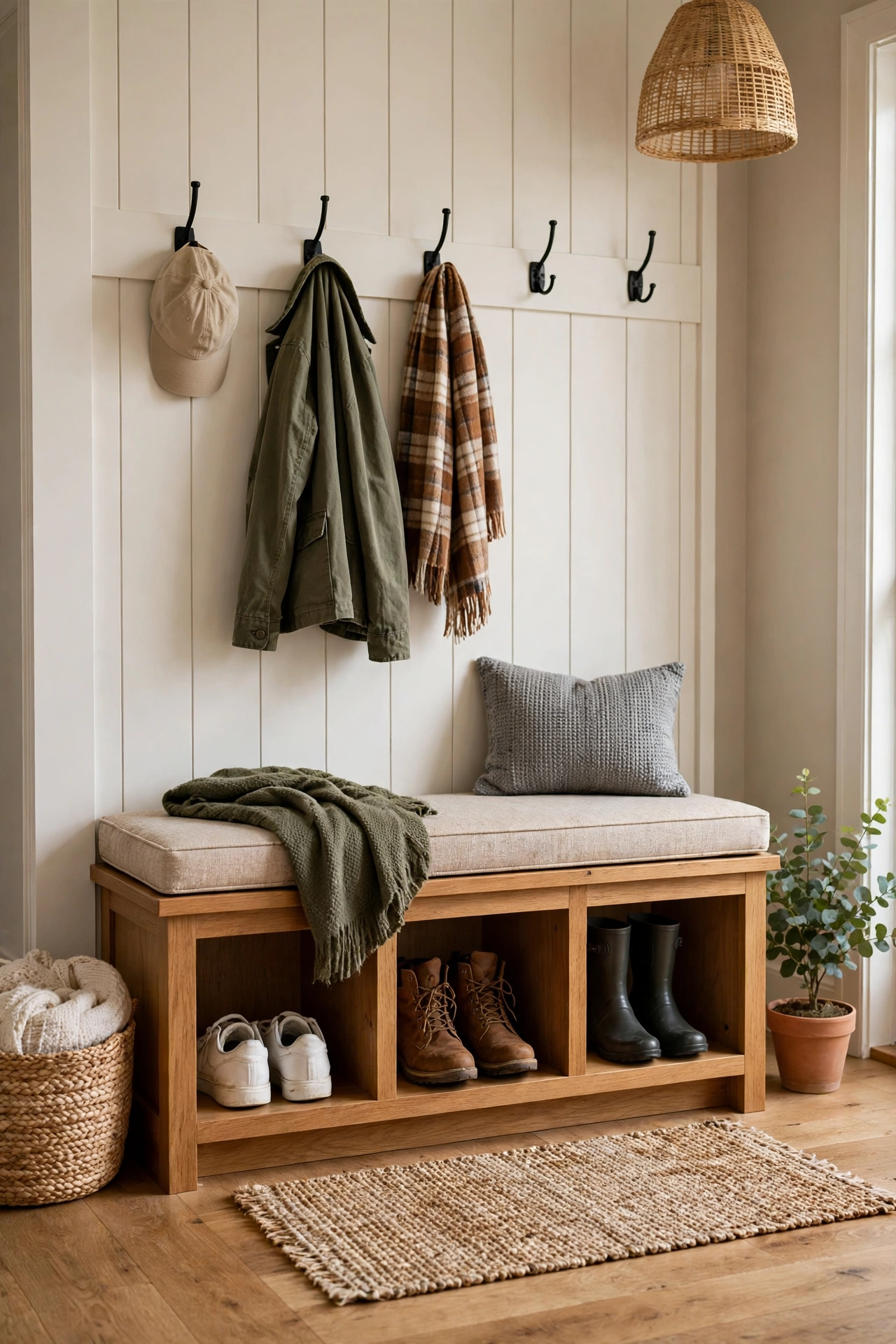
A bench with open cubbies underneath solves two problems at once: a place to sit while you pull boots on, and a visible spot for each pair. Aim for a bench 36 to 48 inches wide with cubbies about 12 inches tall for sneakers and low shoes, plus one taller cubby of 18 inches for boots. Open cubbies beat closed doors for kids, because a pair in plain sight gets put away faster than a pair hidden behind a door. Choose a bench rated for daily sitting weight, not a decorative piece, since a thin bench loosens within a season of real use.
Try this: Put a small basket on the bench seat for gloves and hats, so small gear stops landing on top of the shoes.
Cost: $$$| Difficulty: Easy to Moderate
3. One cubby per person with labels
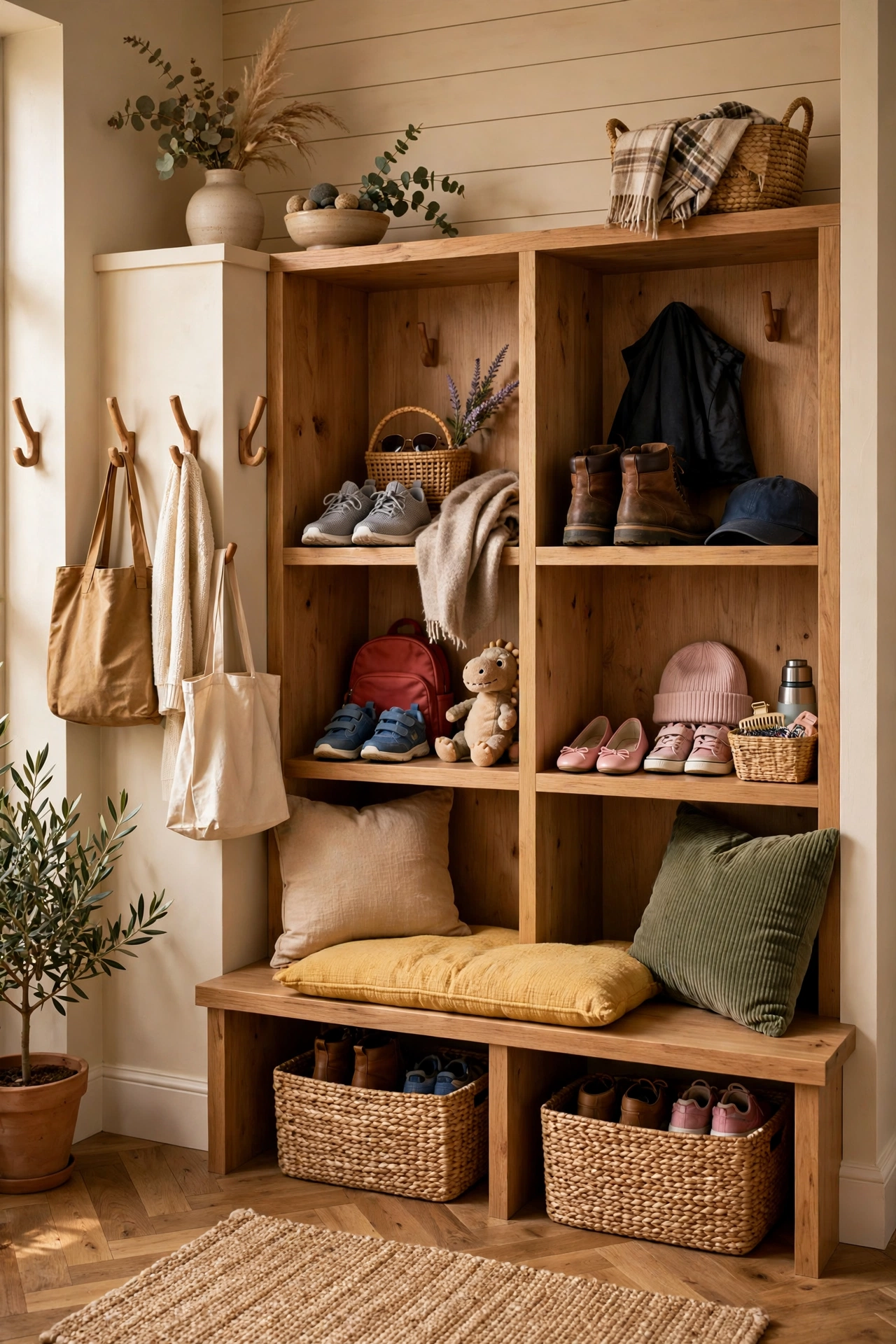
Assigning one cubby per person ends the argument about whose shoes are whose. Each cubby holds two or three daily pairs, and a simple label, a nameplate, a photo, or a colored bin, tells everyone where their shoes belong. Kids do better with low cubbies they can reach without help, while adults can take the higher rows. Cap the rule at daily pairs only. When a cubby overflows, the extra pairs move to a closet shelf, which keeps the system honest instead of letting one cubby turn back into a pile.
Try this: Add a small hook above each cubby for that person’s bag or leash, so the whole leaving routine lives in one spot.
Cost: $$$| Difficulty: Easy
4. Lift top storage bench

A lift top bench hides shoes completely, which suits entries that open straight into a living room. The seat lifts on hinges to reveal a deep compartment that holds 6 to 10 pairs, depending on shoe size. Look for soft close hinges so the lid never slams on fingers, and a bench depth of at least 16 inches so adult shoes fit without cramming. The trade off is speed: shoes inside a bench take one extra step to reach, so keep one open cubby or tray beside it for the pair you wear today.
Try this: Line the inside with a washable mat so mud from one pair never stains the bench interior.
Cost: $$$| Difficulty: Easy
5. Pull out shoe drawers under the bench
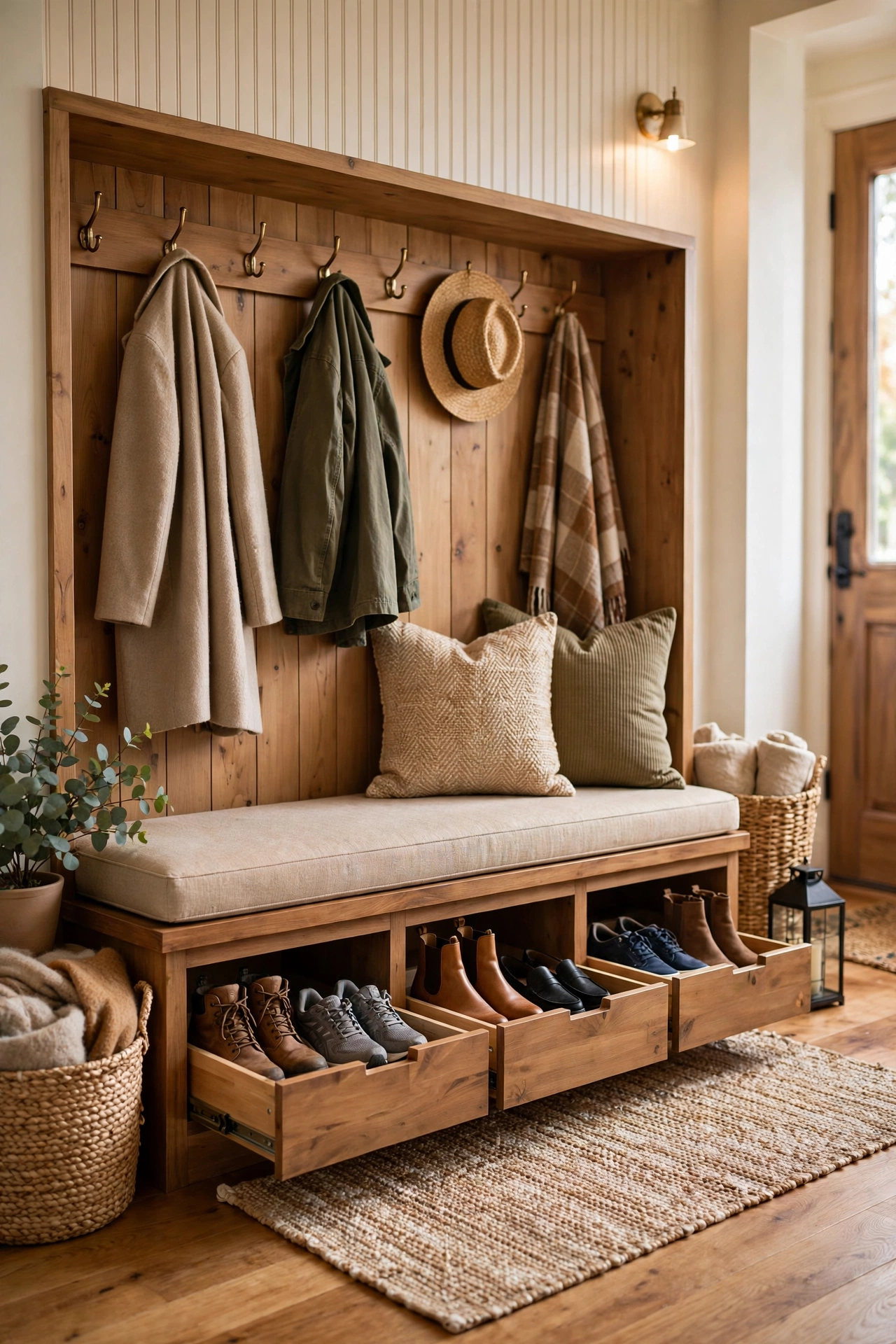
Pull out drawers under a bench give you closed storage without the crouch and reach of a deep cubby. Each drawer slides toward you on full extension runners, so the pair at the back is as easy to grab as the pair at the front. Plan drawers about 14 inches deep for adult shoes and 6 to 8 inches tall per drawer, which fits sneakers and flats but not tall boots. Reserve drawers for daily and dress shoes, and give boots their own tall spot elsewhere. Soft close runners keep drawers from slamming when kids yank them open.
Try this: Put one drawer per person and label the drawer fronts, so the drawer system works like personal cubbies with doors.
Cost: $$$| Difficulty: Moderate
6. Tilt out shoe cabinet for narrow halls

A tilt out cabinet is the answer for a hallway too narrow for a bench. These cabinets project only 8 to 10 inches from the wall, and each compartment tilts down to reveal two or three pairs stored at an angle. Two stacked compartments hold 6 to 8 pairs, which covers daily shoes for two adults or one adult and two kids. Mount the cabinet to wall studs, since a loaded cabinet is heavy and a tip risk in a walkway. Measure your largest shoes first, because tall sneakers and hiking boots need deeper compartments than flats.
Try this: Use the flat top for keys and mail, and add a small mirror above it for a last check before you leave.
Cost: $$$| Difficulty: Easy to Moderate
7. Wall mounted slatted shoe rack

A wall mounted rack with slatted shelves lifts shoes off the floor and leaves the floor clear for sweeping and mopping. Slats matter: solid shelves trap moisture under shoes, while gaps let air move and help damp shoes dry. Mount two or three rows at 10 to 12 inches apart, with the lowest row at least 6 inches above the floor so a mop passes under it. This system suits renters less well, since it needs wall anchors, but it is one of the best uses of a blank entry wall. Keep heavier boots on the lowest row so the rack stays stable.
Try this: Leave one slat row empty in summer for sandals and pool shoes, which need airflow most.
Cost: $$$| Difficulty: Easy to Moderate
8. Over the door shoe pockets for rentals
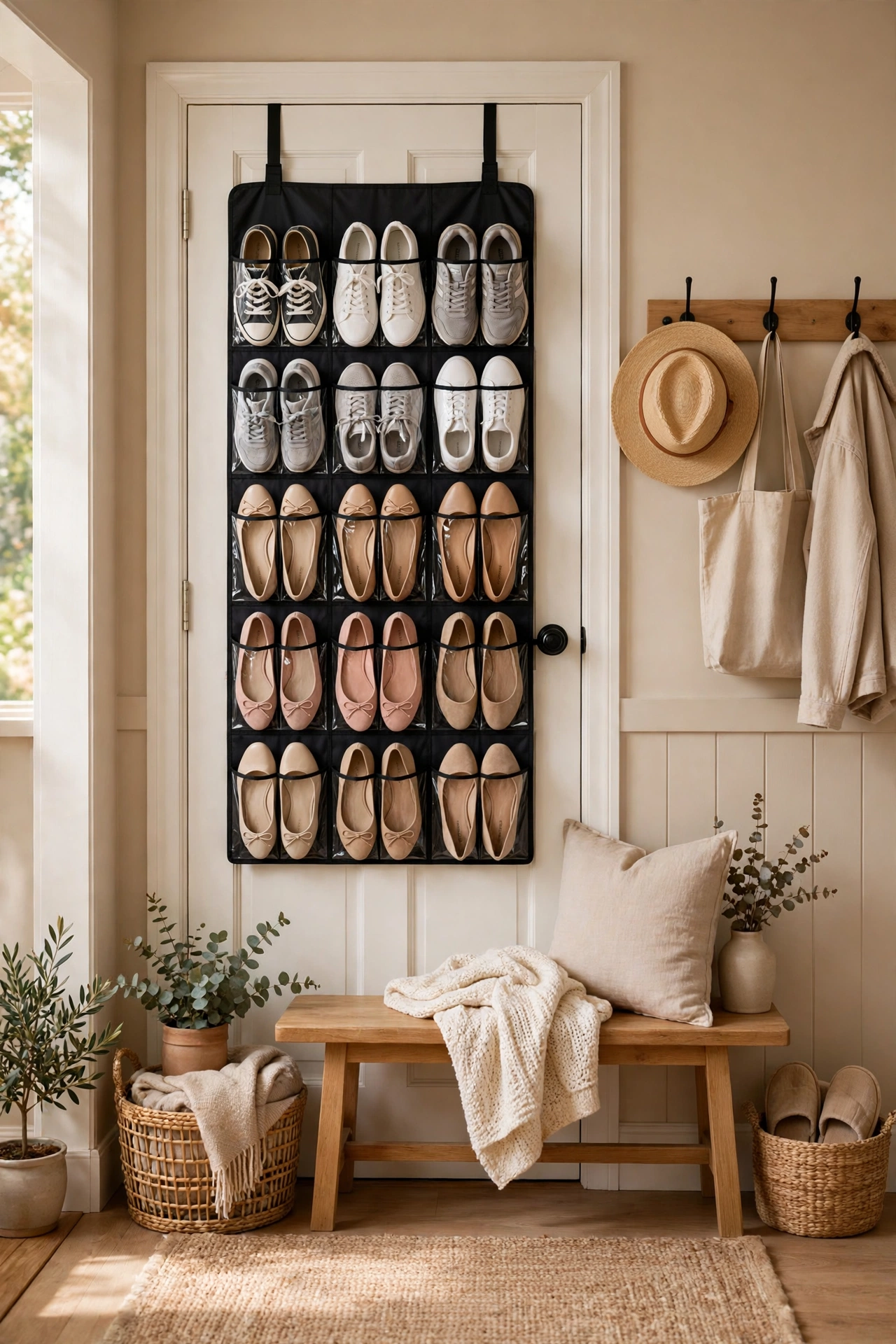
When drilling is not allowed, an over the door organizer adds storage without a single hole. Clear pockets hold sneakers, flats, kids shoes, and sandals, and the clear fronts let you spot the pair you want without opening pockets one by one. Hang it on the mudroom door or a closet door near the entry, and check that the door still closes fully with the organizer loaded. Skip this option for heavy boots, which stretch pockets and pull the door off balance. Use it for lightweight pairs and keep boots on a tray below.
Try this: Reserve the bottom row of pockets for shoe care items like a brush and spare laces, so they stay with the shoes.
Cost: $$| Difficulty: Easy
9. Boot drying rack with pegs

Wet boots dry faster upside down, and a peg rack holds them that way. Each pair hangs sole up on two pegs, which lets air reach the inside and keeps dirty soles off clean surfaces. Place the rack near the door on a tray or waterproof mat, since drips still fall while boots dry. For snowy climates, a heated boot dryer with warm airflow cuts drying time further, but a plain peg rack handles most rainy day use. Wipe pegs dry once a week in wet seasons, since standing moisture on wood pegs leads to mildew.
Try this: Put the rack beside the boot tray so wet boots move from tray to rack in one step, with no drips across the floor.
Cost: $$| Difficulty: Easy
10. Tall boot locker with drip tray base

Tall boots need height, and a full height locker section gives it to them. Build or buy one locker bay 48 to 60 inches tall with a waterproof tray set into the base, so tall winter boots, rain boots, and riding boots stand upright and drain into the tray instead of onto the floor. Keep this bay at the end of the mudroom run, where its height never blocks a walkway or a door swing. One bay per two adults covers most households, since tall boots are seasonal for many people and rotate out in summer.
Try this: Add a boot jack or a small pull handle at the base of the bay, so tall boots come off without a struggle.
Cost: $$$| Difficulty: Moderate
11. Labeled bins under the bench for kids and sports gear

Kids shoes and sports gear resist neat rows, and bins accept that. Slide one labeled bin per child under the bench, and let cleats, sneakers, and shin guards live together in that bin instead of scattered across cubbies. Pick bins with handles so kids can pull the whole bin out, find shoes, and push it back, and choose bins that rinse clean, since sports gear brings home grass and mud. Label bins with names or colors rather than shoe types, because a kid’s gear changes with the season while the bin stays theirs.
Try this: Keep one spare empty bin on the shelf for outgrown shoes headed for donation, so the hand off happens before the next pile forms.
Cost: $$| Difficulty: Easy
12. Tiered open rack for daily rotation pairs

A tiered rack holds the pairs you actually wear this week, in plain sight, at grab height. Two or three slanted tiers show each pair instead of stacking them, so you never dig behind one pair to reach another. Place the rack right by the door for the two or three pairs per person in current rotation, and move the rest to closed storage. This is the best second system to pair with a bench or cabinet, because it handles the daily churn while the main system holds everything else. A rack 24 to 30 inches wide fits most entries without crowding the walkway.
Try this: Rotate the rack every Sunday night: out go pairs you did not wear, in come the pairs for the week ahead.
Cost: $$| Difficulty: Easy
13. Slim rolling cart for narrow gaps

Most entries have a dead gap, between a door frame and a wall, beside a washer, or behind a door swing, that fits nothing except a slim cart. A rolling cart 6 to 8 inches wide slides into that gap and holds 8 to 12 pairs on stacked shelves, then rolls out when you need a pair. Pick a cart with locking casters so it stays put once pushed back, and measure the gap at the floor, since baseboards narrow the space by half an inch on each side. This system works well for flats, sneakers, and kids shoes, but not for tall boots.
Try this: Keep the cart for one person’s shoes only, so it never becomes the household overflow drawer.
Cost: $$| Difficulty: Easy
14. High seasonal swap shelf

Off season shoes do not belong at the door, but they do belong somewhere you can reach them twice a year. A high shelf above the mudroom hooks, fitted with labeled boxes, holds winter boots in summer and sandals in winter, freeing daily cubbies for the pairs you wear now. Label each box by season and person, and keep a small step stool in the mudroom so the swap takes ten minutes, not a weekend project. Run the swap when the weather turns, and use it as a chance to pull out pairs nobody wore all season.
Try this: Put a “donate” box on the same shelf, and drop outgrown or unworn pairs in during each swap.
Cost: $$$| Difficulty: Easy
15. Shoe care station by the door

A shoe system fails when shoes smell or fall apart, so give care supplies their own spot. A small shelf or basket by the door holds a stiff brush for mud, charcoal or cedar pouches for odor, spare laces, and a waterproofing spray. Brush mud off dry shoes before they go back into storage, since dried mud flakes into cubbies and bins. Charcoal pouches tucked into closed cabinets absorb moisture and odor between wears, and they recharge in sunlight. This station costs little, but it keeps every other idea on this list working longer.
Try this: Keep a second brush outside the door for muddy days, so the worst dirt never comes inside at all.
Cost: $$| Difficulty: Easy
How to choose the right mudroom shoe storage for your home
Start by counting pairs, not people. A family of four easily owns 40 to 50 pairs, but only 12 to 16 pairs need to live at the door. Measure the entry wall, the tallest boots, and the walkway width before you buy anything, since those three numbers rule out half the options at once. Pick one landing zone for wet shoes, one main system for daily pairs, and one overflow spot for the rest. Renters should lean on freestanding benches, trays, and over the door pockets, while homeowners can anchor wall racks and build in cubbies. If mornings feel rushed, favor open storage you can see into over closed storage that hides pairs.
Mudroom shoe storage at a glance
| Idea | Cost | Difficulty | Best for |
|---|---|---|---|
| Deep boot tray landing zone | $15-$40 | Easy | Wet and muddy climates |
| Bench with open cubbies below | $80-$250 | Easy to Moderate | Families with kids |
| One cubby per person with labels | $40-$150 | Easy | Shared households |
| Lift top storage bench | $100-$300 | Easy | Entries open to living rooms |
| Pull out shoe drawers under the bench | $150-$400 | Moderate | Daily and dress shoes |
| Tilt out shoe cabinet for narrow halls | $60-$200 | Easy to Moderate | Narrow hallways |
| Wall mounted slatted shoe rack | $30-$120 | Easy to Moderate | Blank entry walls |
| Over the door shoe pockets for rentals | $10-$30 | Easy | Rentals, light shoes |
| Boot drying rack with pegs | $25-$90 | Easy | Rainy and snowy climates |
| Tall boot locker with drip tray base | $120-$350 | Moderate | Tall winter and rain boots |
| Labeled bins under the bench for kids and sports gear | $20-$60 | Easy | Kids and sports families |
| Tiered open rack for daily rotation pairs | $25-$80 | Easy | Fast mornings |
| Slim rolling cart for narrow gaps | $20-$60 | Easy | Dead gaps and tiny entries |
| High seasonal swap shelf | $30-$100 | Easy | Seasonal climates |
| Shoe care station by the door | $15-$40 | Easy | Every mudroom |
Common mistakes to avoid
Buying storage before measuring is the most common error, and it shows up as a cabinet that blocks a door swing or a rack that fits sneakers but not boots. Skipping the wet shoe zone is the second error: a tidy cubby wall still fails if muddy boots land on bare floor first. A third error is storing every pair at the door, which guarantees overflow no matter how big the system is. Closed cabinets without airflow cause a fourth problem, since damp shoes sealed inside stay damp and start to smell. Finally, tall unanchored units in a house with kids are a tip risk, not a storage win.
Safety notes
Anchor tall shoe cabinets, lockers, and wall racks to wall studs with anti-tip hardware, and keep heavier boots on the lowest rows so units stay bottom heavy. The U.S. Consumer Product Safety Commission explains anchoring steps on its Anchor It guidance page. Leave gaps for airflow in closed storage, and dry wet shoes before they go back inside, since trapped moisture feeds odor and mildew. Use a slip resistant mat or tray by the door, and wipe up drips the same day so the entry floor never stays slick. If your home was built before 1978, test for lead paint before sanding or drilling into walls, and follow the EPA Renovation, Repair and Painting program rules for any larger wall work. Hire a licensed electrician for any new outlets or lighting near the entry.
More home and storage ideas
If the mudroom overflows into the bedroom closet, a closet system helps. See these smart built in closet storage ideas for shelves, drawers, and zones that hold the pairs you rotate out of the entry.
For the entry itself, the look around the shoe storage matters too. These perfect mid century modern foyer ideas show how consoles, benches, and mirrors frame a tidy entry.
The labeling and zone habits in this article work in other rooms as well. The same one zone, one label approach drives these genius pantry organization ideas for kitchens.
Shelving logic transfers too: the adjustable and tiered shelf thinking behind these smart walk in pantry shelving ideas applies just as well to shoe shelves.
When storage shapes how a room feels, layout choices matter. These useful bedroom layouts with different furniture show how a storage first layout changes a room.
Frequently asked questions
How many pairs of shoes should a mudroom hold?
Plan for daily pairs only at the door: two or three pairs per person, or 12 to 16 pairs for a family of four. A family easily owns 40 to 50 pairs in total, but the rest belong in closets, under beds, or on a high seasonal shelf. When the mudroom holds everything, it holds nothing well, and the pile returns no matter how big the unit is.
What is the best shoe storage for a small entryway?
A tilt out cabinet or a wall mounted slatted rack fits the smallest entries, since both project 8 to 10 inches from the wall and keep the floor clear. Add a boot tray for wet shoes and an over the door organizer if you rent. Skip a full bench unless the wall is at least 36 inches wide, since a cramped bench blocks the walkway it was meant to serve.
How do you keep mudroom shoe storage from smelling?
Airflow is the fix. Use slatted shelves, leave gaps in closed cabinets, and dry wet shoes on a peg rack before they go back inside. Tuck charcoal or cedar pouches into closed compartments, and brush dried mud off shoes before storage. Rotate pairs so no pair sits damp and unworn for weeks.
How do you store tall boots in a mudroom?
Give tall boots their own full height bay, 48 to 60 inches tall, with a waterproof tray in the base so they stand upright and drain. Boot shapers or rolled magazines inside the shafts keep tall boots from flopping over. Measure your tallest pair before buying, since winter boots run taller than most cubbies allow.
Should mudroom shoe storage be open or closed?
Use both. Open storage wins for daily pairs and kids, because visible pairs get put away and grabbed faster. Closed storage wins for off season pairs, dress shoes, and entries that open into living rooms, where hidden shoes keep the room calm. A common setup is one open rack for today plus one closed cabinet for everything else.
Final thoughts
Pick the landing zone first, then one main system, then one overflow spot, and the pile by the door finally has somewhere else to go. Start with a tray and a count of daily pairs this week, and build from there.
For the whole room beyond shoe storage, see our guide to 14 Mudroom Ideas for an Entry That Finally Stays Tidy for one locker bay per person, a floating bench, a wet-weather station, a pet station, a laundry combo, and a no-drill renter setup.


