


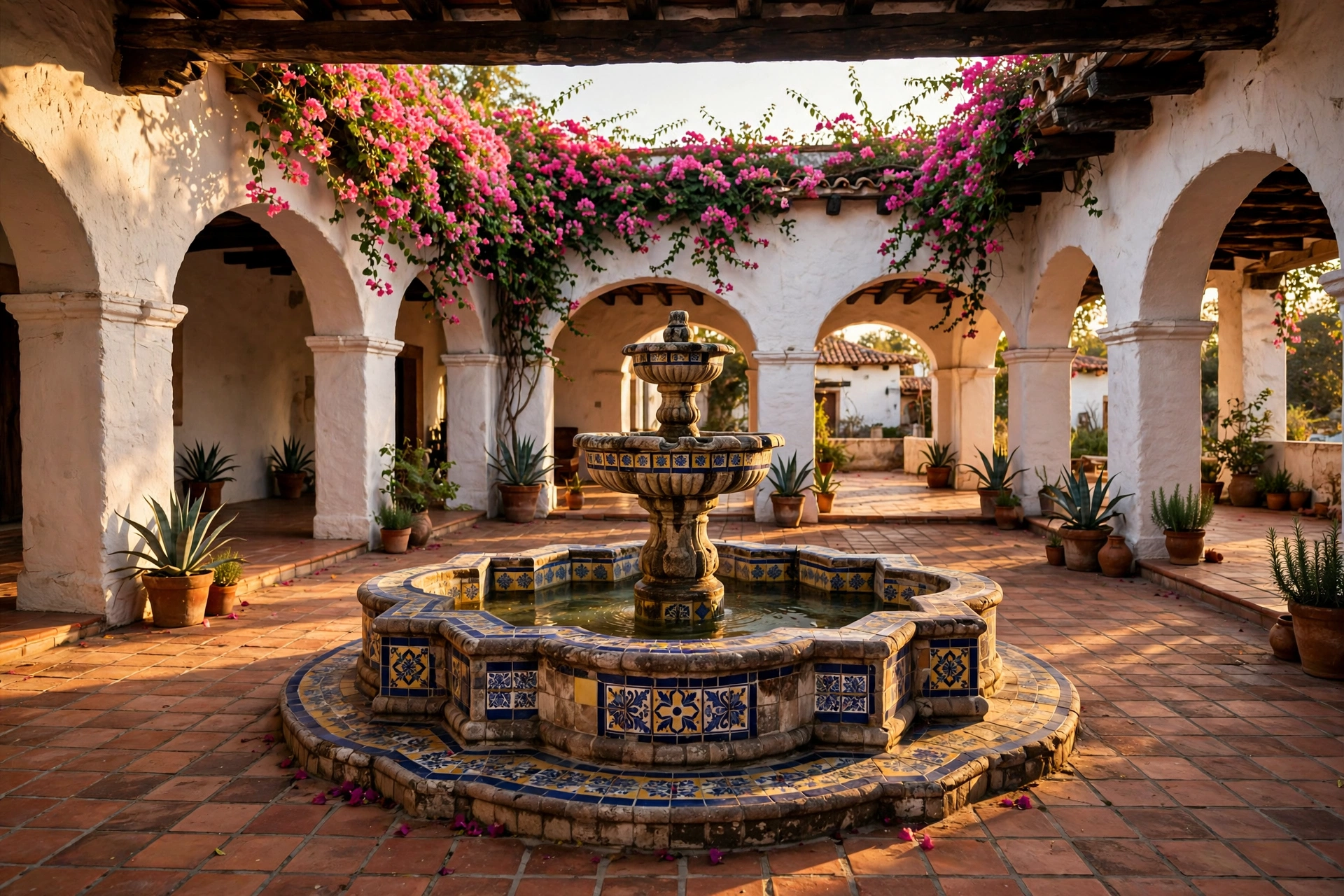
Two years ago I walked into a 200-year-old hacienda outside San Miguel de Allende and forgot how to talk for a minute. It wasn’t grand in the way a mansion is grand. The floors were uneven handmade terracotta, the walls were thick enough to swallow sound, and the whole house wrapped around a courtyard where a stone fountain had been trickling, probably, since before my grandmother was born. I stood there thinking: this is what a house is supposed to feel like. Solid. Warm. Like it grew out of the ground instead of being dropped onto it.
I came home and spent the next eighteen months slowly pulling those ideas into my own house — not a replica, not a theme park, just the bones of the style: warm plaster, honest wood, handmade tile, and rooms that open to the sky. Some of it was big (replacing flooring), most of it was small (a $12 clay pot that changed my entryway). These 25 inspiring hacienda old Mexican house ideas are everything I learned, organized from the biggest transformations to the smallest finishing touches. You don’t need a courtyard or a plane ticket to Mexico. You need warmth, texture, and the courage to let things be a little imperfect.
- Hacienda style = thick plaster walls + terracotta + dark wood + handmade tile + wrought iron. Warmth comes from materials, not paint colors.
- Start with the floor: Saltillo or terracotta-look tile resets the whole house in one move.
- One handmade element (Talavera, hammered copper, carved wood) beats ten mass-produced “Mexican style” accessories.
- Arches, beams, and texture do the architectural work — furniture stays simple.
- Imperfection is the point. Machine-perfect finishes kill the look instantly.
1. Saltillo Terracotta Tile Floors
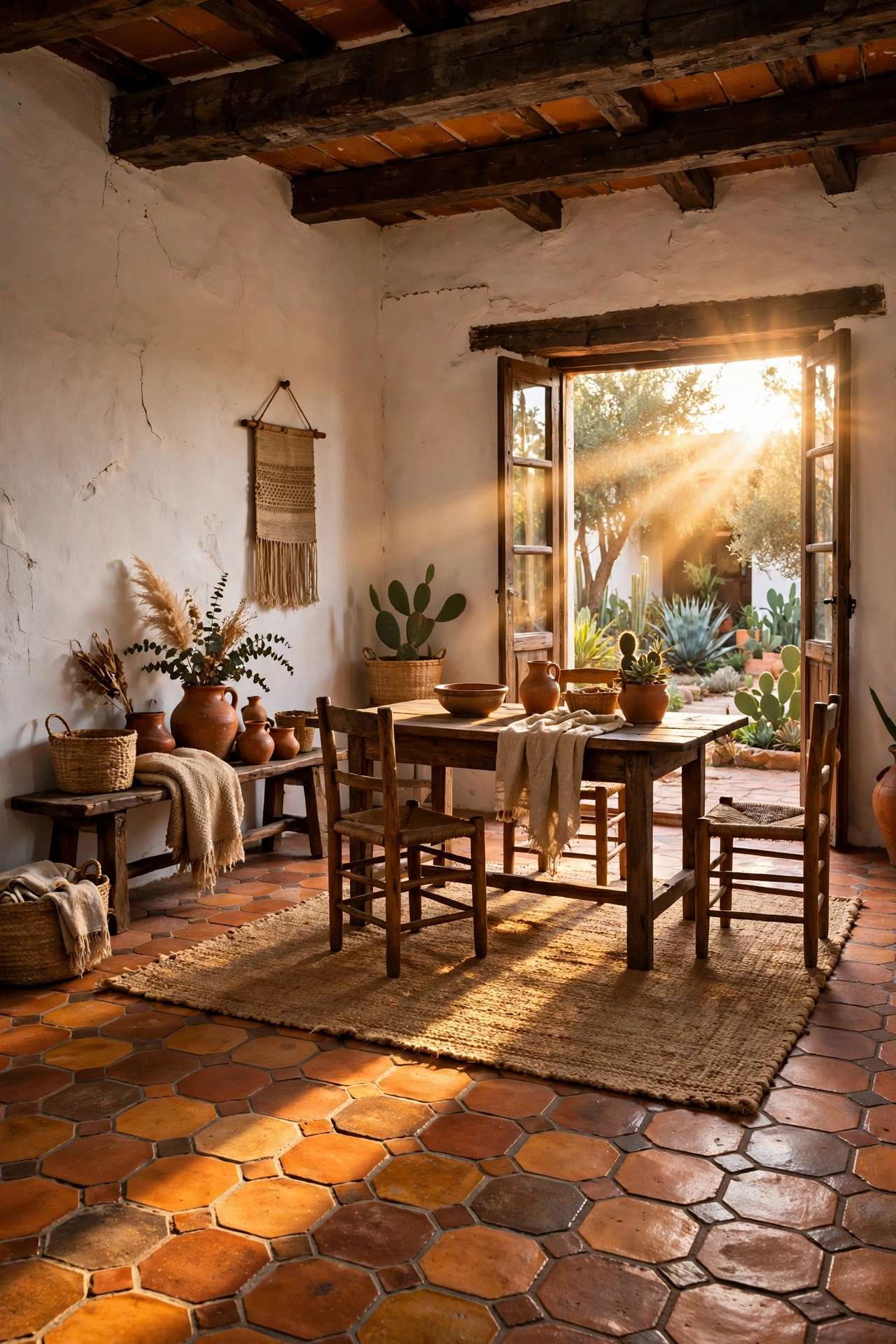
If you do one thing from this list, make it the floor. Handmade Saltillo tiles — those warm, uneven squares in orange, amber, and gold — are the single most defining feature of an old Mexican house. No two tiles match exactly, the surface dips and rises slightly, and over the years they develop a patina that no manufactured tile can fake. They stay cool underfoot in summer and take radiant warmth beautifully in winter.
Try this: if real Saltillo is out of budget, terracotta-look porcelain gives you 80% of the effect with easier maintenance — but seal real Saltillo properly and it will outlive you.
2. A Talavera Tile Kitchen Backsplash
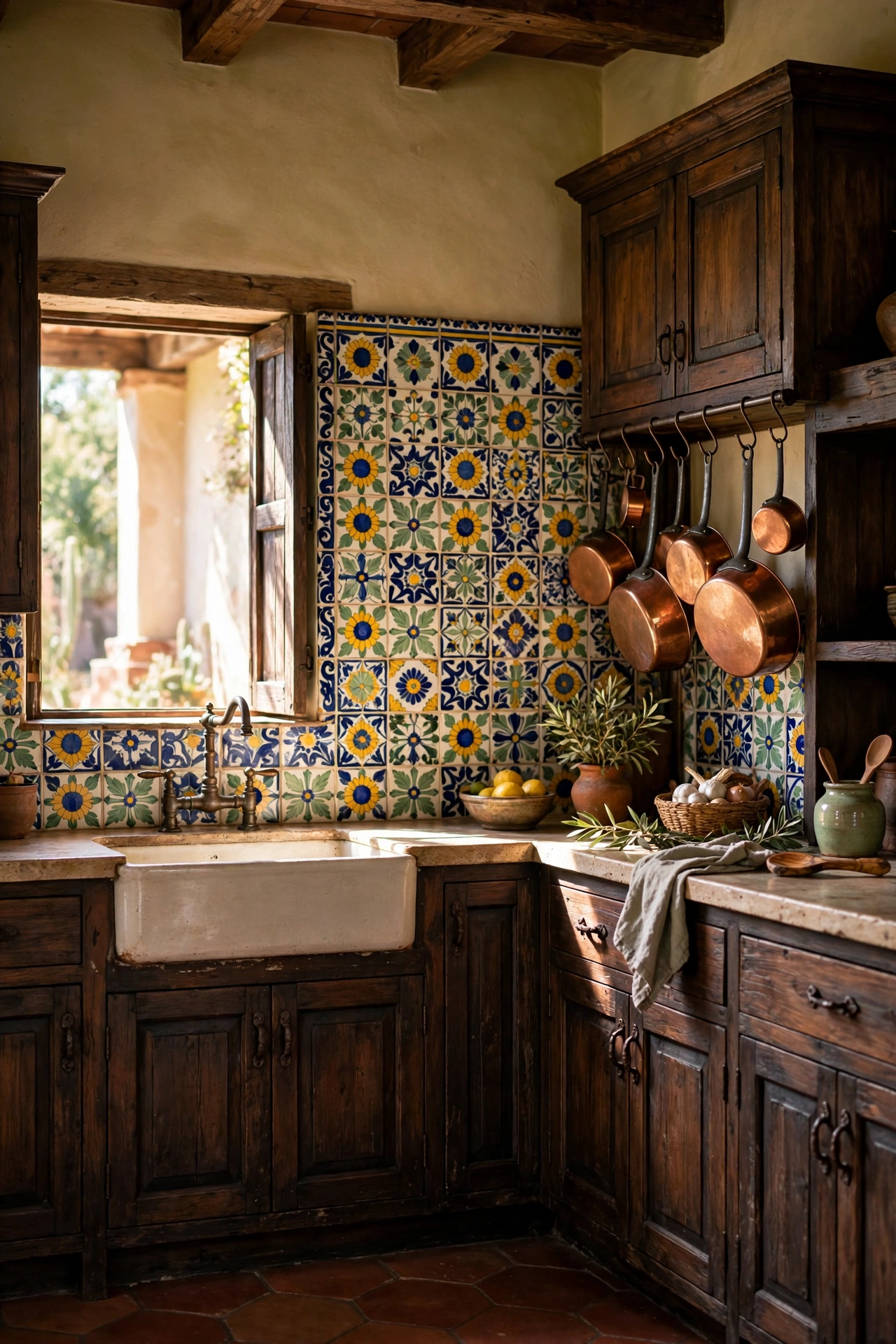
Talavera — the hand-painted tin-glazed pottery from Puebla — is where hacienda houses get their joyful color. A backsplash of Talavera tiles in cobalt blue, sunflower yellow, and green turns an ordinary kitchen into the heart of the house. The patterns are never perfectly uniform, and that’s exactly why they work: the slight wobble of a hand-painted line is what makes your eye linger.
For more ways to work Talavera and other handmade elements into every room, this roundup of Mexican hacienda home ideas is worth browsing for inspiration.
Try this: you don’t need to tile the whole wall. One framed panel of Talavera behind the stove, bordered with plain terracotta tiles, reads as intentional and costs a fraction of a full backsplash.
3. Exposed Wooden Vigas on the Ceiling
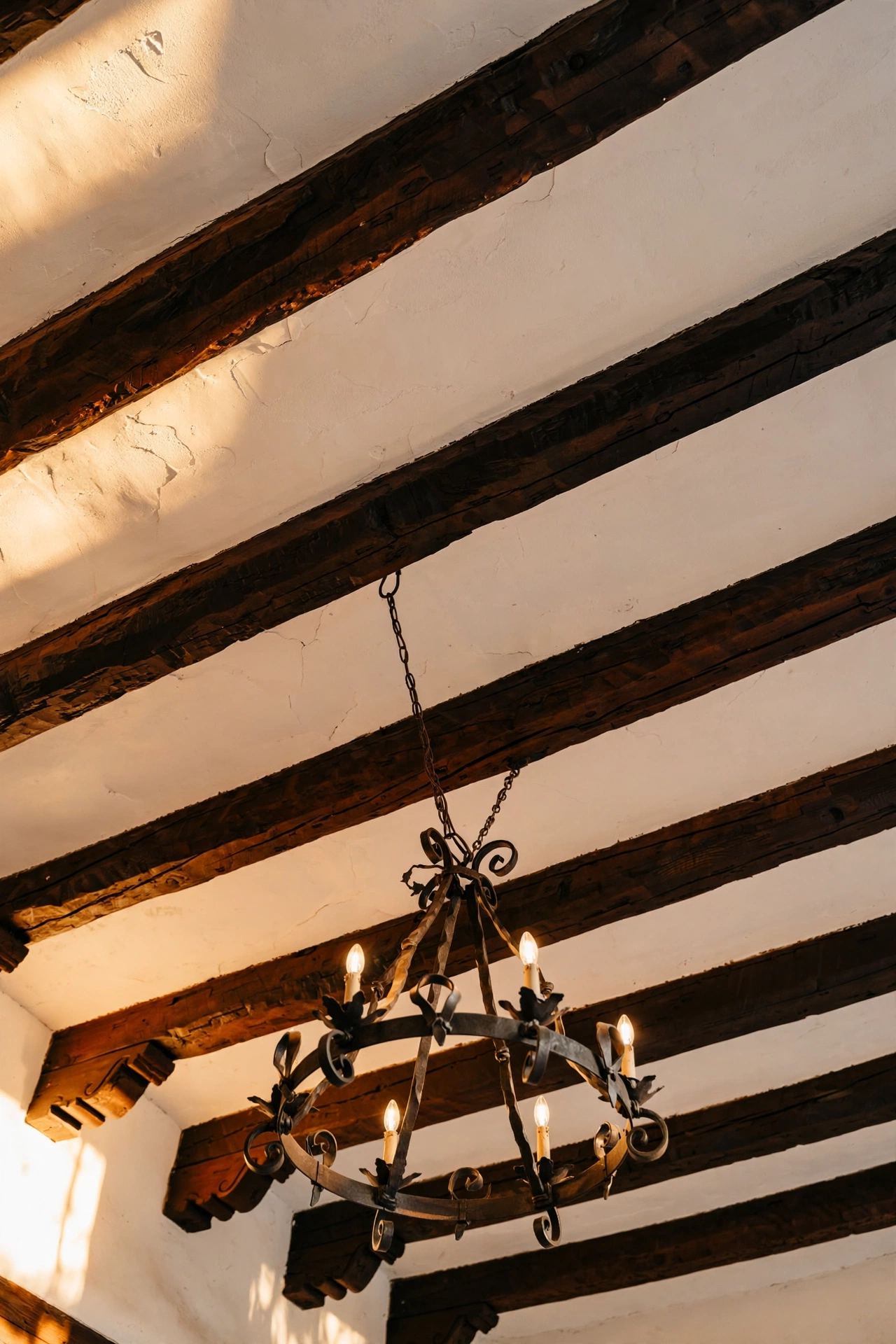
Look up in any old hacienda and you’ll see vigas — massive round or squared wooden beams spanning the ceiling, often with smaller latillas laid across them. They make a room feel anchored and ancient in the best way. If your ceiling is flat drywall, even a few faux beams in dark-stained wood change the architecture of the room overnight.
Try this: stain beams dark walnut, not black. Real aged vigas are deep brown with warm undertones, and that warmth is what keeps the ceiling from feeling heavy.
4. Graceful Arched Doorways
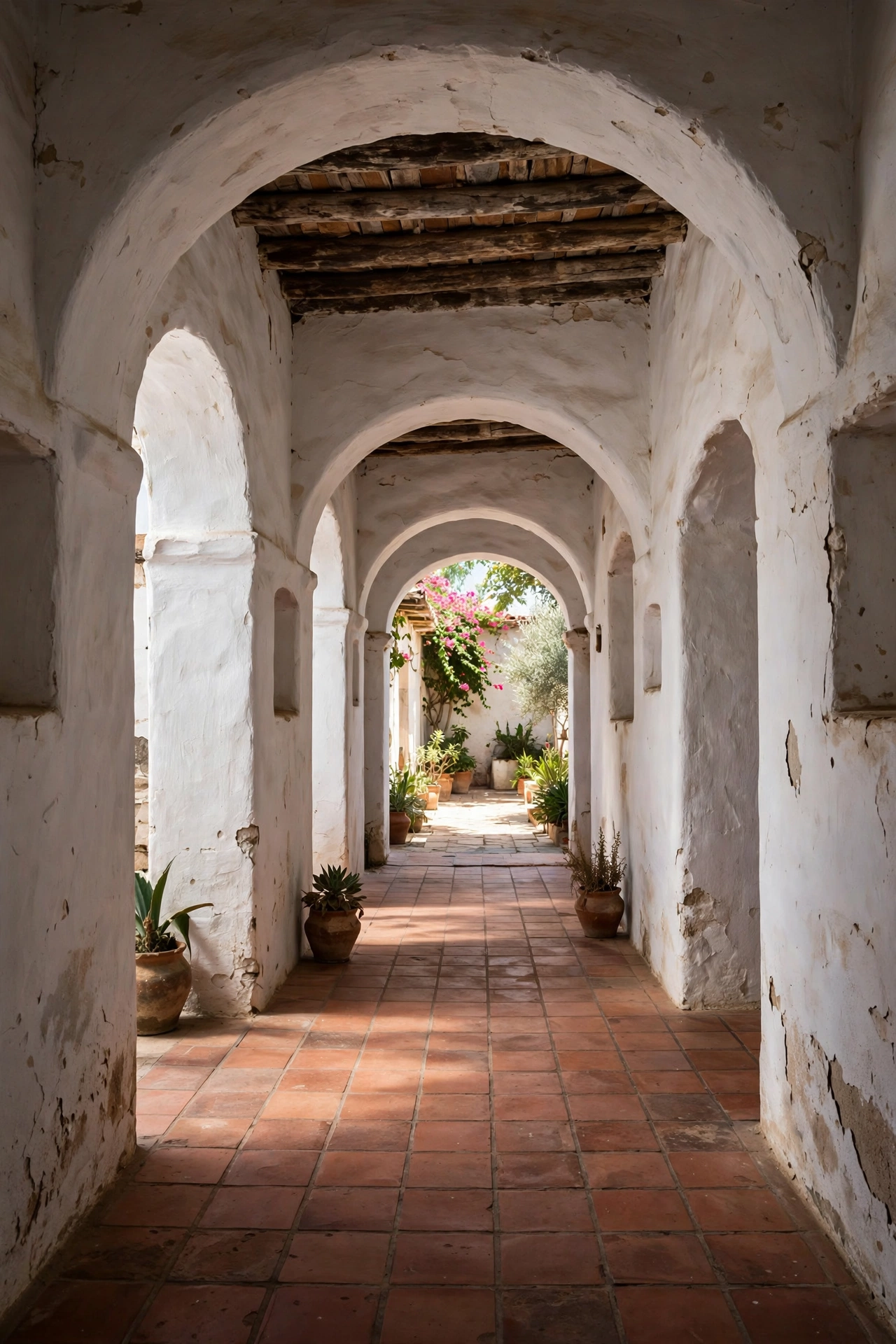
Hacienda houses almost never have sharp rectangular doorways — arches are everywhere, softening every transition between rooms. If you’re renovating, arching a single doorway between the living room and kitchen is a surprisingly affordable carpentry job with an outsized effect. Renters can fake the feeling with an arched mirror or an arched-top bookcase against a flat wall.
Try this: paint the inside curve of the arch one shade deeper than the walls. It adds shadow and depth that makes the arch look original to the house.
5. A Hand-Forged Wrought Iron Chandelier
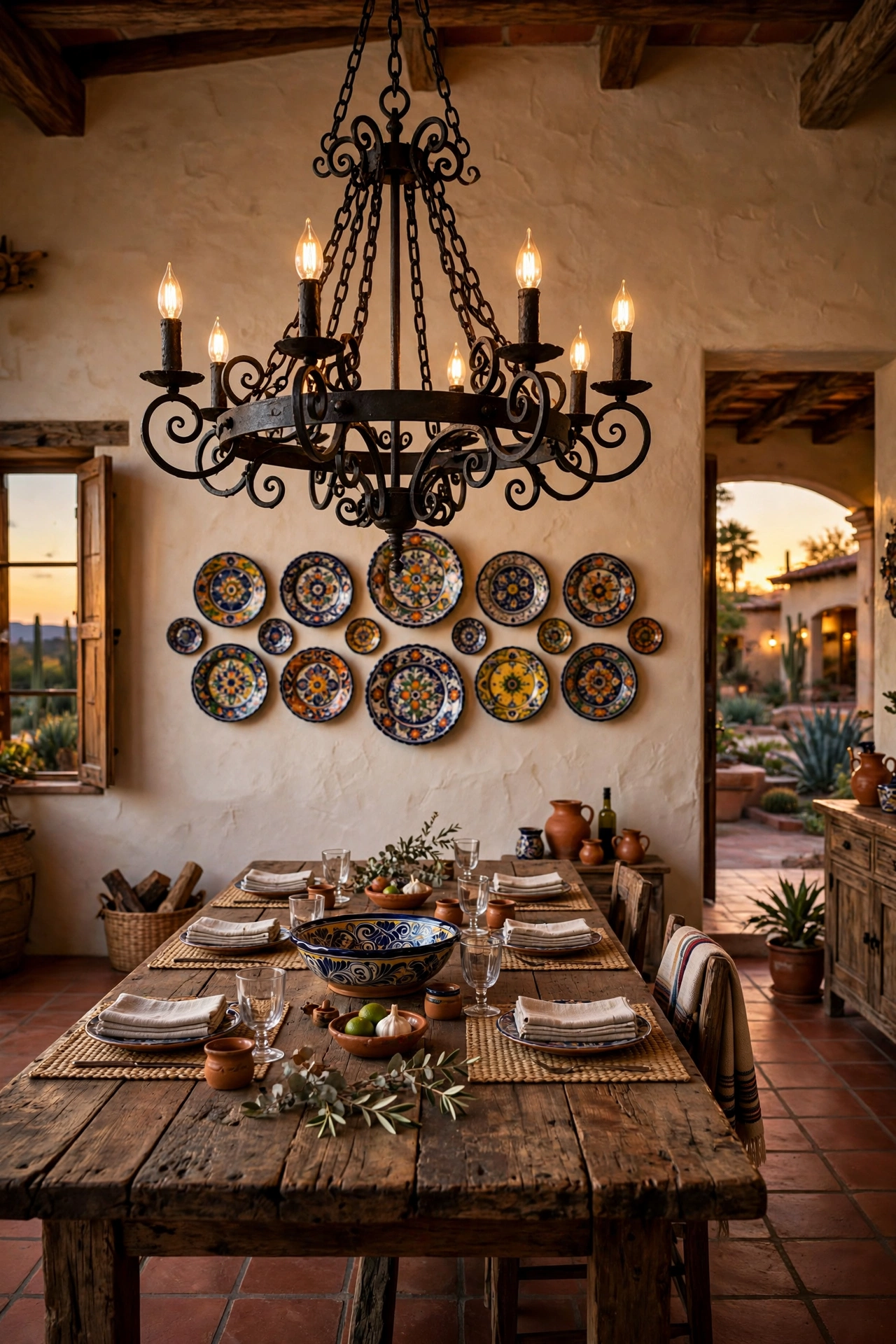
Wrought iron is the jewelry of hacienda design — dark, sculptural, and handmade-looking. A large ring or multi-arm chandelier over the dining table instantly gives the room old-world gravity. The ironwork should look hammered and slightly irregular; slick powder-coated “Tuscan style” fixtures from big-box stores miss the mark.
Try this: pair the chandelier with candle-style bulbs at 2700K. The warm flicker-like glow is what makes iron feel romantic instead of industrial.
6. Warm Limewashed Plaster Walls
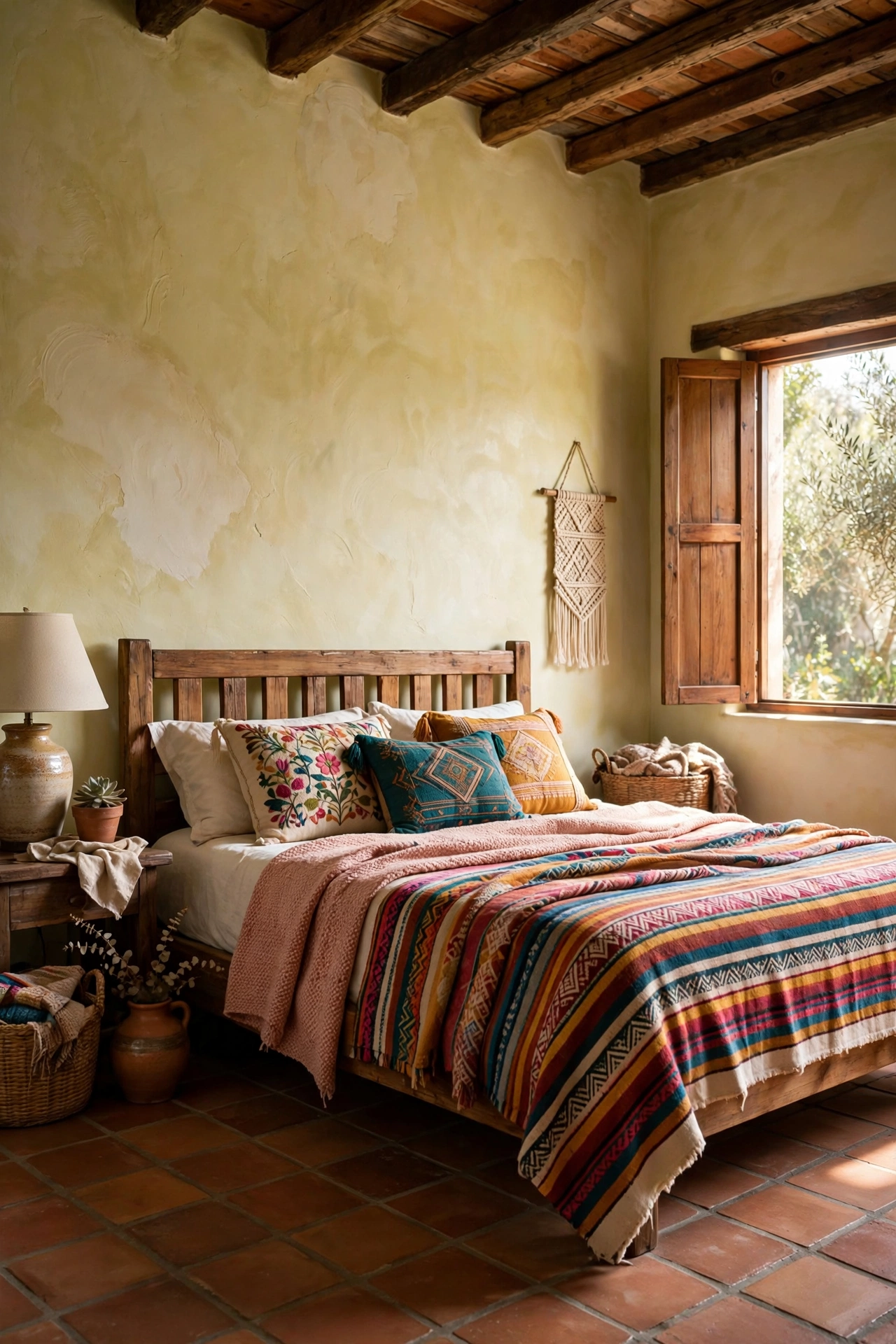
Forget flat latex paint. Old Mexican walls are plaster — sometimes limewashed, always with a hand-troweled texture you can see in raking light. You can get remarkably close with limewash paint, which goes on in cloud-like layers and dries with soft movement. Choose warm whites, sand, or pale ochre; cool grays will fight every other element in this list.
Try this: apply limewash in crisscross strokes with a big block brush and don’t overwork it. The patchiness IS the finish.
7. A Curated Talavera Pottery Collection
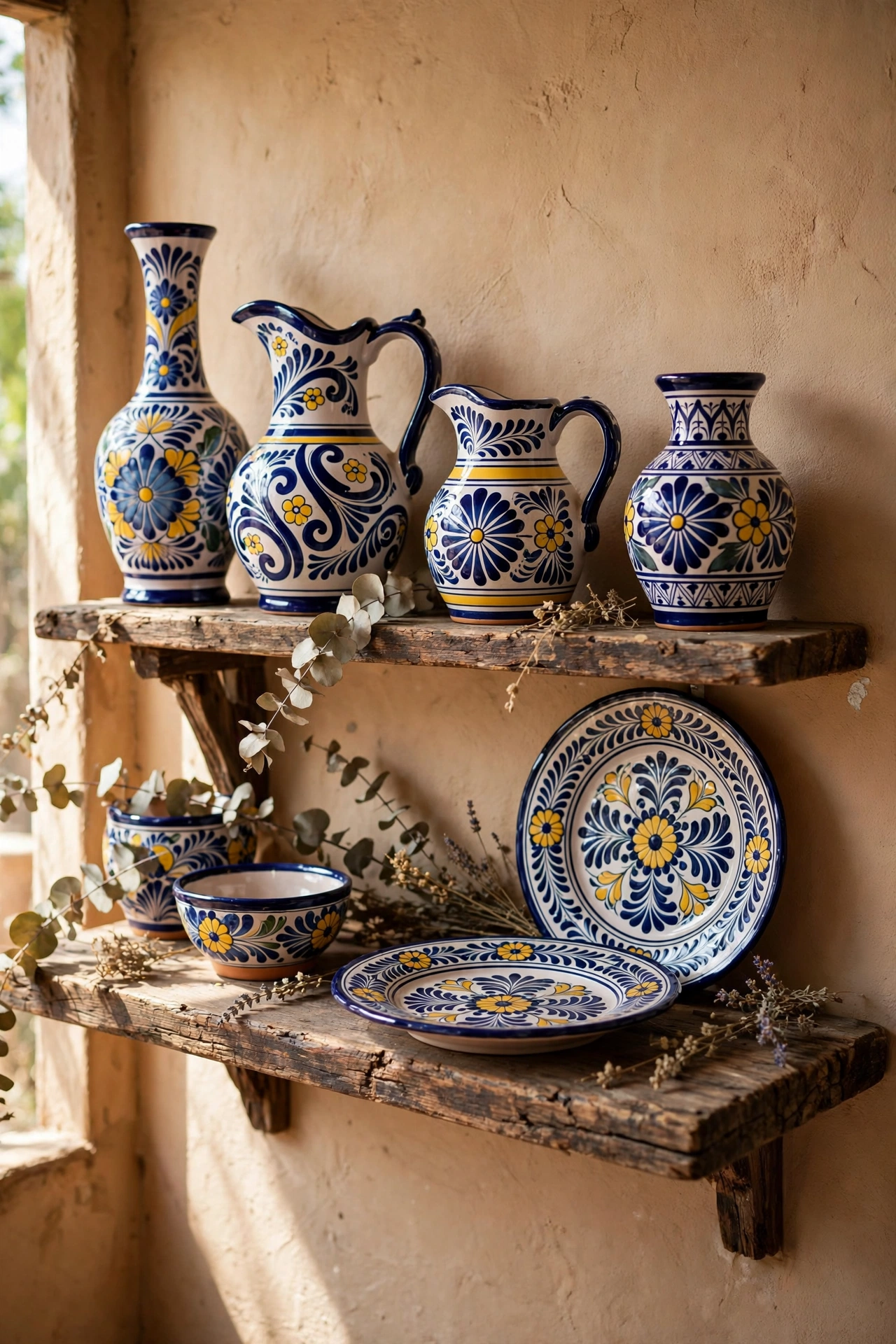
One Talavera vase is a souvenir; five of them grouped together is a collection that anchors a room. Gather pitchers, plates, and vases in the classic blue-and-white with yellow accents and display them on an open shelf, a sideboard, or the top of a bookcase. Odd numbers, varied heights, and a little breathing room between pieces.
Try this: hunt flea markets and estate sales before buying new. Old Talavera has a softness to the glaze that new pieces take years to develop.
8. A Central Courtyard Fountain
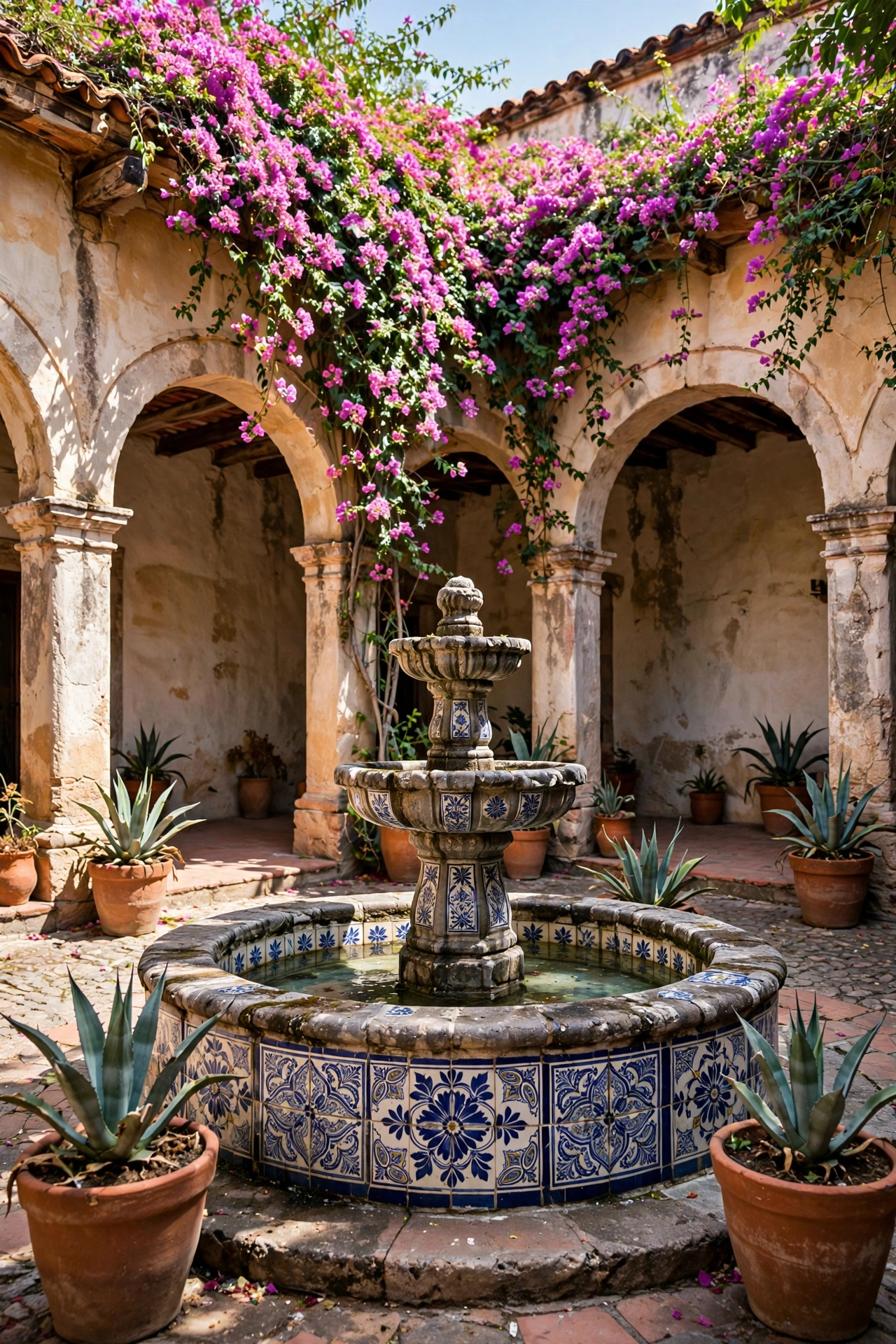
The courtyard is the soul of the hacienda — rooms open onto it, life happens around it, and at its center there’s almost always water. A small stone or Talavera-tiled fountain brings that feeling to any patio or even a large balcony. The sound matters as much as the look: moving water drops the perceived temperature and makes outdoor space feel like a retreat.
Try this: a simple recirculating pump in a large clay pot gives you the fountain sound for under $50, no plumbing required.
9. Massive Carved Wood Doors
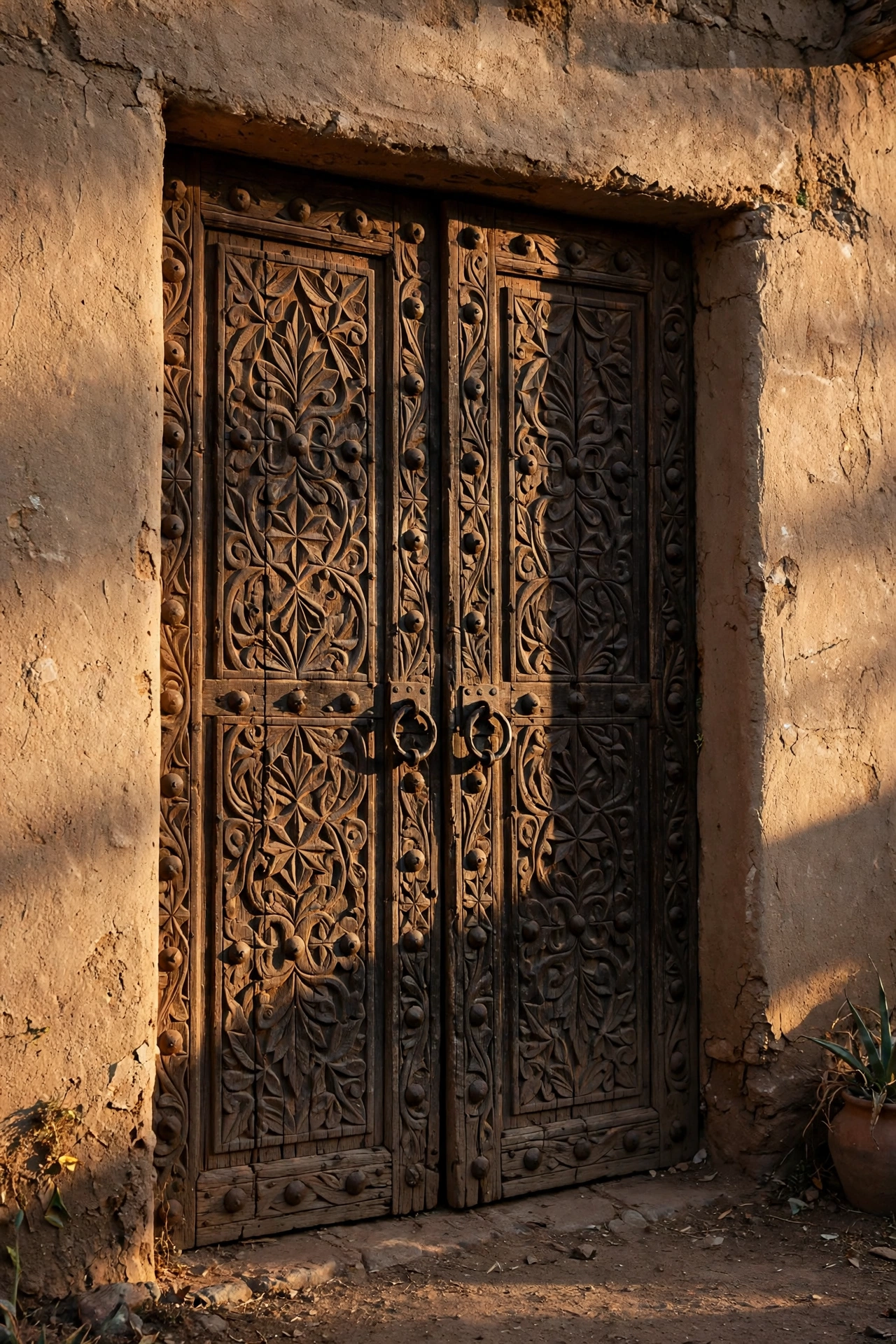
Hacienda doors are not subtle — thick, dark, hand-carved, studded with iron. If replacing your front door is too much, apply the idea inside: swap a hollow interior door for a solid wood one, or clad a flat door with carved-look panels and iron-style hardware. Weight and texture are what you’re after.
Try this: matte black iron hinges and a ring handle on any wood door instantly push it toward hacienda territory for very little money.
10. An Earthy, Sun-Baked Color Palette
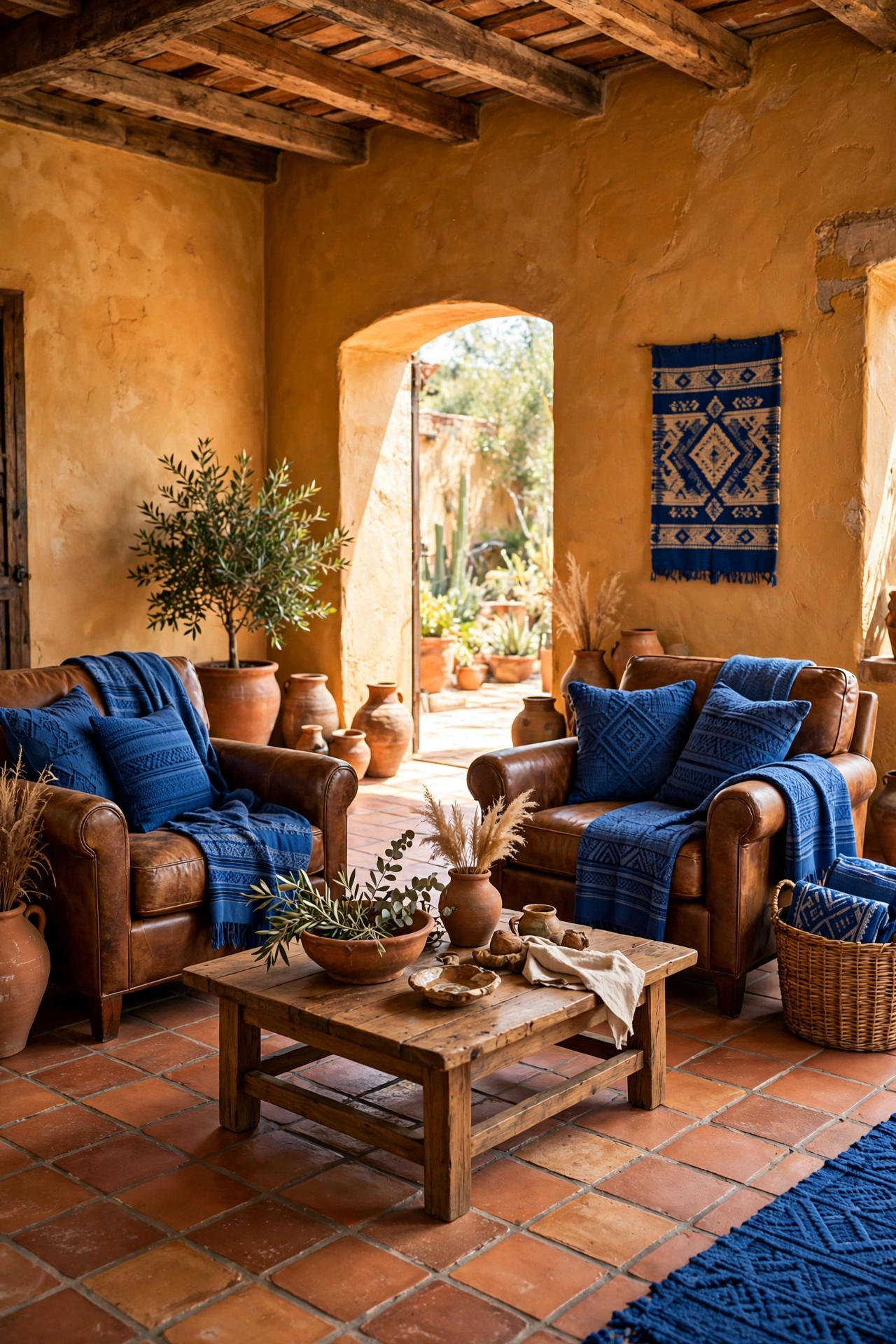
The hacienda palette comes straight from the landscape: terracotta, ochre, sand, warm white, with punches of cobalt blue, deep green, and chili red. Keep the big surfaces (walls, floors) in the warm neutrals and let the saturated colors live in textiles, pottery, and tile. That restraint is what separates an authentic-feeling room from a restaurant theme.
If you’re drawn to the enveloping warmth of a fully committed palette, this guide to enchanting hacienda style homes walks through how color, texture, and layout work together for that cozy retreat feeling.
Try this: pick three colors max for accents and repeat each one at least three times around the room. Repetition is what makes bold color feel calm.
11. Exposed Adobe Brick Walls
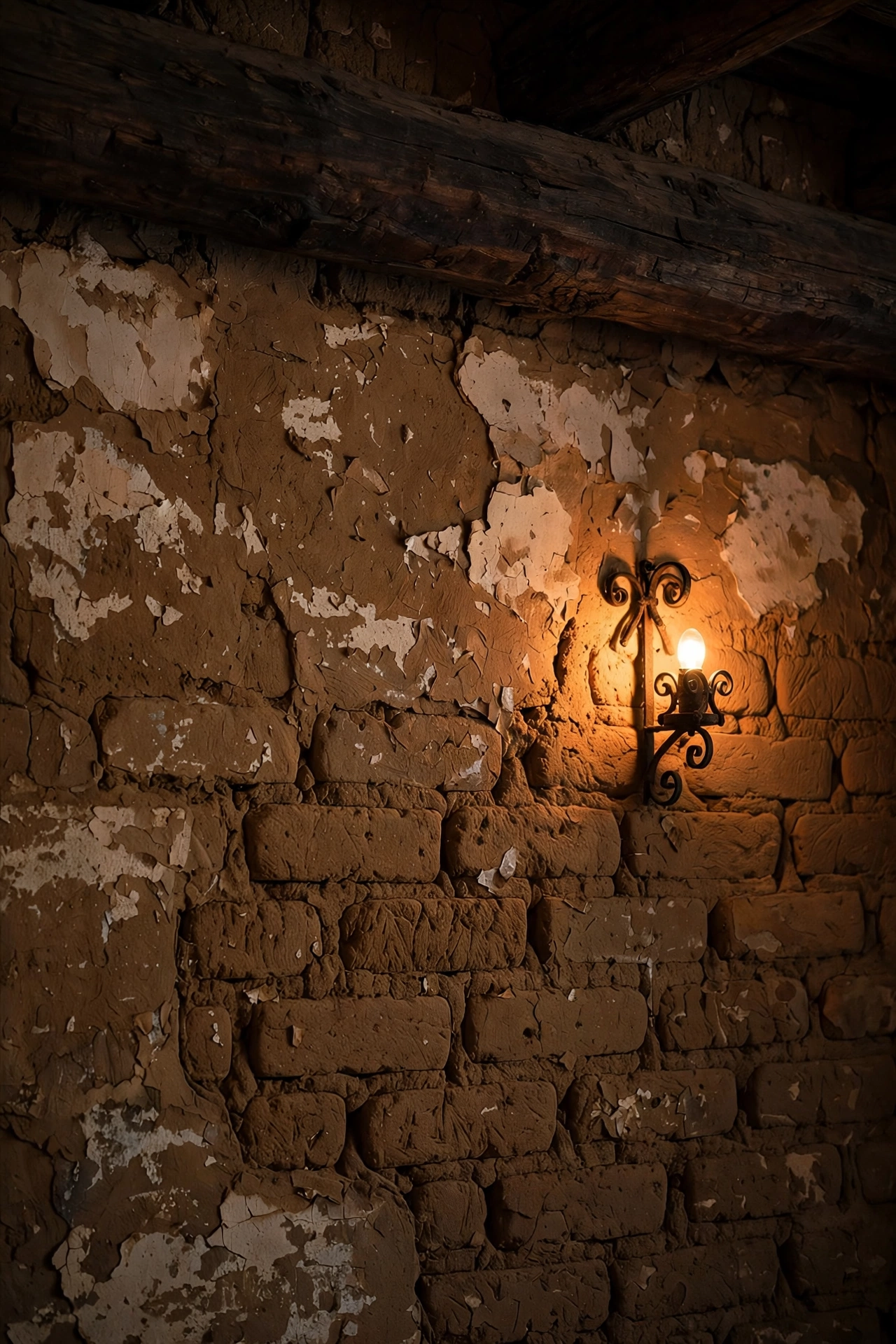
Where plaster has worn away in old houses, you see adobe brick — and it’s beautiful. Exposing one interior brick wall (or faking it with thin brick veneer in warm earth tones) adds history and texture no paint can match. Keep the mortar slightly recessed and the bricks uneven; perfect brickwork reads as new construction.
Try this: if you expose real brick, seal it with a matte sealer. Unsealed brick sheds dust forever.
12. Layered Mexican Textiles
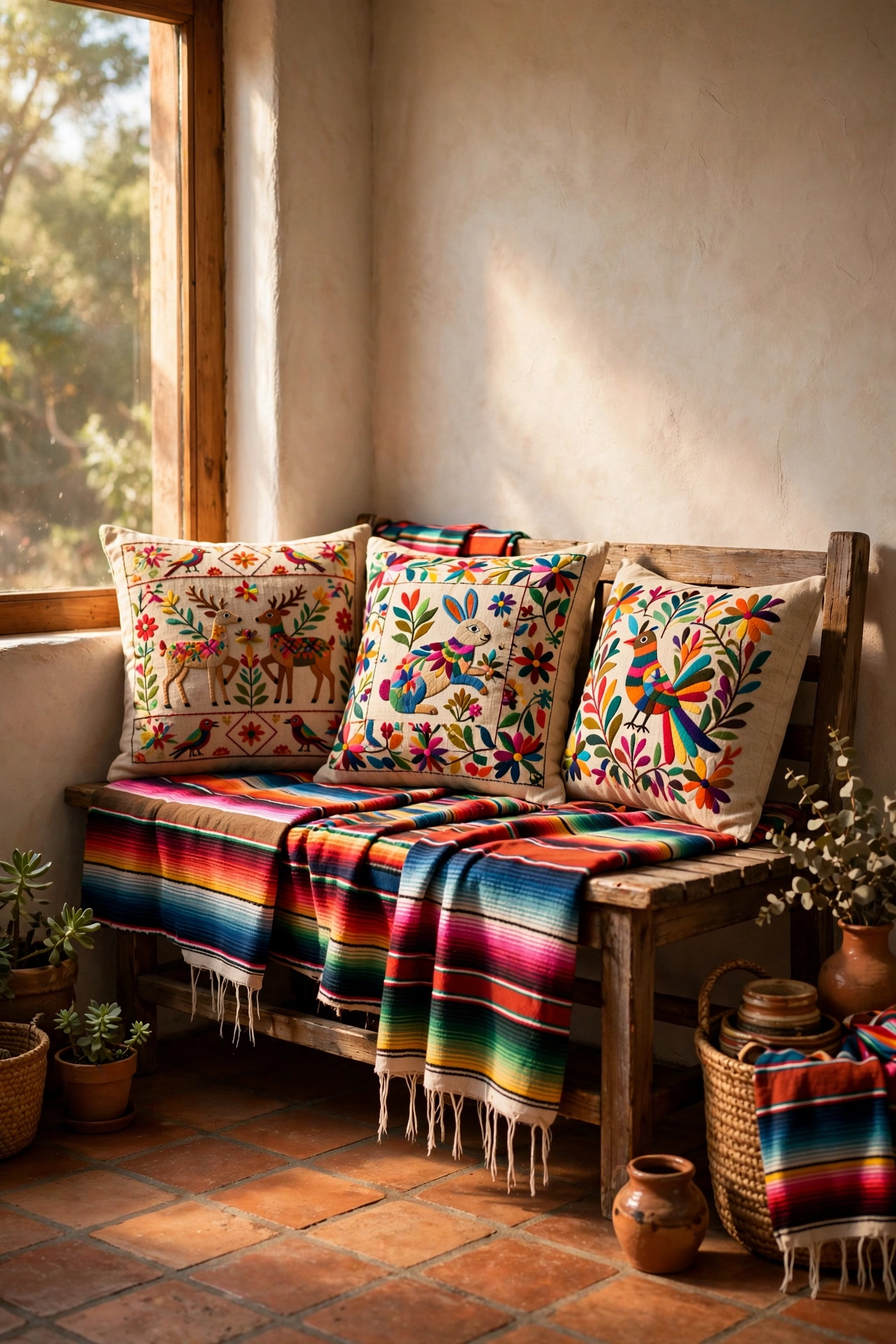
Serapes, Otomi embroidery, hand-loomed wool rugs — Mexican textiles are the fastest, cheapest way to pull a room toward hacienda style. Drape a striped serape over the sofa arm, stack embroidered pillows on the bed, lay a flat-weave rug over your existing flooring. The patterns are bold, so let them be the color while furniture stays quiet.
Try this: Otomi textiles (the ones with embroidered animals) look best as a single statement — one runner on a table or one pillow among solids — because the embroidery is so detailed.
13. A Hammock in the Courtyard
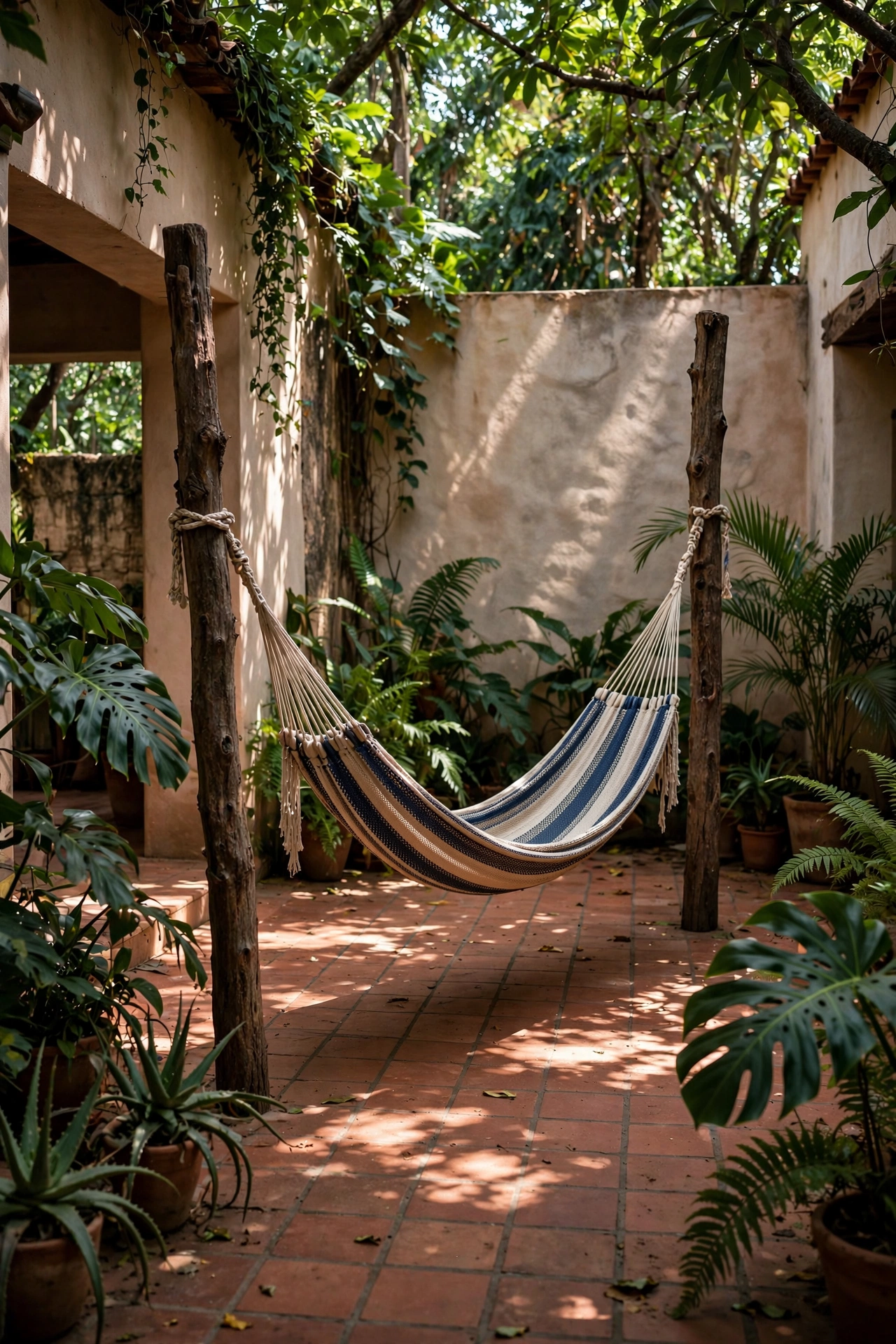
Nothing says hacienda living like a hammock in dappled shade. A hand-woven cotton hammock strung between two posts or trees turns any patio corner into the most-used seat in the house. The Mayan-style woven net hammocks are the most comfortable and the most authentic-looking.
Try this: hang it with a deep sag — about a 30-degree angle on the ropes. A hammock strung too tight flips you out; strung loose, it cradles you.
14. A Clay Chimenea on the Patio
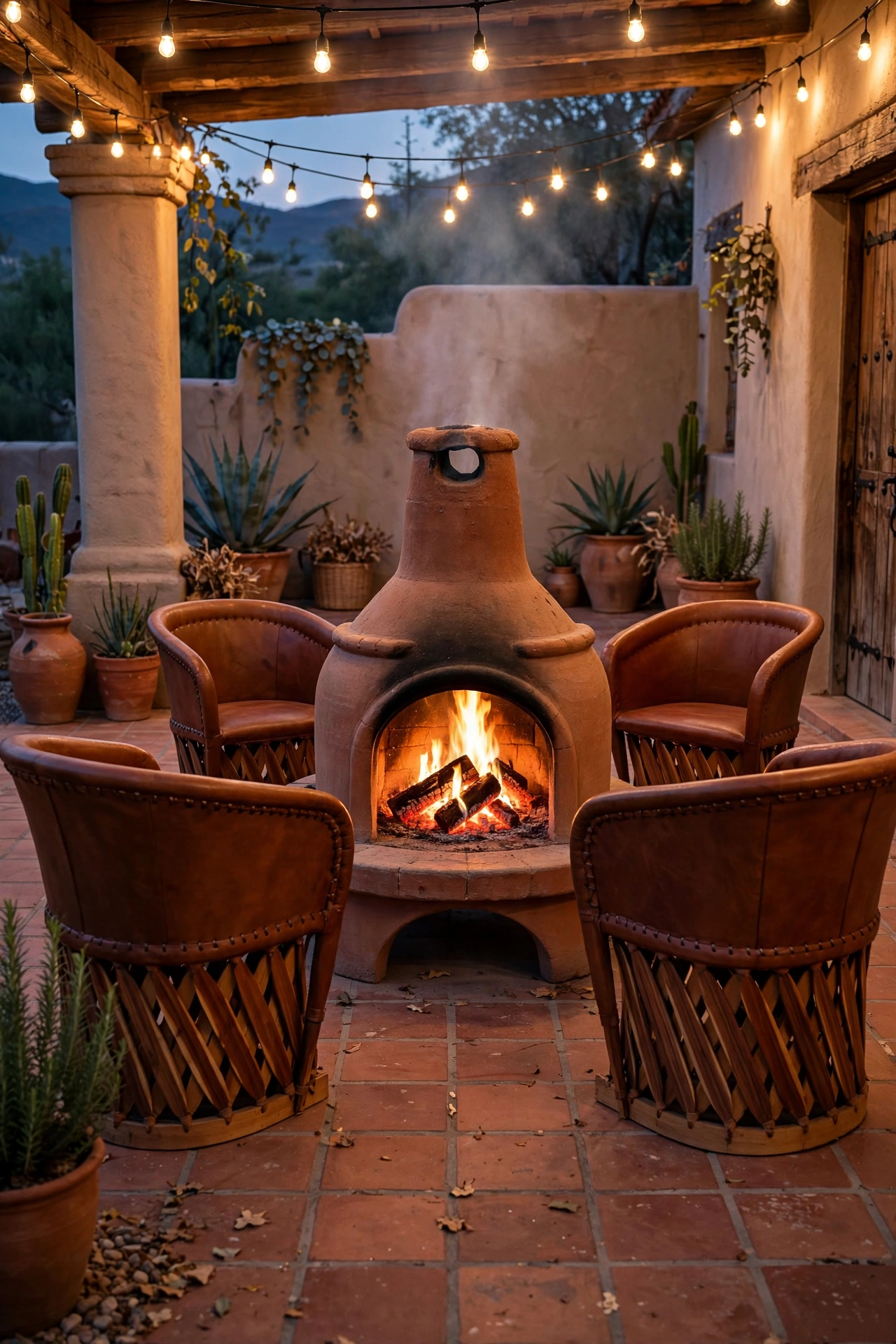
The chimenea — that bulbous clay fireplace with the tall neck — is the hacienda’s answer to the fire pit, and it’s better looking than any metal bowl. It throws heat forward where people sit, the clay glows faintly when it’s going, and it looks like sculpture when it’s not. Place it on stone or tile, never directly on a wood deck.
Try this: burn only dry hardwood and let the chimenea cure with three small fires before the first big one, or the clay can crack.
15. Carved Cantera Stone Details
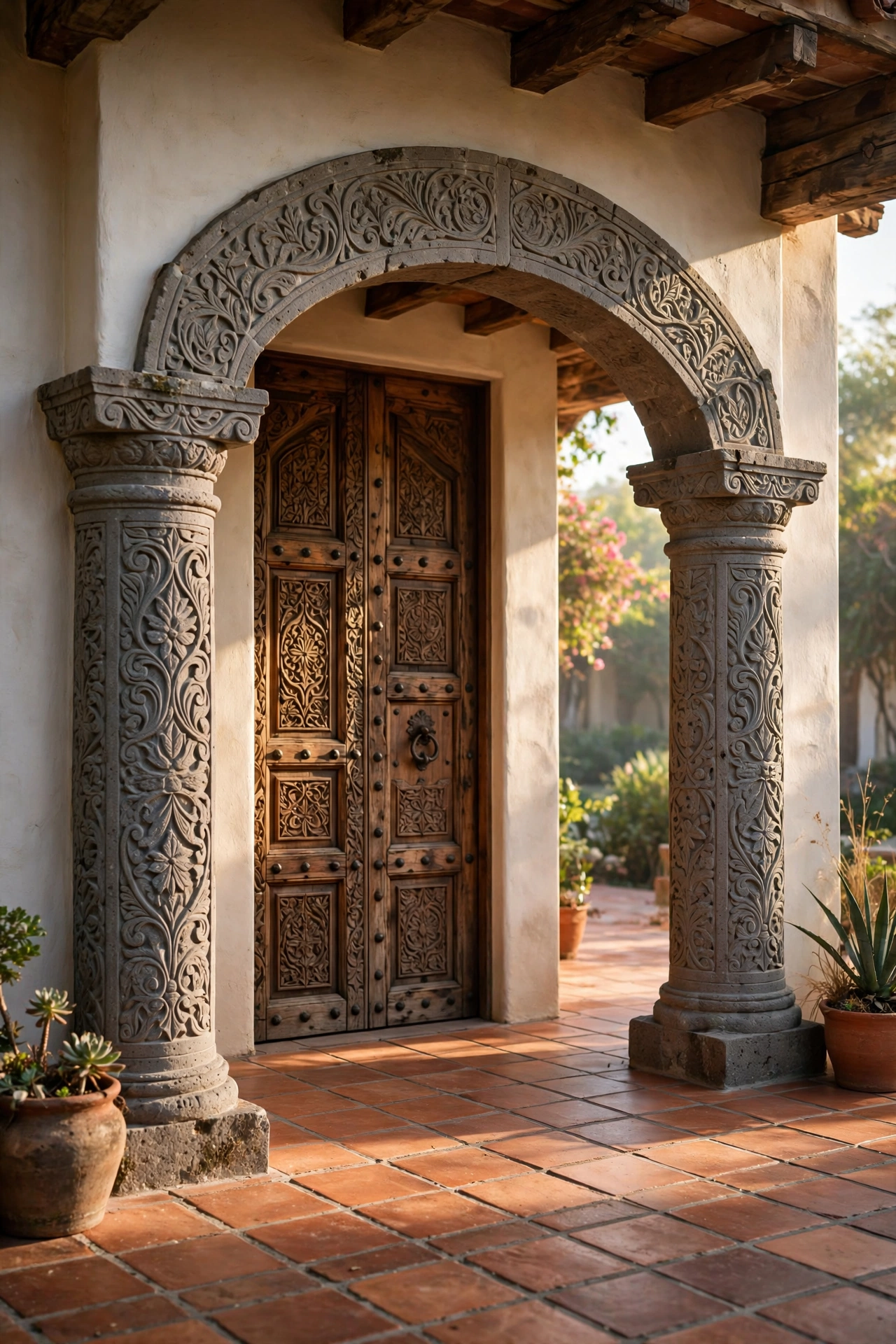
Cantera is the volcanic stone carved all over colonial Mexico — columns, arches, fountains, window surrounds. You probably won’t carve columns, but a cantera-look planter, a stone door surround, or even stone-look tile around an entryway borrows the gravitas. The pinkish-gray and green varieties are the most typical.
Try this: one stone element per area is plenty. Cantera is visually heavy; let it be the anchor, not the wallpaper.
16. Hand-Painted Tiled Stair Risers
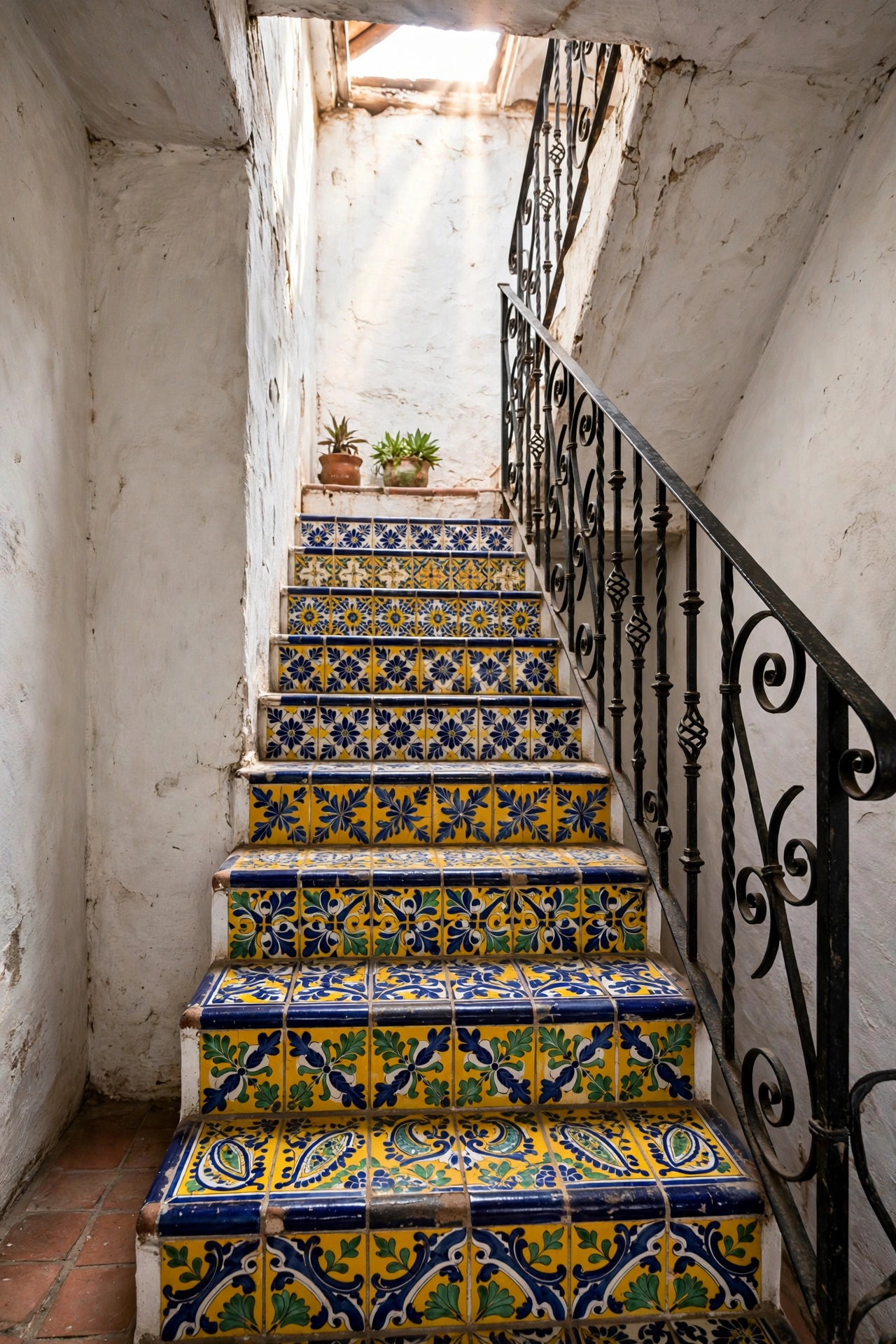
This is the detail guests photograph. Tiling just the risers (the vertical faces) of a staircase with colorful Talavera or Mexican-pattern tile turns a purely functional element into folk art. The treads stay plain wood or stone so the stairs remain safe and walkable, while every step up is a little painting.
Try this: use a repeating pattern rather than random tiles. A consistent motif up the whole staircase looks designed; mixed patterns can look busy on stairs.
17. A Lush Courtyard Garden
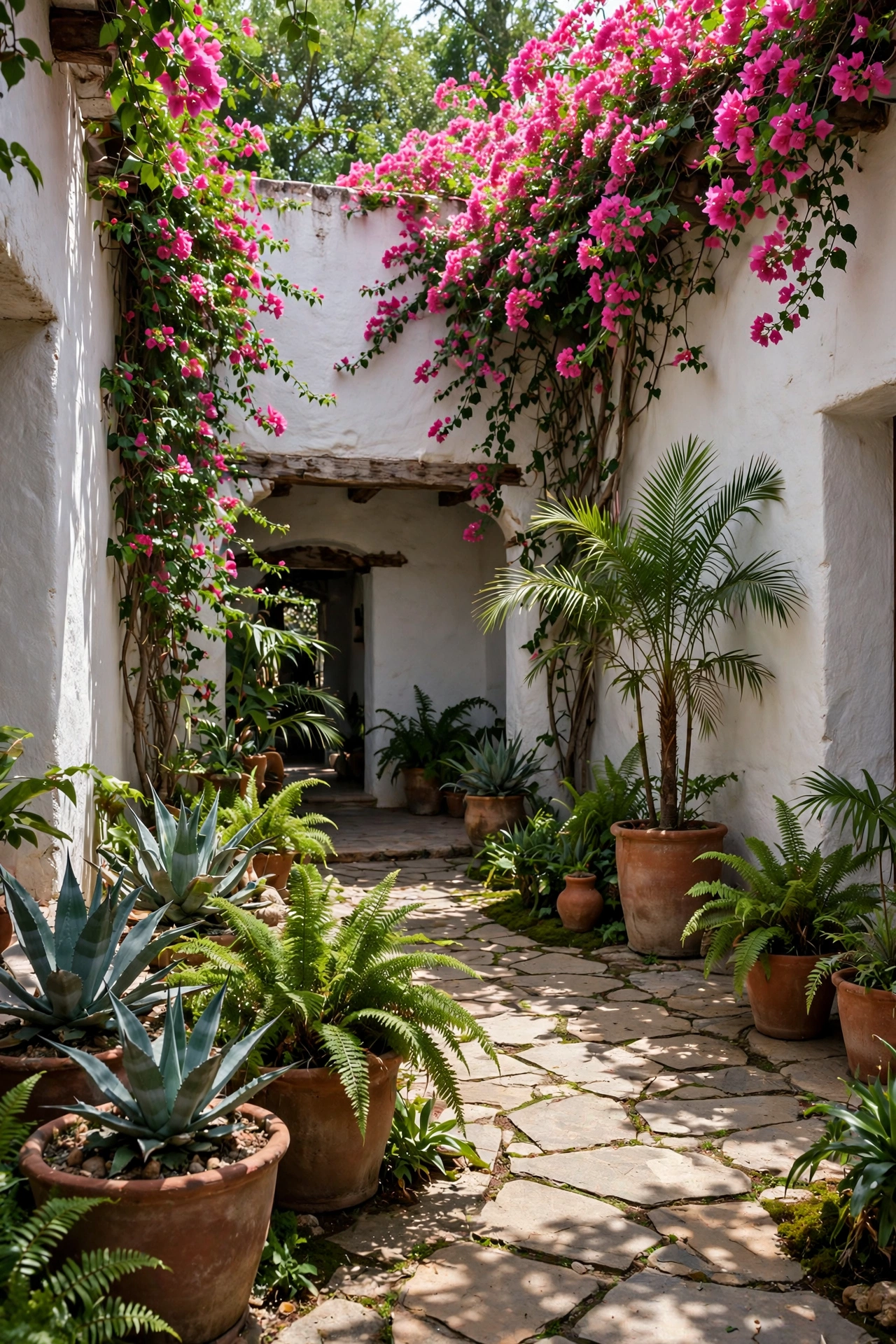
Hacienda courtyards are jungles in the best sense — agave, palms, bougainvillea, citrus trees in giant clay pots. Even without a courtyard, cluster large terracotta planters by your sunniest window or door and you get the feeling. Big leaves, sculptural shapes, and fragrant plants (jasmine, orange blossom) do the most work.
If your plant corner has you dreaming bigger, these cozy library room with plants ideas show how to turn any plant-filled nook into a proper retreat.
Try this: group pots in odd numbers with one tall thriller, and water everything on the same morning so it becomes a ritual, not a chore.
18. Equipal Leather Furniture
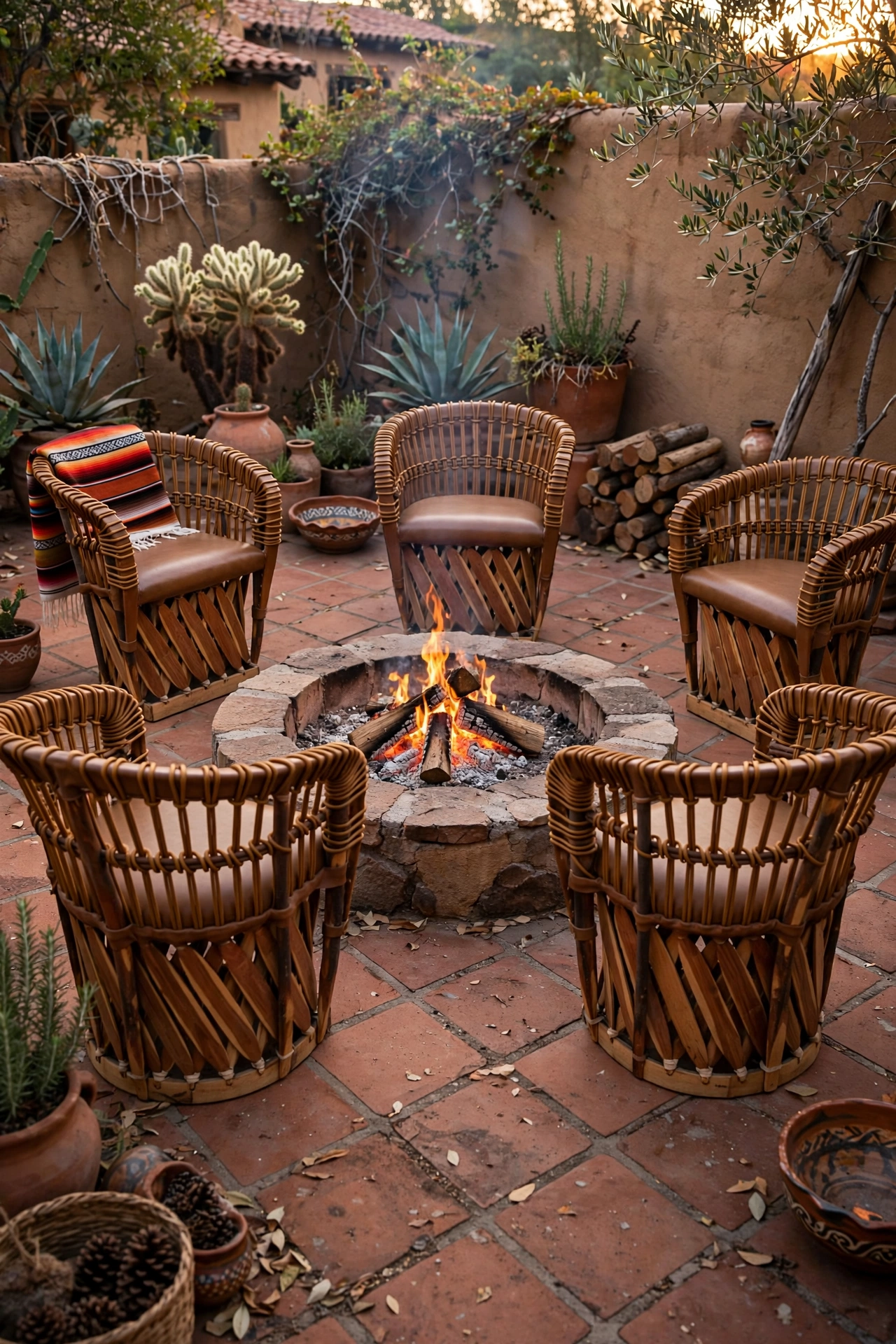
Equipal furniture — pigskin leather woven over cedar frames, traditionally made in Jalisco — is the iconic hacienda chair. The low, barrel-shaped equipal chairs around a fire pit or on a patio are comfortable in a slouchy way and develop a gorgeous patina. They’re handmade, so each one is slightly different.
Try this: condition the leather once a year with a leather balm. Sun and dry air are the enemies; a little care keeps equipal supple for decades.
19. A Hammered Copper Sink
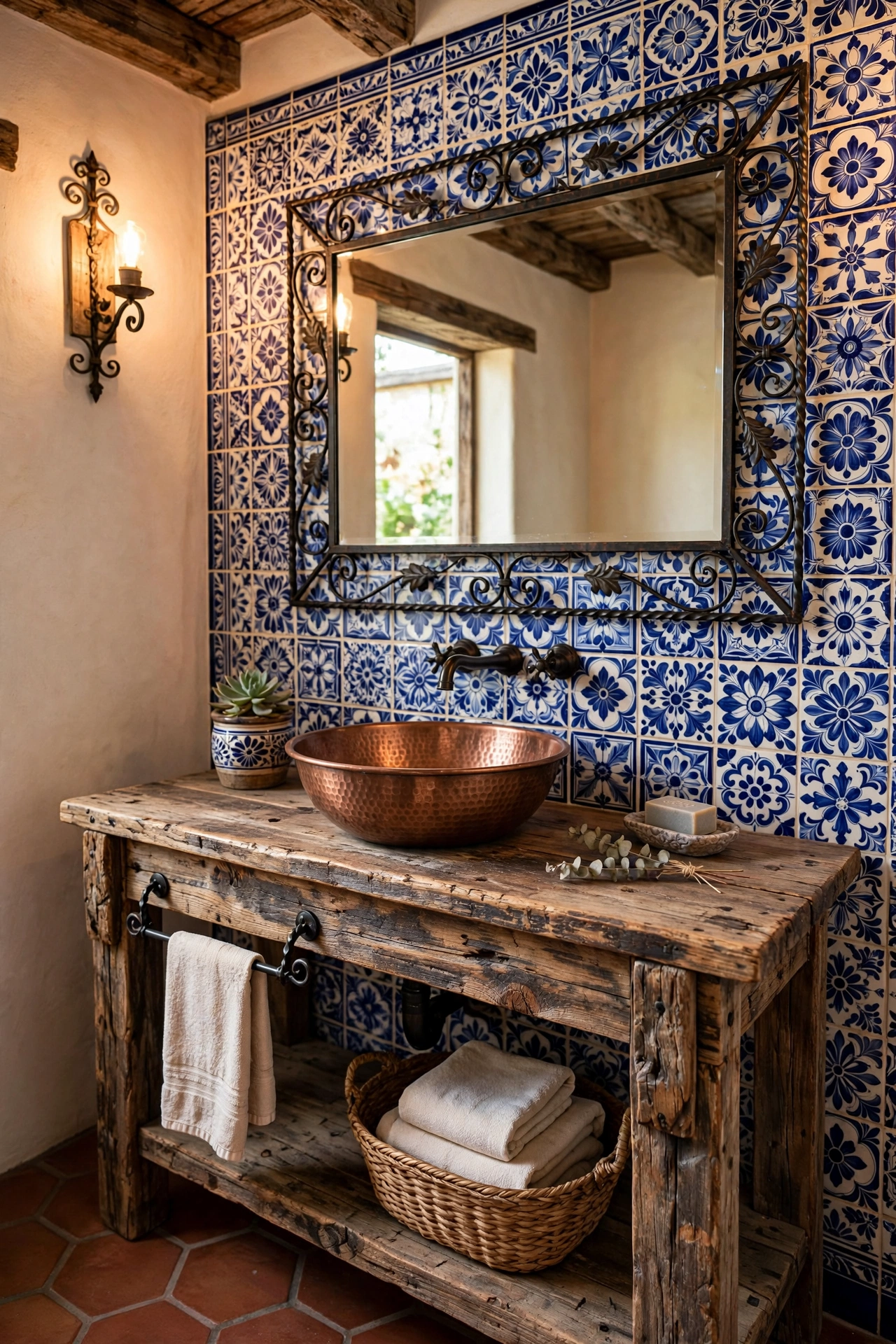
Hammered copper is everywhere in old Mexican houses — sinks, range hoods, lanterns. A copper vessel sink in a powder room is the single most luxurious small upgrade on this list: the hammered texture catches light beautifully, it develops a living patina, and it’s naturally antimicrobial. Pair it with a Talavera tile wall and the room designs itself.
Try this: don’t polish it. Let the patina develop — the darkening in the hammer marks is what makes it look old and rich.
20. Nichos: Little Arched Wall Niches
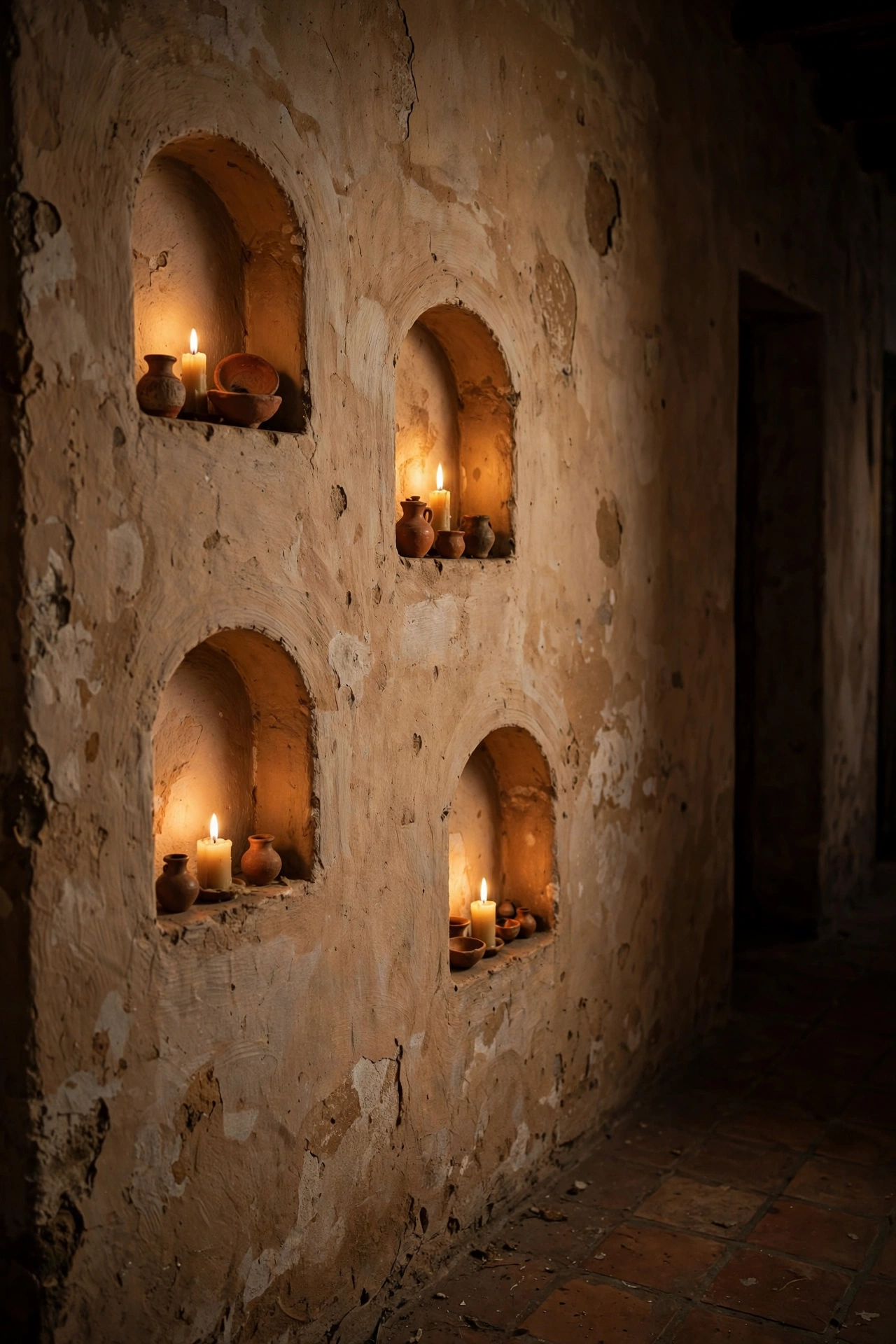
Nichos are small arched niches set into thick plaster walls, originally for saints and candles. Recess one into a hallway or dining room wall and fill it with a candle, a small clay figure, or a single perfect shell. Lit from within by a tiny puck light or a real candle, a nicho becomes the most intimate focal point in the house.
Try this: keep the inside of the nicho one shade darker than the wall. The shadow is what gives it depth and mystery.
21. A Brick Bóveda Vaulted Ceiling
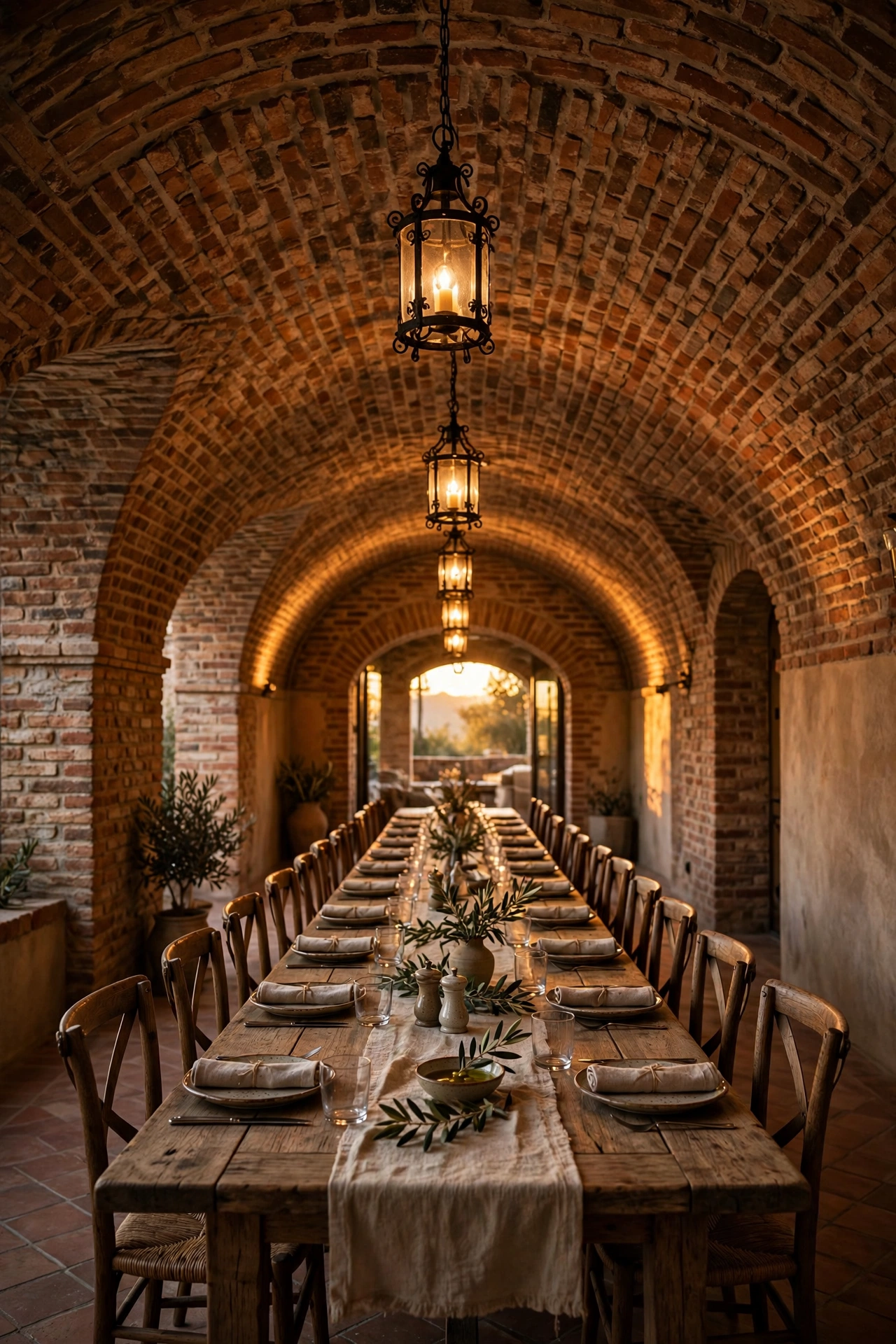
The bóveda — a shallow barrel vault of brick — is the most dramatic ceiling in Mexican architecture, and it’s appearing in modern hacienda-inspired builds everywhere. You won’t retrofit one easily, but a curved plaster arch over a hallway or a barrel-vaulted outdoor passage borrows the feeling. Even a curved ceiling in a small powder room makes people gasp.
Try this: light a vaulted ceiling with uplights at the spring line (where the curve meets the wall). The curve catches the light and glows.
22. A Hand-Tiled Fireplace Surround
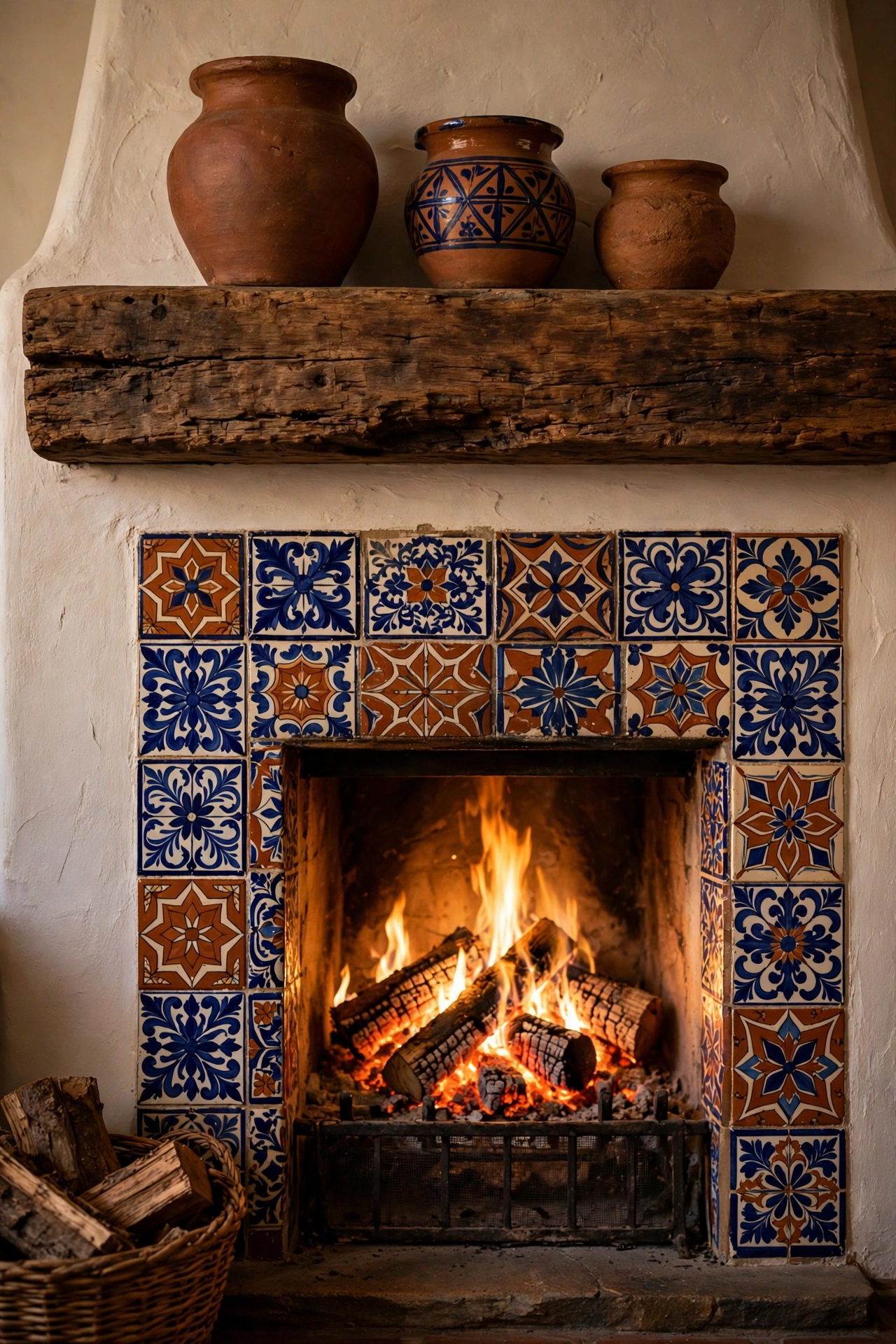
A fireplace faced in hand-painted Mexican tile is the interior equivalent of the tiled stair risers — folk art you warm your hands by. Mix Talavera with plain terracotta tiles in a border pattern, or go full mosaic. Keep the mantel thick rustic wood to ground all that pattern.
When the seasons turn and you want to dress that mantel, these fall mantel decorating ideas are made for exactly this kind of warm, layered hearth.
Try this: use heat-rated thinset and grout. Standard mastic behind tile near a firebox can fail; the right adhesive matters more than the tile choice.
23. Terracotta Pots of Agave and Cactus
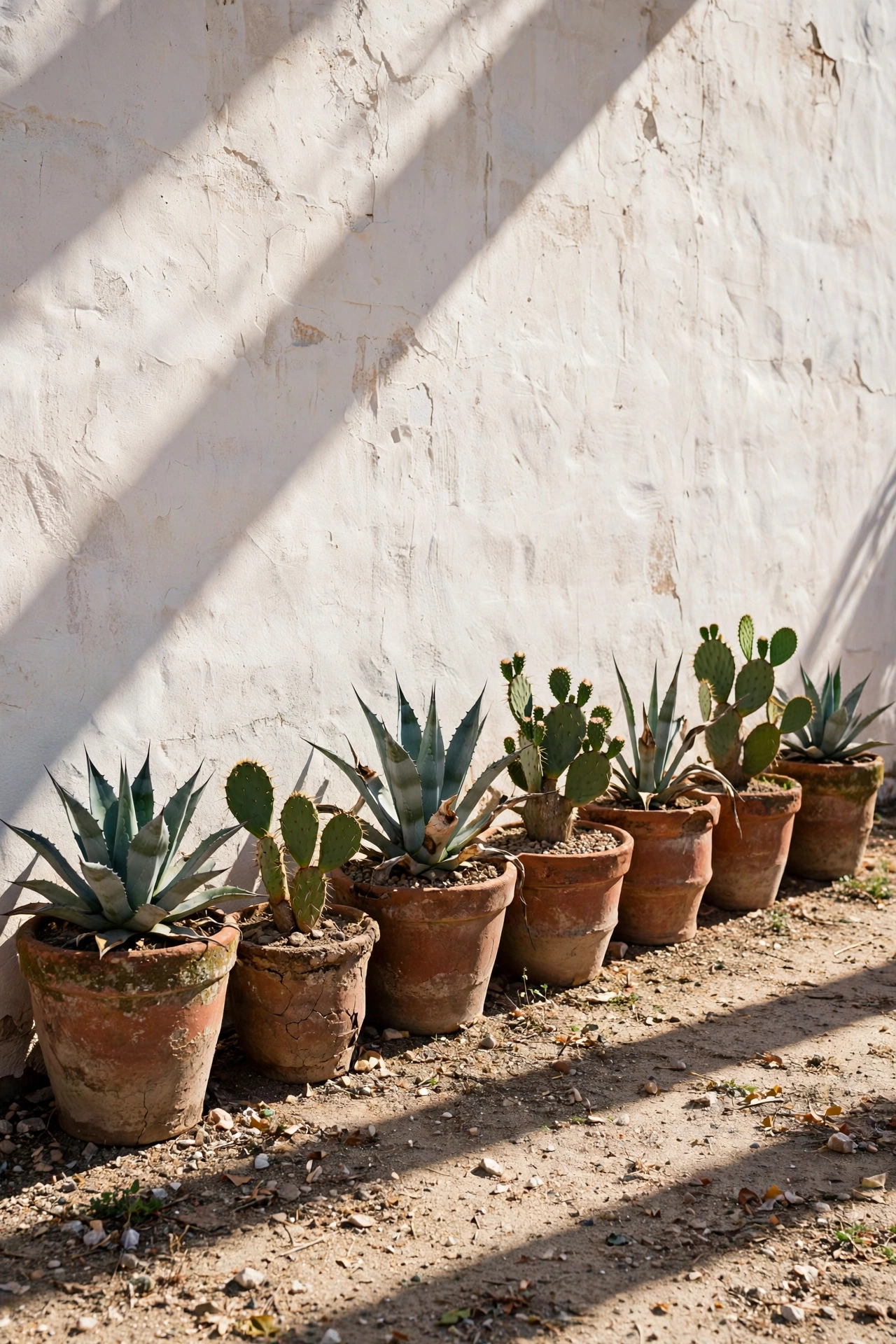
The simplest idea here and one of the most effective: weathered terracotta pots planted with agave, prickly pear, and barrel cactus, lined against a whitewashed wall. The sculptural plants against the plain wall and the orange clay is a composition that needs nothing else. It works on a balcony, a doorstep, or a full courtyard.
Try this: use a cactus-mix soil and pots with real drainage holes. Agave forgives neglect but never forgives wet feet.
24. A Textile-Piled Window Seat
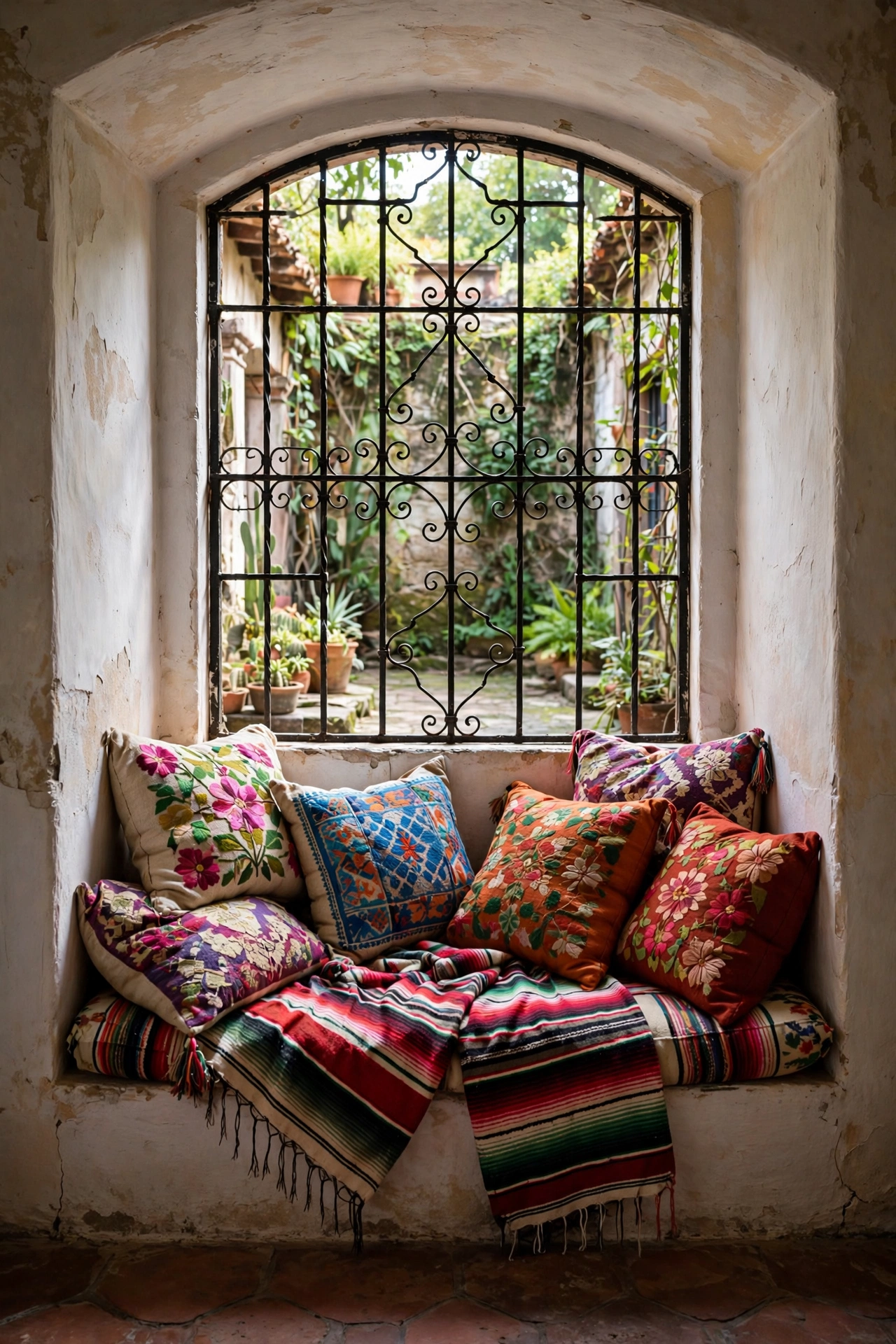
Old Mexican houses have deep-set windows with thick walls — the perfect depth for a window seat. Pile yours (or any wide sill or bench under a window) with embroidered cushions and a serape throw, and it becomes the reading spot everyone fights over. The arched window with an iron grille is the dream; the textiles do the work regardless.
Try this: use outdoor-rated fabric for the seat cushion if the window gets direct sun. Mexican-bright colors fade fast in UV without protection.
25. Lanterns and String Lights in the Courtyard
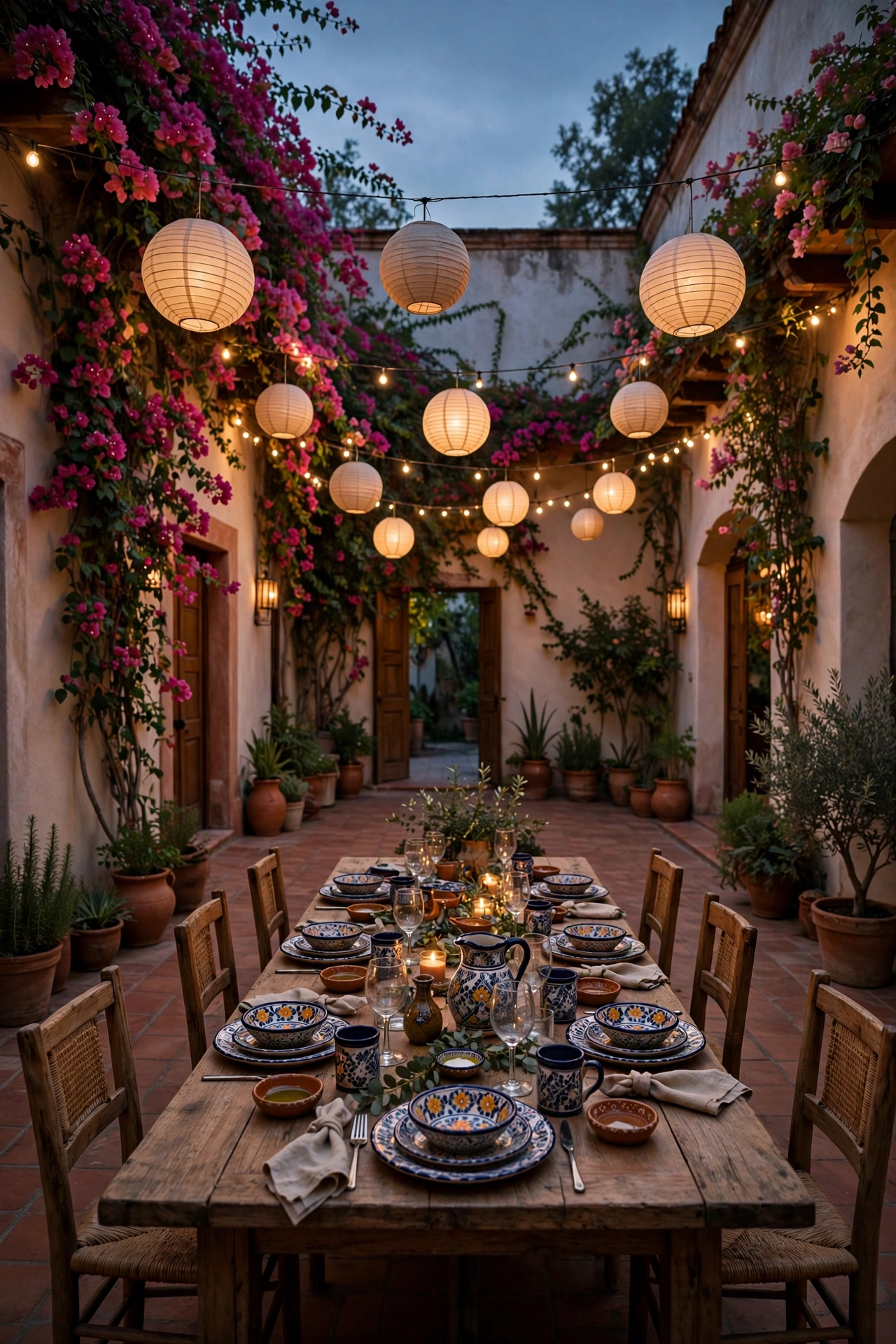
When the sun drops, the hacienda courtyard glows — paper lanterns, iron lanterns with candles, strings of warm lights crisscrossing overhead. It’s the cheapest evening transformation in this list and the most romantic. Keep every bulb warm (2700K) and let the light pool rather than flood.
Try this: hang string lights in a loose catenary curve, not pulled tight. The drape is what makes them look festive instead of temporary.
Renter-Friendly Hacienda Touches
You don’t need to own the walls to borrow this style. Peel-and-stick Talavera-look tiles give you the backsplash without the commitment. A serape throw, two clay pots, and a woven hammock chair transform a rental patio. Swap cabinet hardware for iron-look pulls, hang an arched mirror, and lean a big Talavera vase in the entry. For more no-damage upgrades, these creative renter-friendly upgrades are full of tricks landlords never need to know about. And if you fall for the weathered-wood look of hacienda shutters and windows, these farmhouse old window projects show how to get it with salvaged finds.
Quick-Pick Cheat Sheet
Not sure where to start? This cheat sheet matches the highest-impact moves to their cost and effort:
| Start With This | The Move | Why It Matters | Rough Cost |
|---|---|---|---|
| Saltillo-look floors | Terracotta-look tile in the main living area | Resets the whole house’s temperature in one move | $3–$8/sq ft |
| One Talavera moment | Backsplash panel or stair risers | The joyful handmade color everything else plays off | $50–$300 |
| Beams overhead | Dark-stained wood beams on the ceiling | Instant architecture and old-world gravity | $200–$600 |
| Textiles everywhere | Serapes, Otomi pillows, woven rugs | Cheapest, fastest style shift in the list | $30–$150 |
| Courtyard glow | Fountain pump + string lights + lanterns | The sound-and-light combo that feels like Mexico | $60–$200 |
Frequently Asked Questions
What defines a hacienda style house?
Thick plaster walls, terracotta tile floors, dark wood beams (vigas), arched doorways, interior courtyards with fountains, and handmade details like Talavera tile and wrought iron. It blends Spanish colonial architecture with indigenous Mexican craftsmanship, and its warmth comes from natural materials rather than decoration.
How can I get the hacienda look on a budget?
Start with textiles and pottery: serape throws, embroidered pillows, and a few Talavera pieces change a room for under $150. Peel-and-stick Talavera-look tiles fake the backsplash, terracotta-look porcelain fakes Saltillo floors, and a clay chimenea plus string lights give you the courtyard feeling for under $200.
What colors are used in Mexican hacienda decor?
Warm neutrals on the big surfaces — terracotta, ochre, sand, warm white — with saturated accents in cobalt blue, deep green, sunflower yellow, and chili red. The rule is simple: neutrals for walls and floors, bold color for tile, textiles, and pottery.
What is Talavera tile and where do I use it?
Talavera is hand-painted tin-glazed pottery from Puebla, Mexico, recognizable by its cobalt blue, yellow, and green patterns on white. Use it for kitchen backsplashes, stair risers, fountain insets, and bathroom walls — anywhere you want one joyful handmade focal point.
Can I mix hacienda style with modern furniture?
Absolutely — clean-lined modern furniture actually lets the handmade elements shine. Keep the architecture and materials traditional (plaster, wood, tile, iron) and the furniture simple. The contrast between sleek shapes and rustic textures is what makes the mix feel current instead of themed.
Final Thoughts
Here’s what that hacienda in San Miguel taught me, and what eighteen months of borrowing its ideas confirmed: a house doesn’t need to be expensive to feel rich. It needs materials with a past — clay shaped by hands, wood darkened by decades, tile painted one brushstroke at a time. Start with one idea this weekend. Lay a serape over the sofa, or set a clay pot of agave by the door, or hang the string lights you’ve been meaning to hang. The warmth compounds. Before long, someone will walk into your house and forget how to talk for a minute too.


