
A blank journal page can feel like a test you did not study for. You want to make something, but the empty paper asks for a plan, and the plan never comes, so the journal stays shut on the shelf. My first page was a blue wash with a torn bus ticket glued on it, and it still sits in my oldest journal, crooked and plain.
This guide gives you 12 easy steps that take you from that blank page to a finished one, with no drawing skill required. Each step uses cheap supplies, takes 30 minutes or less, and works for a total beginner who wants a small daily creative habit.
- Start with mixed-media paper that handles wet paint, not a thin lined notebook.
- Five tools cover every step here: a pen, watercolors, a glue stick, scissors, and one flat brush.
- Backgrounds come first, so you never face a blank page again.
- Short sessions beat long ones: most pages take 10 to 20 minutes.
- Date each page and write one line back, and your practice builds itself.
1. Pick a journal that handles wet paint

Paper decides whether paint behaves or buckles. Choose a journal with mixed-media or watercolor paper at 140 lb (300 gsm), in a size you can hold in one hand, either hardbound or spiral-bound. Thin lined notebooks soak through, wrinkle, and bleed, which turns a first page into a mess. Test one corner with a wet brush before you commit to page one.
Try this: if the page dries flat, the journal passes.
Cost: $$ | Difficulty: Easy | Time: 10 minutes
2. Gather a five-tool starter kit

You need five tools, and everything else can wait. Pack a black fine-tip pen, a small watercolor set, a glue stick, scissors, and one flat brush into a single pouch. That pouch is your whole studio for the first month. New supplies feel exciting, but each extra tool adds a decision, and decisions stall beginners. Buy the rest only after you finish ten pages.
Try this: keep the pouch where you sit down to journal, so setup takes one minute.
Cost: $ | Difficulty: Easy | Time: 15 minutes
3. Wash the blank page with watercolor
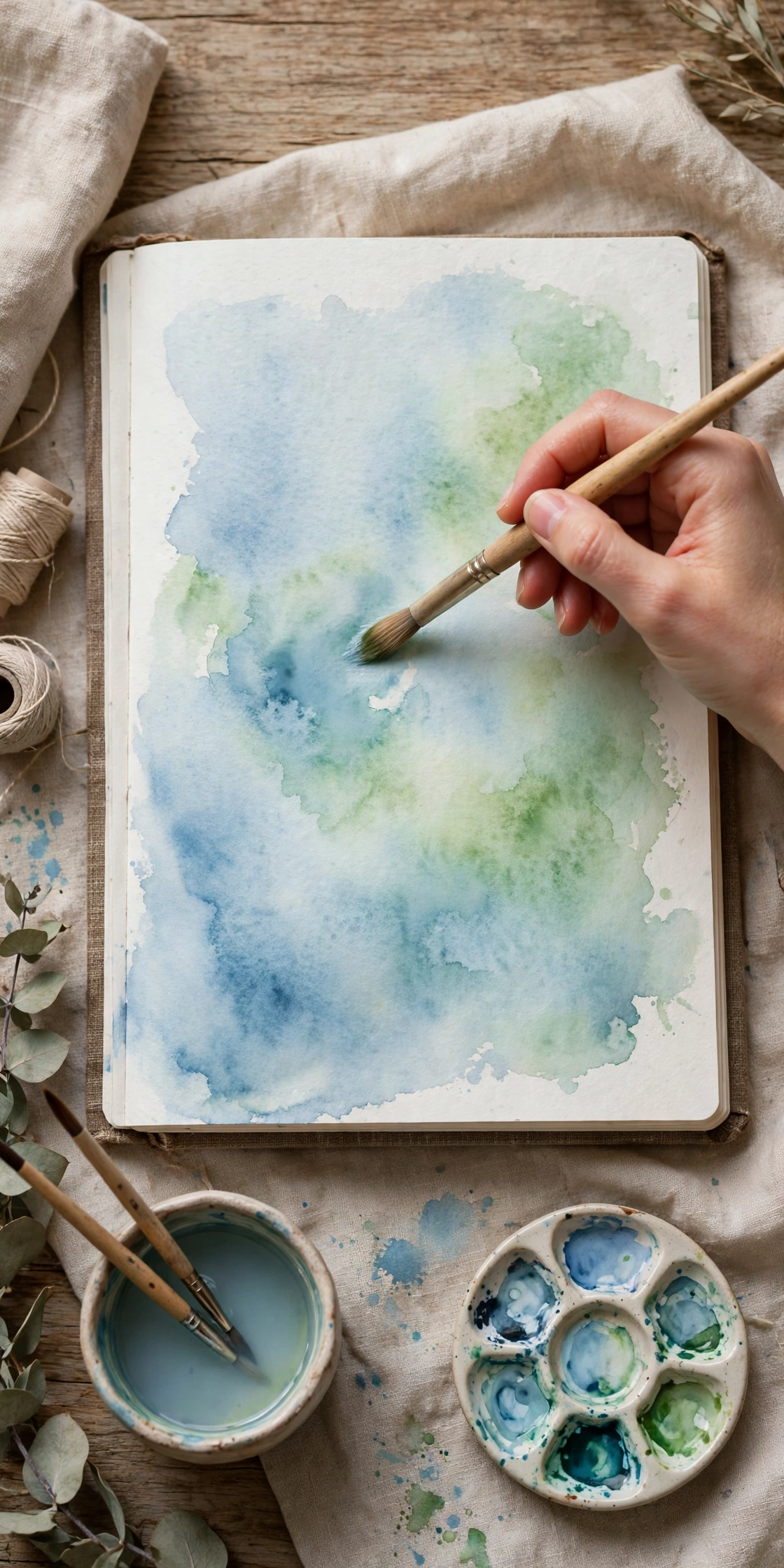
A wash kills blank-page fear in one move. Wet the page with clean water, drop in two colors, and tilt the journal so they blend on their own. Leave white gaps where the paper shows through, and let the page dry fully before you add anything else. Wet paint over wet paint turns muddy, so patience is the whole technique here.
Try this: pick two colors that sit near each other, like blue and green, for a calm first wash.
Cost: $ | Difficulty: Easy | Time: 20 minutes
4. Tear and glue a collage base

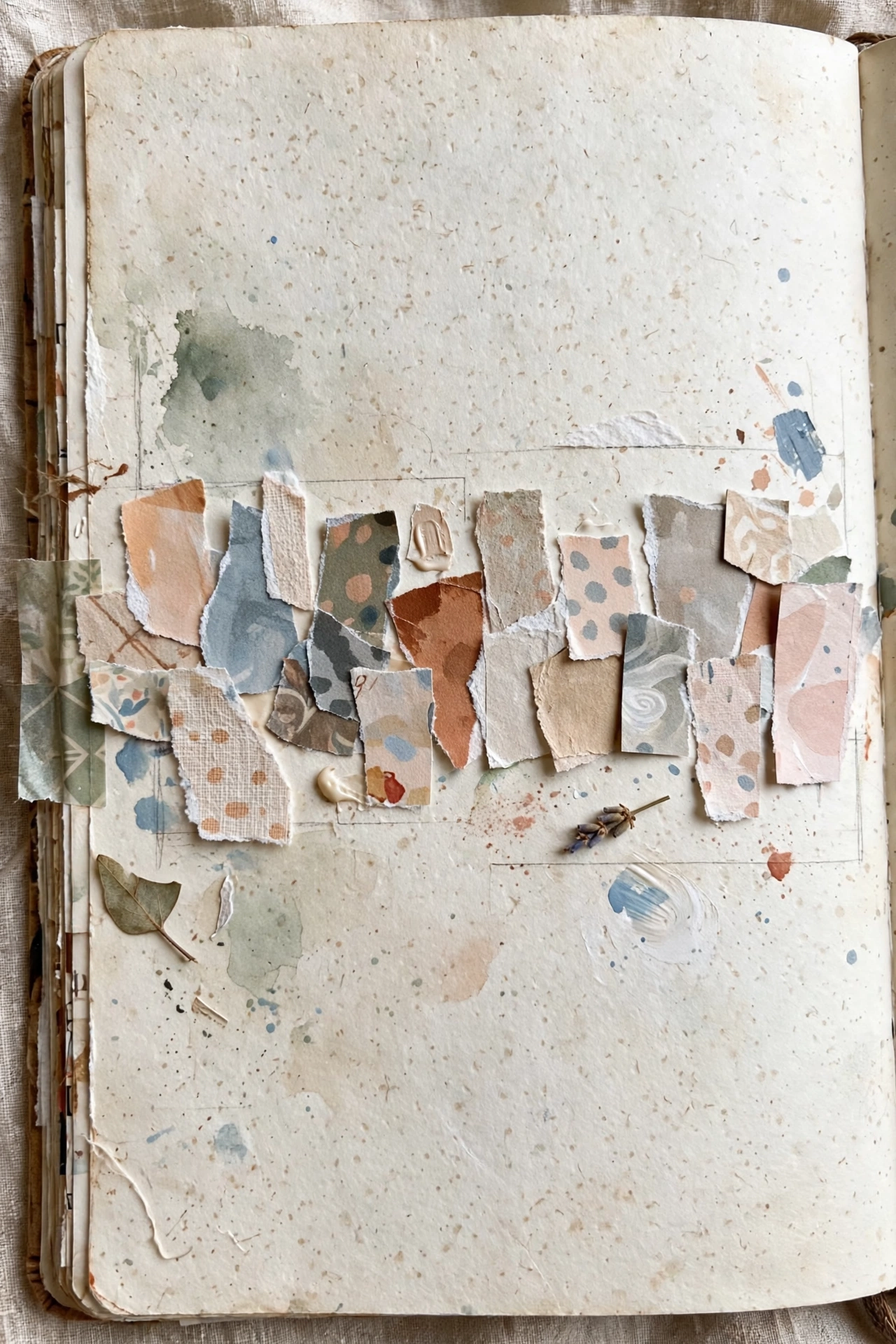
Torn paper gives you texture without drawing a thing. Tear magazine pages and tissue paper into rough shapes, brush on glue stick, and overlap the edges across the page. Torn edges blend into each other, while cut edges leave hard lines that fight the paint later. Limit the base to three papers so the page stays calm enough to build on.
Try this: leave one bare gap in the collage for a word or drawing later.
Cost: $ | Difficulty: Easy | Time: 20 minutes
5. Paint your mood in color

Some days have no words, and color can carry them instead. Cover a page in washes, dots, and strokes using only colors that match how the day feels, with no picture and no sentence. Heavy days get dark, dense marks; light days get thin, wide washes. The page becomes a record you can read back later without explaining it.
Try this: name the color after you finish, not before you start.
Cost: $ | Difficulty: Easy | Time: 15 minutes
6. Fill a page with doodle patterns
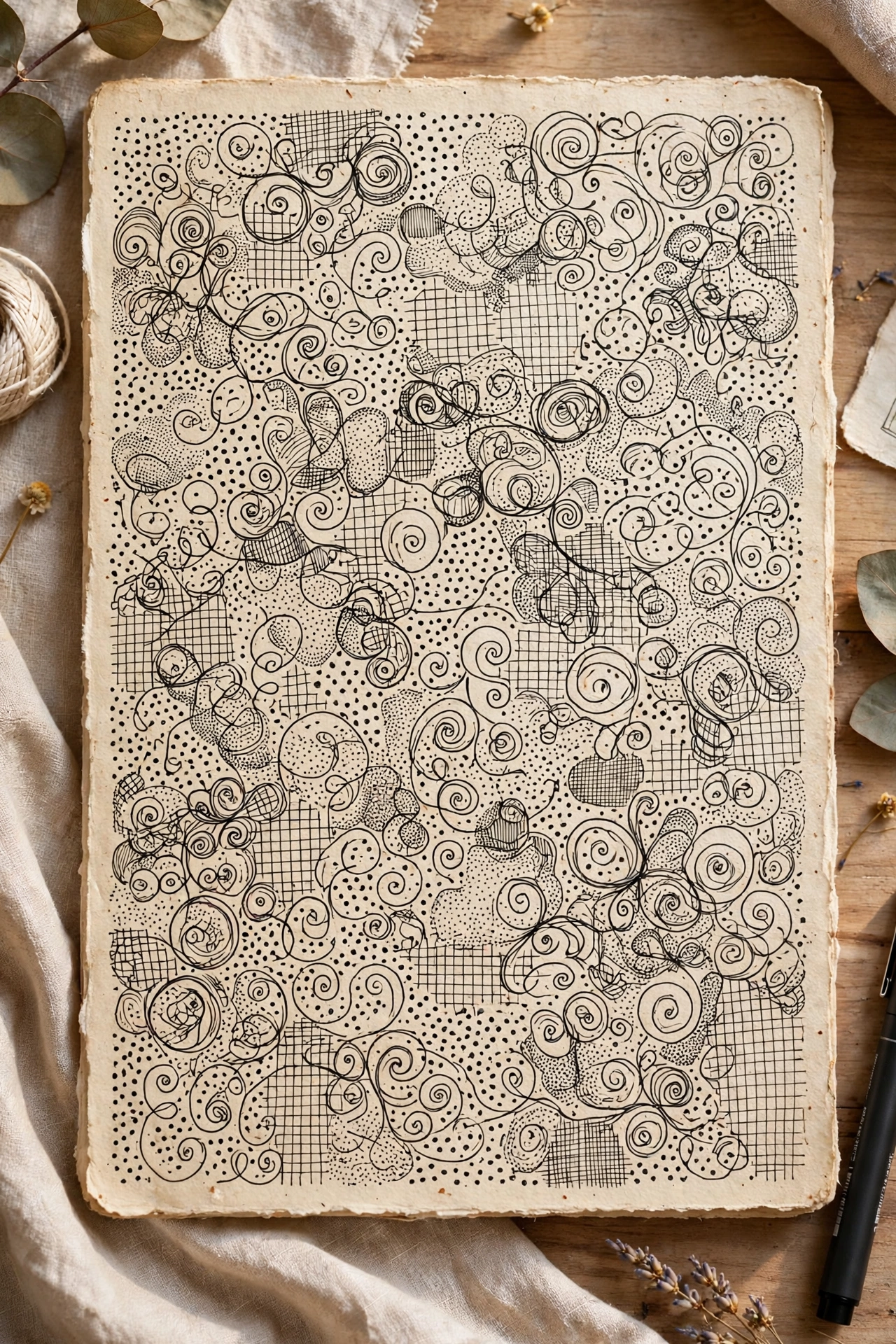
Repeated marks turn a shaky hand into a pattern. Take one pen and fill the whole page with dots, loops, lines, and grids, one shape at a time, with no plan and no erasing. The repetition steadies your hand, and the page looks finished even though no single mark matters much. Work across the full page, not just a border, so the pattern owns the space.
Try this: fill one corner first, then grow outward from it.
Cost: $ | Difficulty: Easy | Time: 20 minutes
7. Make a one-color page

One color teaches more than ten. Pick a single color and build the whole page from it: paint in its light and dark shades, pen marks in the same hue, and paper scraps that match. The limit forces you to notice value, texture, and spacing instead of reaching for a new tube. Finish with one white gel pen highlight to lift the darkest area.
Try this: choose a color you already own in three forms, like paint, pen, and paper.
Cost: $ | Difficulty: Easy | Time: 15 minutes
8. Cut words that catch your eye
Found words write the sentence for you. Flip through a magazine, cut out any word that stops you, and arrange the words into one line on the page. The line does not need to make sense, and it does not need to be a quote. Arrange everything before you glue, so you can swap words around until the line feels right.
Try this: keep the line to eight words or fewer, so it reads at a glance.
Cost: $ | Difficulty: Easy | Time: 20 minutes
9. Draw what sits in front of you
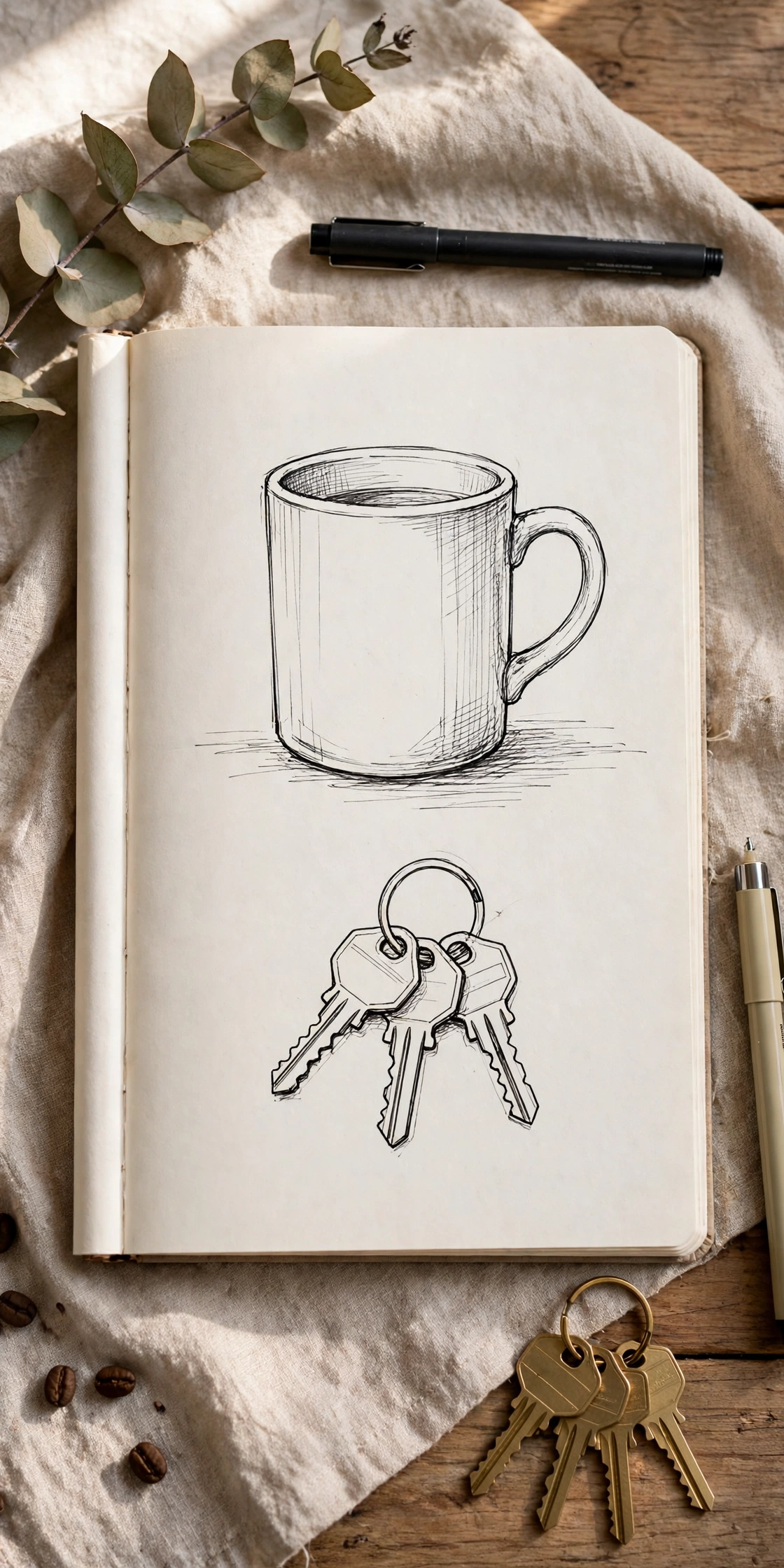
Observation beats memory for beginners. Set a mug, a set of keys, or a small plant in front of you and draw its shape, skipping fine detail and keeping the pen moving. The goal is a page that proves you looked, not a picture that fools anyone. A timer helps here, because fussing past 20 minutes rarely improves a sketch.
Try this: set a 10-minute timer so you stop before you start fixing.
Cost: $ | Difficulty: Moderate | Time: 20 minutes
10. Draw yourself in five lines

A self-portrait needs five lines, not fifty. Draw your hair shape, your face shape, your shoulders, one feature you like, and one line of background. Work from a mirror, not a photo, so you draw what you see instead of copying a flat image. Stick-figure honesty counts here, because the page is a record of you, not a test of skill.
Try this: draw the same five lines once a month and watch them change.
Cost: $ | Difficulty: Moderate | Time: 15 minutes
11. Swatch every pen and paint you own

A swatch chart ends supply guessing. Paint and draw one labeled row for every pen and paint you own, and note which pens bleed through and which paints dry darker than they look wet. The chart becomes the first page you check before starting any other page, and it saves you from ruining a good wash with a pen that bleeds.
Try this: redo the chart each time you buy a new supply, so it stays true.
Cost: $ | Difficulty: Easy | Time: 30 minutes
12. Date the page and write one line back

A date turns a page into a record. Write the date and one short sentence about what you did or noticed, tucked under the art where it does not fight for attention. The sentence can be plain, like what color you used or how long the page took. Months later, those lines show your practice growing in a way the art alone cannot.
Try this: keep the line short enough to fit under the art without crowding it.
Cost: $ | Difficulty: Easy | Time: 5 minutes
Mistakes to avoid
Four mistakes stall most beginners. Waiting for inspiration keeps the journal shut, so start messy and let the page lead. Buying too many supplies adds decisions, so finish ten pages with five tools first. Comparing your pages to polished ones online forgets that those pages took years of practice, so keep your journal private until you trust it. Giving up after three pages misses the point, since short sessions twice a week beat one long session a month.
Safety notes for art journaling
Keep craft knives and sharp scissors away from children, and cut on a mat, not on the journal page itself. Work with paints and adhesives in a room with fresh air, and wash your hands after handling inks and glues. When you buy paints, look for the ACMI AP seal, which marks products certified as non-toxic for art use. For more on that seal, see the Art and Creative Materials Institute. Art journaling is a personal creative practice, not a therapy session, and the American Art Therapy Association describes art therapy as a credentialed profession, so keep the journal as play, not treatment.
Step comparison table
| Step | Cost | Difficulty | Time | Best for |
|---|---|---|---|---|
| 1. Pick a journal that handles wet paint | $$ | Easy | 10 min | First purchase |
| 2. Gather a five-tool starter kit | $ | Easy | 15 min | Starting cheap |
| 3. Wash the blank page with watercolor | $ | Easy | 20 min | Beating blank-page fear |
| 4. Tear and glue a collage base | $ | Easy | 20 min | No-drawing days |
| 5. Paint your mood in color | $ | Easy | 15 min | Wordless days |
| 6. Fill a page with doodle patterns | $ | Easy | 20 min | Steadying your hand |
| 7. Make a one-color page | $ | Easy | 15 min | Learning value |
| 8. Cut words that catch your eye | $ | Easy | 20 min | Word lovers |
| 9. Draw what sits in front of you | $ | Moderate | 20 min | Building observation |
| 10. Draw yourself in five lines | $ | Moderate | 15 min | Monthly check-ins |
| 11. Swatch every pen and paint you own | $ | Easy | 30 min | Knowing your supplies |
| 12. Date the page and write one line back | $ | Easy | 5 min | Building the habit |
Cost key: $ means $1 to $10, $$ means $11 to $99, $$$ means $100 to $999, $$$$ means $1,000 and up.
Related reading
If you want a corner that stays set up for journaling, see our guide to Creative Art Studio Hobby Room Ideas for desk layouts, storage bins, and lighting that keep supplies within reach.
For a mixed-media technique to try once backgrounds feel easy, see our guide to Gold Leaf Canvas for gilded layers you can adapt to journal pages.
Finished pages can live on a wall too, and our guide to Creative Diy Home Decor Ideas shows simple ways to display handmade art around the house.
A filled journal page makes a personal handmade gift, and our guide to Amazing Diy Birthday Gifts For Friends Ideas has more gift projects in the same spirit.
For a pocket kit that carries pens and paper scraps on the go, see our guide to Amazing Altoid Mint Tin Crafts for small tins that hold a travel sketch kit.
Frequently asked questions
Can I start art journaling if I can’t draw?
Yes. Drawing is only one tool in art journaling, and collage, color washes, patterns, and found words all make full pages without a single realistic drawing. Start with steps 3, 4, and 6 in this guide, which use paint, torn paper, and repeated marks, and add drawing only when you feel like it.
What journal paper handles paint without buckling?
Mixed-media or watercolor paper at 140 lb (300 gsm) handles watercolor washes and glue without buckling, while thin lined notebook paper soaks through and wrinkles. If you already own a thin-paper journal, brush a thin coat of gesso on each page and let it dry before painting, which gives the paper a stiffer surface.
How much time does one art journal page take?
Most beginner pages take 10 to 20 minutes, and the steps in this guide range from 5 minutes for dating a page to 30 minutes for a full swatch chart. Short sessions twice a week build the habit better than one long monthly session, because the journal stays familiar instead of turning into a project you dread.
Do I need expensive supplies to start?
No. A black fine-tip pen, a small watercolor set, a glue stick, scissors, and one flat brush cover every step in this guide, and the journal itself is the only purchase over $10. Old magazines and tissue paper supply collage material for free, so the whole starter kit stays under $20 in most cases.
Should I share my art journal or keep it private?
Keep it private unless you choose otherwise. Art journals work best as a judgment-free space, and sharing early pages often brings comparison that stalls beginners. If you later want feedback, share one page you like with one trusted person, not the whole journal at once.
Final thoughts
Start tonight with one wash, one torn page, or one line of found words, and let the journal teach you the rest page by page.

For common beginner hand embroidery mistakes, see our guide to 10 Common Beginner Hand Embroidery Mistakes, From Puckered Fabric to Tangled Floss for pulling stitches too tight and cutting thread too long to skipping the hoop and using the wrong needle, with a fix for each.
For creative mood tracker bullet journal stickers, see our guide to 15 Creative Mood Tracker Bullet Journal Stickers, From Emoji Faces to Flower Petals for emoji faces and weather icons to flower petals, mountain peaks, and printable sheets, with costs, difficulty, and time for each.
For fun travel scrapbook journal ideas, see our guide to 30 Fun Travel Scrapbook Journal Ideas, From Ticket Timelines to Map Collages for ticket stub timelines and torn map collages to food tasting notes and pressed petals, with costs, difficulty, and time for each.
For step by step watercolor flowers tutorials, see our guide to 15 Step By Step Watercolor Flowers Tutorials, From Spiral Roses to Lavender Sprigs for spiral roses and layered peonies to lavender sprigs, cherry blossoms, and wildflower fields, with costs, difficulty, and time for each.
For amazing binding junk journal ideas, see our guide to 6 Amazing Binding Junk Journal Ideas, From Pamphlet Stitch to Glue Spine for a three-hole pamphlet stitch and coptic chain stitch to ring, disc, elastic, and glue spine bindings, with materials, costs, difficulty, and time for each.
Need a spark to start? See these 30 mind blowing creative writing prompts from memory markets to backward tales.
An all-nighter is a perfect excuse to start: pair it with these 13 fun all nighter activities to do by yourself for a full night of solo creativity.