


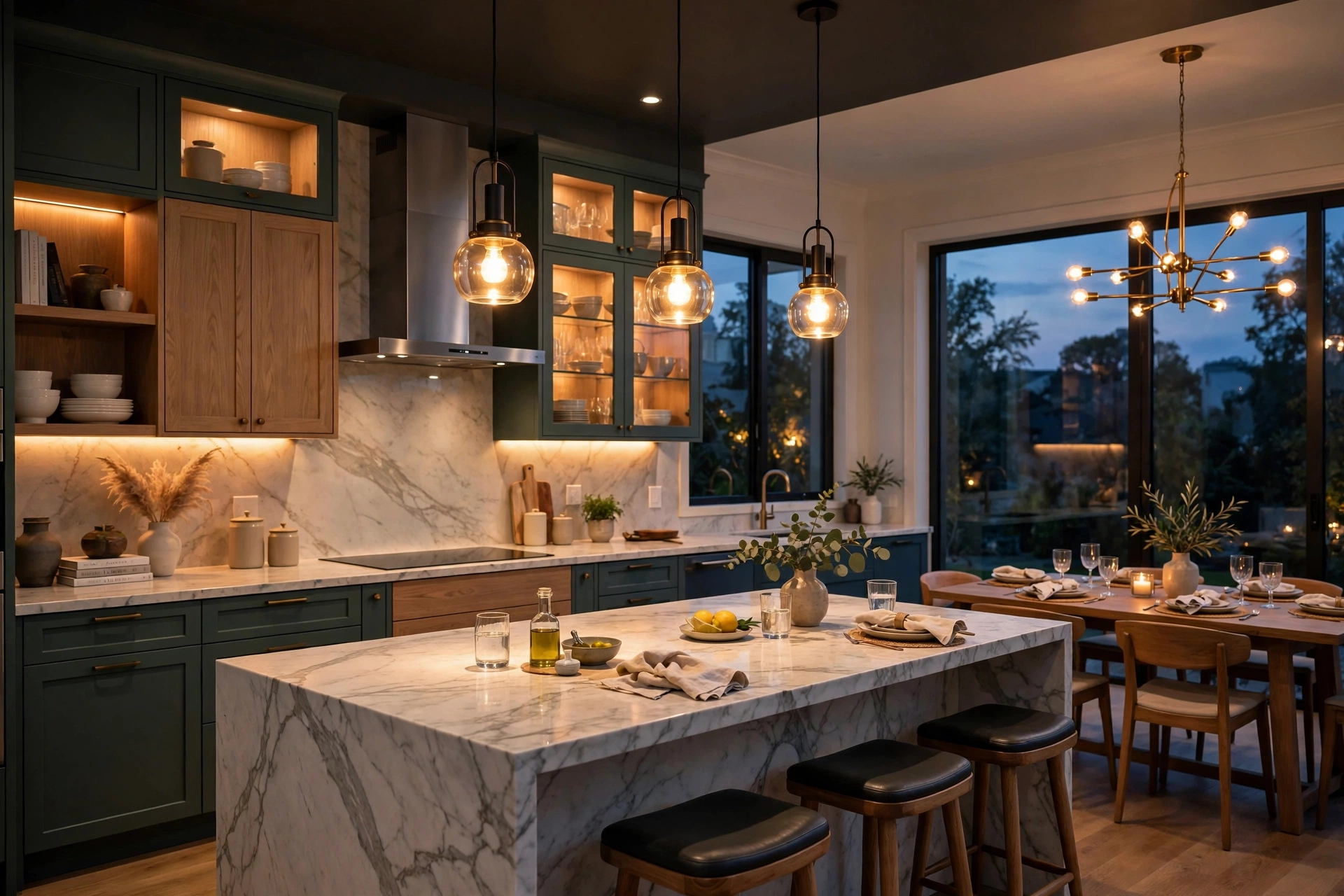
Here is the open secret of every kitchen makeover show: the “after” almost always comes down to lighting. Same cabinets, same layout — but the harsh overhead fluorescent is gone, replaced by a warm pendant trio, a glow under the cabinets, and suddenly the whole room looks expensive. I have seen $200 in lighting do what a $5,000 cabinet repaint only dreams of.
Light is the cheapest renovation material there is. A single fixture swap can change how your kitchen feels at 7 a.m. versus 7 p.m., make food look better, and turn the island into the place everyone gathers. And most of the ideas below need no electrician, no permits, and no tearing anything out.
These 25 creative kitchen lighting transformations are organized from the biggest visual payoffs to the cleverest small upgrades — pendants, under-cabinet LEDs, chandeliers, dimmers, and DIY fixtures included. Every one has a practical tip and a realistic sense of cost, so you can pick the transformation that fits your kitchen and your weekend.
- The fastest transformation is swapping one dated fixture for a pendant or chandelier you actually love.
- Under-cabinet LED strips are the highest-impact DIY: peel-and-stick, plug-in, under $40, done in an hour.
- Put task lighting on dimmers — bright for cooking, low for evening, one $20 switch.
- Stick to warm white (2700–3000K) for ambient light; go slightly cooler (3000–3500K) only right over work zones.
- No new wiring? Plug-in pendants, battery LEDs, and smart bulbs transform a kitchen with zero electrician visits.
1. Statement Pendant Trio Over the Island

Nothing says “new kitchen” faster than three matching pendants over the island. They replace the single sad flush-mount, give you real task light for chopping and homework, and act as jewelry for the room. Hang them 30–36 inches above the countertop and space them roughly 24–30 inches apart so the light pools evenly.
Try this: buy the trio, then buy one extra shade — if a shade ever gets discontinued, you will thank yourself.
2. Under-Cabinet LED Strip Glow

This is the single best dollar-for-drama upgrade in the entire list. A $25 plug-in LED strip kit under your wall cabinets washes the counters in warm light, kills the shadows your old overheads cast, and makes the kitchen look custom-lit at night. Most kits are peel-and-stick with a remote — no tools beyond scissors. LEDs are also the cheapest energy upgrade you can make in a kitchen — this Energy Saver lighting guide explains how they use a fraction of the power of old bulbs while lasting years longer.
Try this: mount the strip toward the front lip of the cabinet, not the back wall — front placement throws light onto the counter instead of the backsplash.
3. Oversized Farmhouse Chandelier

One big farmhouse chandelier over the kitchen table or island does what three small fixtures can’t: it anchors the whole room. Go bigger than you think — a 24–30 inch fixture suits most eat-in kitchens — with candle-style bulbs for that warm farmhouse glow. If the farmhouse look runs through your whole house, these farmhouse old window projects carry that same rustic warmth into other rooms for almost no money.
Try this: hang the chandelier so its bottom sits about 30 inches above the table surface — low enough to feel intimate, high enough to see across.
4. DIY Mason Jar Pendant Lights

The classic DIY for a reason: a pendant cord kit, a mason jar, an Edison bulb — under $15 per light and genuinely charming over a coffee bar or small island. Drill or punch the lid for the socket, screw it on, and hang. They read as intentional, not cheap, especially in threes with the jars at slightly staggered heights.
Try this: use frosted or amber-tinted jars to soften the bulb glare; clear jars with bright bulbs can feel harsh up close.
5. Linear Suspension for a Long Island

Islands longer than six feet look odd with a trio of small pendants — the gaps show. A single linear suspension bar runs the full length, gives perfectly even task light, and reads as high-end modern. Most are LED-integrated now, so there is no bulb-changing for a decade.
Try this: choose a fixture about two-thirds the island’s length — full-length bars can visually chop the room in half.
6. Recessed Can Light Makeover

If your kitchen ceiling is a grid of yellowed 1990s cans, the fix is easier than a rewire: retrofit LED trim kits pop into the existing housings in minutes, no electrician needed. Pick 3000K for a clean-but-warm look, and suddenly the whole ceiling disappears and the room feels taller.
Try this: replace the trims, not the housings — a $12 retrofit kit per can beats a $200-per-can electrician visit.
7. Put Everything on Dimmers

A dimmer is the cheapest mood transformation in home improvement: full brightness for cooking, a low glow for dinner, a nightlight setting for midnight snacks. A single-pole dimmer costs about $20 and takes 20 minutes to install — just make sure you buy one rated for LED bulbs or you will get flicker. If you have never swapped a switch before, this step-by-step dimmer installation walkthrough covers the whole job, including the safety checks.
Try this: always turn off the breaker and test with a non-contact voltage tester before touching any switch — no exceptions.
8. Over-Sink Pendant Moment

The sink window is the most looked-at spot in the kitchen and the least lit. One small pendant — a mini globe, a schoolhouse shade, a little brass dome — turns dish duty from a chore zone into a vignette. It is usually a straight swap for an existing fixture, so it is a true one-hour project.
Try this: match the sink pendant’s finish to your faucet — that one repeated metal makes the whole kitchen feel designed.
9. Backlit Open Shelving

Run a slim LED strip behind or beneath open shelves and your everyday dishes become a display. The backlight silhouettes glassware beautifully and gives the kitchen depth after dark. Battery-powered strips with remotes mean even renters can do this with zero wiring.
Try this: use warm 2700K strips here — cool white behind dishes makes food look clinical.
10. Rattan and Wicker Pendants

Woven pendants throw the prettiest patterned shadows of any fixture on this list — dappled light across the island that photographs like a resort. They soften modern kitchens and warm up all-white ones, and they are light enough to hang from almost any existing box.
Try this: look for open-weave rattan if you need real task light; tight weaves are moodier but dimmer.
11. Industrial Cage Pendants

Black metal cage pendants bring instant edge — they suit modern, industrial, and transitional kitchens alike because the open cage disappears visually while the bulb becomes the star. Pair with vintage-style Edison bulbs for the full effect, and they cost a fraction of designer fixtures.
Try this: hang cages with the bulb fully enclosed — exposed-bulb pendants at eye level are a glare headache.
12. Frosted Glass Globe Pendants

When you want glow without glare, frosted globes are the answer. They diffuse the bulb completely, so you get soft even light that flatters faces at the island — the reason restaurants love them. A trio of milk-glass globes is timeless enough to survive three kitchen style changes.
Try this: size up — a 10–12 inch globe reads intentional; tiny 6-inch globes can look lost over a big island.
13. Toe-Kick Floor Glow

LED strips tucked into the toe-kick (that recessed strip at the bottom of your base cabinets) make the cabinets look like they float — and they are the perfect nighttime path light for the kitchen. Motion-sensor strips turn on as you walk in, so nobody fumbles for a switch at 2 a.m.
Try this: put toe-kick lights on the same motion sensor as the pantry (idea #21) so the whole kitchen wakes up together.
14. Lit Glass-Front Cabinets

A puck light or slim LED bar inside each glass-front cabinet turns your prettiest dishes into a lit display case. It is the jewelry-box effect: by day, normal cabinets; by night, a warm glow that makes the whole kitchen feel layered and expensive.
Try this: use rechargeable puck lights with remotes — no wiring inside the cabinet, and you can dim them for movie-night ambiance.
15. Skylight and Sun Tunnel Daylight

The ultimate transformation is free light: a skylight or sun tunnel pours real daylight into a dark kitchen and changes how the room feels all day. Sun tunnels (about $200–500 installed) fit between roof rafters with no structural work and can light a windowless galley like a lamp that never needs a bulb.
Try this: place the tunnel over the main work zone, not the room’s center — daylight where you chop matters most.
16. Sconces Flanking the Window

Two small sconces flanking the kitchen window frame the view like art and add warm side light that overheads never give. Plug-in or battery sconces with cord covers make this renter-friendly; hardwired ones are a quick electrician visit if a switch already exists nearby.
Try this: mount sconces at about 60 inches from the floor — eye level when standing, so the glow flatters instead of glares.
17. Range Hood Statement Lighting

The range hood is the kitchen’s architectural moment — treat it like one. A hood with strong integrated lighting (or a bold hood silhouette with picture-light-style spots) turns the cooking wall into the focal point. If a new hood is out of budget, upgrading just the hood’s bulbs to bright 3000K LEDs transforms how the whole wall reads.
Try this: clean or replace the hood’s grease filter when you upgrade the bulbs — brighter light shows every speck.
18. Smart Bulbs, Zero Rewiring

Swap your existing bulbs for smart bulbs and your phone becomes a lighting designer: bright white for cooking, warm amber for dinner, scheduled on/off so you never walk into a dark kitchen. No new fixtures, no wiring, no electrician — just screw in and connect.
Try this: start with the island and under-cabinet zones only; whole-kitchen smart setups get expensive fast.
19. Vintage Edison String Look

A swag of Edison string lights across a beam, along open shelving, or over a breakfast nook gives instant bistro warmth for under $30. It is not task lighting — it is pure atmosphere — which is exactly why it transforms how the kitchen feels after dinner.
Try this: choose LED Edison strings, not incandescent — same amber glow, a tenth of the heat and power.
20. Warm Brass Fixture Swap

Sometimes the transformation is just a finish: swapping chrome or dated bronze fixtures for warm brass or champagne gold instantly updates the whole kitchen’s temperature. Brass plays well with white, wood, black, and green cabinets — it is the hardest-working metal in kitchen design right now.
Try this: swap all visible fixtures to the same brass tone at once — mixed “almost-brass” finishes look accidental.
21. Motion-Sensor Pantry Lights

Open the pantry door, lights on; close it, lights off — motion-sensor LED strips or pucks make the pantry feel like a luxury upgrade for about $20. No more phone-flashlight archaeology for the baking soda. The same trick works inside deep lower cabinets and lazy Susans.
Try this: mount the sensor where the door swing triggers it, not deep inside where your hand has to reach first.
22. Breakfast Nook Chandelier

The breakfast nook deserves its own light — a small chandelier or mini pendant hung low over the table turns a forgotten corner into the family’s favorite seat. Keep it 30–34 inches above the tabletop so it feels intimate without blocking conversation. A well-lit breakfast nook quickly becomes the house’s favorite reading spot, and these cozy library room ideas with plants show how to style little corners for lingering.
Try this: add a dimmer here first — a nook at half-brightness is the coziest seat in the house.
23. The Three-Layer Lighting Rule

Designers light kitchens in three layers, and most dated kitchens have only one (the overhead). Add them in order: ambient (ceiling/recessed for general light), task (pendants and under-cabinet for work zones), accent (shelf, toe-kick, and cabinet lights for glow). A kitchen with all three feels finished at every hour; a kitchen with one feels flat.
Try this: audit your kitchen tonight with all lights on — whichever layer is missing is your next project.
24. Plug-In Swag Pendants (No Electrician)

Renters, this one’s for you: a plug-in pendant with a long fabric cord swags from a ceiling hook to the nearest outlet — no wiring, no holes that matter, full pendant look. Drape the cord in a gentle curve and it reads as intentional design, not a workaround.
Try this: use a cord cover or paintable raceway along the ceiling run so the cord looks like trim, not clutter.
25. Candlelight-Evening Mode

The final transformation costs nothing: after dinner, turn off every overhead and light the kitchen with candles, the under-cabinet strips at their lowest dim, and one pendant. The kitchen exhales — counters glow, the room feels smaller and warmer, and cleanup feels less like a chore. The same low, warm light that makes a kitchen feel magical works everywhere — these fall mantel decorating ideas use candles and fairy lights to cozy up a living room the same way.
Try this: keep a tray of pillar candles and a lighter in one cabinet so “evening mode” takes ten seconds to start.
Kitchen Lighting Cheat Sheet
Not sure where to start? Match the upgrade to your budget and DIY comfort:
| Upgrade | Best Spot | Typical Cost | DIY Difficulty |
|---|---|---|---|
| Pendant trio over island | Kitchen island | $90–$300 | Easy (swap existing fixture) |
| Under-cabinet LED strips | Counter work zones | $25–$60 | Very easy (peel & stick) |
| Farmhouse chandelier | Eat-in kitchen / table | $120–$400 | Easy (swap existing fixture) |
| Recessed LED retrofit trims | Whole-kitchen ambient | $12–$20 per can | Very easy (pop-in) |
| Dimmer switches | Task & ambient zones | $20 per switch | Easy (basic wiring) |
| Plug-in swag pendant | Nook / rental kitchens | $30–$80 | Very easy (no wiring) |
| Motion-sensor pantry lights | Pantry / deep cabinets | $15–$30 | Very easy (battery) |
| Smart bulbs | Island & accent zones | $10–$25 per bulb | Very easy (screw-in) |
| Toe-kick LED strips | Base cabinets | $20–$50 | Easy (peel & stick) |
| Sun tunnel / skylight | Dark kitchens | $200–$500+ | Pro recommended |
Frequently Asked Questions
How many pendant lights do I need over a kitchen island?
For islands under 6 feet, two pendants usually suffice; for 6–8 foot islands, three is the sweet spot. Space them 24–30 inches apart (center to center) and hang them 30–36 inches above the countertop. For very long islands, switch to a single linear suspension about two-thirds the island’s length instead of crowding in four or five pendants.
What color temperature is best for kitchen lighting?
Warm white (2700–3000K) for ambient and accent lighting — it flatters skin tones and makes the kitchen feel inviting. For task zones like under-cabinet strips over prep counters, 3000–3500K gives slightly crisper light for chopping and reading recipes. Avoid anything above 4000K in a home kitchen; it reads as office lighting.
Can I install under-cabinet lighting myself?
Yes — plug-in LED strip kits are one of the easiest DIYs in the house. Clean the cabinet underside, peel the adhesive backing, stick the strip near the front lip, and plug into the nearest outlet. Battery-powered strips with remotes need no outlet at all. Hardwired under-cabinet lighting is the only version that calls for an electrician.
Do I need an electrician to change kitchen light fixtures?
Not for a straight fixture swap — if a light already hangs there, replacing it with a new pendant or chandelier is a standard DIY job (power off at the breaker first, always). You need an electrician when running brand-new wiring to a spot that never had a fixture, adding recessed cans where none existed, or touching the main panel.
How can I brighten a dark kitchen without rewiring?
Four no-wire wins: plug-in LED strips under the cabinets, a plug-in swag pendant over the island or nook, brighter LED bulbs in existing fixtures (check the fixture’s max wattage equivalent), and battery motion-sensor lights in the pantry and dark corners. Together they can double a kitchen’s perceived brightness for under $100.
Final Thoughts
If there is one thing to take from this list, it is that kitchen lighting is never really about the fixtures — it is about how the room feels at the hours you actually live in it. The bright, even light that makes Tuesday’s dinner prep easy and the low, warm glow that makes Friday night feel like a restaurant are two different kitchens, and dimmers plus layers let you have both.
Start with the single change that bugs you most — the dark corner over the sink, the buzzing fluorescent, the island everyone crowds around in the dark. Fix that one thing this weekend. Lighting has a way of snowballing: once you see what one good fixture does, the rest of the list starts looking like a very fun to-do list.


