



A koi pond is already a garden centerpiece, but most of them look alike: a kidney-shaped hole with rocks around it. Kolam patterns, the geometric floor art drawn across South India, give the pond a shape and a soul at the same time.
These 16 kolam koi designs combine kolam geometry with healthy koi pond building. Every design keeps the fish first: proper depth, filtration, and fish-safe materials, with the pattern work on top.
Quick takeaways
- Koi ponds need at least 3 feet of depth to protect fish from predators and temperature swings.
- Use only fish-safe sealants, paints, and tiles; standard construction materials can leach toxins into the water.
- Every pond needs mechanical plus biological filtration sized for its gallon count.
- Kolam shapes (octagons, petals, dot grids) translate well to pond outlines and tile inlays.
- Plan 250 gallons per adult koi as a minimum; overcrowding is the most common pond mistake.
1. Octagonal Kolam Pond

The octagon is a classic kolam frame, and it makes a naturally balanced pond. Build the shell 3 to 4 feet deep with straight walls, which are easier to form than curves and give koi more usable swimming room. Edge it with stone cut to the eight sides. Float a non-toxic painted wooden rangoli on the surface for festivals, and remove it after so it never decays in the water.
Try this: add a small waterfall at one corner; the eight-sided shape hides the plumbing behind the fall.
Cost: $$$$· Difficulty: Moderate
2. Flower Petal Pond With LED Jets

Shape the pond like a stylized kolam flower with six or eight rounded petals. Low-pressure colored LED jets in each petal create a light show after dark without stressing the fish; keep jet pressure gentle and aim flow along the walls, not at resting spots. Warm white reads elegant, while slow color cycling suits parties. Use waterproof, fish-safe LED fixtures rated for ponds.
Try this: put the lights on a separate timer from the pump so the show runs only in the evening.
Cost: $$$$· Difficulty: Moderate
3. Sun and Moon Dual Pond
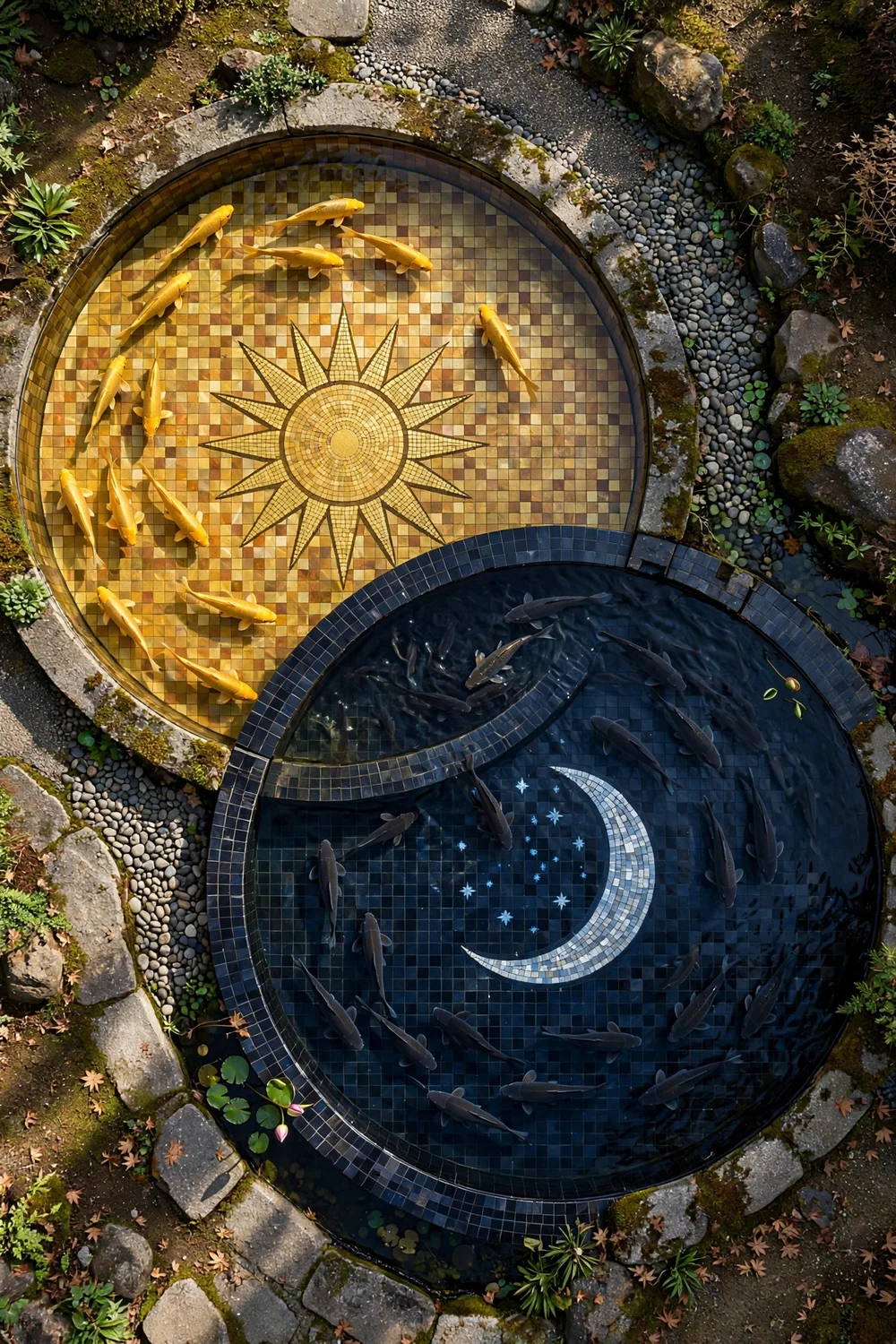
Two intersecting circles, one tiled in warm golds and one in deep blacks and blues, mirror the sun-moon symbolism found in kolam art. Stock one side with gold koi and the other with darker varieties like karasu. A submerged divider with gaps lets fish move freely while the visual duality stays crisp from above. Keep both sides at equal depth so water chemistry stays uniform.
Try this: run one filtration loop serving both circles to keep maintenance simple.
Cost: $$$$· Difficulty: Advanced
4. Glass-Walled Kolam Pond

Thick tempered glass on one or two walls turns the pond into a living picture. Lay the kolam pattern on the pond floor using water-resistant porcelain tile or fish-safe epoxy paint so the design shows through the water and the glass. This design suits courtyards and atriums where the pond sits at seating height. Have the glass panels set by a professional; water pressure at 3 feet deep is serious force.
Try this: backlight the floor pattern with a soft underwater light so the kolam glows at night.
Cost: $$$$· Difficulty: Advanced
5. Pulli Kolam Grid Pond
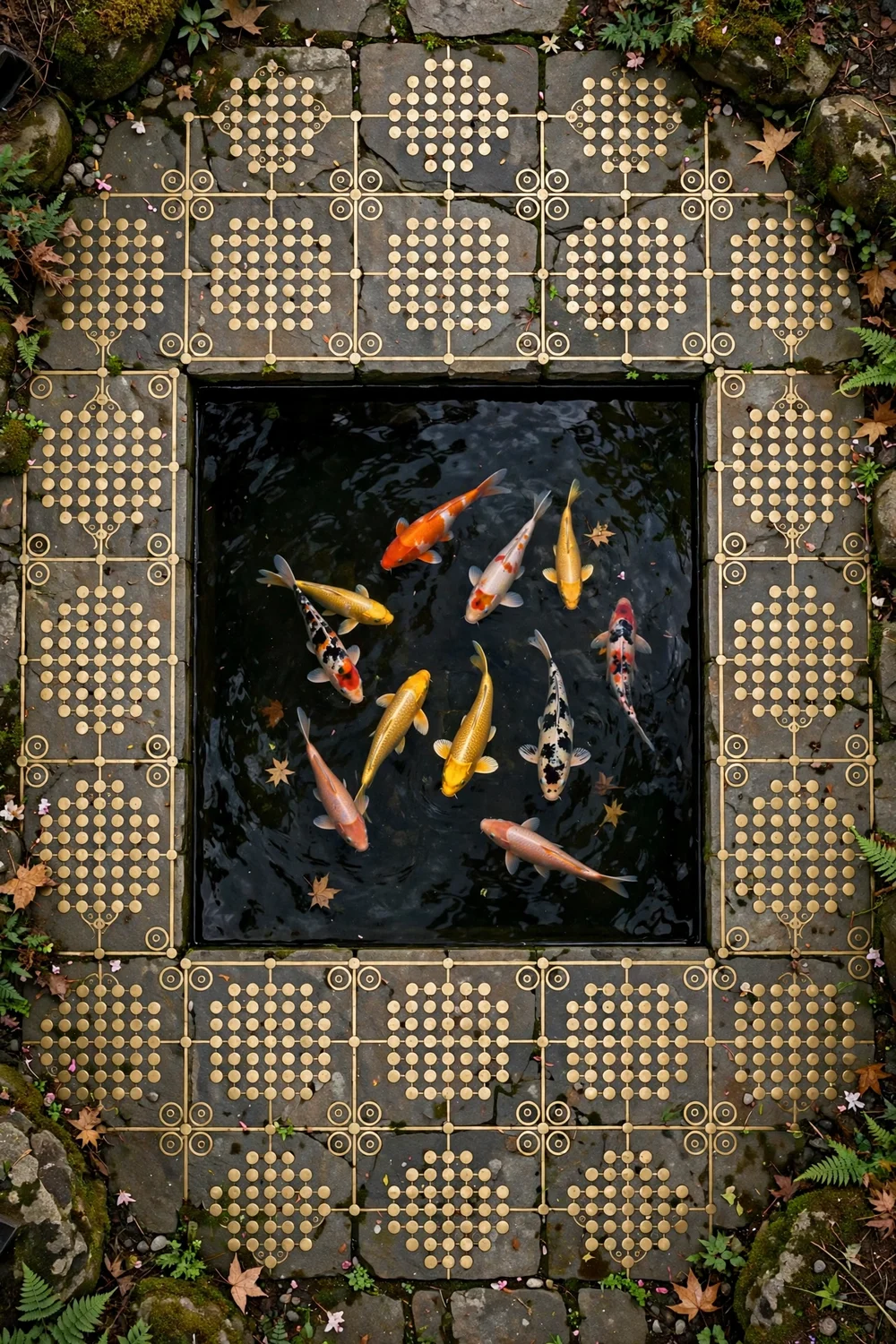
Pulli kolam starts from a grid of dots, which translates beautifully to a square pond with a dotted patio inlay around it. Set brass or stone dots into the surrounding pavers in the traditional grid, and keep the pond itself a clean square with a dark interior that makes the koi pop. The geometry does the decorating; the pond stays simple and easy to maintain.
Try this: use glow-in-the-dark grout dots sparingly so the grid appears at night without lighting the whole yard.
Cost: $$$$· Difficulty: Moderate
6. Lotus Centerpiece Pond

A round pond with a planted lotus island in the middle echoes the lotus kolams drawn for festivals. Plant lotus in submerged pots, never loose in the pond, so the roots stay contained and the water stays clear. Keep plants to about one-third of the surface so koi still get open swimming water and enough oxygen exchange. A stone lotus sculpture at the edge completes the theme on land.
Try this: choose a dwarf lotus variety for ponds under 500 gallons so leaves do not cover the surface.
Cost: $$$$· Difficulty: Easy
7. Peacock Feather Edge Pond

The peacock feather is a beloved kolam motif, and it works as a mosaic band around the pond rim. Lay the feather “eyes” in blue and green glass tile on the vertical inner wall just below the waterline, where they shimmer through the water. Above the waterline, use stone coping for a clean edge. Keep all tile and grout rated for constant submersion and fish-safe once cured.
Try this: sketch the feather pattern on paper first and transfer it with a grid so the eyes stay even.
Cost: $$$$· Difficulty: Moderate
8. Raised Brick Kolam Pond

A raised brick pond, 2 feet above ground with 2 feet below, is easier to build, easier to view, and safer for small children than a ground-level pond. Inlay a white kolam line pattern into the brick face using contrasting mortar or thin stone strips. The raised wall doubles as seating. Waterproof the interior with a fish-safe pond sealant before filling.
Try this: cap the wall with wide, smooth coping stones so the seating edge stays comfortable.
Cost: $$$$· Difficulty: Moderate
9. Kolam Bridge Pond

A small arched bridge over a long pond gives the classic koi garden moment, and the deck boards are a perfect canvas for a painted kolam border. Use exterior deck paint for the pattern and reseal it yearly. The bridge also shades a strip of water, giving koi a cool refuge on hot afternoons. Keep the arch gentle so the bridge stays walkable when wet.
Try this: paint the kolam in white on dark-stained deck boards for maximum contrast.
Cost: $$$$· Difficulty: Moderate
10. Indoor Atrium Pond
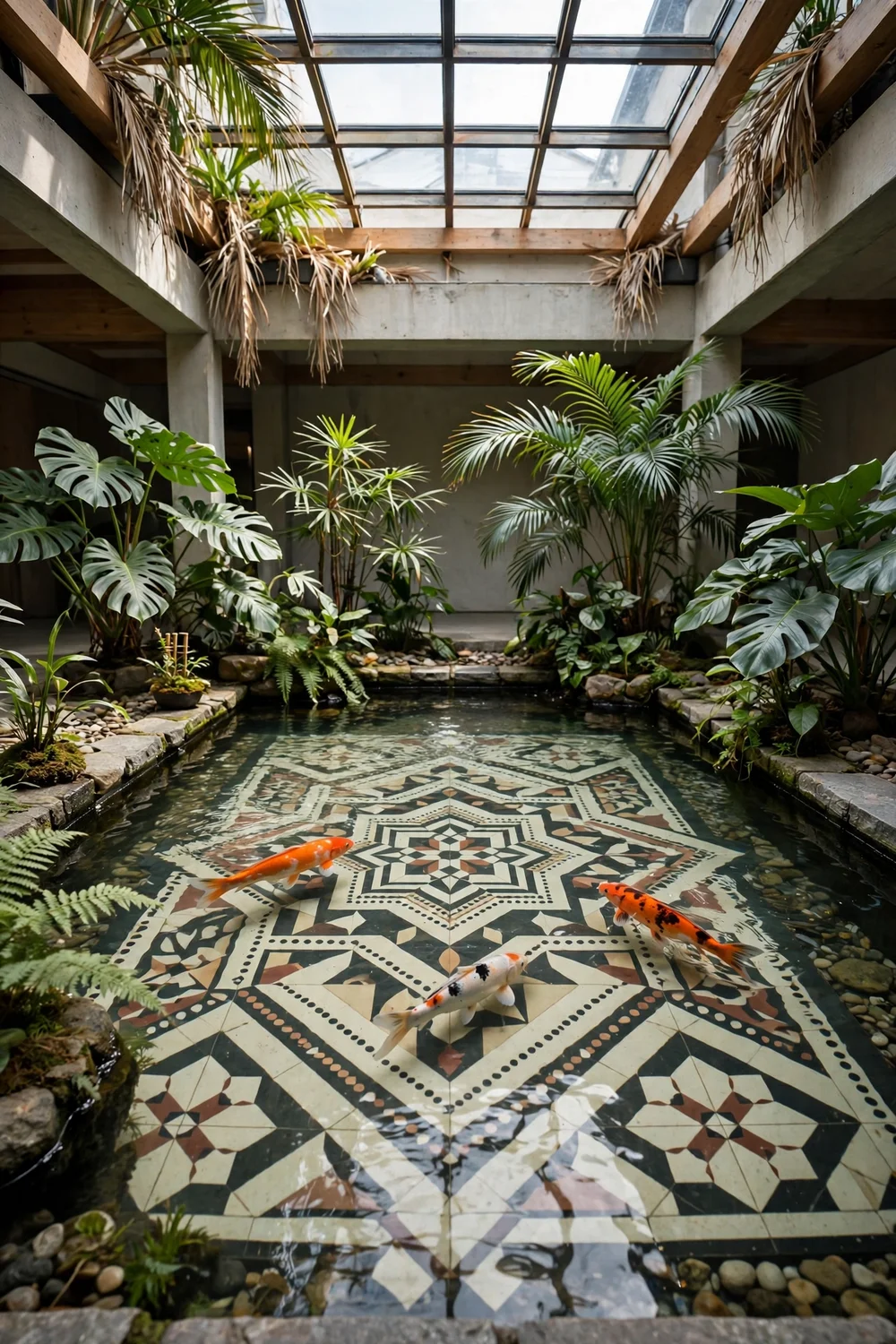
A courtyard or atrium pond with a kolam-tiled floor brings the art inside the home’s sightlines. Without weather swings, water temperature stays stable and maintenance drops. Install a floor drain and waterproof membrane under the whole feature, and ventilate the space; indoor ponds raise humidity. A skylight above gives plants and fish natural light cycles.
Try this: add a quiet canister filter instead of a waterfall filter to keep indoor noise down.
Cost: $$$$· Difficulty: Advanced
11. Waterfall Kolam Border Pond

A stacked-stone waterfall at one end aerates the water and masks pump noise, while a kolam tile border rings the pond at the waterline. Build the falls with flat stones stacked dry, then lock them with waterfall foam so water sheets over the faces instead of leaking behind. The moving water also discourages mosquitoes, a real plus in warm climates.
Try this: angle the falls so the splash lands on a stone shelf, not directly on the liner, to reduce wear.
Cost: $$$$· Difficulty: Moderate
12. Two-Tier Fountain Pond

An upper fountain basin spills into the main koi pond below through a kolam-mosaic spillway. The upper tier can be shallow and planted, while the lower tier holds the full 3-foot depth the koi need. One pump drives the whole system if the plumbing is sized right. Keep the upper basin fish-free so plants get the nutrients and koi get the clean lower water.
Try this: fit a ball valve on the spillway line to tune the flow between a trickle and a sheet.
Cost: $$$$· Difficulty: Moderate
13. Corner Courtyard Pond

A triangular or quarter-circle pond tucks into a courtyard corner and still holds enough volume for a few koi if it is deep. Three feet deep in a 6-foot triangle gives roughly 250 gallons, enough for two small koi with strong filtration. Paint a large kolam on the wall behind it as the backdrop. Corner ponds are the best answer when the yard is small but the ambition is not.
Try this: mirror the corner with a wall-mounted fountain so the small space feels doubled.
Cost: $$$$· Difficulty: Moderate
14. Viewing Window Pond
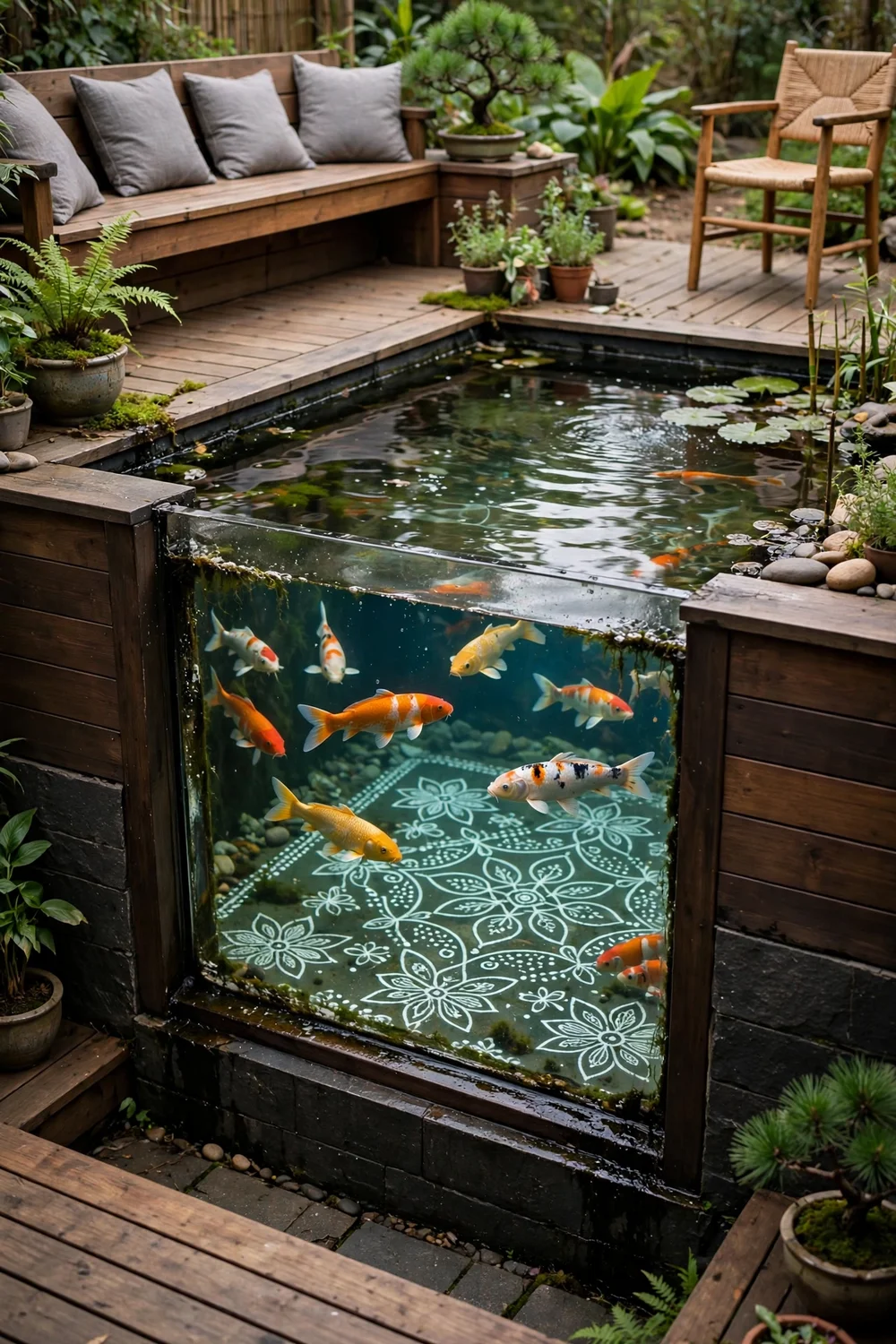
A single underwater viewing window in a raised pond wall lets you watch koi at eye level, and the kolam floor pattern becomes the backdrop of the show. Use a purpose-made acrylic pond window with a proper flange and fish-safe sealant, set during construction, never cut in afterward. Position it where seating already faces for an instant garden focal point.
Try this: keep the glass shaded from direct afternoon sun to slow algae growth on the pane.
Cost: $$$$· Difficulty: Advanced
15. Festival Diya Ledge Pond

A wide, flat stone ledge around the pond doubles as a diya shelf during festivals like Diwali and Pongal. Keep the ledge 12 inches wide and level so rows of lamps sit stable, and set it back from the water so wax and oil never reach the pond. For everyday use, the same ledge holds potted plants. Battery diyas give the glow without any flame risk near water.
Try this: line the ledge with a washable runner during festivals to catch wax drips.
Cost: $$$· Difficulty: Easy
16. Koi Variety Display Pond

A long, narrow pond with a viewing deck along one side is built for appreciating koi varieties: kohaku, sanke, showa, and tancho each read clearly against a dark pond floor. Keep the floor a solid dark color with no pattern so the fish are the art here, and let the kolam work live on the surrounding patio inlay. A dark floor also makes health checks easier since color changes show early.
Try this: photograph each fish yearly against the dark floor to track growth and pattern changes.
Cost: $$$$· Difficulty: Moderate
How to plan a kolam koi pond
Start with the fish math, then draw the art. Size the pond for 250 gallons per adult koi, dig at least 3 feet deep, and choose a shape you can actually build: octagons, squares, and rectangles are far easier than freeform curves. Sketch the kolam pattern on paper, transfer it to the site with stakes and string, and build the shell before any decorative tile goes in. Filtration and plumbing get roughed in during construction, never after.
Mistakes to avoid with koi ponds
The classic mistake is building too shallow; 2 feet feels deep during construction and proves too shallow the first hot summer. Second is undersized filtration: size the filter for the pond’s gallons plus the fish load, not just the gallons. Third is using non-fish-safe paint, sealant, or mortar additives, which can poison the water for weeks. Cure all materials fully and test water before adding a single fish.
Koi pond safety essentials
Open water and small children need separation: a fence, a raised wall at least 2 feet high, or a rigid safety cover. Keep electrical equipment on GFCI circuits and cords out of reach. New ponds need 4 to 6 weeks of cycling before fish go in; add koi gradually. The CPSC Pool Safely campaign covers barrier rules that apply to ponds too, and the koi pond water quality guide from the Environmental Literacy Council details the targets for koi health.
Frequently asked questions
What is a kolam koi design?
It is a koi pond whose shape or decoration borrows from kolam, the geometric line art traditionally drawn on floors in South India. Octagons, flower petals, dot grids, and sun-moon motifs translate naturally into pond outlines, tile inlays, and patio patterns.
How deep should a koi pond be?
At least 3 feet, with 4 feet better in hot climates or where herons hunt. Depth protects koi from predators, buffers temperature swings, and gives fish room to overwinter below the ice line in cold regions.
Are painted kolam patterns safe for koi?
Only with fish-safe materials: epoxy paints and sealants labeled safe for potable water or aquatic life, fully cured before filling. Standard house paint, and any paint with mildewcides, can leach toxins that harm or kill fish.
How many koi can my pond hold?
Plan 250 gallons per adult koi as a minimum, with strong filtration. A 1,000-gallon pond suits about four adult koi. Overcrowding causes poor water quality, stunted growth, and disease.
How long before I can add koi to a new pond?
Wait 4 to 6 weeks while the biological filter cycles, testing ammonia and nitrite until both read zero. Add fish a few at a time, not all at once, so the filter bacteria can catch up with the load.
Conclusion
A kolam koi pond works when the geometry serves the fish: right depth, right filtration, fish-safe materials, and a pattern that makes the water more beautiful instead of more complicated. Draw the kolam, build the pond around it, and let the koi do the rest.
For a quiet sitting spot beside the water, these garden nook seating ideas pair well with any pond. To frame the pond with flowering vines, these climbing rose trellis ideas add height and scent around the water.


