


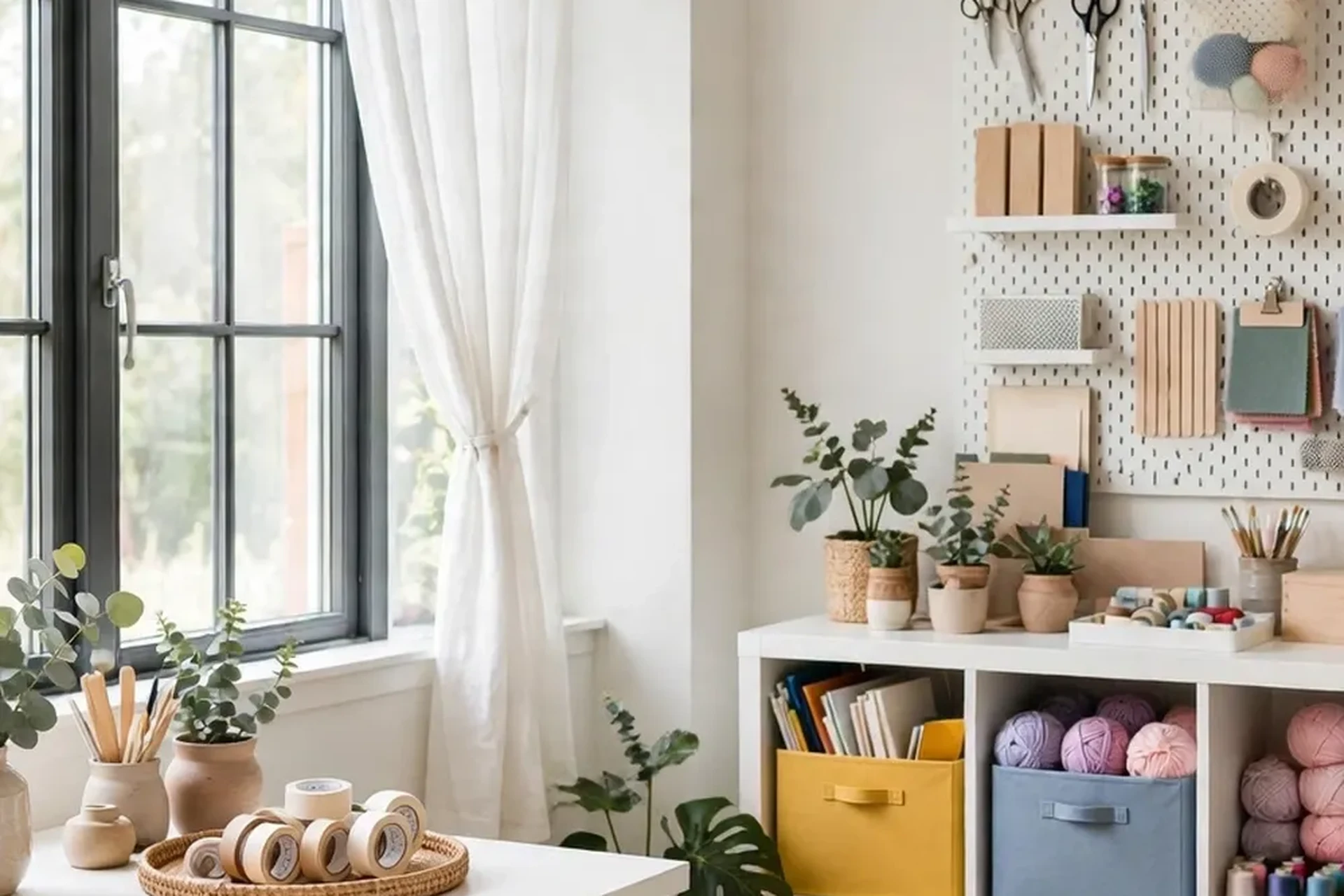
My craft supplies used to live in seventeen tote bags, three laundry baskets, and one drawer I was afraid to open. Every project started with twenty minutes of digging and ended with glitter in places glitter should never be. Then a friend with the tidiest sewing room I’ve ever seen told me her secret: almost everything in it came from IKEA, and almost none of it was used the way IKEA intended.
That sent me down a rabbit hole that lasted six months and two IKEA trips (the second one just for “a few small things” — I came home with a KALLAX). What I learned is that IKEA’s modular furniture is basically a construction kit for craft rooms: the pieces are cheap, the measurements are standard, and crafters have spent years figuring out brilliant ways to hack them. My craft room went from tote-bag chaos to a space where I can see every supply and reach every tool without standing up.
These 25 stunning IKEA craft room hacks are the best of what I found and tested — real modifications, real product combinations, and the small tweaks that turn flat-pack furniture into a custom craft studio. Most cost under $100 in IKEA parts, most go together in an afternoon, and every one of them is built around products you can actually buy.
- ALEX drawer units + a tabletop is the undisputed king of craft desks — sturdy, cheap, and endlessly reconfigurable.
- Go vertical: SKÅDIS pegboards, BOAXEL shelving, and wall-mounted storage free up your desk and your floor.
- RASKOG carts keep supplies mobile — roll the right tools to the project instead of carrying the project to the tools.
- KALLAX, TROFAST, and BILLY all take simple hacks (dividers, deeper backs, tilt bins) that turn generic storage into craft-specific storage.
- Light it: LED strips under shelves make every supply visible and the whole room feel like a studio.
1. The ALEX + Tabletop Craft Desk

This is the hack that started a thousand craft rooms: two IKEA ALEX drawer units with a tabletop laid across them. It’s sturdy enough for a sewing machine, the drawers swallow every small tool you own, and the whole thing costs less than one “craft table” from a specialty store. The ALEX drawers are shallow and smooth-gliding — perfect for pens, rulers, blades, and tapes that would stack and tangle anywhere else. If you want to compare drawer-unit sizes, inserts, and tabletop combinations, IKEA’s ALEX series page shows the full line in one place.
Try this: put drawer dividers in the top two drawers on day one. ALEX drawers without dividers become junk drawers by week three.
2. A KALLAX Wall of Craft Storage

A wall of KALLAX cube shelving is the fastest way to give every craft category a home: one cube for fabric, one for yarn, one for paper, one for the Cricut supplies. Mix open cubes with fabric bins and a few door or drawer inserts so the wall looks calm instead of chaotic. KALLAX is modular, so the wall can grow upward as your stash grows — no reorganizing the whole room.
Try this: label every bin, even the obvious ones. Six months from now, “blue fabric” and “blue paper” will not be as distinguishable as you think.
3. The SKÅDIS Pegboard Tool Wall

Mount a SKÅDIS pegboard above your desk and your tools leave the desktop forever. Scissors, rulers, and rotary cutters hang on hooks; cups hold clips, pins, and pens; small shelves carry glue bottles and paint jars. The whole layout rearranges without tools, so when your tool collection evolves, the wall evolves with it. It turns a plain wall into the most functional square meter in the room.
If you’re choosing which pegboard accessories to start with, IKEA’s own SKÅDIS pegboard combination page shows the hooks, shelves, and containers that work together — it’s the easiest way to see the system before you buy.
Try this: group tools by task (all sewing tools in one zone, all paper tools in another) instead of by type. Your hands learn where “sewing” lives faster than where “scissors” live.
4. The RASKOG Rolling Cart, Upgraded

The RASKOG three-tier cart is already a craft room staple, but small items scatter across its deep tiers. Add tiered shelf dividers or small containers to each level and suddenly beads, buttons, and ribbons each have a compartment. The cart stays mobile — you roll the supplies to the cutting table, the sewing machine, or the couch. Nothing falls through, nothing gets lost.
Try this: dedicate one tier per active project. When the project moves, the whole tier moves with it.
5. TROFAST Frames as Fabric Sorters

TROFAST was designed for kids’ toys, but tilted upright it becomes a brilliant fabric sorter. The tilt-out bins separate fabric scraps, fat quarters, and remnants by color or project, and everything is visible the moment you pull a bin. Stand the frame tall instead of wide and it compresses a huge amount of storage into a narrow wall strip or a tight corner.
Try this: mix shallow and deep bins in the same frame — shallow for scraps you’ll dig through, deep for yardage.
6. The Flush-Mount Sewing Station

Here’s the sewing hack worth the effort: cut a hole in a LINNMON tabletop so your sewing machine sits flush with the surface. No more fabric catching on the machine’s edge, no more awkward hump in your work surface — the bed of the machine becomes one continuous plane with the table. Two ALEX units on either side hold bobbins, presser feet, and patterns within arm’s reach.
Try this: trace the machine base, then cut 5mm inside the line. The machine should drop in snugly; you can always widen, never narrow.
7. The GERTON Mixed-Media Desk

If you work in paint, clay, or mixed media, you need a tougher desk than white laminate. The solid wood GERTON top takes abuse — paint wipes off, cuts can be sanded out — and it looks better with age. Pair it with a big pegboard behind for brushes, palette knives, and jars of mediums. It’s the art-studio version of the ALEX desk, built for mess.
Try this: seal the GERTON with a clear matte polyurethane before the first project. Future-you will thank present-you the first time acrylic paint lands on it.
8. The Compact Corner Craft Desk

Small room? One ALEX drawer unit, a short tabletop, two legs on the far end, and a SKÅDIS pegboard on the wall above. That’s a complete craft station in about a square meter. The pegboard does the heavy lifting — everything that would need drawers or shelves lives on the wall instead. It fits in a bedroom corner, a hallway nook, or half a home office.
For more ways to squeeze function into tight rooms, these small bedroom storage ideas use the same vertical-first thinking for bedrooms.
Try this: a fold-down wall table instead of the ALEX setup if you need the floor space back sometimes — but the ALEX version stores more.
9. DIGNITET Wire as a Paint Tube Display

Stretch a DIGNITET curtain wire across the wall and clip paint tubes to it with small clips. You see every color at a glance, tubes are grab-and-go, and the wall becomes a rainbow display that doubles as decor. The same wire holds inspiration cards, pattern pieces, and works in progress. It’s the cheapest wall storage IKEA sells, and in a craft room it looks intentional.
Try this: hang the wire with a slight sag and sort tubes by color family. The gradient effect is genuinely beautiful.
10. The Cricut Corner

Give your cutting machine a permanent home: a sturdy desk section with the Cricut or Silhouette always plugged in and ready, a SKÅDIS pegboard above holding weeding tools, scrapers, and spatulas, and vinyl rolls stored vertically in a bin or on a dowel rack beside it. Machines that live in a closet get used twice a year; machines that live on a desk get used twice a week.
Try this: store vinyl rolls upright in a tall bin, not stacked flat. Flat stacks curl and tangle; upright rolls stay ready.
11. BOAXEL Wall-to-Wall Shelving

When the stash outgrows furniture, go full wall: the BOAXEL system mounts directly to the wall with no floor footprint, so you get shelf after shelf of storage above your desk or along an entire wall. It’s adjustable, so shelf heights change as your supplies change. Slim bins under the lowest shelf catch markers, gel pens, and pencils. This is the “serious crafter” wall — and it costs less than one built-in bookcase.
Try this: mount the bottom shelf at desk height and use the wall above the desk as one continuous storage column — desk, shelves, done.
12. The SATSUMAS Ladder Stand

The SATSUMAS bamboo ladder stand comes with plant pots, but in a craft room the pots hold buttons, beads, and bobbins instead. It leans against the wall taking up almost no floor space, and the tiered pots keep small supplies visible and sorted. It’s the prettiest small-footprint storage in the IKEA catalog, and it costs less than a set of desk organizers.
Try this: one pot per material (all buttons, all beads) rather than one pot per project — materials stay findable forever.
13. PINNIG Benches, Mounted Vertically

PINNIG benches are meant for entryways, but mount one vertically on the craft room wall and it becomes a hanging station: hooks hold tote bags and aprons, the little shelf holds jars, and stacked multiples make a full storage column. It saves floor space, costs very little, and looks like custom wall storage. Anchor it to studs — it’s holding real weight once loaded.
Try this: mount two side by side at different heights for a staggered, designed look rather than a single lonely bench.
14. The Paper Crafter’s Wide Desk

Paper crafters need surface above all: take an extra-wide tabletop and put four ALEX drawer units under it. You get a huge flat expanse for cardstock, die-cutting machines, and stamping, with drawers for inks, stamps, punches, and embellishments. The drawers are shallow enough that nothing stacks and vanishes. Add a self-healing mat that lives on the desk permanently.
Try this: reserve one full ALEX unit just for paper, sorted by color in hanging files. Paper is the supply that multiplies fastest.
15. LED Strips Under Every Shelf

The single cheapest “studio” upgrade: warm LED strip lights under each shelf. Supplies become visible instead of shadowed, colors read true, and the whole room glows like a workspace instead of a spare bedroom. Battery or USB strips mean no wiring; adhesive backing means no tools. Put the strips you use every evening on a timer so the room lights itself.
If you’re planning the lighting carefully, these hidden lighting ideas for a cozy home are full of strip-light tricks that work beautifully above craft desks too.
Try this: 2700K warm white everywhere. Cool-white strips make fabric colors lie to you.
16. Deepen a BILLY Bookcase

BILLY shelves are too shallow for fabric bolts and big paper pads — things hang over the edge and slide off. The hack: add a plywood back set deeper and simple side panels to give the unit true depth. Suddenly bolts stand upright, paper pads lie flat, and nothing falls behind the shelf. Add casters and the whole deep-storage unit rolls where you need it.
Try this: measure your widest fabric bolt before building — depth should exceed it by 5cm, no more, or you lose the reach-in convenience.
17. DETOLF Cabinets as Supply Display

Combine two or three DETOLF glass cabinets side by side and you get a dust-free display wall for your most beautiful supplies: vintage buttons, washi tape collections, ribbon spools, special papers. Glass doors mean you see everything without opening anything, dust stays off delicate items, and the display becomes inspiration — you craft more when your prettiest materials are visible. It’s the museum version of craft storage.
Try this: back the cabinets with a light color or mirror-effect film. Dark backs swallow small colorful items visually.
18. The IVAR Fabric Wall

IVAR is solid pine, unfinished, and endlessly adaptable — perfect for a fabric wall. The open shelves hold folded fabric stacks sorted by color, the uprights take hooks for scissors and rulers, and you can add, move, or remove shelves as the stash changes. Leave it natural for a warm look or paint it white to match the rest of the room. It grows with you in a way fixed shelving never does.
Try this: fold fabric around comic-book backing boards for uniform mini-bolts. The wall looks like a fabric store, in the best way.
19. The Ribbon Spool Dowel Wall

Mount wooden dowels on simple brackets and slide ribbon spools onto them — rows of color, all visible, all pull-and-cut ready. It beats every ribbon box ever made: no tangling, no digging, and you can see at a glance which colors are running low. Hang scissors on the end of each dowel and the station is complete.
Try this: cut dowels to the exact bracket span plus 2cm. Too long and they bow; too short and they slip.
20. Vertical Wrapping Paper Storage

Wrapping paper rolls are the awkward giants of craft storage — too long for shelves, always falling over in corners. Stand them upright in a tall narrow bin, a repurposed umbrella stand, or a tall KALLAX cube turned vertical. Upright rolls don’t crease, don’t unroll themselves, and take up almost no floor. Group gift wrap, kraft paper, and vinyl rolls together by height.
Try this: a tension rod across the top of the bin keeps tall rolls from tipping out when you pull one.
21. The Thread Spool Rainbow Wall

Mount rows of small wooden pegs or a pegboard strip and fill them with thread spools in rainbow order. Every color visible, every spool grabbable, and the wall itself becomes the prettiest thing in the room. It works for embroidery floss on bobbins too — wind floss onto bobbins, hang the bobbins, done. You’ll never buy a duplicate color again because you can see what you own.
Try this: sort by color family, not by brand. Your eye finds “the right red” faster than it finds “that one brand’s red.”
22. The Cutting Mat Workstation

Dedicate one desk zone to cutting and never move it: a large self-healing mat that lives on the desk permanently, a rotary cutter in a wall-mounted holder, a long metal ruler on a hook above. When the cutting station is always set up, you cut more — setup friction is what kills crafting momentum. A clear acrylic ruler rack on the wall keeps every size visible.
Try this: replace the mat when cuts stop closing. A worn mat drags blades and ruins fabric edges — it’s a consumable, not furniture.
23. The Hidden PAX Craft Closet

No spare room? A PAX wardrobe with the doors open becomes a complete craft station: shelves for supplies, a fold-down or pull-out table surface, even a small LED light inside. Close the doors and the craft room vanishes — perfect for shared spaces, rentals, and anyone whose “craft room” is also the guest room. Outfit the interior with KOMPLEMENT-style inserts and small bins.
For more no-damage ideas that keep landlords happy, these creative renter-friendly upgrades are full of tricks that leave no trace.
Try this: mount a power strip inside the PAX so the sewing machine and lamp plug in permanently — open the doors and you’re crafting in sixty seconds.
24. Customize KALLAX with Inserts

A plain KALLAX cube is just a box — the hack is the inserts. Mix drawer inserts, door inserts, and open fabric bins in a single unit: drawers for the tiny stuff (needles, pins, clasps), doors for the ugly stuff (half-finished projects), open bins for the pretty stuff (yarn, fabric). One customized KALLAX replaces three separate organizers and looks like built-in cabinetry.
Try this: put the drawer inserts at the top cubes (eye level, easy reach) and deep bins at the bottom (heavy stuff, low center of gravity).
25. The BEKANT Standing Craft Desk

Crafting hunched over a low table for hours wrecks backs and necks. A BEKANT sit-stand desk lets you raise the work surface for cutting and standing tasks, then lower it for detailed handwork. An anti-fatigue mat underneath, tools arranged in an arc within reach, and you’ve built the ergonomic craft station most people never think they need until their shoulders complain.
Try this: set two height presets on day one — one for standing, one for sitting — or you’ll never bother adjusting it.
Quick-Pick Cheat Sheet
Not sure where to start? This cheat sheet matches the highest-impact hacks to their cost and effort:
| Start With This | The Hack | Why It Matters | Rough Cost |
|---|---|---|---|
| ALEX + tabletop desk | Two ALEX units, one tabletop | The foundation every craft room builds on | $150–$250 |
| SKÅDIS pegboard wall | Pegboard + hooks above the desk | Frees the entire desktop | $25–$60 |
| RASKOG rolling cart | Cart + tiered dividers | Supplies roll to the project | $35–$60 |
| KALLAX storage wall | Cubes + bins + inserts | Every category gets a home | $70–$200 |
| LED strip lighting | Strips under each shelf | Studio visibility, zero wiring | $15–$40 |
Frequently Asked Questions
What is the best IKEA desk for a craft room?
The ALEX drawer unit paired with a tabletop is the most popular craft desk for good reason: it’s sturdy, the shallow drawers are perfect for small tools, and the whole setup costs far less than a specialty craft table. For messy media like paint, the solid-wood GERTON top is tougher; for long hours, the BEKANT sit-stand desk saves your back.
How do I organize a small craft room with IKEA?
Go vertical. A SKÅDIS pegboard above the desk, BOAXEL wall shelving, and tall narrow units like TROFAST or a single KALLAX tower use wall space instead of floor space. A RASKOG cart keeps tools mobile so one small desk can serve cutting, sewing, and assembly.
Which IKEA storage is best for fabric?
TROFAST frames with tilt-out bins sort scraps and fat quarters by color; IVAR shelving holds folded yardage on open shelves; and a deepened BILLY bookcase stores fabric bolts upright. For the prettiest option, fold fabric around backing boards and display it on open IVAR shelves like a fabric store.
How can I hide my craft room in a small home?
Build it inside a PAX wardrobe: shelves, a fold-down table, and an interior light turn the wardrobe into a complete station, and closing the doors makes it vanish. A RASKOG cart that rolls into a closet between sessions works the same way on a smaller scale.
Are IKEA craft room hacks durable enough for daily use?
Yes, with two upgrades: seal wood tops like GERTON before the first project, and anchor everything tall (KALLAX walls, IVAR, pegboards) to wall studs. The furniture is designed for daily use — the hacks just redirect it toward craft-specific jobs.
Final Thoughts
Here’s what two IKEA trips and six months of reorganizing taught me: the perfect craft room isn’t the one with the most storage — it’s the one where everything has a visible, reachable home. The ALEX drawers mean I never dig. The pegboard means I never search. The RASKOG means the right tools arrive at the project instead of the other way around. Start with one hack this weekend — the desk, the pegboard, or just the LED strips — and build from there. Your seventeen tote bags will thank you. (Mine are now neatly labeled and living in the KALLAX. Progress.)


