


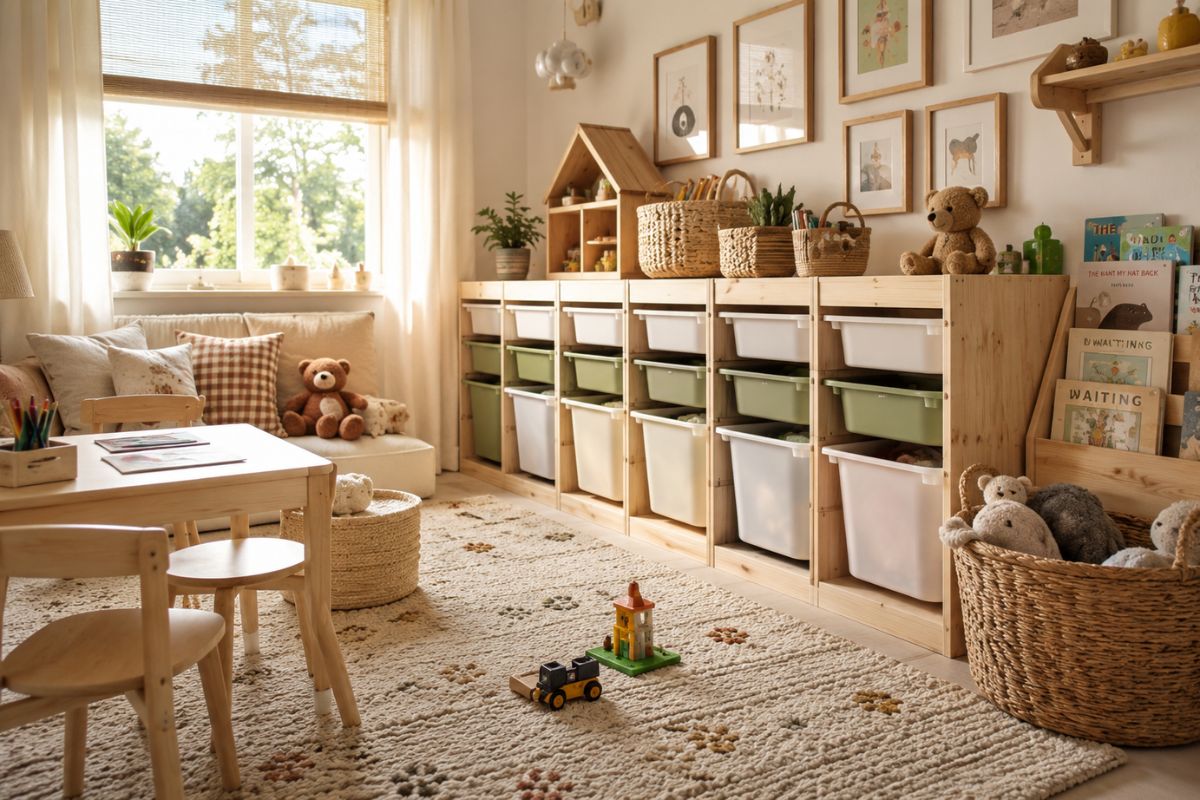
A playroom can get messy fast. Toys, books, and craft supplies can fill every corner. The biggest problem is often not having enough storage. It is having storage that kids cannot easily use, so the mess comes back soon after cleanup.
When planning an IKEA kids playroom, I focus on three things first: easy access, useful storage, and enough open space for play. IKEA pieces can work well because many setups combine storage with activity areas, but the right arrangement matters just as much as the furniture. The ideas below focus on practical playroom setups that can help families keep toys organized while giving kids room to read, create, pretend, and play.
What Is the Best IKEA Setup for a Kids Playroom?
The best IKEA kids playroom setup combines easy toy storage with clear activity areas. TROFAST works well for everyday toys, KALLAX can provide storage and seating, FLISAT is useful for art and crafts, and SKÅDIS can organize small supplies on the wall. Add a reading corner, pretend-play area, and soft play space to make the room useful for different activities.
Quick Takeaway
If you want an IKEA kids playroom that stays organized, these pieces can help:
- TROFAST: Best for everyday toy storage
- KALLAX: Useful for storage, seating, and reading areas
- FLISAT: Great for art, crafts, and sensory play
- SKÅDIS: Helps organize small supplies on the wall
- DUKTIG: Creates a fun pretend-play kitchen
- BILLY: Useful for books and a reading corner
- MOSSLANDA: Works for books, artwork, and small displays
- IKEA baskets: Good for quick toy storage and cleanup
- Labels: Help children know where toys belong
- Activity zones: Keep play, reading, art, and quiet time organized
1. Build an IKEA TROFAST Toy Storage Wall

TROFAST is one of the most useful IKEA pieces for a kids playroom. Its bins make it easy to sort toys by type.
Use separate bins for blocks, cars, dolls, puzzles, and building toys. Keep the bins at a height your child can reach.
You can also add labels to each bin. Picture labels work well for younger kids. This makes cleanup easier because children can see where each toy belongs.
2. Turn a KALLAX Setup Into a Cozy Reading Bench

A low KALLAX setup can create a cozy reading bench while also providing useful storage. Add baskets or inserts to the storage sections and place a firm cushion on top for comfort.
Follow IKEA’s assembly and anchoring instructions for the specific KALLAX unit you use. Keep the reading area stable and suitable for your child’s age.
Put the bench near a wall with books. Add a small rug, pillows, and soft lighting to make the area feel cozy.
This setup creates a simple reading nook without taking up much floor space.
For another IKEA storage bench idea, you can also see these IKEA organization ideas.
3. Create an IKEA FLISAT Art Station

The IKEA FLISAT children’s table works well as an art and craft station. Set up paper, crayons, washable markers, and other art supplies.
A nearby SKÅDIS pegboard can hold smaller art and craft supplies. Use baskets or storage boxes for items that need to stay together.
Keep the most-used supplies within easy reach. This helps kids start creative activities without asking for help every time.
For more craft ideas that can fit this area, see these easy paper crafts for kids.
4. Make a Montessori Toy Rotation Shelf

A simple toy rotation shelf can keep the playroom from feeling crowded. Choose a few toys and place them on an open IKEA shelf.
Keep the selection small. You can change the toys every week or two.
Use baskets for extra toys and bring them out later. This gives children fresh choices without putting every toy in the room at once.
5. Create a DUKTIG Play Kitchen Café Corner

The IKEA DUKTIG play kitchen is a fun choice for pretend play. Give it a small corner of the playroom.
Add a few play dishes, pretend food, and a small basket for supplies. You can also create a pretend café or bakery theme.
A simple sign can make the area feel like a little shop. Keep the setup easy to change as your child’s interests change.
6. Use SKÅDIS Pegboards for Easy Toy Organization

A SKÅDIS pegboard can turn empty wall space into useful storage. Use hooks, containers, and shelves for art supplies and small toys.
Place the SKÅDIS near the art area, homework desk, or toy storage zone so small supplies stay easy to reach.
Wall storage also saves floor space. This makes it useful for small playrooms.
7. Make a Soft Play Corner With Rugs and Cushions

Kids need a comfortable place to sit, build, play, and relax. A soft play area can be made with a rug, floor cushions, and a few washable pillows.
Keep this area open. Children can use it for blocks, books, board games, or quiet play.
Choose materials that are easy to clean. A simple setup can still make the room feel warm and inviting.
8. Add a MOSSLANDA Picture Ledge for LEGO and Toy Displays

The IKEA MOSSLANDA picture ledge can give kids a simple place to display LEGO creations, small toys, artwork, or favorite books.
Place the ledge in a safe spot where children can easily see their displays. Use it to create a small display area without taking up floor space.
Rotate the items from time to time. This keeps the display fresh and gives kids a place to show their latest creations.
9. Create a Hidden Storage Corner With IKEA Cabinets

Open storage is great for toys that children use often. Closed storage is useful for items that you want to keep out of sight.
Use IKEA cabinets or storage units for puzzles, craft supplies, seasonal toys, and extra games.
Keep daily toys in open bins. Store less-used items behind cabinet doors.
This mix can help the playroom look cleaner without removing the fun.
10. Make a Mini Homework and Craft Desk

Older kids may need a small place for homework, drawing, or crafts. Create a simple desk area with an IKEA table and chair.
Add a small shelf for notebooks and books. Use wall storage for pencils, paper, and other supplies.
Keep the desk separate from the main toy area if possible. This gives children a clear place for focused activities.
11. Make an IKEA Playroom Reading Tent

A reading tent can create a special quiet spot. Place it on a soft rug with a few cushions.
Keep a small book basket nearby. Choose picture books for younger children and chapter books for older kids.
Soft lighting can make the area more inviting. This space can also work as a calm corner when your child needs some quiet time.
12. Use IKEA Baskets for Cute Toy Storage

Baskets are an easy way to hide small toys. Use them inside KALLAX shelves or under benches.
Give each basket a purpose. One can hold stuffed animals, another can hold dolls, and another can hold building blocks.
Choose baskets that match the room. Matching storage can make different IKEA pieces look like part of one playroom setup.
13. Build a Small-Space IKEA Kids Playroom

You do not need a large room to create a useful play area. Use vertical storage and furniture with more than one purpose.
A KALLAX shelf can provide storage and seating. Wall shelves can hold books. A SKÅDIS pegboard can keep craft supplies off the floor.
Leave enough open floor space for play. Avoid filling every wall and corner with furniture.
For another small-space storage idea, see these small bedroom storage ideas for useful ways to make better use of limited space.
14. Create a Dress-Up and Pretend Play Station

A small dress-up station can make pretend play more exciting. Use hooks, baskets, or a low clothing rail for costumes.
Keep hats, bags, shoes, and accessories in separate baskets. Add a mirror if there is enough space.
The station can also be changed with the seasons. Add costumes that match your child’s current interests.
15. Add a Cozy Calm Corner

A calm corner gives kids a quiet place to rest. It does not need to be large.
Use a small rug, floor cushion, soft blanket, and a few books. Keep the area away from the busiest part of the playroom.
This can become a simple space for reading, resting, or quiet activities.
16. Turn Wall Space Into Smart IKEA Storage

Walls can provide extra storage in a small playroom. Use shelves, pegboards, picture ledges, and wall-mounted storage where suitable.
Keep heavier items low. Place lighter items on higher shelves.
Wall storage can also keep the floor clear. This gives children more room for active play.
17. Make an Under-Bench Toy Storage Spot

If you have a KALLAX bench or another IKEA seating setup, use the space below it.
Add baskets or storage bins under the seat. This is a good place for stuffed animals, games, and toys.
It keeps storage close to the play area. Kids can also put toys away without walking across the room.
18. Add Soft Lighting for a Cozy Playroom Feel

Good lighting can change the mood of a playroom. Use a main light for general activities and softer lighting near reading or quiet areas.
A small lamp can work well beside a reading bench. Warm light can make the room feel more comfortable in the evening.
Keep cords and lights safely out of children’s reach. Check that lamps and other items are stable.
19. Make a Puzzle and Learning Shelf

Create a small shelf for puzzles, matching games, books, and learning toys. Keep the items easy to see.
Use small baskets for puzzle pieces and cards. Put the most-used activities on the lower shelves.
A simple learning area can fit beside a craft station or reading corner. It gives kids a place for quieter activities.
20. Build a Cute IKEA Play Grocery Store

Turn pretend play into a small grocery store. Use an IKEA shelf, baskets, and the DUKTIG play kitchen to create the setup.
Add pretend fruits, vegetables, boxes, and a small shopping basket. You can make simple signs for different sections.
This setup encourages pretend play and can also help kids learn about sorting, counting, and everyday shopping.
21. Create a Shared Playroom for More Than One Child

A shared playroom needs storage that works for everyone. Give each child a basket or labeled bin for personal items.
Keep large toys and activity areas shared. For example, siblings can share the reading nook, art table, and play kitchen.
If the children have different ages, create separate activity areas. Younger kids can have a simple toy shelf while older kids get a homework or LEGO area.
22. Create an IKEA BILLY Reading and Book Display Corner

An IKEA BILLY bookcase can create a dedicated book area in a kids playroom. Use the shelves for picture books, chapter books, puzzles, and other quiet activities.
Keep the books your child uses most at an easy-to-reach height. Add a small rug or cushion nearby to create a simple reading corner.
You can also use a few shelves to display favorite toys or LEGO creations. Secure the bookcase properly according to IKEA’s instructions.
23. Create an IKEA Toy Rotation Closet

A toy rotation closet is useful when you have more toys than your child needs at one time.
Store extra toys in labeled IKEA bins or baskets. Keep a smaller selection in the playroom.
Rotate the toys every week, two weeks, or whenever your child loses interest. Keep the system simple so it is easy for you to maintain.
24. Add Cute Labels for Easy Cleanup

Labels can make toy organization much easier. Use words, pictures, or both based on your child’s age.
For example, use labels such as:
- Cars
- Blocks
- Dolls
- Puzzles
- Art
- Books
- Stuffed Animals
Put each label on the front of a bin or basket. Kids can quickly see where items belong.
25. Mix IKEA Pieces With Cozy Decor

IKEA furniture has a simple look, so you can add cozy decor to make the playroom feel more personal.
Use a soft rug, cushions, framed art, curtains, baskets, and a few favorite colors. Keep the main IKEA furniture simple so the room does not feel crowded.
Choose decor that can grow with your child. You can change small items later without replacing the main furniture.
How to Choose IKEA Pieces for Your Playroom
Start with the main problem in your playroom. Then choose IKEA pieces that solve that problem instead of filling the room with furniture.
Too many toys: Start with TROFAST or KALLAX storage.
Small playroom: Use wall storage and furniture that can serve more than one purpose.
Lots of art supplies: Combine a FLISAT table with SKÅDIS storage.
Too many books: Create a reading area with BILLY, KALLAX, or a picture ledge.
Need more pretend play: Use DUKTIG for a kitchen, café, or grocery store setup.
Shared playroom: Give each child a personal basket or bin while keeping the main activity areas shared.
This approach helps you build an IKEA kids playroom around your family’s needs instead of simply adding more furniture.
How to Divide an IKEA Kids Playroom Into Activity Zones
You can create different activity zones without dividing the playroom into separate rooms. Group IKEA furniture by the activity your child does there.
IKEA Toy Zone
Use TROFAST bins, KALLAX baskets, or other IKEA storage for everyday toys. Keep the most-used toys at child height.
IKEA Reading Zone
Use a KALLAX reading bench, BILLY bookcase, or book display area with a rug and cushions.
IKEA Art Zone
Place a FLISAT children’s table near SKÅDIS storage. Keep paper, crayons, and other craft supplies close by.
IKEA Pretend-Play Zone
Use the DUKTIG play kitchen, grocery store setup, or dress-up station in one part of the room.
IKEA Learning Zone
Use a small desk or shelf for puzzles, books, LEGO, and other quiet activities.
IKEA Quiet Zone
Create a reading tent or calm corner with cushions, a soft rug, books, and gentle lighting.
Keeping each activity in its own area helps the playroom feel more organized and gives children a clear place for each type of play.
How to Make an IKEA Playroom Easy for Kids to Clean
Give each type of toy a clear storage spot. Use low IKEA bins, baskets, and shelves for toys that children use every day.
Picture labels can help younger kids know where each item belongs. Older children can use simple word labels.
Keep fewer toys available at one time with a toy rotation system. This reduces clutter and makes cleanup faster.
The goal is simple: children should be able to take out a toy, play with it, and put it back without needing help every time.
IKEA Kids Playroom Ideas by Age
The best IKEA playroom setup can change as children grow.
Toddlers
Use low storage, simple toys, soft play areas, and easy-to-reach books. Keep small pieces away from young children.
Preschoolers
Add a FLISAT art area, pretend-play station, sensory activities, puzzles, and dress-up storage.
School-Age Kids
Create areas for LEGO, crafts, reading, games, and homework inside the playroom.
Siblings
Use shared activity zones with separate baskets or bins for personal toys. This gives each child some storage while keeping the main playroom shared.
IKEA Kids Playroom Safety Tips
Secure tall or heavy IKEA furniture according to the manufacturer’s instructions. Keep heavy items on lower shelves whenever possible.
Make sure storage units, shelves, and seating are stable. Keep walkways clear so children have enough space to move and play.
Choose toys that are suitable for your child’s age. Keep small pieces away from young children who may put them in their mouths.
Check furniture and storage from time to time. Tighten or repair anything that becomes loose or unstable.
Safety note: Always follow the assembly, anchoring, and safety instructions for the specific IKEA product you use. This is especially important for tall storage, wall-mounted pieces, and play furniture.
IKEA Kids Playroom Planning Guide
| Playroom Need | IKEA Option | Best Use |
|---|---|---|
| Toy storage | TROFAST | Daily toys and removable toy bins |
| Storage and seating | KALLAX | Reading bench and basket storage |
| Art and crafts | FLISAT | Drawing, crafts, and creative play |
| Wall organization | SKÅDIS | Art supplies and small items |
| Pretend play | DUKTIG | Kitchen and café play |
| Book storage | BILLY | Books and reading area |
| Displays | MOSSLANDA | Books, artwork, and small displays |
| Small toys | IKEA baskets | Quick storage and cleanup |
| Shared storage | KALLAX or TROFAST | Sibling and shared toy storage |
| Small spaces | Wall storage | Save floor space |
IKEA Kids Playroom FAQs
What IKEA furniture is best for a kids playroom?
TROFAST is a useful choice for toy storage because its removable bins make it easy to sort and access toys. KALLAX, FLISAT, SKÅDIS, BILLY, and DUKTIG can also serve different playroom needs.
How do I organize an IKEA kids playroom?
Start with the toys your children use most. Use low storage for daily toys, baskets for smaller items, and simple labels to give each toy category a clear home. Then create separate areas for reading, art, pretend play, and quiet activities.
Is IKEA TROFAST good for a playroom?
Yes. TROFAST is useful for organizing toys in removable bins. It works well for building toys, cars, dolls, games, and other items that need regular cleanup.
How can I make a small IKEA playroom?
Use furniture that serves more than one purpose. A KALLAX setup can provide storage and seating, while SKÅDIS and other wall storage can keep small supplies off the floor. Leave enough open floor space for children to play.
How can I make an IKEA playroom easier for kids to clean?
Keep everyday toys in low, easy-to-reach bins. Use simple picture or word labels and give each toy category its own storage spot. A toy rotation system can also help reduce clutter.
How do I make an IKEA playroom work for siblings?
Give each child a personal basket or bin while keeping larger activity areas shared. A shared reading corner, art station, and pretend-play area can work well for multiple children.
Final Thoughts
After working through different kids’ playroom layouts and storage setups, one thing stands out: a good playroom does not need to be packed with furniture or expensive decor. The setups that work best are usually simple, easy for kids to reach, and built around the way the family actually uses the room. Start with the biggest problem, such as toy clutter or limited space, then add IKEA storage and activity areas that solve that problem. A TROFAST toy station, KALLAX reading area, FLISAT craft space, or SKÅDIS wall organizer can each have a clear purpose. When every item has a place and children can help with cleanup, the playroom becomes easier for the whole family to enjoy.


