


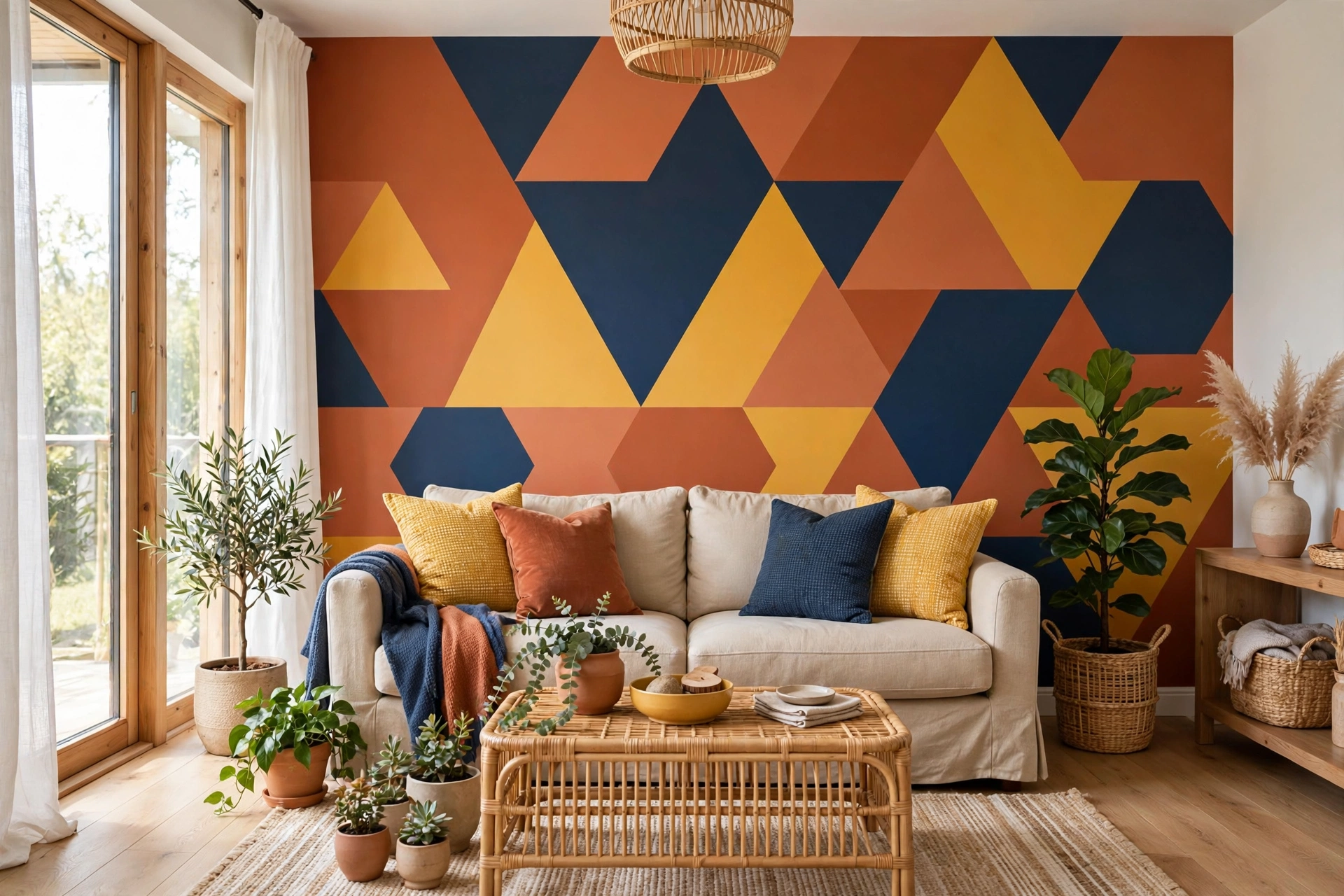
Of all the DIY projects I have ever done in a living room, painting one geometric accent wall gave me the biggest “wait, this is actually my house?” moment for the least money. It was a Saturday, a roll of painter’s tape, three sample pots of paint, and by Sunday afternoon the flat, forgettable wall behind my sofa looked like something from a design magazine.
That is the magic of geometric accent walls. They turn paint — the cheapest decorating material that exists — into architecture. No new furniture, no demo, no contractor. Just shapes, color, and a little patience with tape lines. And because the living room is where you spend most of your time (and where guests actually look), it is the single best wall in the house for this kind of transformation. Below are 25 DIY living room geometric accent wall ideas I have researched, taped, and in several cases painted myself. They range from dead-simple (a diagonal two-tone split you can finish in an afternoon) to showstoppers (a 3D cube illusion that stops people mid-sentence), in every style from minimalist Scandi to bold maximalist. Each idea includes a practical tip so your tape lines come out crisp.
- Invest in quality painter’s tape (FrogTape or similar) — cheap tape bleeds, and crisp lines are the entire project.
- Seal tape edges by brushing your base color over the tape first; it fills micro-gaps and stops color bleed.
- Stick to 2–3 colors pulled from your existing furniture, rug, or pillows for a cohesive look.
- Remove tape while the final coat is still slightly tacky for the cleanest edges — pull low and slow.
- Always buy sample pots first and test colors in your actual room light before committing.
1. Classic Painter’s Tape Triangles
Difficulty: Easy | Cost: $30-$80
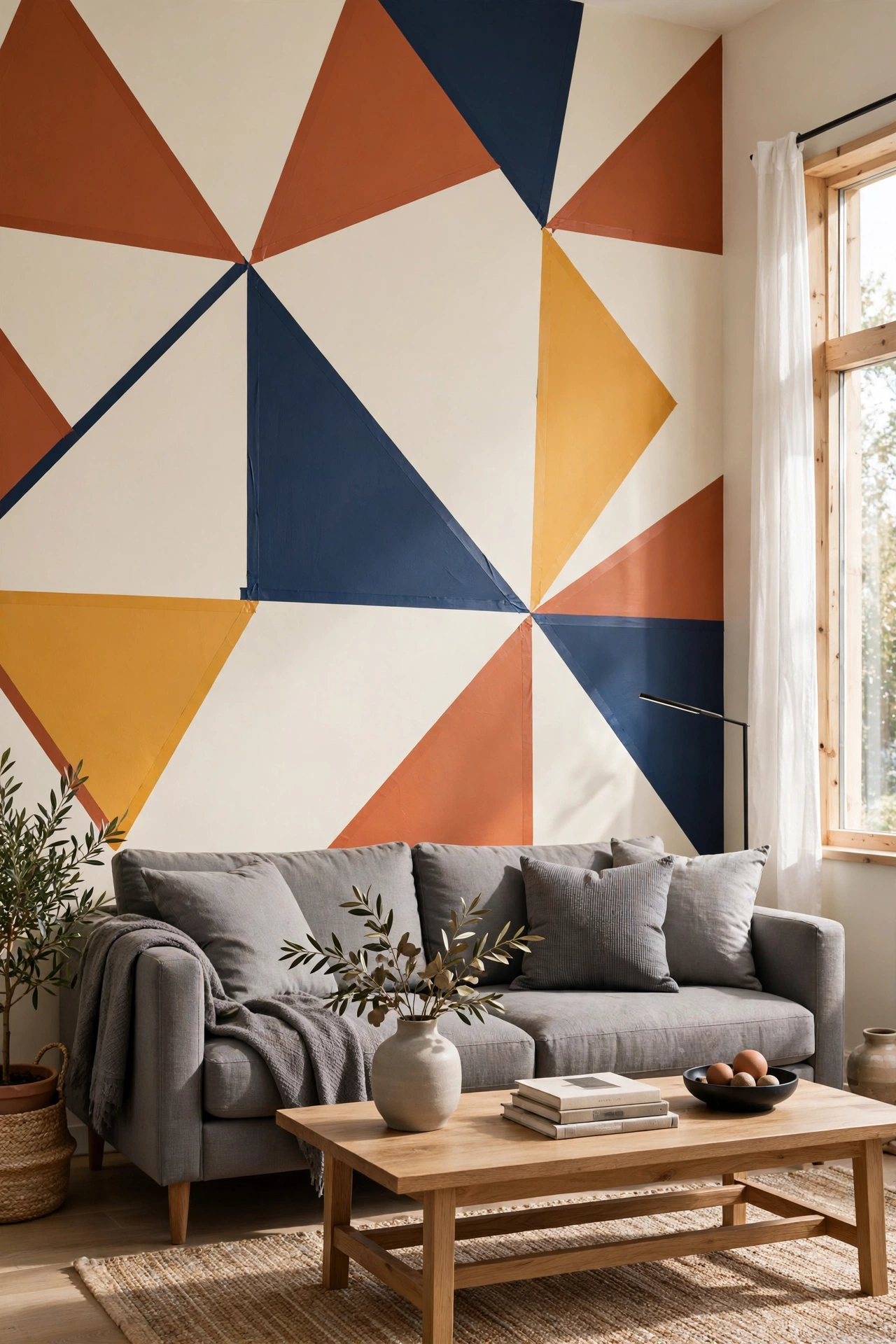
The gateway geometric wall: triangles in three colors, taped off on a cream base. It is the most forgiving first project because triangles hide minor wobbles, and the color-blocking does all the visual work. Pick three colors from your sofa cushions and let the wall echo them back bigger and bolder.
Try this: sketch the layout on paper first and mark each triangle with the color it will get (a small pencil code in the corner). It saves you from staring at a wall of tape wondering which section is which.
2. Hexagon Honeycomb Grid
Difficulty: Easy | Cost: $30-$80
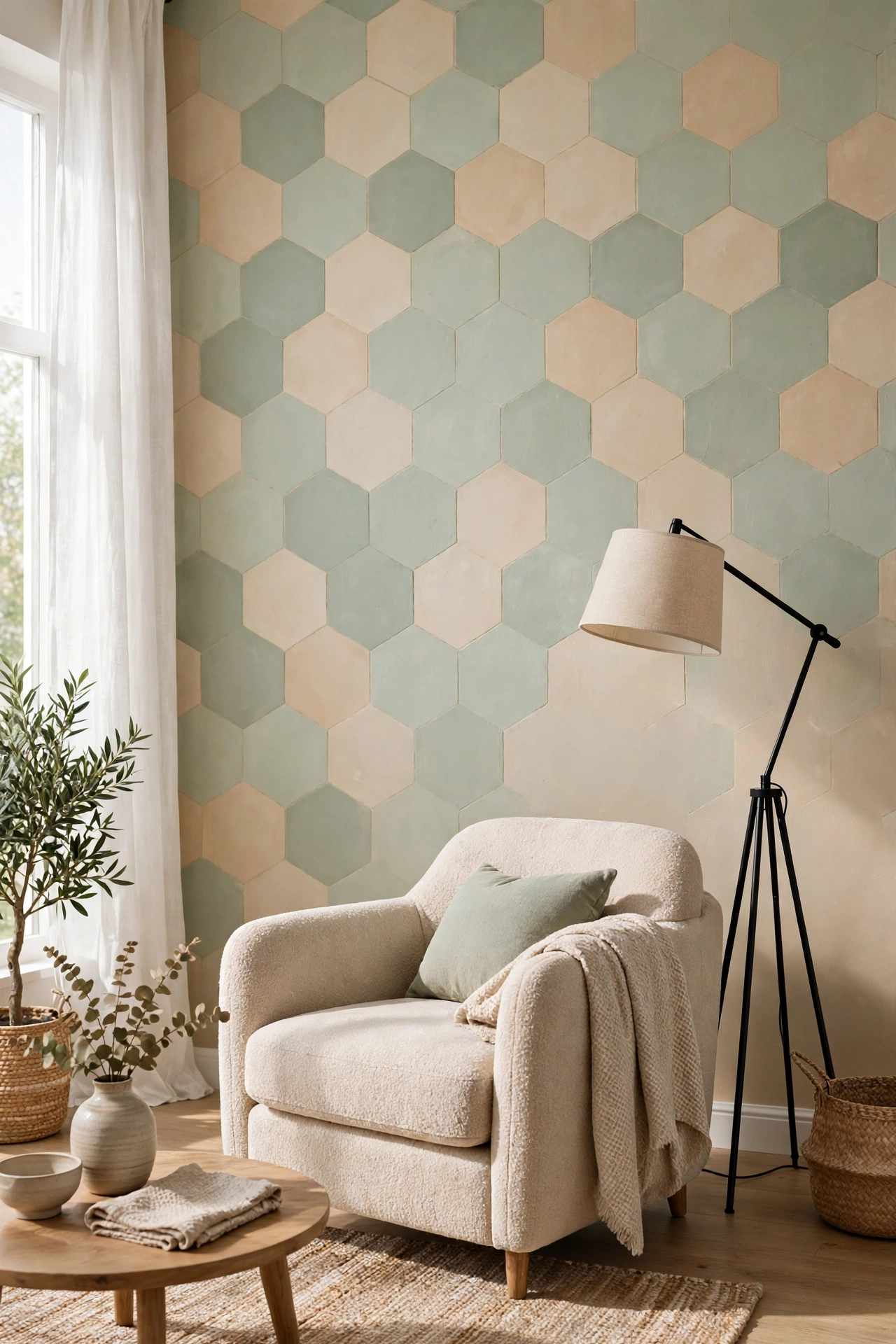
Hexagons feel softer and more organic than triangles — part nature, part math. Cut a cardboard hexagon template, trace it across the wall, tape the outlines, and paint alternating colors. A partial honeycomb that fades out toward the edges looks artistic and modern rather than tiled-bathroom.
Try this: make your template from stiff cardboard and trace in light pencil. Consistency in hexagon size is what makes this look professional instead of hand-drawn.
3. Overlapping Diamond Cascade
Difficulty: Moderate | Cost: $40-$100
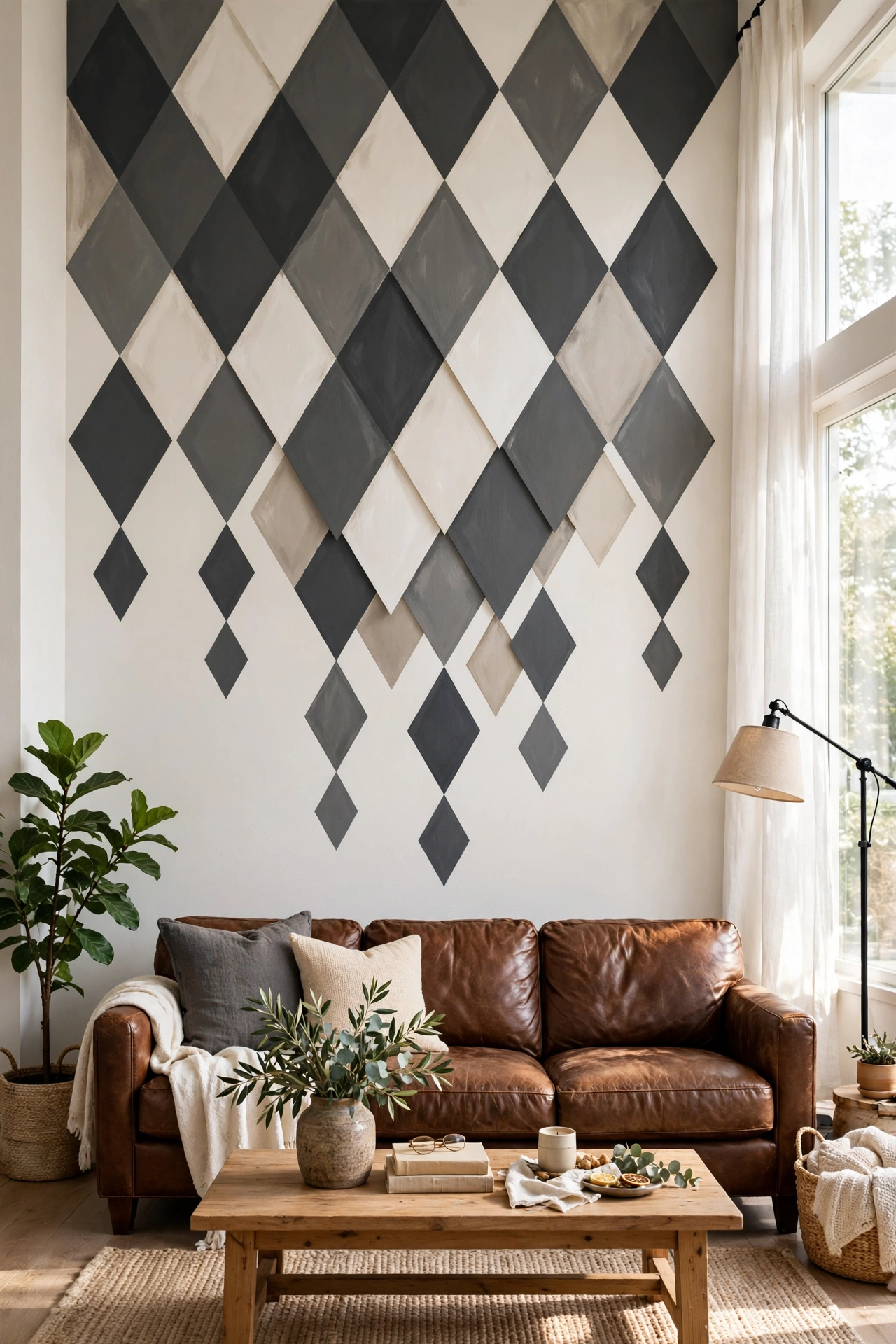
Overlapping diamonds create secondary shapes where they intersect, so the wall reveals new patterns the longer you look at it. Paint the “back” diamonds first, let them dry, then tape and paint the ones that sit “in front.” Two contrasting colors are enough — the overlap does the rest.
Try this: plan your layering order on paper before taping. Every diamond needs to know which neighbor it overlaps, or you will paint yourself into a corner.
4. Painted Herringbone Pattern
Difficulty: Moderate | Cost: $40-$100
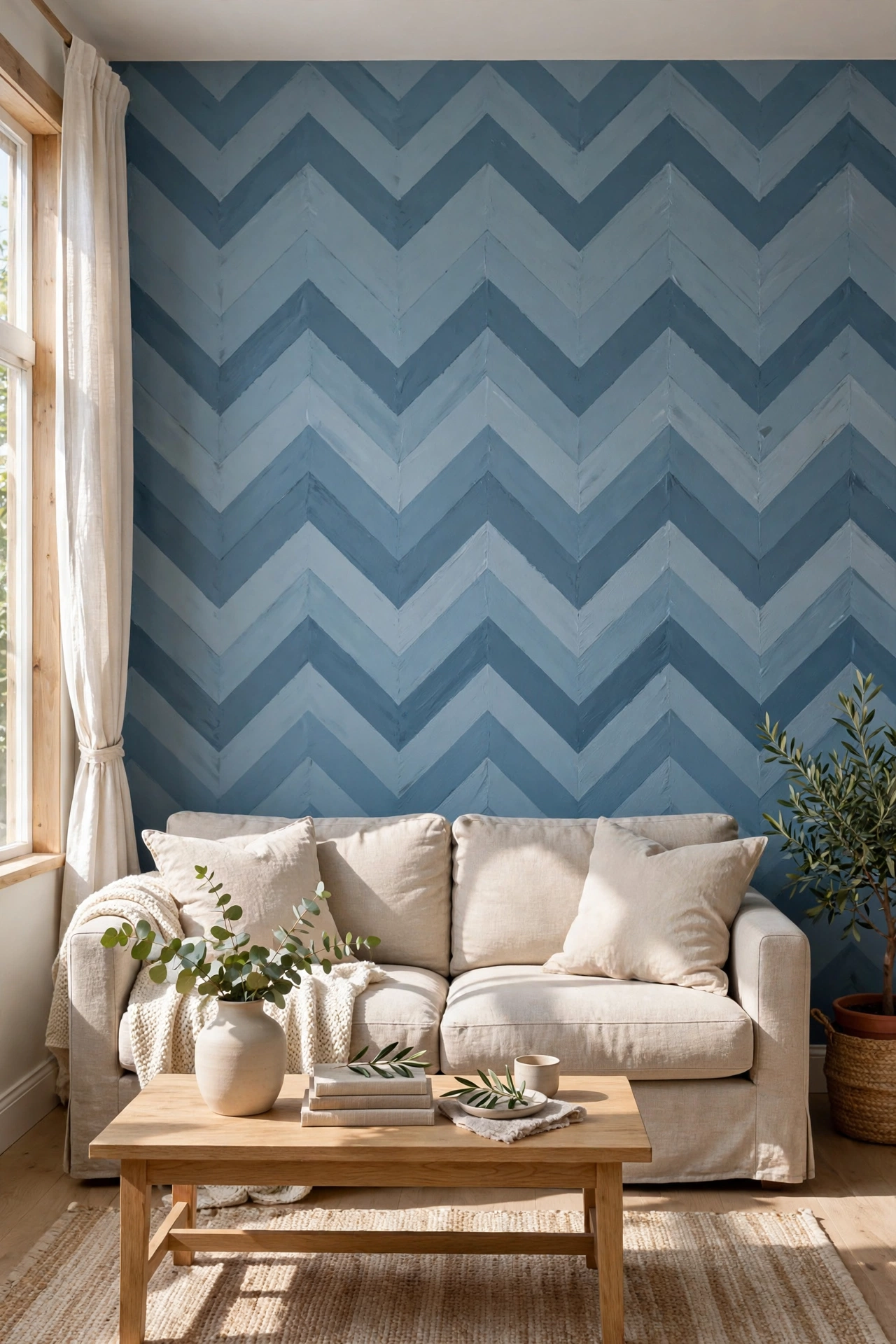
Herringbone in two paint tones makes a stunning wall — all rhythm and movement. Each zigzag is just a straight line, so there is nothing technically hard about it. Two shades of one color family keep it sophisticated. For herringbone, hexagon, and diamond taping walkthroughs, FrogTape’s geometric accent wall guide covers the tape work and line-crisp tricks for each pattern.
Try this: work in sections instead of taping the whole wall at once. Long tape runs lift and shift; short runs stay exactly where you put them.
5. Geometric Mountain Mural
Difficulty: Easy | Cost: $30-$80
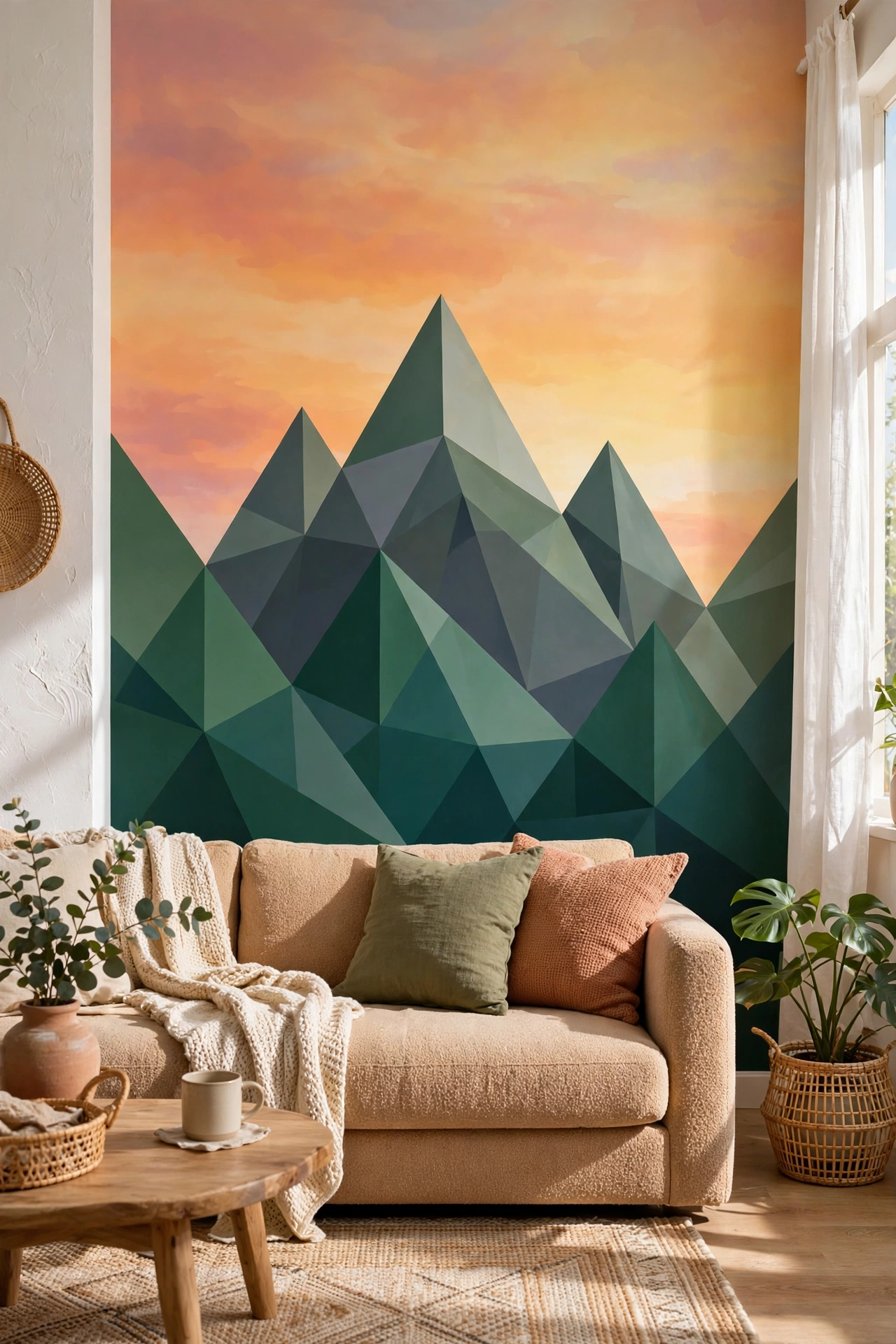
Triangles become mountain peaks, and suddenly your living room has a view. Layer three tones of green or slate for the peaks and blend a warm gradient above for a perpetual sunset. It is the most emotional geometric wall — people do not just notice it, they feel it.
Try this: keep your peaks slightly irregular. Perfectly uniform triangles look like a logo; slightly varied ones look like actual mountains.
6. Color-Block Arch with Geometric Accents
Difficulty: Easy | Cost: $30-$80
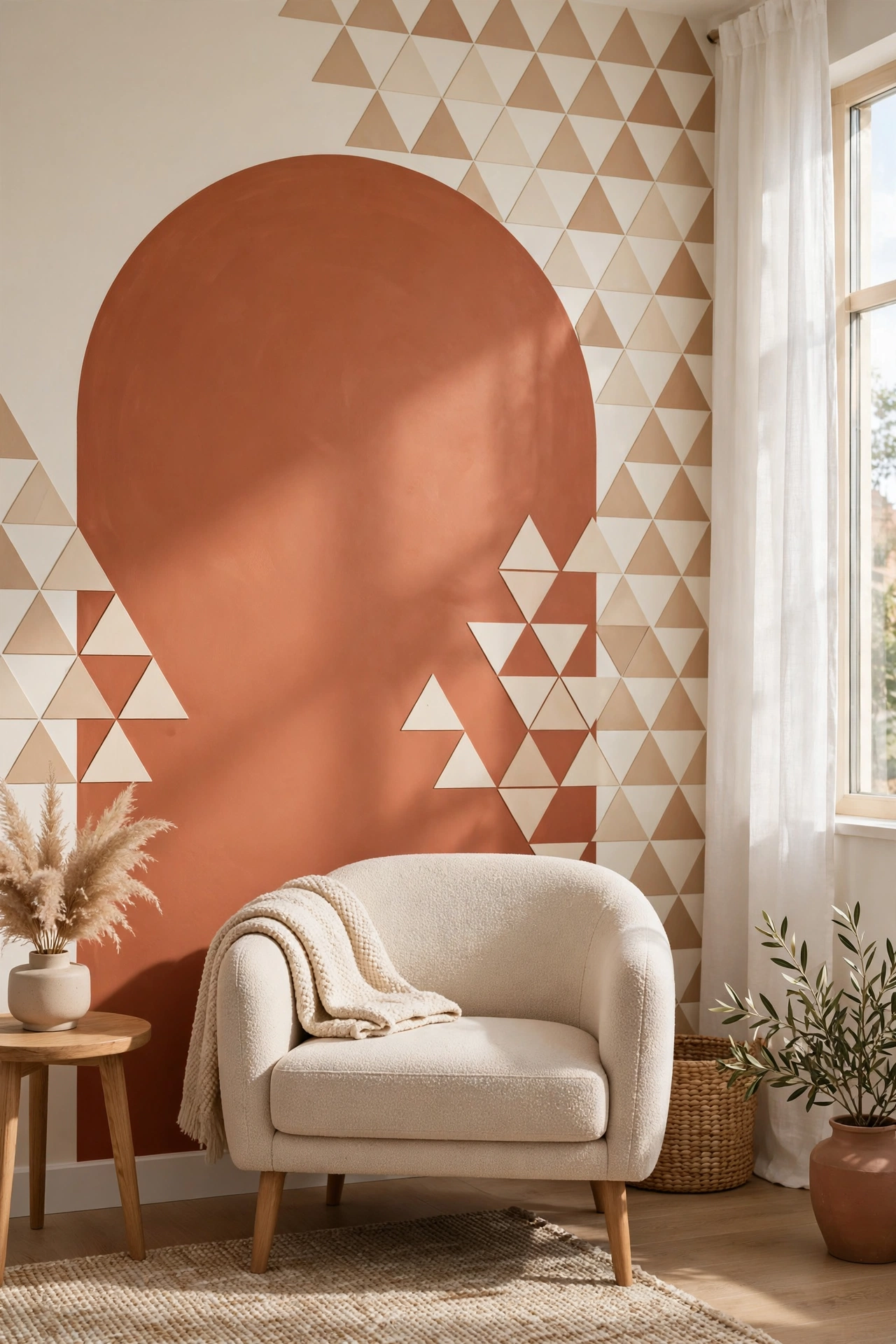
The painted arch trend meets geometry: one big terracotta arch as the anchor, with small triangles and shapes scattered around it. It frames your sofa or reading chair like a piece of art and softens the sharpness of pure geometric patterns. All you need is a pencil on a string for the arch curve and tape for the shapes.
Try this: swing the arch from a pin at center height using a string as a compass. Freehand arches always look slightly drunk; string arches look perfect.
7. Sunburst Lines from the Corner
Difficulty: Moderate | Cost: $40-$100
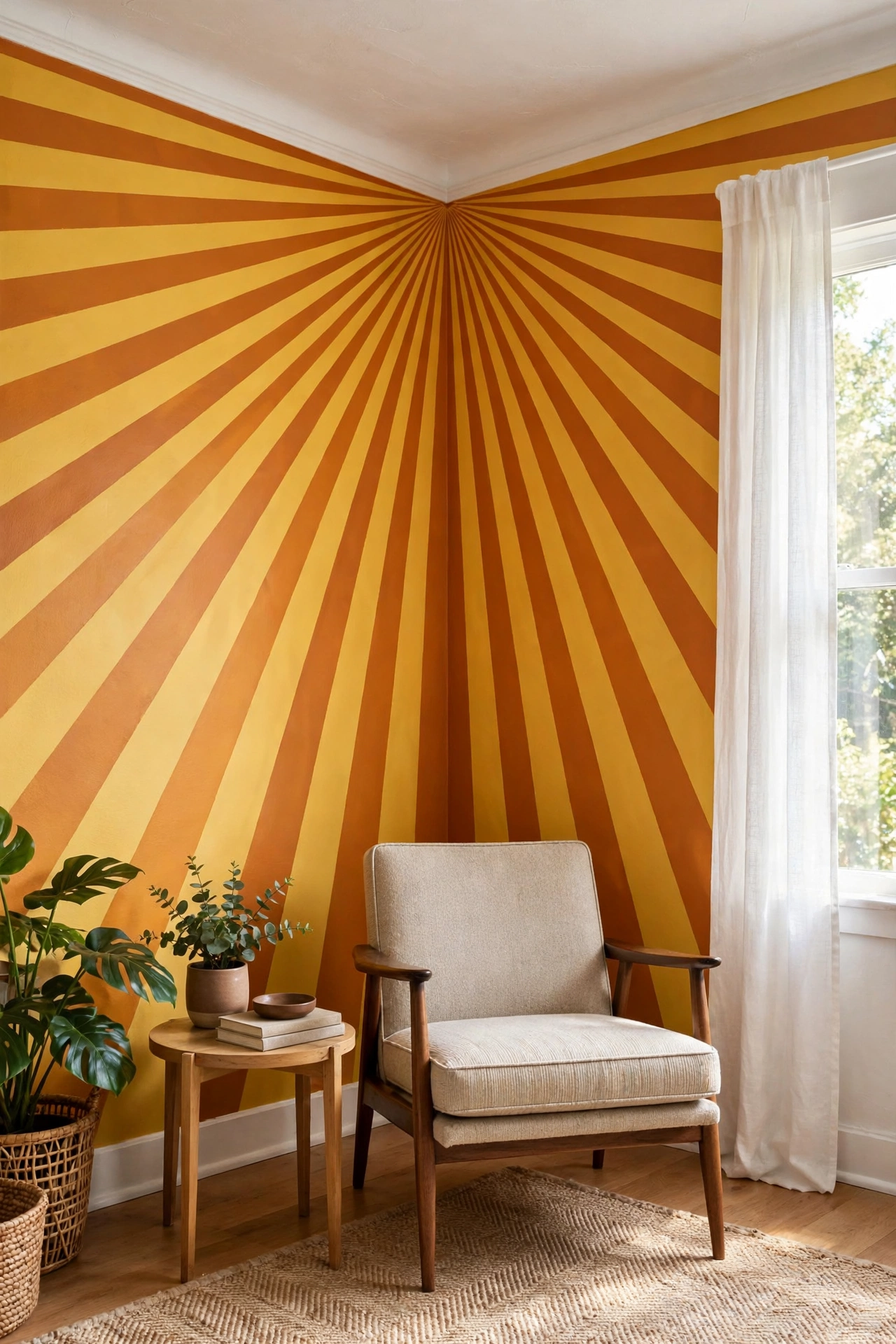
Lines radiating from one corner turn a plain wall into an energy source. Pin a string at the corner, swing it to mark perfectly straight rays, tape, and paint alternating colors. Corners that feel dead and awkward become the liveliest spot in the room.
If you are dressing up an awkward living room corner anyway, these beautiful corner cabinet ideas show how to pair a statement wall with corner furniture that uses the space instead of wasting it.
Try this: leave some rays unpainted so the base wall color becomes part of the pattern. Negative space makes sunbursts breathe.
8. Overlapping Circles Grid
Difficulty: Easy | Cost: $30-$80
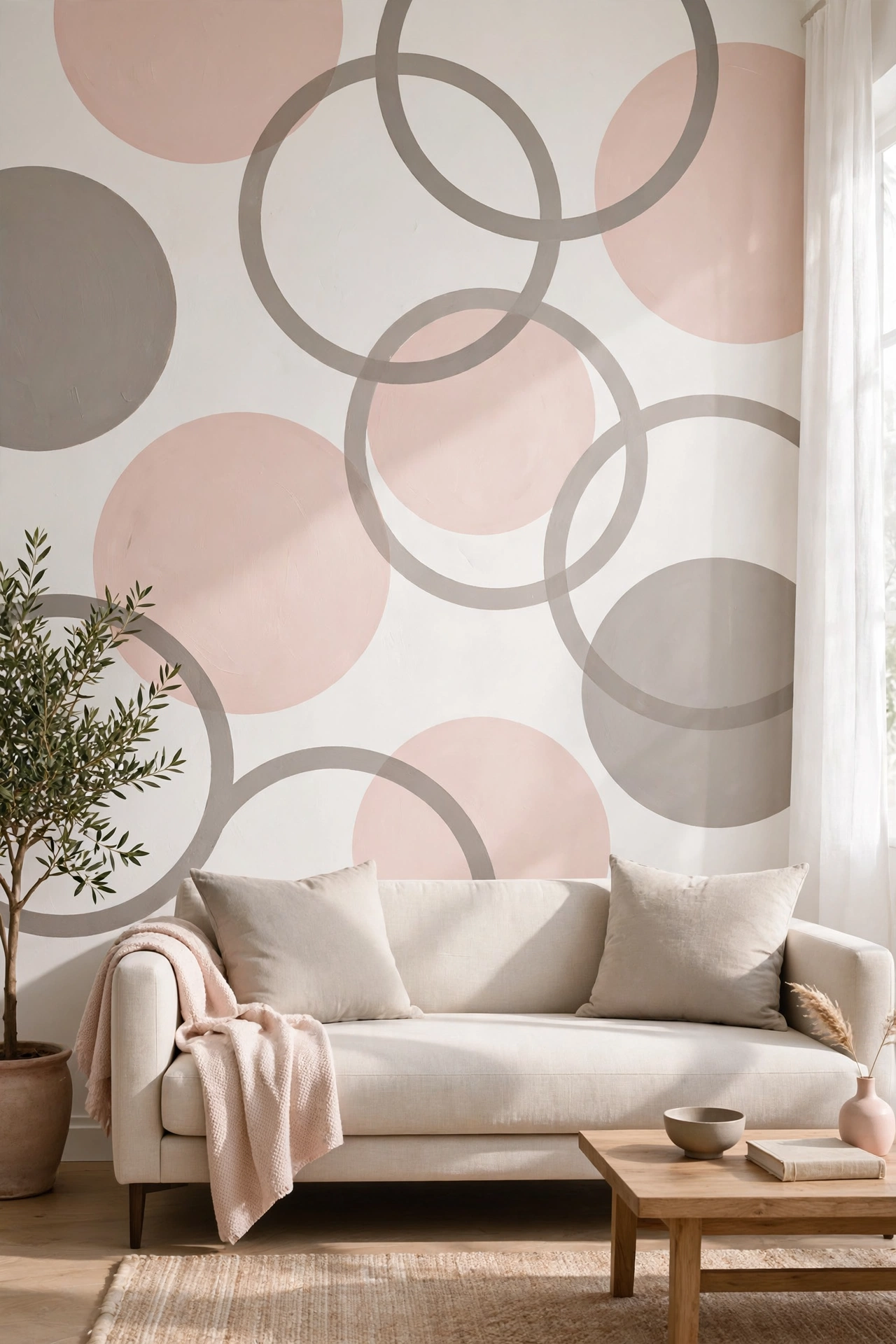
Circles are geometry’s soft side — all the modern edge of a pattern wall with none of the sharpness. Use a pushpin and string to mark consistent arcs, or trace large plates and bowls. Overlapping circles in two muted tones look textile-like and calm, perfect if bold angles feel too aggressive for your space.
Try this: mark a light pencil grid first so your circles stay evenly spaced. Eyeballed circles drift, and drift is very visible in a grid.
9. 3D Cube Optical Illusion
Difficulty: Easy | Cost: $30-$80
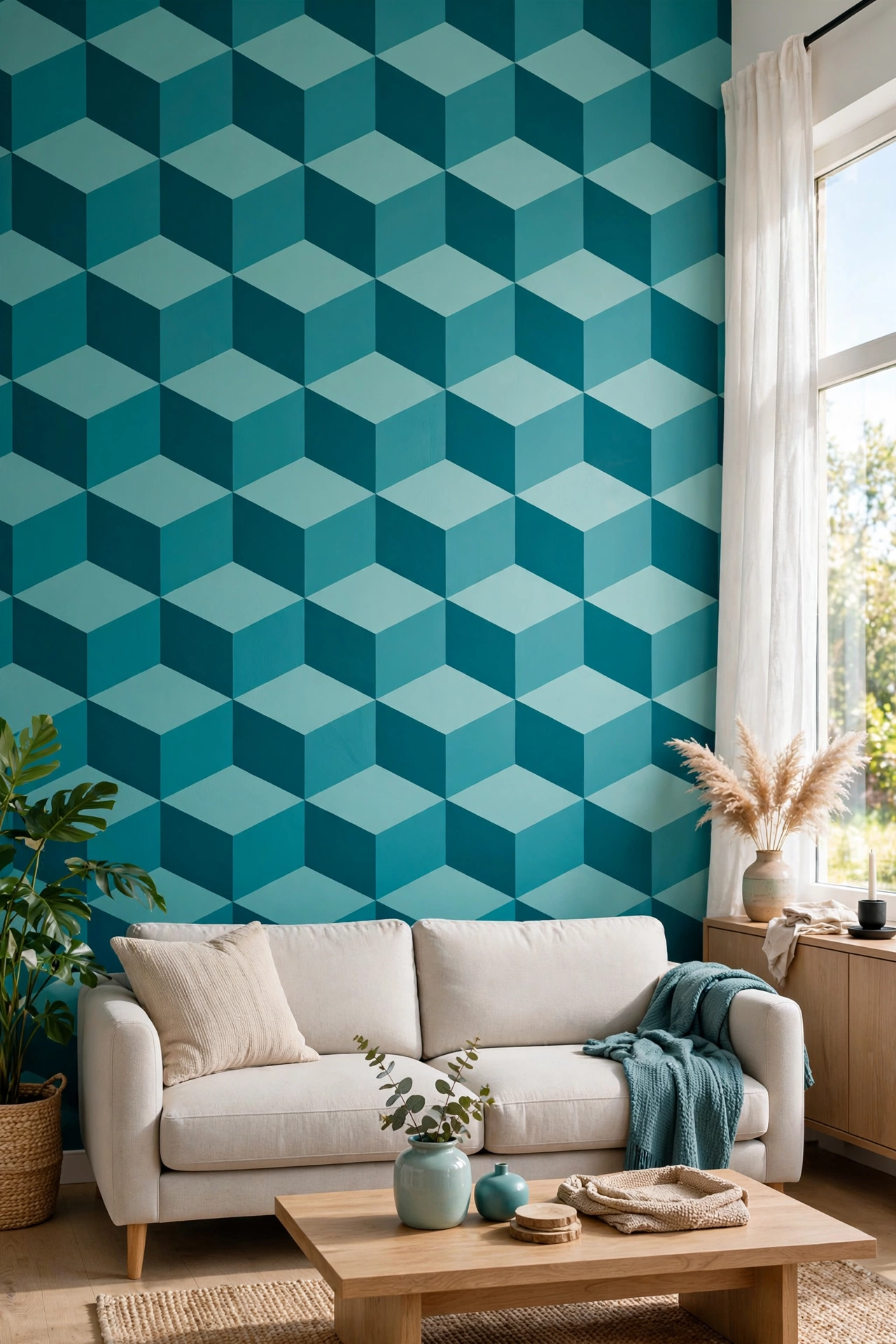
The showstopper: painted cubes that look like they float off the wall. Each cube needs three specific shades (light, medium, dark) placed on the right faces, and the illusion holds from across the room. It is fiddly — do a small paper mockup first — but nothing else gets this reaction from guests.
Try this: finish one complete cube before starting the next. Consistent angles across cubes are what keep the illusion from falling apart.
10. Scandi Minimalist Outline Triangles
Difficulty: Moderate | Cost: $40-$100
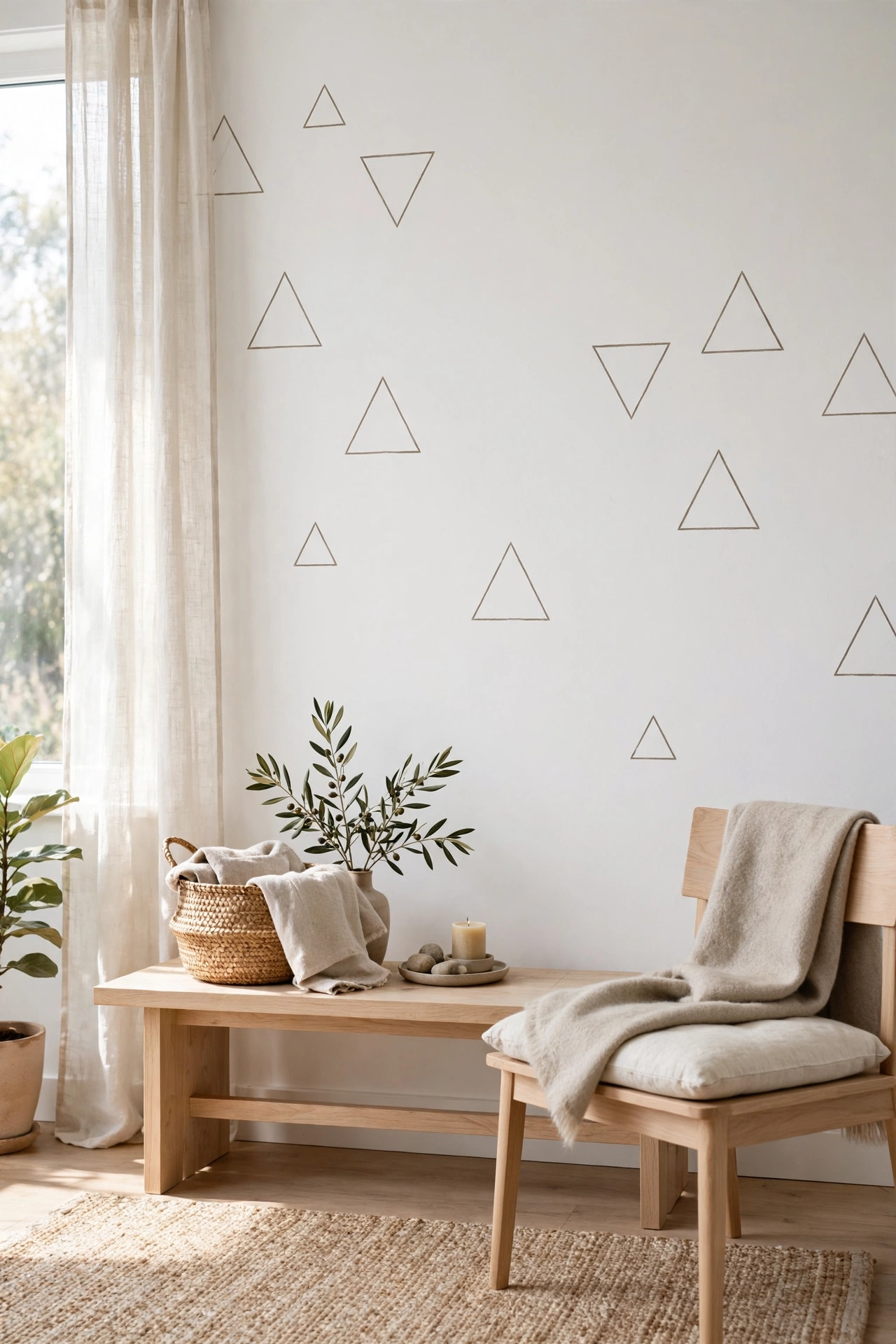
For the “I like geometric walls but I live in a calm house” crowd: thin outline triangles, sparsely scattered on white. Same tape-and-paint technique, a fraction of the commitment. It adds interest without noise, and it is the easiest pattern on this list to undo if you change your mind.
Try this: use washi tape or fine-line tape for the outlines. Thin lines need thin tape, and regular painter’s tape makes them clumsy.
11. Black and White Graphic Triangles
Difficulty: Easy | Cost: $30-$80
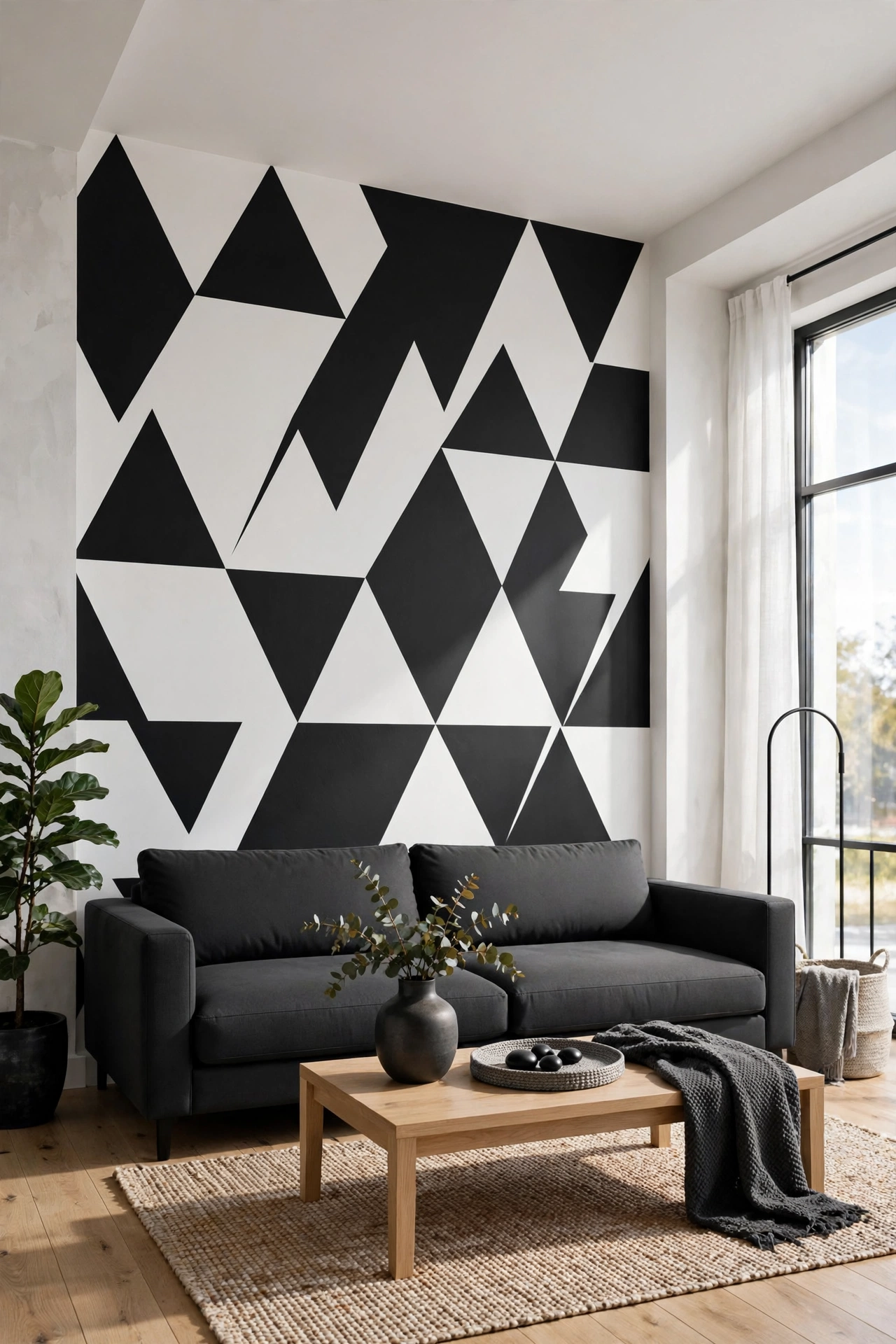
Black and white triangles are the little black dress of accent walls — dramatic, timeless, and they go with literally everything. The high contrast does demand crisp lines, so take your time with the tape. One wall of this and a neutral room suddenly has a point of view.
Try this: seal every tape edge with your white base coat before painting black. Black bleeds show on white like nothing else, and this one step prevents them all.
12. Terracotta Arch and Triangle Combo
Difficulty: Easy | Cost: $30-$80
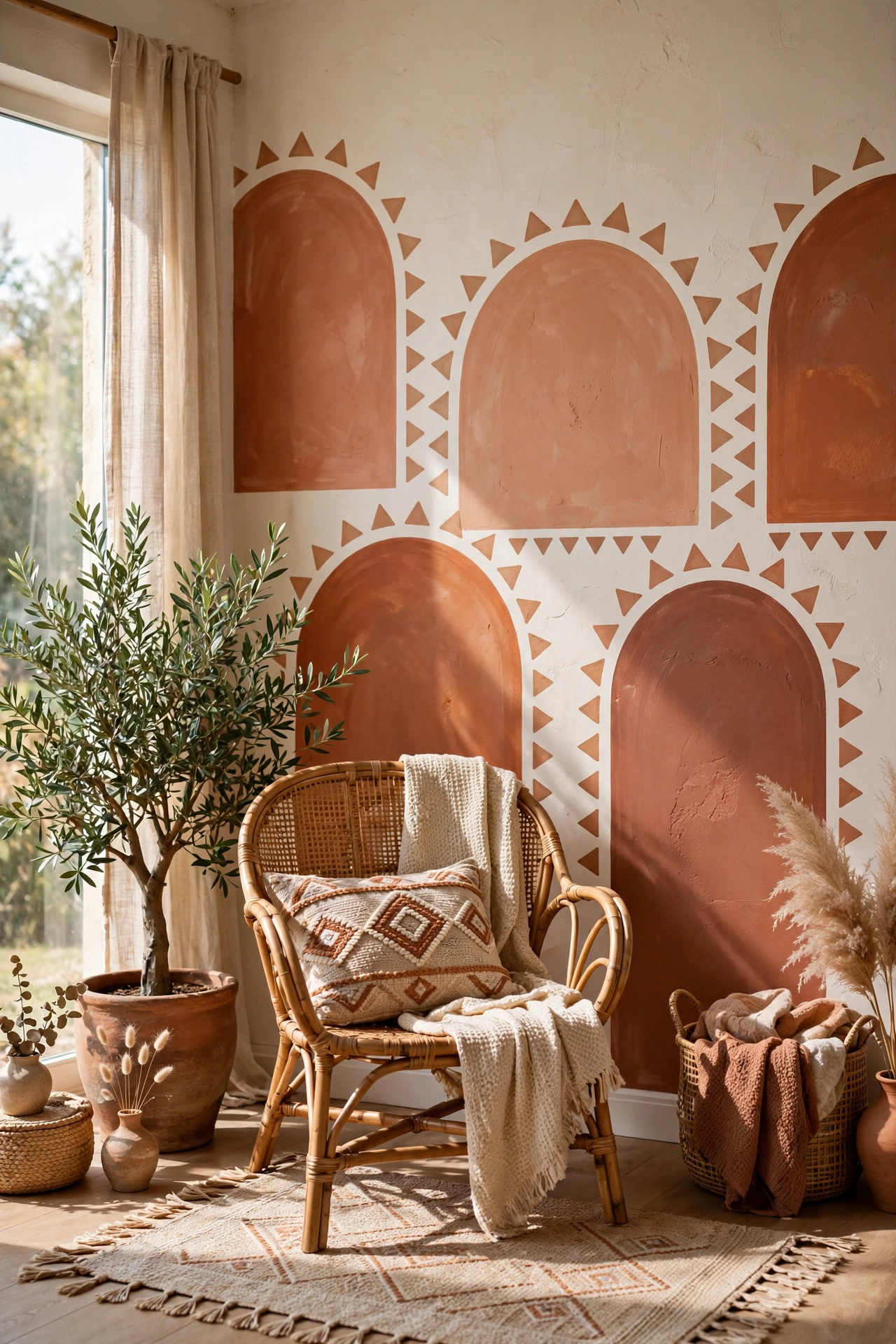
Boho geometry: warm clay arches, small triangle motifs, rattan and texture everywhere. This is the friendliest geometric wall — earthy instead of edgy. Paint the arches with a brush (no tape needed for curves if you steady your hand) and tape only the triangles. It pairs beautifully with woven baskets, macramé, and sun-warmed wood tones.
Try this: warm your terracotta sample against your actual furniture before buying gallons. Terracotta shifts wildly between warm and cool light.
13. Ombre Gradient Triangles
Difficulty: Easy | Cost: $30-$80
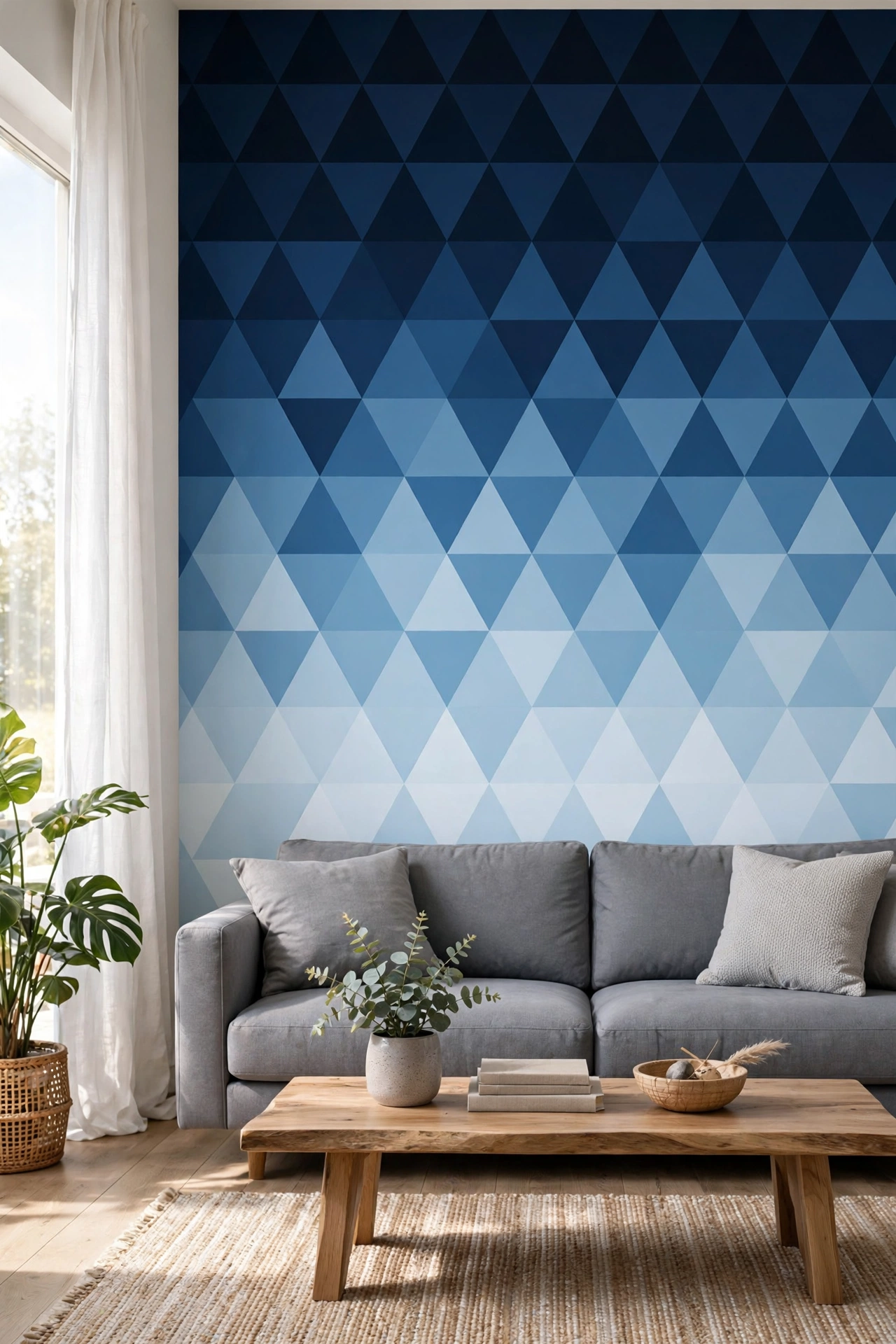
Paint your triangles in a gradient — deep navy at the bottom fading to pale sky blue at the top — and the wall gains depth and movement. Mix your own stepped shades between the two endpoints (five or six steps is plenty). It reads as one sophisticated idea rather than a bunch of separate shapes.
Try this: paint all triangles of one shade before mixing the next. Assembly-line painting keeps your gradient steps consistent.
14. Half-Wall Diagonal Split
Difficulty: Moderate | Cost: $40-$100
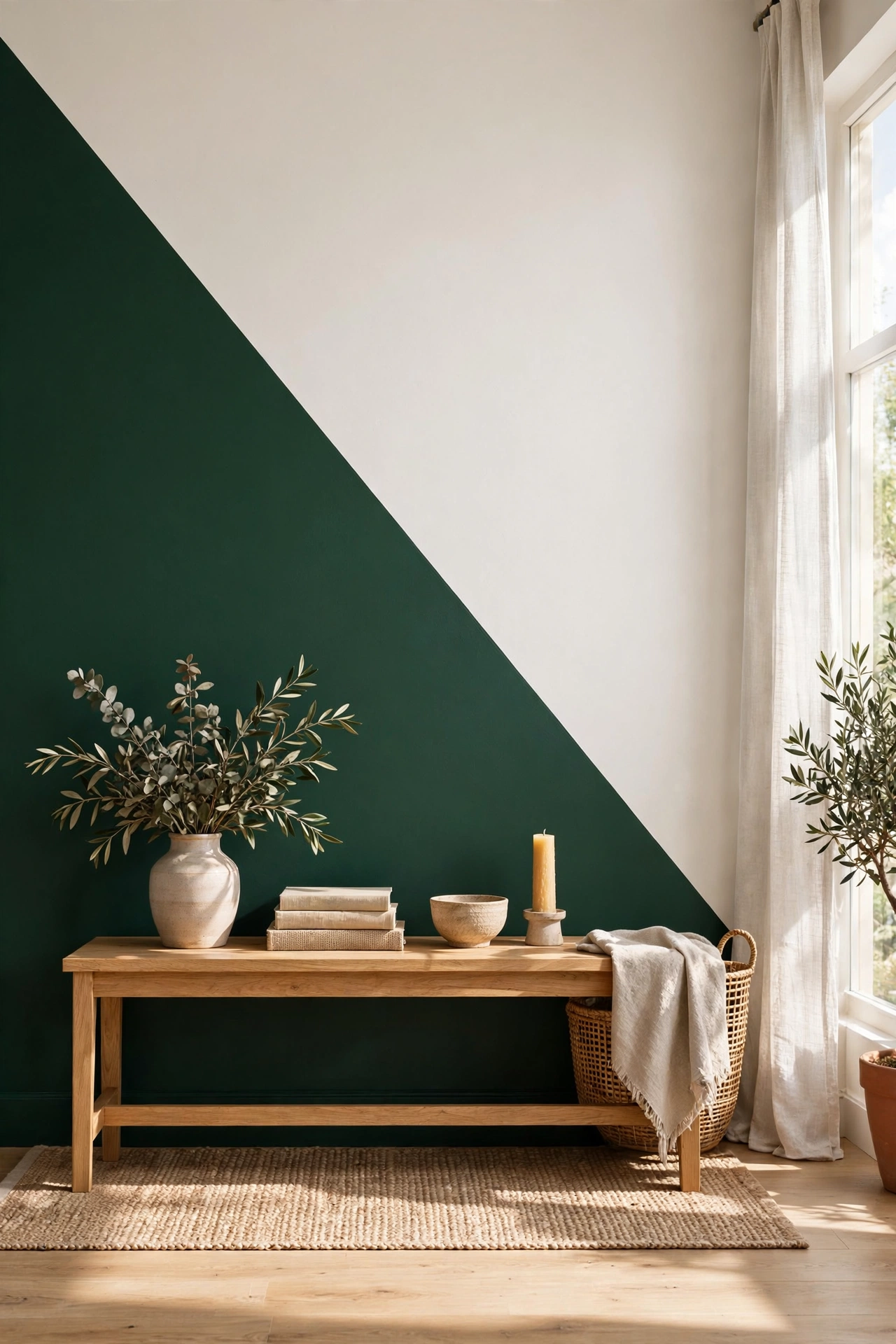
The simplest geometric wall that still looks designed: one diagonal line, two colors. Deep green below, warm white above, and the diagonal makes the ceiling feel higher and the room feel longer. You can tape and paint this in a single afternoon, and it is the best first-timer project on this list.
Try this: run the diagonal from a high corner down to about chair-rail height on the other side. Too shallow and it looks like a mistake; a bold angle looks intentional.
15. Modern Checkerboard Grid
Difficulty: Easy | Cost: $30-$80
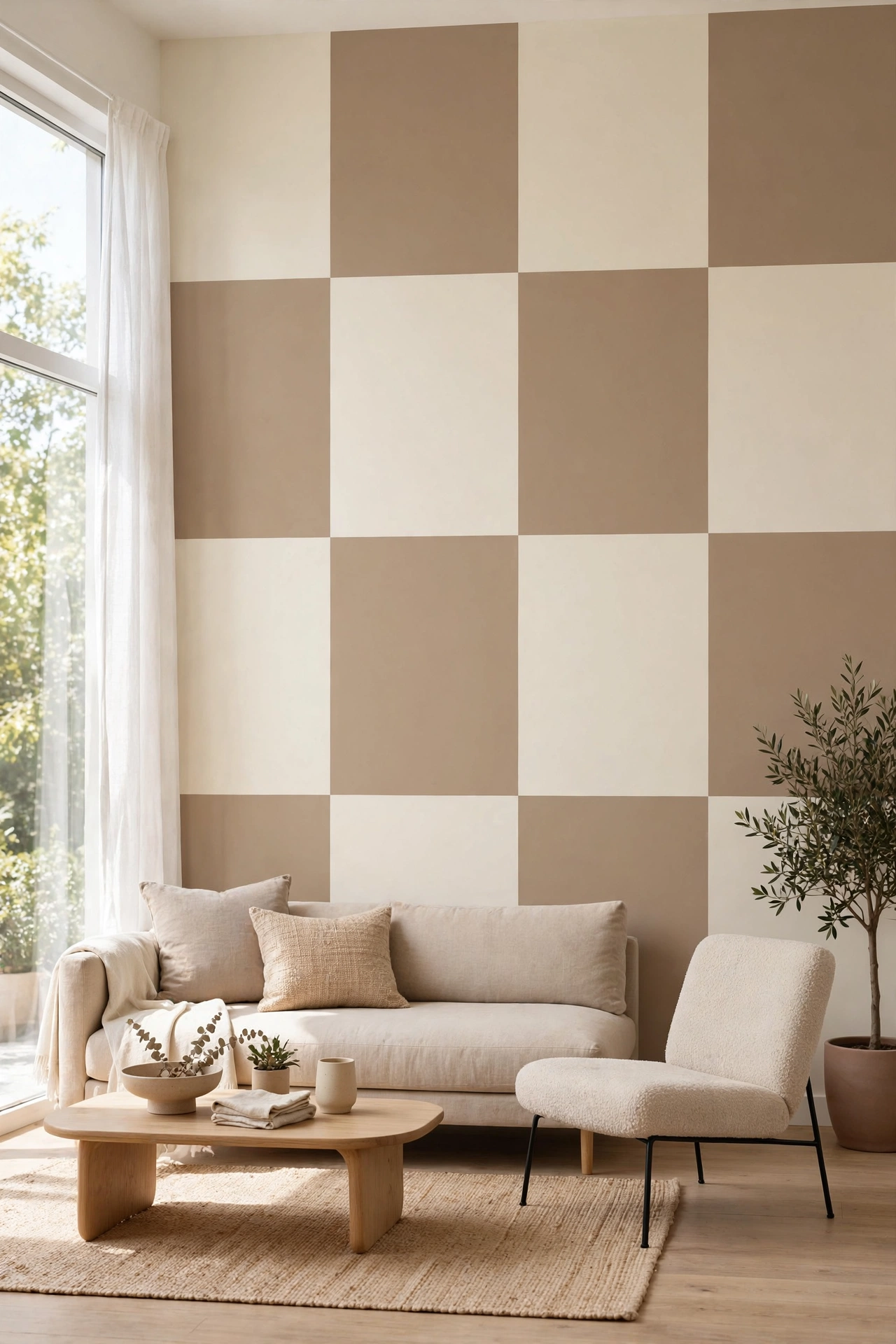
Oversized checkerboard squares in two soft neutrals — not the black-and-white diner version, but a grown-up, warm take. Big squares (18 to 24 inches) keep it calm and graphic. It is pure tape-and-measure work, no artistic talent required, and it photographs beautifully. Try cream with warm taupe, or soft gray with greige.
Try this: start your grid from the center of the wall and work outward so the cut squares land evenly at both edges.
16. Mountain Range Behind the Sofa
Difficulty: Easy | Cost: $30-$80
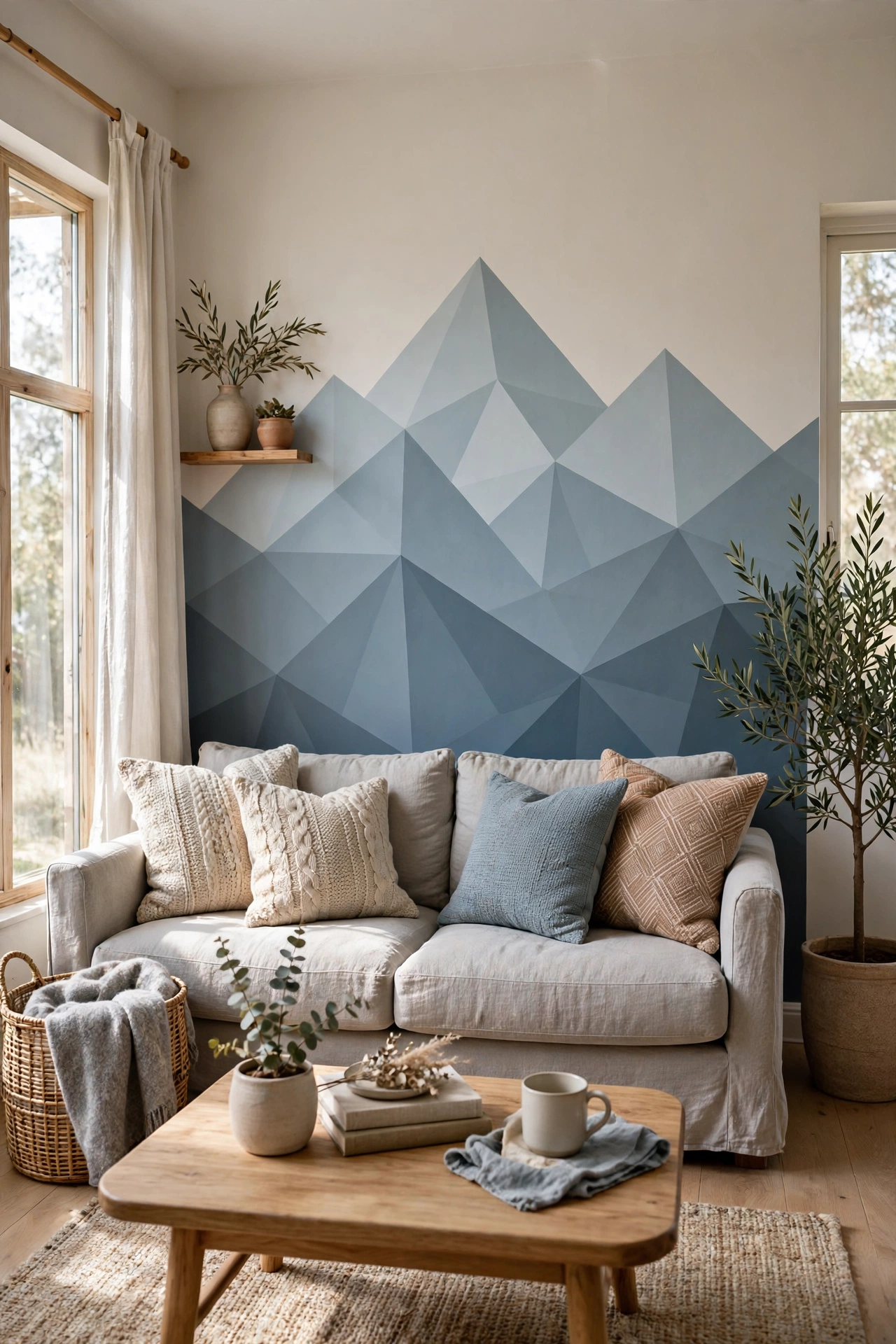
Your sofa’s backdrop is the most-seen wall in the house, and a muted mountain range turns it into a focal point. Keep the palette calm — layered blue-grays on a warm white base — so it feels serene rather than shouty. The sofa in front of the peaks completes the composition like a frame.
Try this: paint the mountains first, then position the sofa. It is much easier to compose the scene when the furniture is not in the way.
17. Wide Chevron Stripes
Difficulty: Moderate | Cost: $40-$100
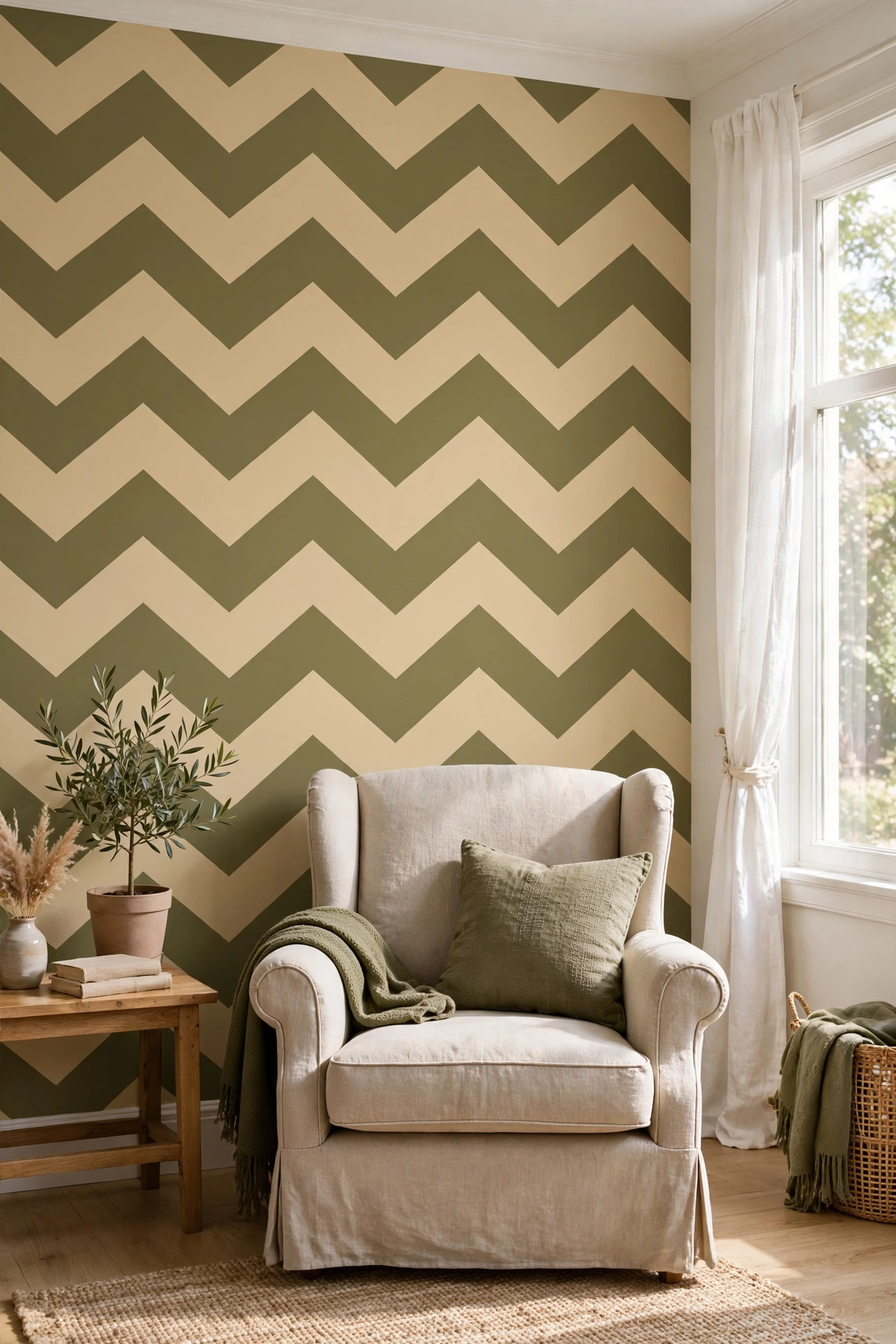
Chevron is the friendlier cousin of herringbone — continuous zigzag stripes instead of broken ones, so the taping is simpler. Wide stripes in warm neutrals keep it relaxed and timeless. It adds energy without demanding attention, which makes it great behind a TV or a busy bookshelf.
Try this: keep your chevron points at the same height across the wall with a level line. Drifting peaks are the one thing that ruins chevron.
18. Art Deco Scallop Fans
Difficulty: Moderate | Cost: $50-$120
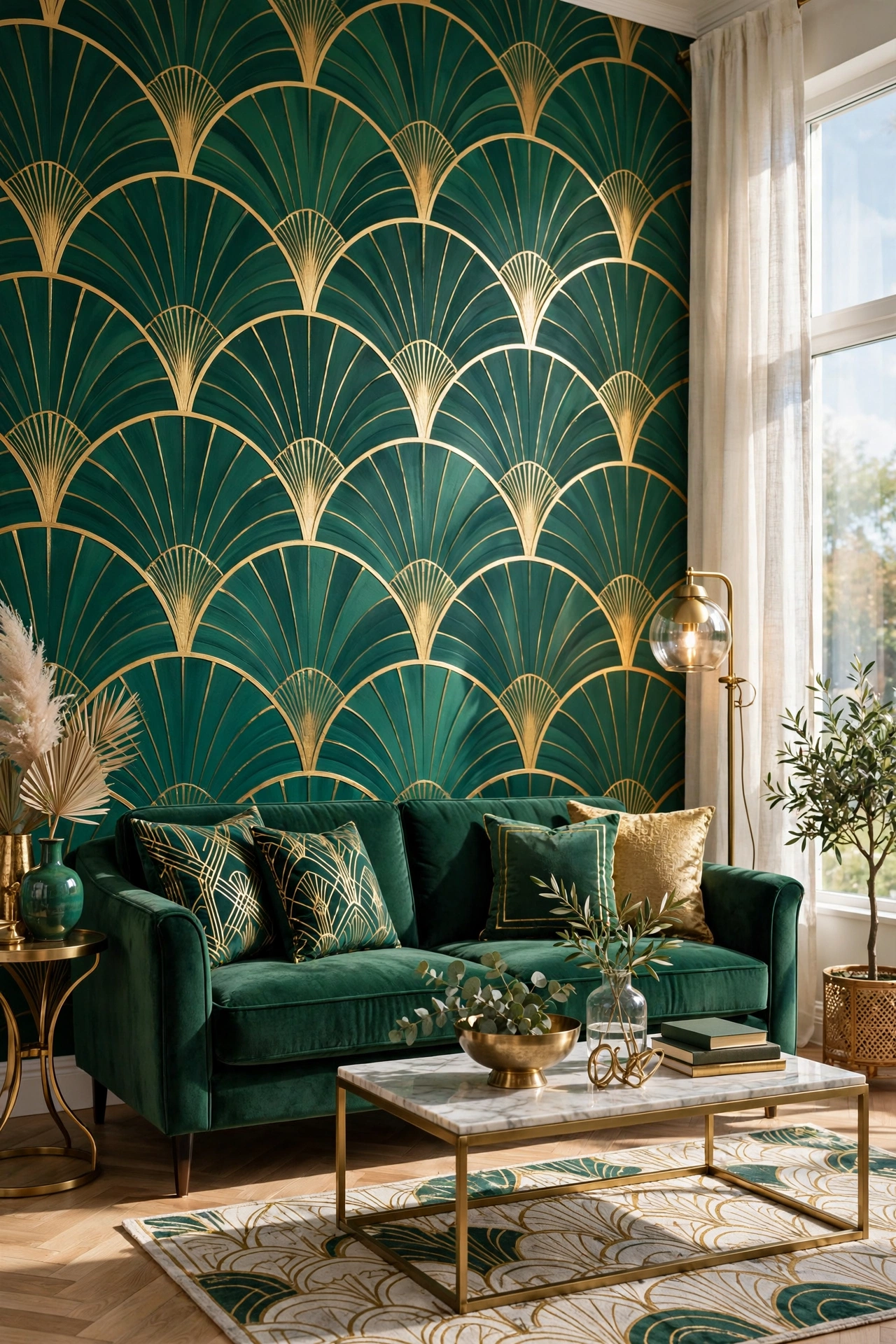
Art deco geometry — scallop fans, stepped arches, gold accents — brings instant glamour. Trace scallops with a large bowl, paint emerald or navy, add thin gold lines with a metallic paint pen. For another weekend accent-wall project, Sherwin-Williams’ ombre accent wall guide walks through a blended color wall step by step.
Try this: practice one scallop on poster board first. Curves are the only shapes on this list that reward a rehearsal before the wall.
19. Geometric Forest Silhouette
Difficulty: Easy | Cost: $30-$80
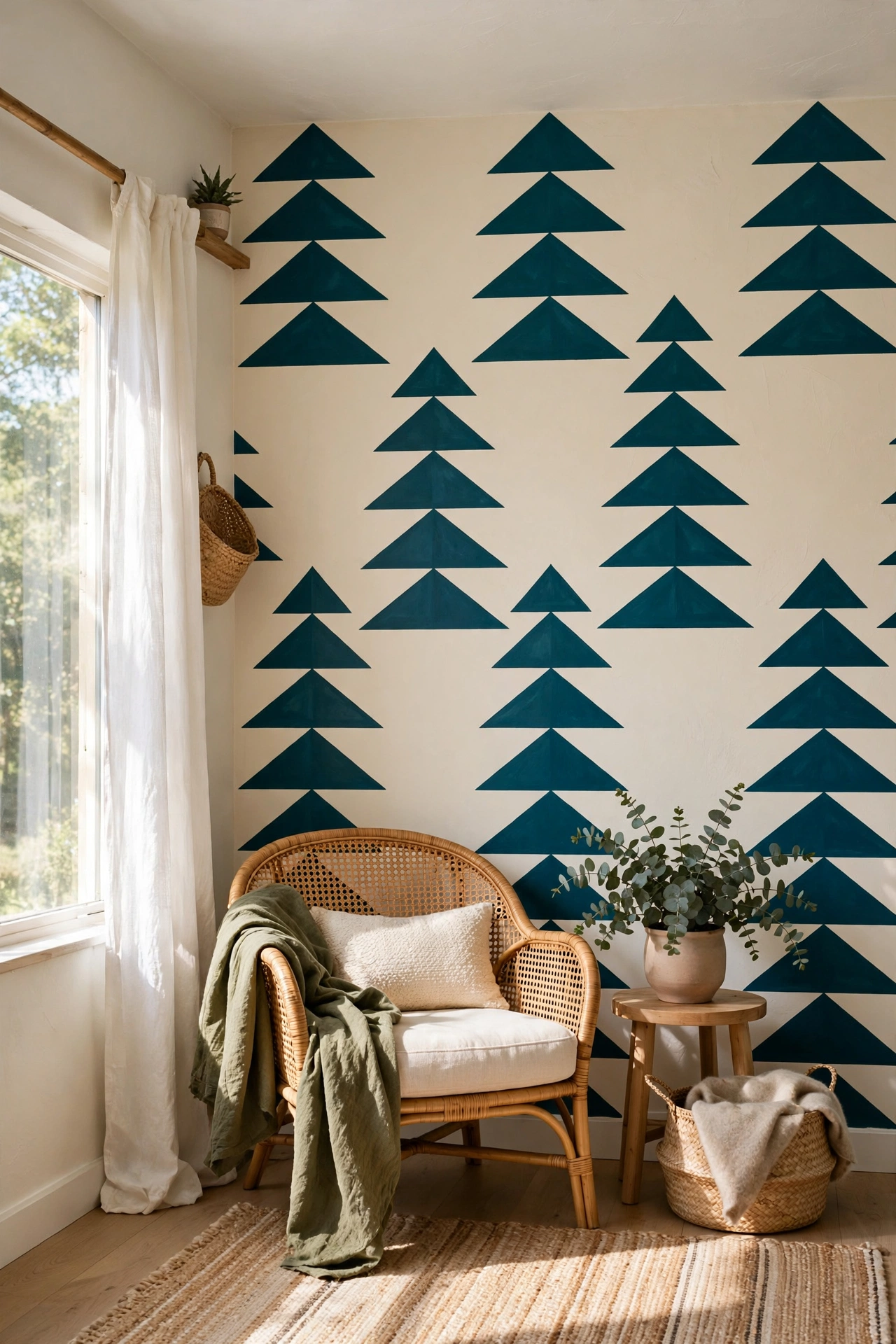
Angular pine trees made of straight lines and triangles — a forest reduced to pure geometry. Deep teal trees on cream feel both modern and cozy, and it is a lovely fit for a reading nook corner. The straight-line trees are surprisingly easy: every branch is just a tapered triangle.
Try this: vary the tree heights and cluster them in odd numbers. Three or five trees look natural; two or four look like a logo.
20. Faux Panel Molding Rectangles
Difficulty: Easy | Cost: $30-$80
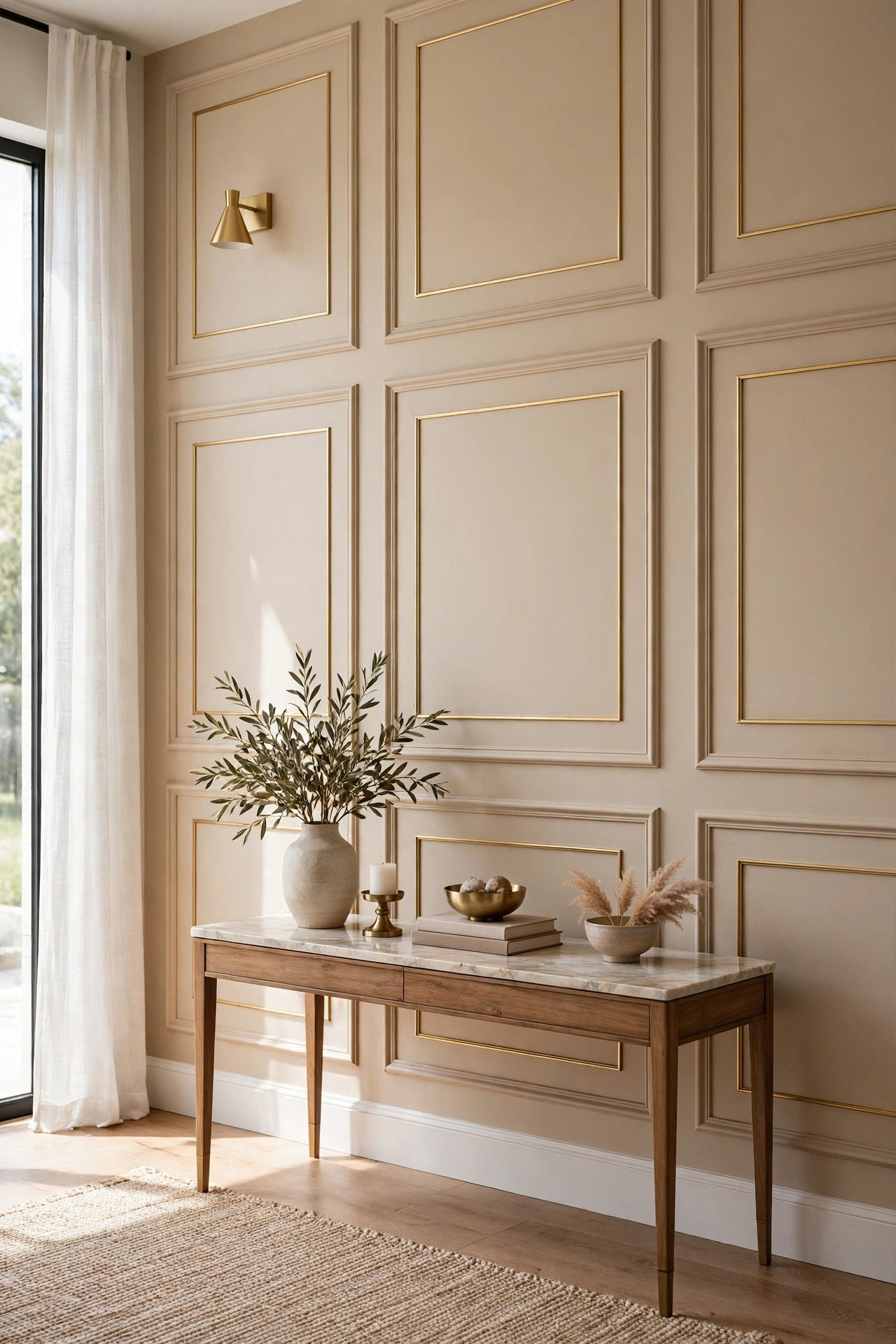
All the elegance of panel molding with none of the carpentry: tape off classic panel rectangles and paint them the same color as the wall, or one shade deeper. From across the room it reads as real millwork. Add thin gold trim lines inside the rectangles for a Parisian-apartment feel.
Try this: map the rectangles with painter’s tape and live with it for a day before painting. Proportion mistakes are free to fix in tape and expensive in paint.
21. Bold Diagonal Stripes
Difficulty: Easy | Cost: $30-$80
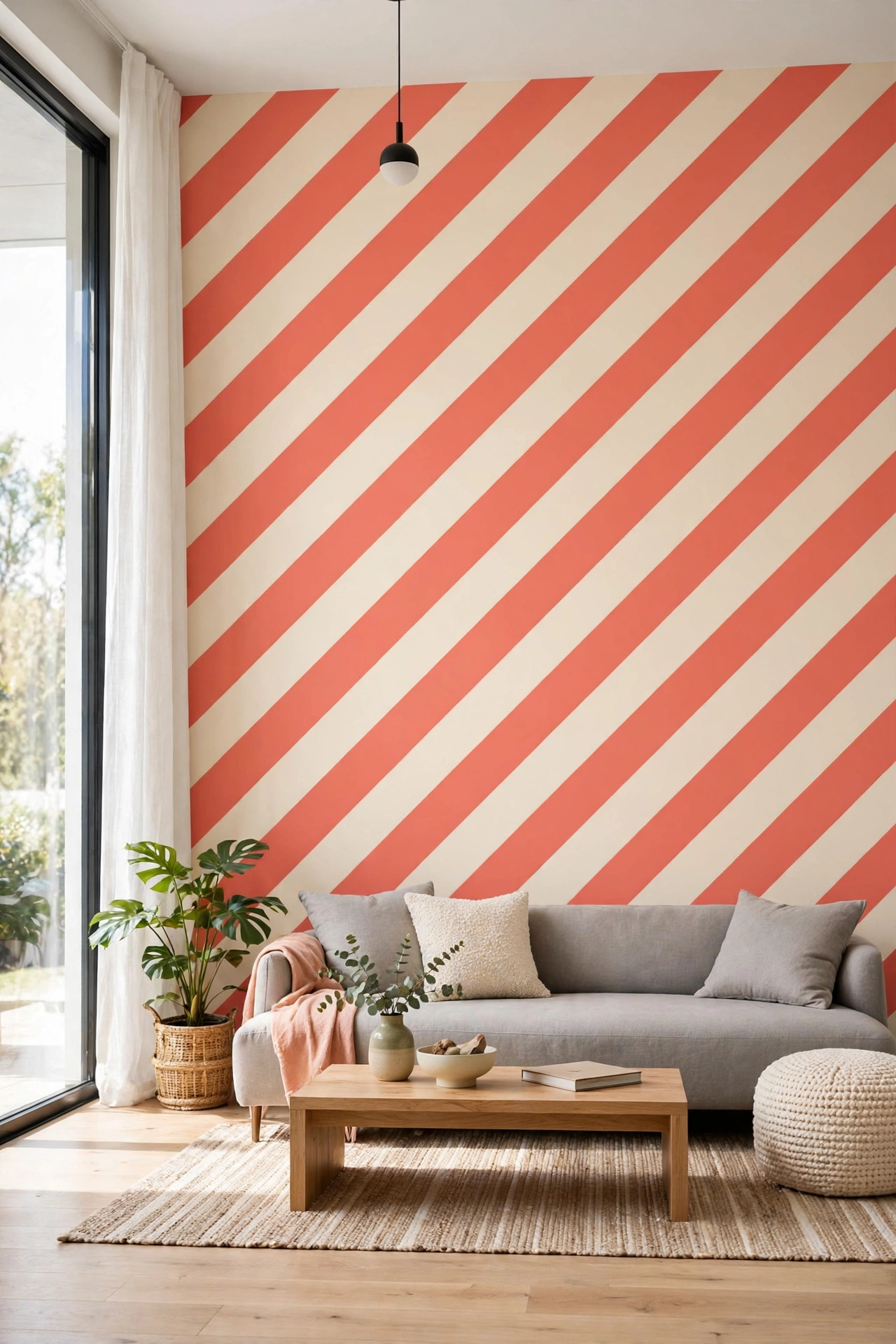
Wide diagonal stripes in coral and cream — maximum energy, minimum effort. Diagonals make narrow rooms feel wider and low ceilings feel taller because the eye travels along the slope. Two colors, one roll of tape, one weekend. This is the wall for people who want drama without complexity.
Try this: keep stripe widths consistent with a spacer block (a piece of cardboard cut to width). Consistent stripes look designed; drifting ones look accidental.
22. Triangle Gallery Cluster
Difficulty: Moderate | Cost: $40-$100
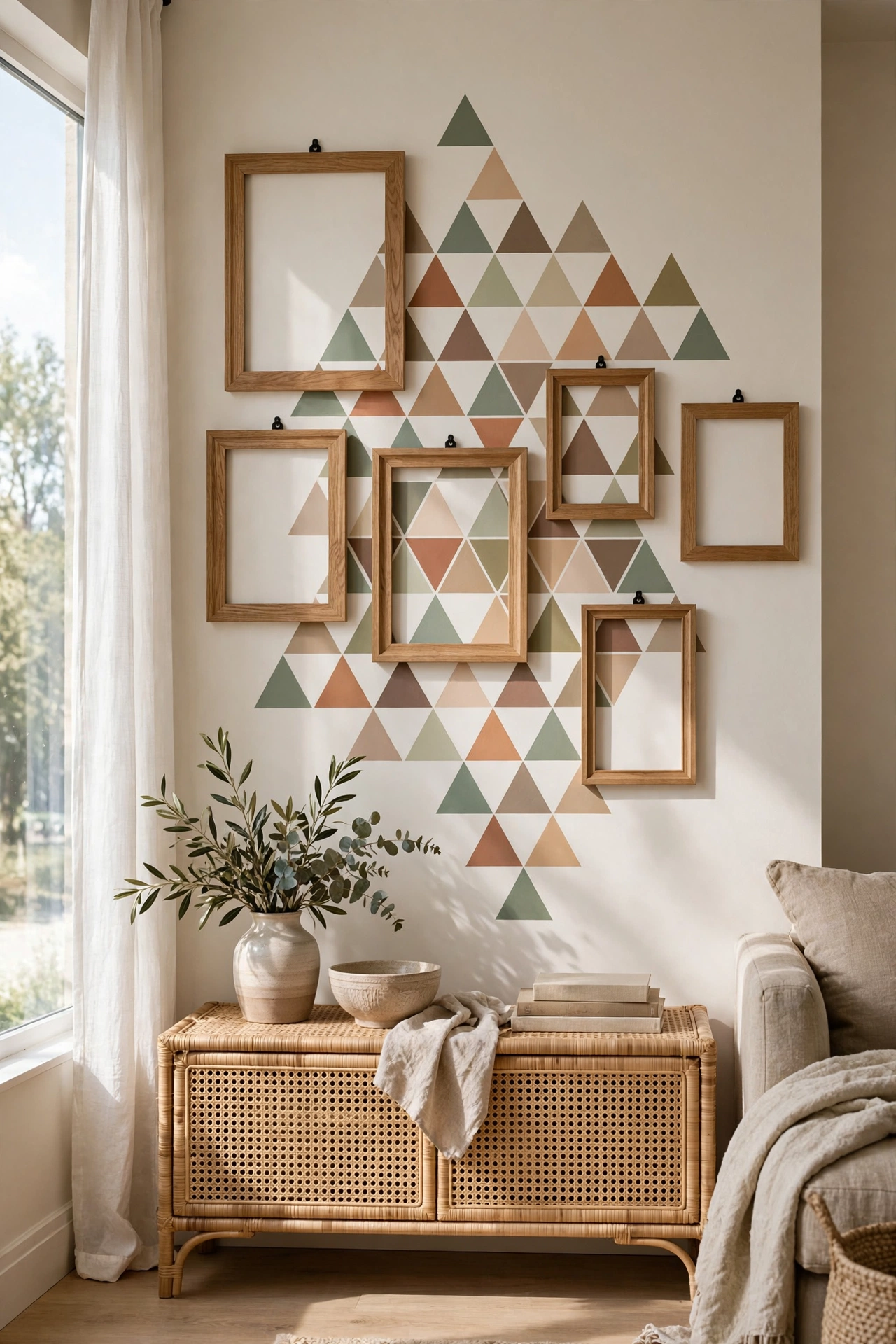
Paint a loose cluster of small triangles in earth tones, then hang your actual framed art over the top. The painted shapes become a backdrop that makes the frames look curated and intentional — like a gallery wall with its own custom wallpaper. It is the best of both worlds: pattern plus personality.
If you love styling walls beyond paint, these decorative wall ideas are full of ways to layer art, shelves, and mirrors over any accent wall — geometric or otherwise.
Try this: hang frames after the paint cures fully (at least 48 hours). Fresh paint plus frame hooks equals chipped paint and tears.
23. Soft Sage Overlapping Shapes
Difficulty: Easy | Cost: $30-$80
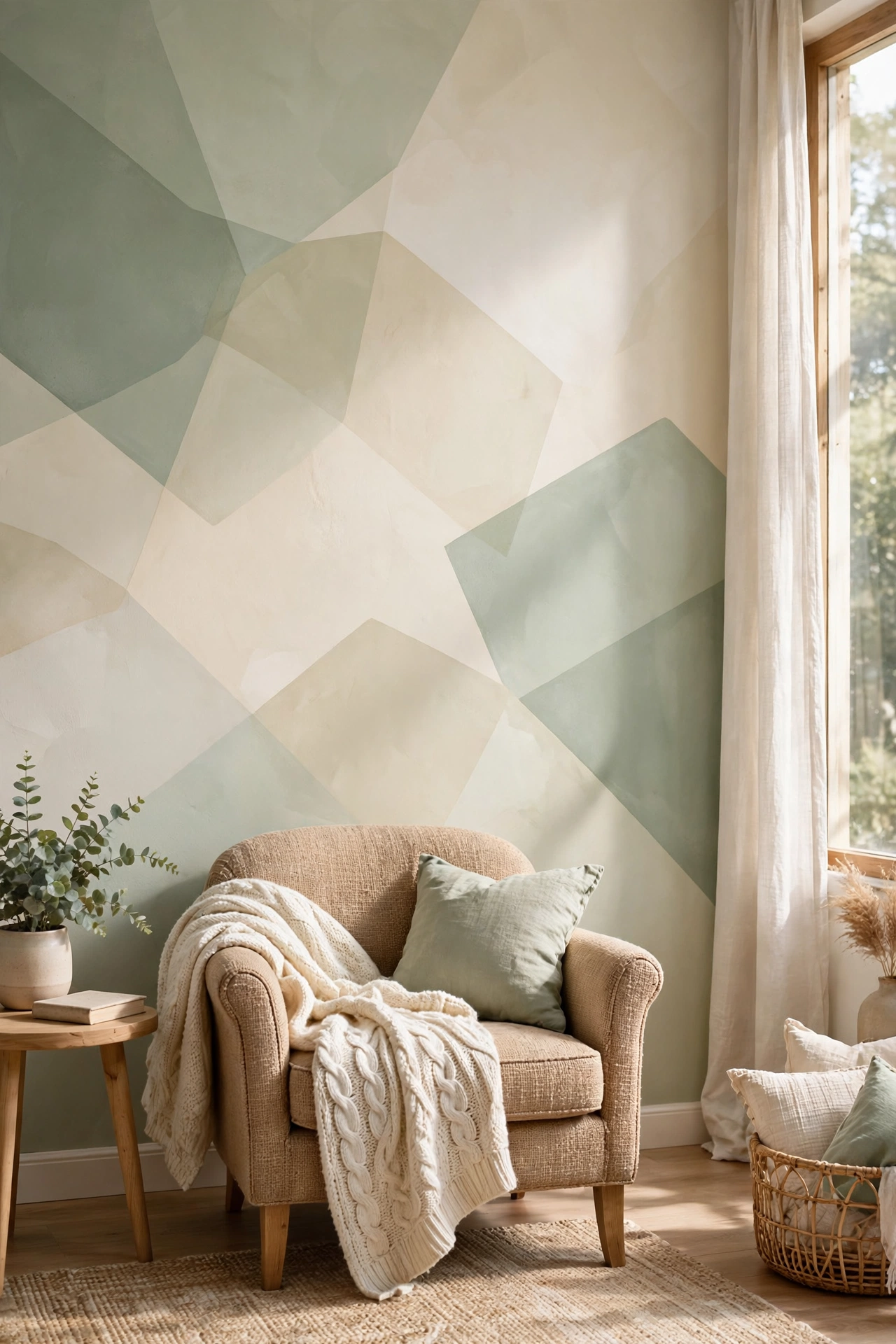
Overlapping organic shapes in sage and cream — geometry at its calmest. No sharp contrast, no loud colors, just gentle layered forms that add depth without noise. Perfect for a room that needs interest but not energy. It works beautifully with natural wood, linen curtains, and soft daylight.
Try this: use low-contrast tones (two steps apart on a paint strip) so the overlaps whisper instead of shout.
24. Geometric Compass Star
Difficulty: Easy | Cost: $30-$80
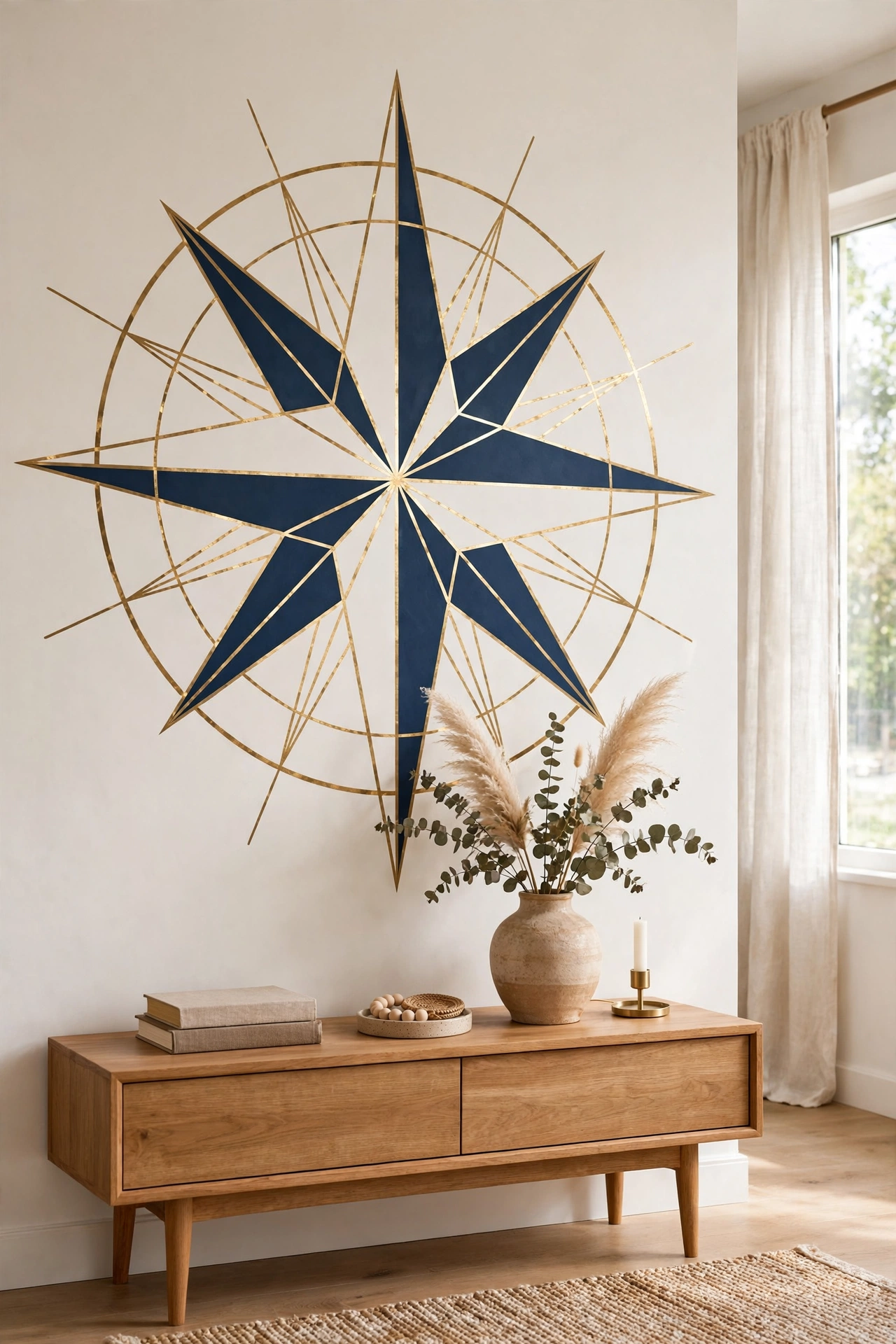
One large compass star — navy points, brass gold accents, centered on the wall — is a single statement instead of a full pattern. It suits traditional and transitional living rooms that want a focal point without a whole wall of busyness. Draw it with a string compass and a straightedge, then tape the straight sections.
Try this: center the star on the wall’s visual center (usually just above where the console table or sofa back hits), not the mathematical center.
25. Two-Tone Blocks with Metallic Accents
Difficulty: Easy | Cost: $30-$80
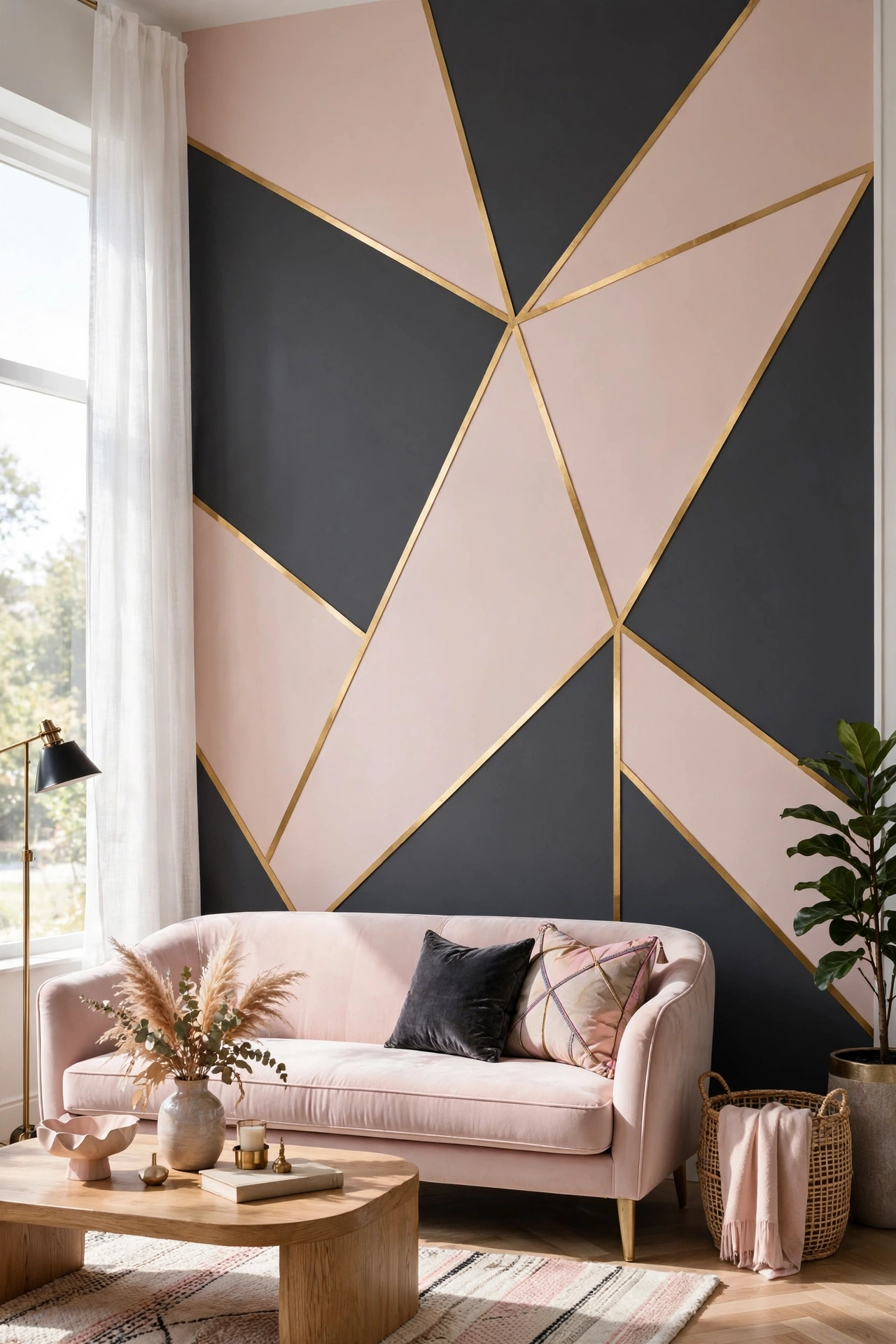
Large two-tone blocks in charcoal and blush, with select sections painted in metallic gold that catch the light as the day moves. The metallics are the secret — they make a simple block pattern feel expensive and alive. Use them sparingly: three or four gold blocks among twenty matte ones is the right ratio.
Try this: paint metallics last, over fully dry base coats, and use two thin coats. Metallic paint shows every brushstroke, so thin and even wins.
Quick-Pick Cheat Sheet
Not sure which pattern fits your living room and your weekend? This cheat sheet matches the most popular options to their difficulty, cost, and style:
| Pattern | Best Style | Est. Cost | Difficulty |
|---|---|---|---|
| Half-wall diagonal split | Modern, minimalist | $15–$30 | Beginner |
| Bold diagonal stripes | Eclectic, maximalist | $20–$40 | Beginner |
| Painter’s tape triangles | Modern, playful | $25–$50 | Beginner |
| Scandi outline triangles | Scandi, minimalist | $15–$30 | Beginner |
| Checkerboard grid | Modern, retro | $25–$45 | Beginner |
| Hexagon honeycomb | Modern, organic | $30–$60 | Intermediate |
| Herringbone | Classic, elegant | $30–$60 | Intermediate |
| Mountain mural | Boho, nature-inspired | $30–$60 | Intermediate |
| 3D cube illusion | Statement, modern | $35–$70 | Advanced |
| Art deco scallops | Glam, traditional | Intermediate |
Frequently Asked Questions
What is the easiest geometric accent wall for a beginner?
A half-wall diagonal split or simple bold stripes. Both need only one roll of painter’s tape, two paint colors, and straight lines — no templates, no curves, no measuring grids. You can finish either in a single afternoon, and the result still looks intentional and designed.
How do I get crisp lines on a geometric accent wall?
Use quality painter’s tape and press the edges down firmly with a credit card or plastic tool. Then seal the tape edge by brushing your base wall color over it — this fills micro-gaps so your accent color cannot bleed under. Remove the tape while the final coat is still slightly tacky, pulling low and slow at a 45-degree angle.
How many colors should I use on a geometric accent wall?
Two to three colors is the sweet spot. Two colors give you clean contrast; three let you add depth and play. Pull them from your existing furniture, rug, or curtains so the wall echoes the room instead of fighting it. If you want a fourth, make it a metallic accent used sparingly.
Which wall should be the accent wall in a living room?
The wall your eyes land on first — usually the one behind the sofa, behind the TV, or the longest uninterrupted wall. Avoid walls broken up by lots of doors and windows; geometric patterns need breathing room to read clearly. In an open-plan space, the wall that anchors the seating area is the natural choice.
Can I do a geometric accent wall in a rental?
Yes, with two caveats: you will need to repaint it back to the original color when you move out, and bold patterns take more coats to cover. Stick to the base-color-plus-pattern approach so covering it later means repainting one solid color over the pattern — usually two coats of primer plus paint. Test your landlord’s flexibility first; some welcome accent walls.
Final Thoughts
A geometric accent wall is the rare project where the gap between effort and impact is almost absurd. Tape, paint, patience — that is the whole recipe. And when the tape comes off and the pattern snaps into focus, it feels less like a paint job and more like you built something.
Start with the pattern that matches your nerve, not your dreams. First-timer? The diagonal split will teach you everything about tape lines in one afternoon. Feeling bold? Triangles and hexagons are more forgiving than they look. And whatever you choose, remember the one rule that matters: seal your tape edges, pull while tacky, and step back often. The wall is going to look fantastic — you just have to let it.


