


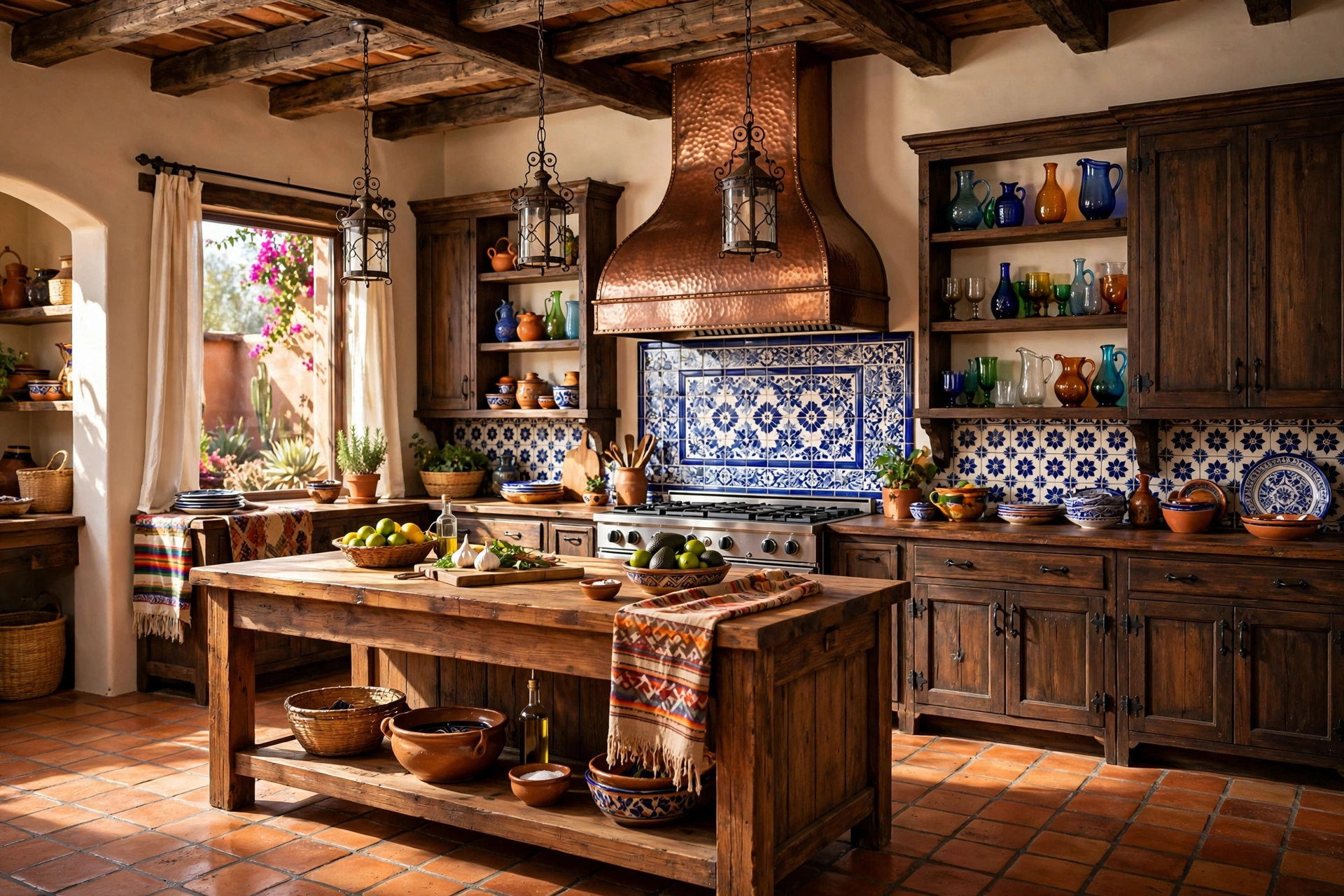
Years ago, we spent a long weekend at a hacienda-style vacation rental in the Arizona desert — the kind of place with a courtyard fountain and a kitchen that stopped me in my tracks the moment I walked in. The floor was warm Saltillo terracotta, the backsplash was a patchwork of hand-painted Talavera tiles in cobalt and saffron, and a rack of copper pots hung from the ceiling beams like jewelry. We cooked every meal there, partly because the restaurants were far away, but mostly because nobody wanted to leave that room.
I came home with two suitcases of pottery and a mission: give our own kitchen some of that warmth. What I learned is that Mexican style isn’t about one expensive renovation — it’s a layering of handmade, honest materials that any kitchen can borrow from. The tile, the wood, the wrought iron, the color: each piece stands on its own. These 25 awesome Mexican style kitchen ideas are everything I’d do again, refined by the mistakes I made the first time around — some are weekend projects, some are bigger investments, and all of them share the same goal: a kitchen that feels like a gathering place, not just a workspace.
- Start with handmade materials: Talavera tiles, Saltillo floors, and distressed wood are the soul of the style.
- Warm colors do the heavy lifting — terracotta, cobalt blue, turquoise, and mustard turn any kitchen festive.
- Mix materials boldly: copper, wrought iron, clay, and glass belong together here, not apart.
- Display your cookware — open shelving, pot racks, and visible pottery are decor, not clutter.
- Renters can get 80% of the look with peel-and-stick tiles, textiles, and accessories — no demolition required.
1. A Talavera Tile Backsplash
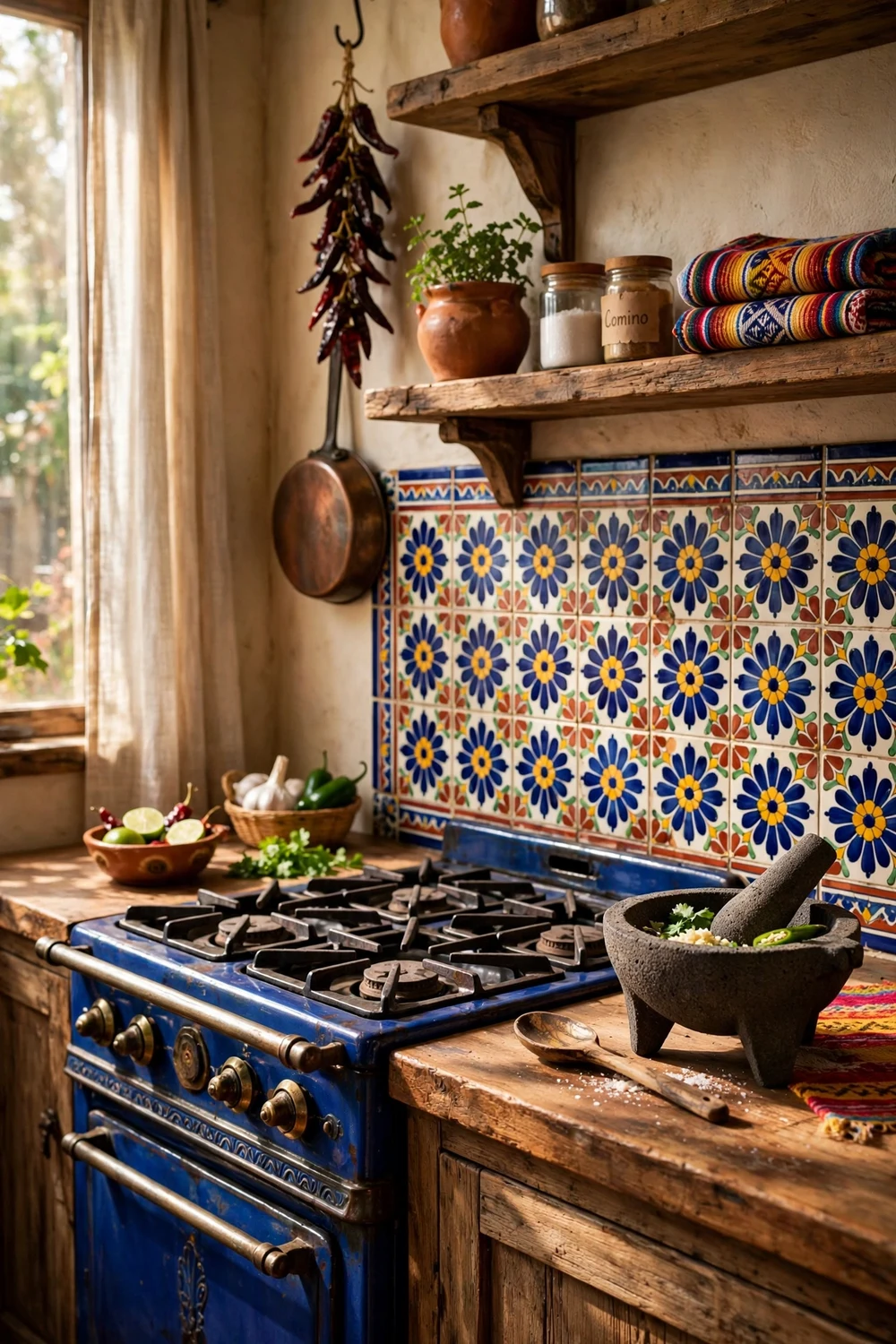
Nothing says Mexican kitchen like Talavera — the hand-painted tin-glazed tiles from Puebla — unmistakable cobalt, saffron, terracotta. A backsplash is their highest-impact spot: one wall of pattern beats any paint color. Mix patterns patchwork-style for a collected look, or repeat one motif for calm.
If you want to go deeper on the history and the different regional tile styles, this guide to indigenous Mexican tile designs breaks down where each pattern comes from and how to combine them.
Try this: use authentic handmade tiles only in the backsplash, and match them with solid-color lookalike tiles on adjacent walls — same palette, half the cost.
Difficulty: Involved | Cost: $800-$2,000
2. Saltillo Terracotta Floors
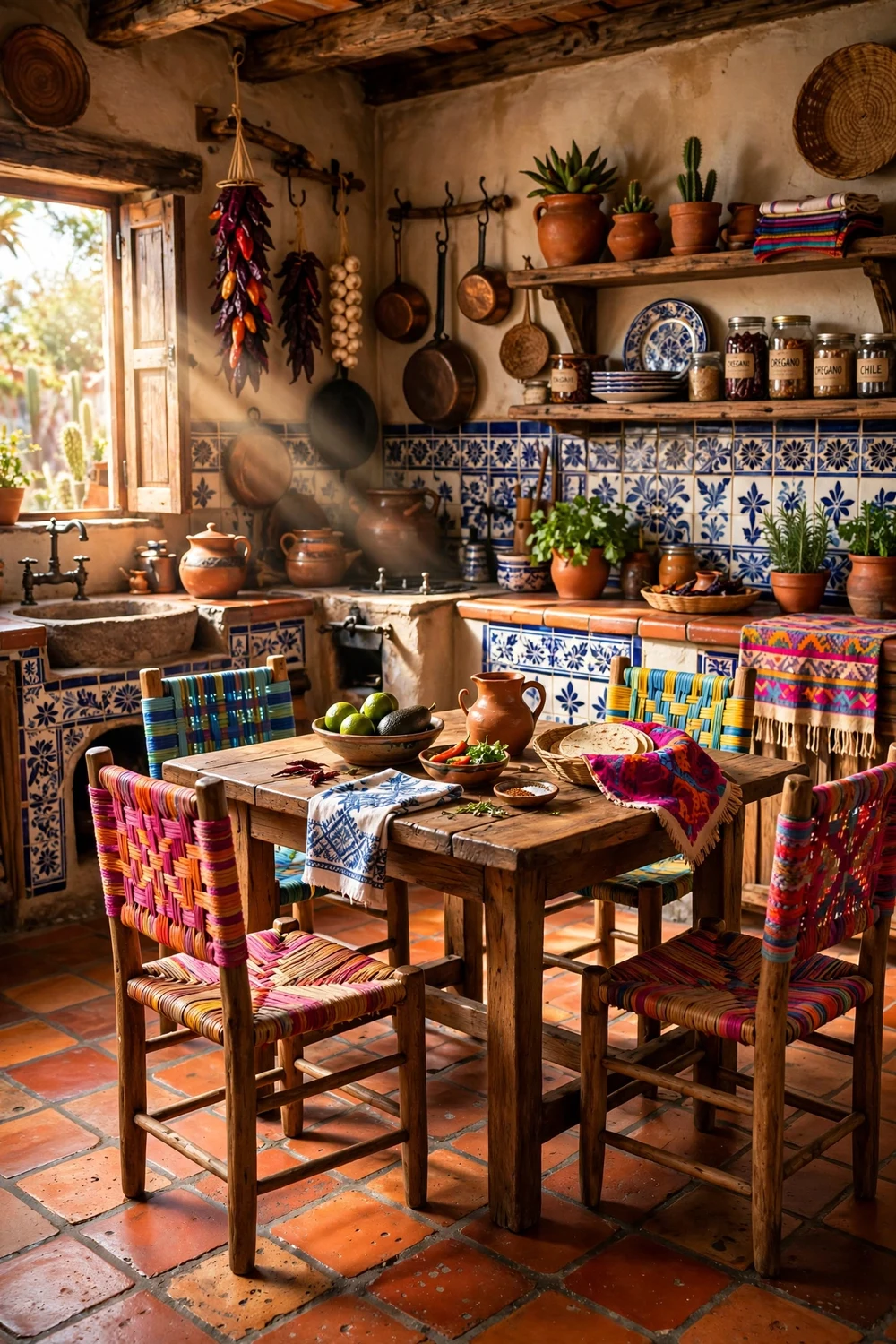
Saltillo tiles — handmade from river clay in Mexico — are the foundation of the classic hacienda kitchen. No two tiles are the same color: they range from pale peach to deep rust, and that variation is exactly what makes the floor glow. They’re warm underfoot, nearly indestructible, and they age beautifully.
Try this: have them sealed with a penetrating sealer during installation. Unsealed Saltillo stains; sealed Saltillo wipes clean for decades.
Difficulty: Involved | Cost: $1,500-$4,000
3. Exposed Wooden Ceiling Beams
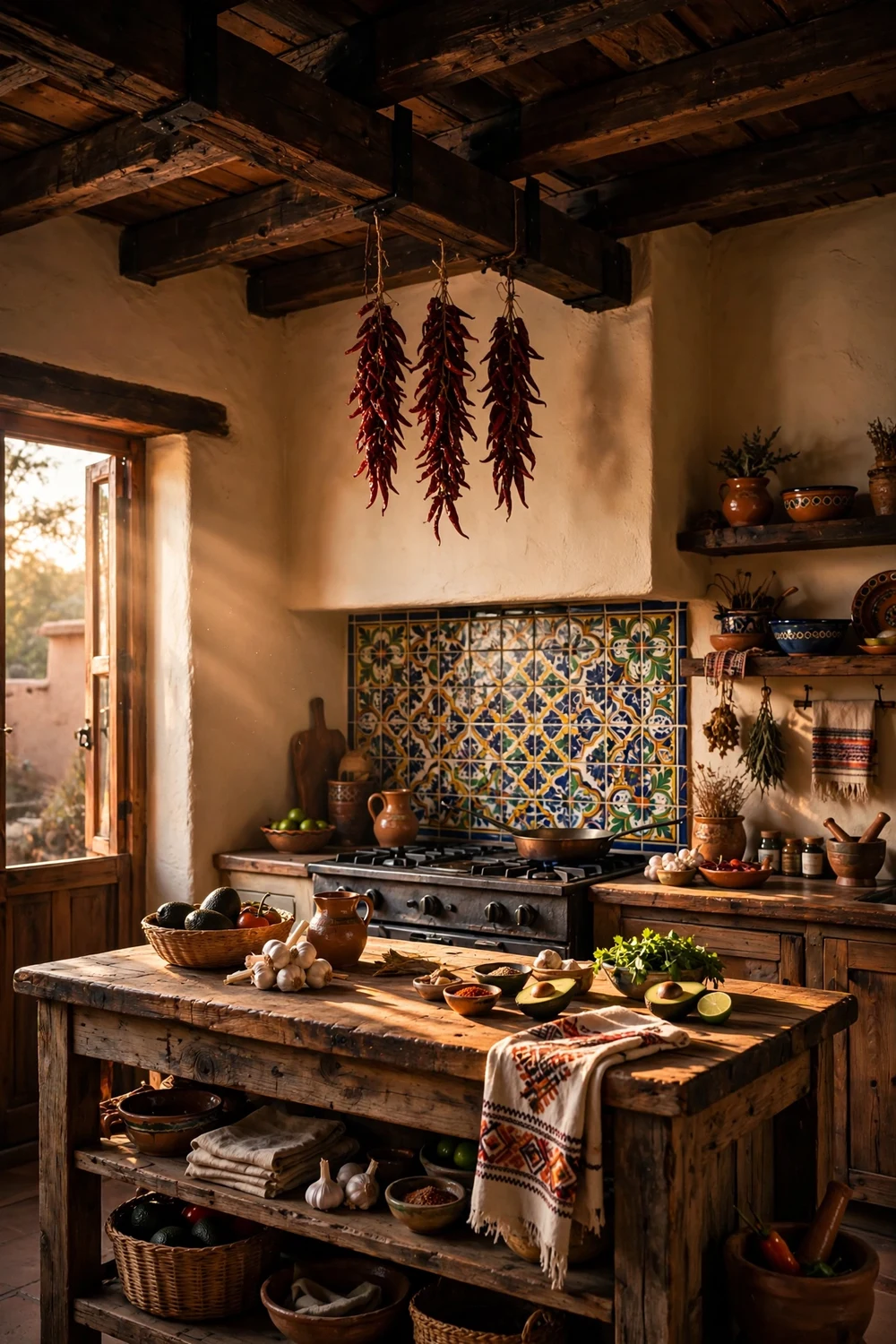
Exposed vigas — heavy timber beams across the ceiling — give a kitchen instant architecture. If your ceiling has real beams hiding under drywall, uncovering them is the cheapest dramatic change you can make. If not, boxed beams made from reclaimed wood give the same weight without the engineering.
Try this: stain the beams two shades darker than your cabinets. The contrast is what makes them read as structure instead of decoration.
Difficulty: Involved | Cost: $1,000-$3,000
4. A Copper Cookware Rack
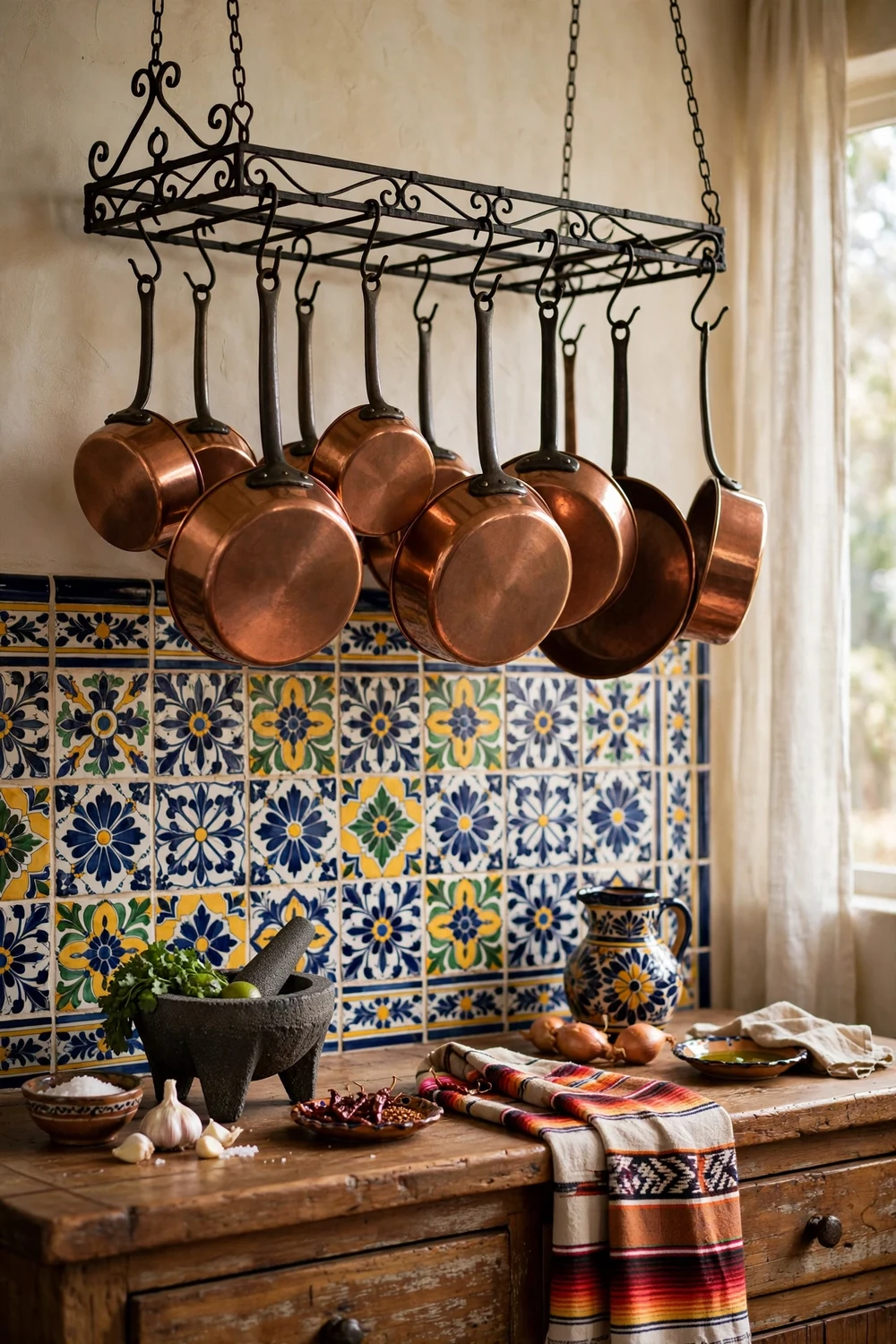
Copper is the metal of Mexican kitchens — hammered cazuelas, gleaming saucepans, the whole collection on display. Hang a wrought iron rack from the ceiling or mount one on the wall, and your cookware becomes the chandelier. It frees up cabinet space and looks like a working kitchen should: proud of its tools.
Try this: hang your three prettiest copper pieces at eye level in the center. The rest can be everyday stainless — nobody will notice.
Difficulty: Easy | Cost: $80-$300
5. Turquoise Blue Cabinets
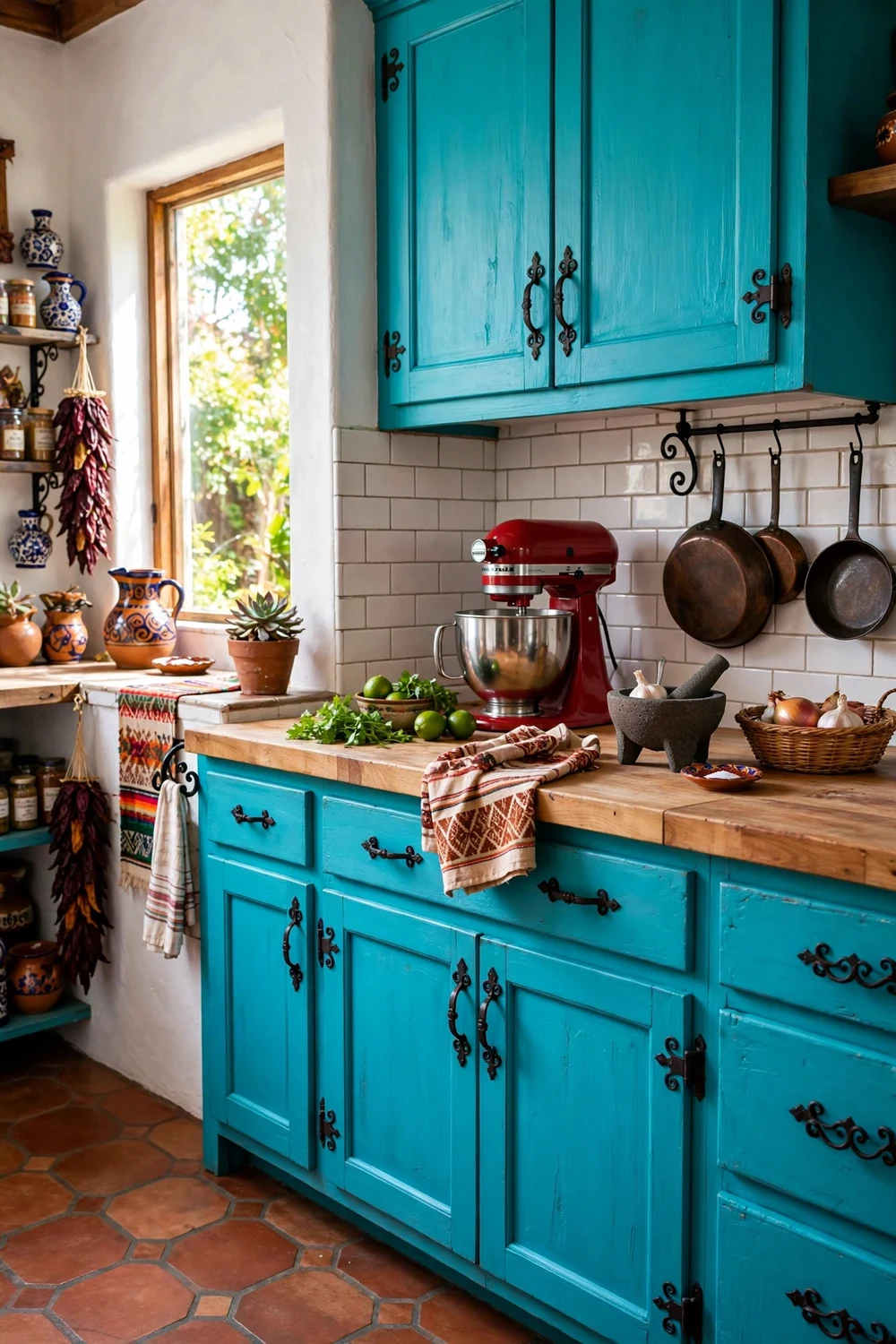
If beige cabinets bore you, go where Mexican kitchens go: a bold, joyful blue. Turquoise-painted cabinets with dark wood or white counters are the fastest way to make a kitchen feel like a fiesta instead of a showroom. It takes courage, but the color forgives everything — clutter, old floors, mismatched chairs.
Try this: paint the island turquoise first and live with it for two weeks. If you love it, do the whole kitchen; if not, one island is easy to repaint.
Difficulty: Moderate | Cost: $300-$900
6. Terracotta Clay Walls
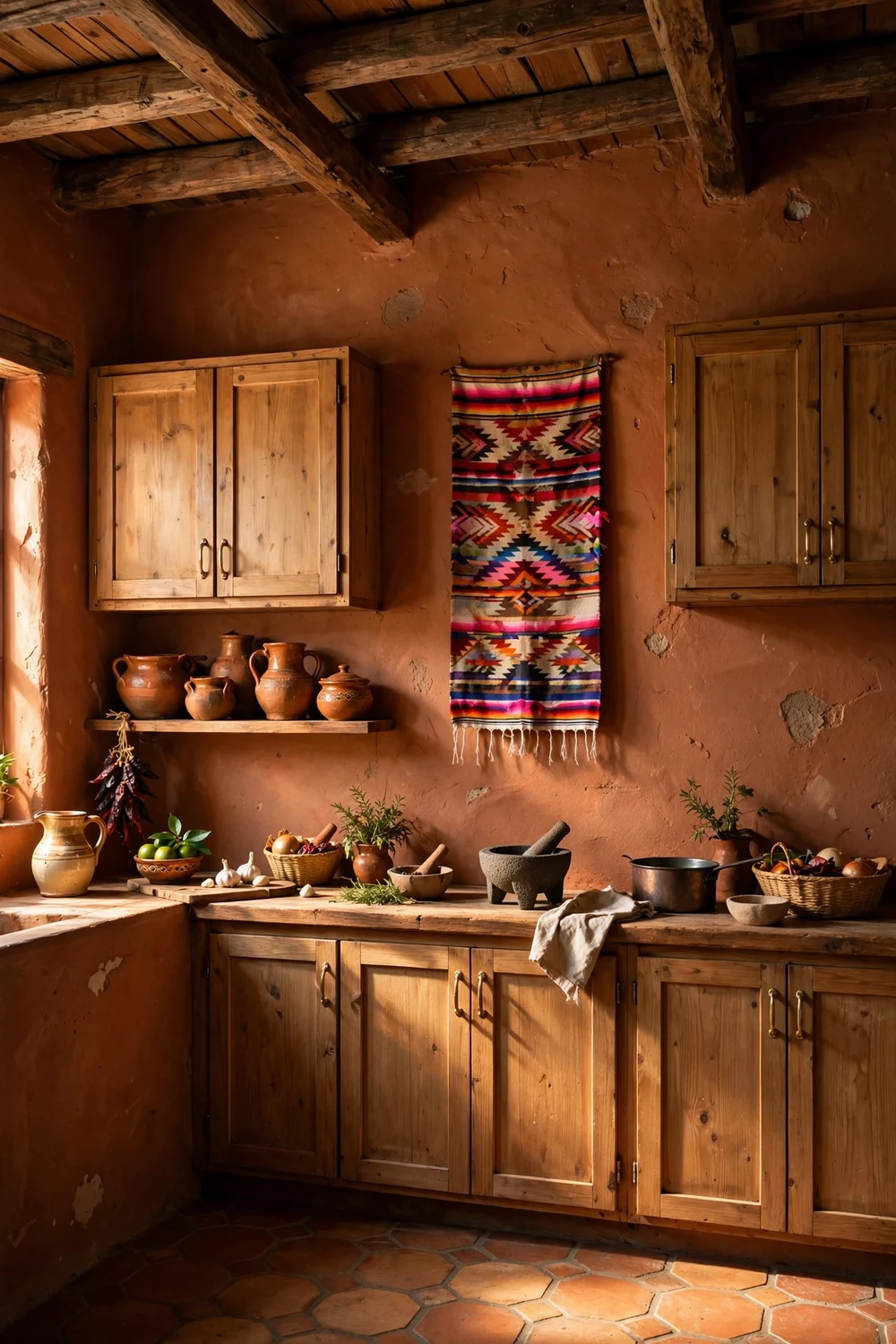
Skip flat white paint and go for warmth: terracotta-toned plaster or limewash walls give the whole kitchen a sun-baked glow that flatters everyone and everything. Textured finishes hide imperfections, which makes them merciful in older kitchens with less-than-perfect drywall. Seal the finish with a matte topcoat so the walls wipe clean without losing their chalky, old-world depth.
Try this: sample pots are cheap and one wall is a weekend project. Live with it through a full day of light before deciding on the whole room.
Difficulty: Easy | Cost: $50-$200
7. A Talavera Tile Sink
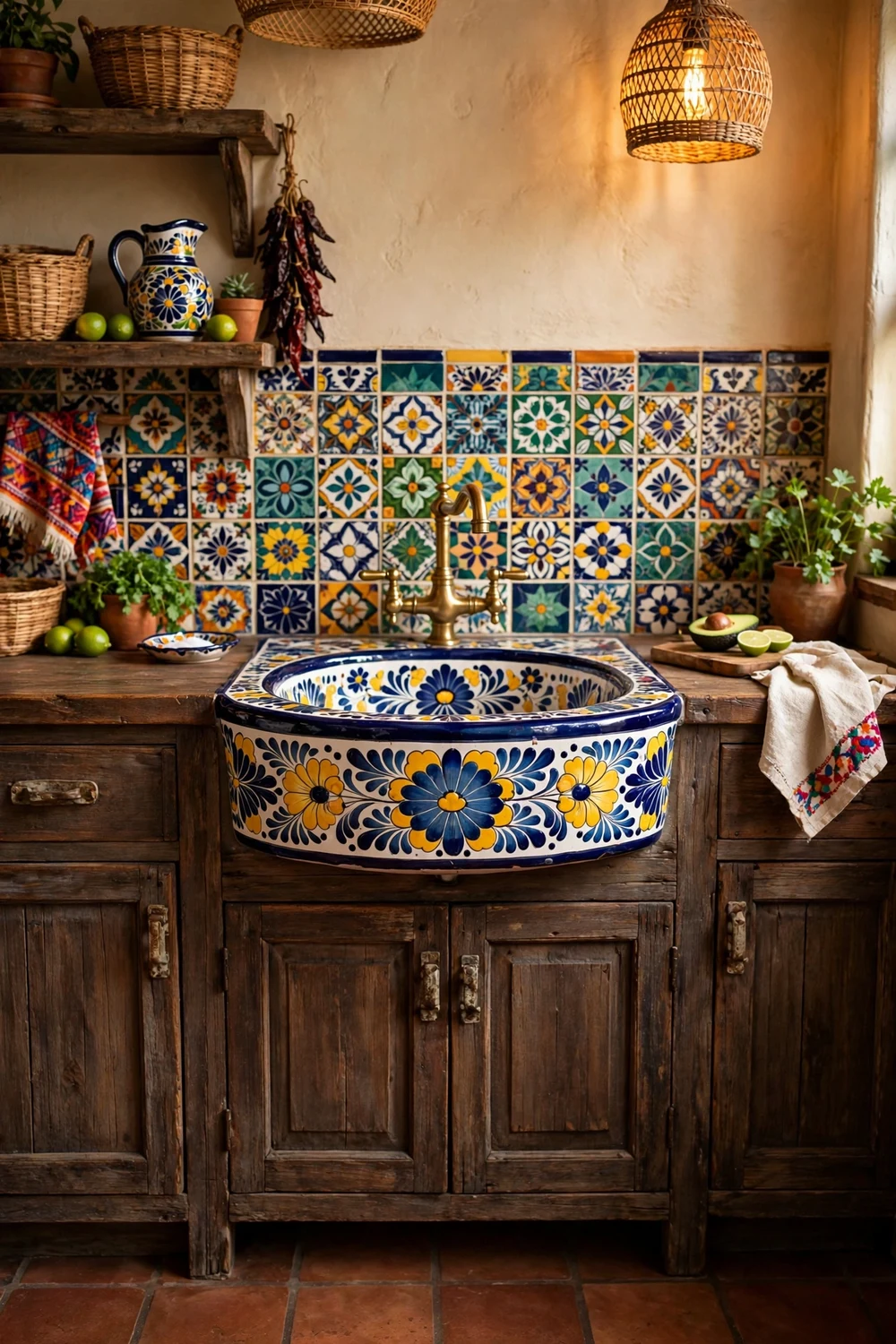
The sink is the one fixture you touch fifty times a day — why make it boring? A hand-painted Talavera sink in cobalt and white turns dishwashing into a small daily pleasure. They come as drop-in or vessel styles, and the glaze is as hard as any ceramic. Vessel styles sit proud of the counter and show off more of the painting.
Try this: pair the patterned sink with a plain solid-color counter. Pattern needs breathing room on at least one side.
Difficulty: Moderate | Cost: $250-$700
8. Rustic Open Shelving
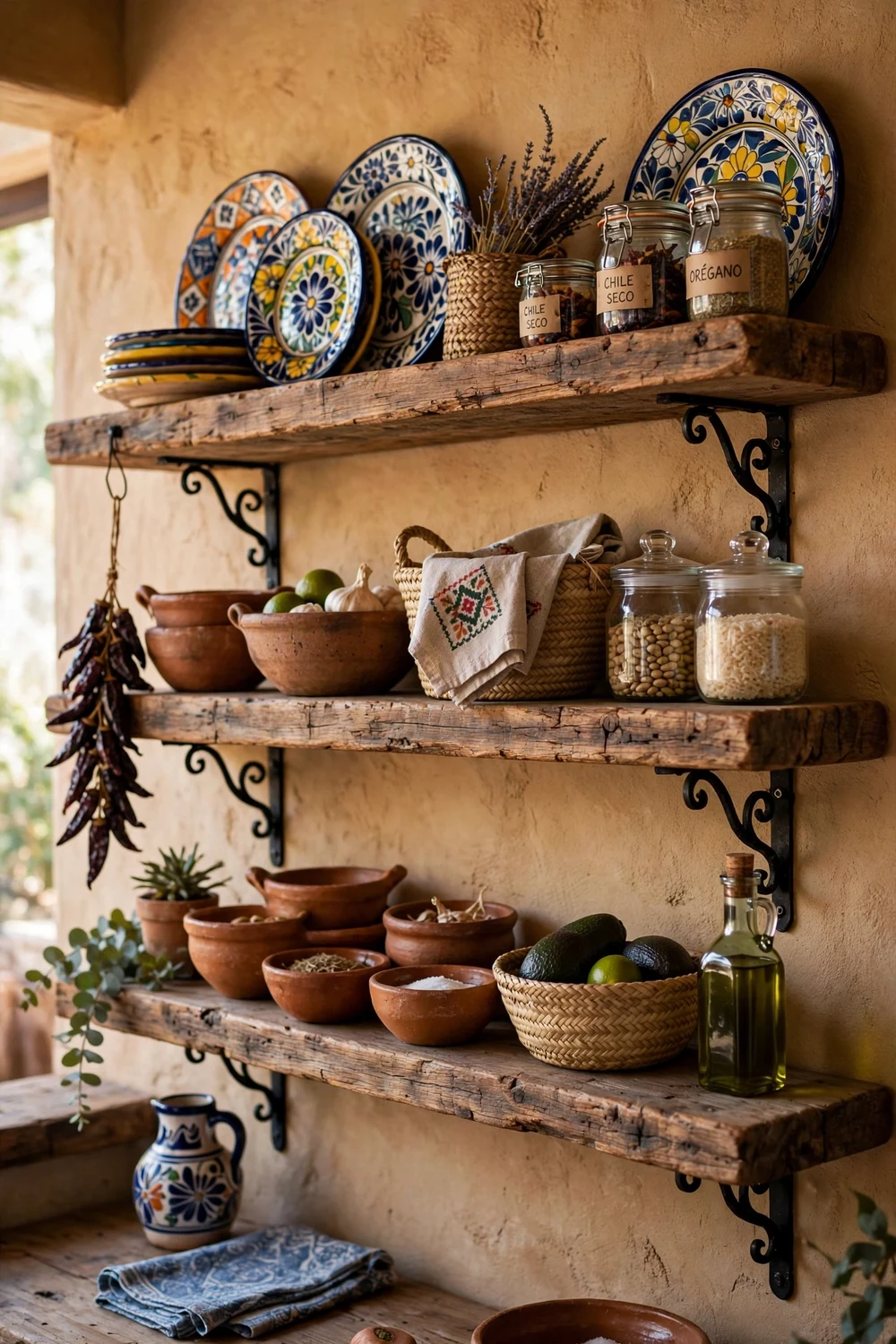
Thick planks of distressed wood on iron brackets, loaded with colorful bowls and glassware — that’s the Mexican kitchen’s answer to upper cabinets. Open shelving forces you to keep things you actually love, and it puts your prettiest pieces at eye level where they belong. Style them the way you’d set a table, mixing heights and colors so the shelves read as decor, not storage.
Try this: keep shelves to two or three and load the bottom one heaviest. Top-heavy shelving looks precarious even when it isn’t.
Difficulty: Easy | Cost: $60-$250
9. A Wrought Iron Chandelier
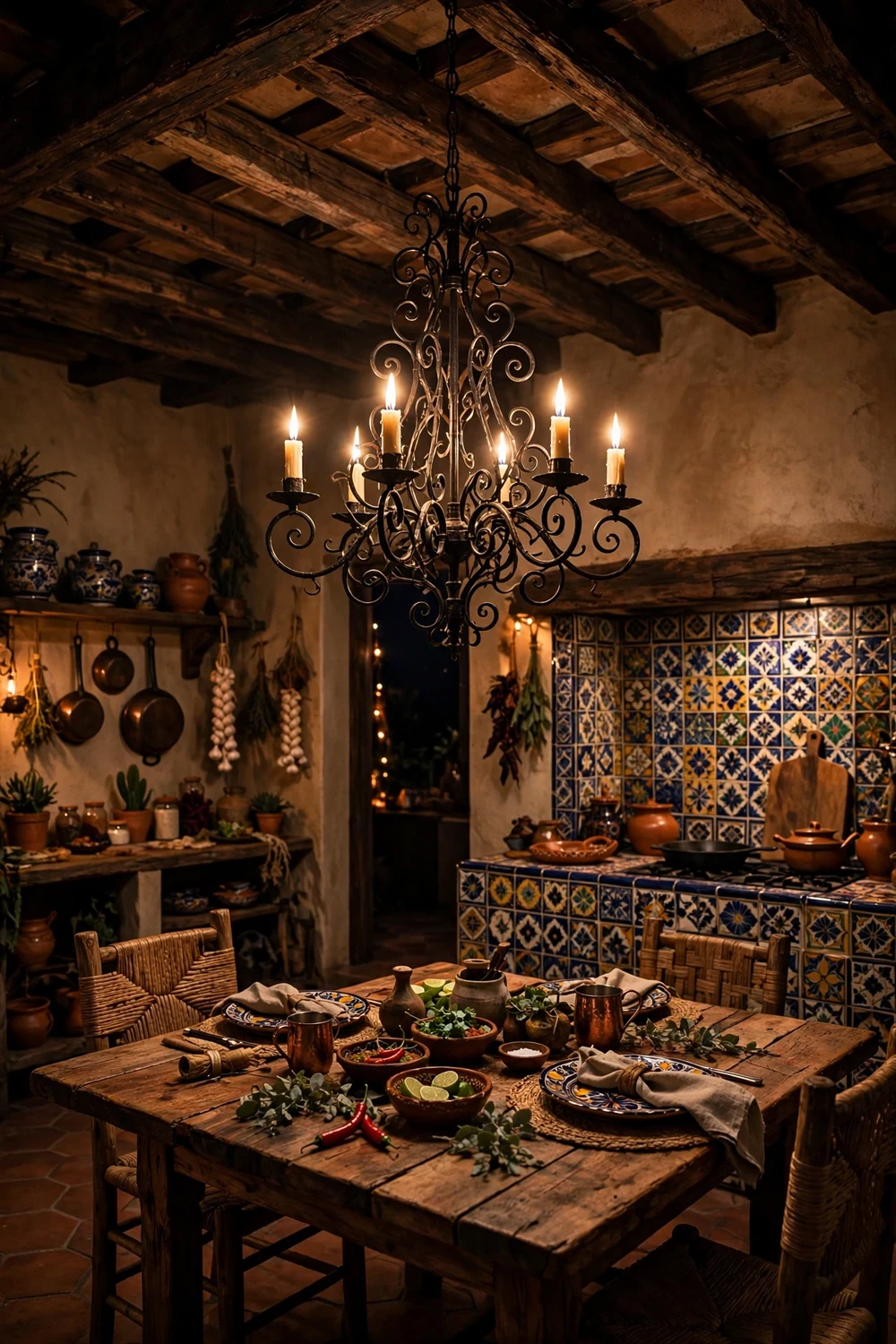
Forget recessed cans. A forged wrought iron chandelier — scrolling, candle-style, maybe with a ring of glass shades — is the light fixture a Mexican kitchen deserves. It casts patterned shadows on the walls at night, and during the day it’s sculpture.
For more ways to layer warm light without rewiring the house, these hidden lighting ideas for a cozy home work beautifully above kitchen islands too.
Try this: hang it on a dimmer. Full brightness for cooking, low for dinner — one fixture, two moods.
Difficulty: Moderate | Cost: $150-$600
10. A Tile-Covered Kitchen Island
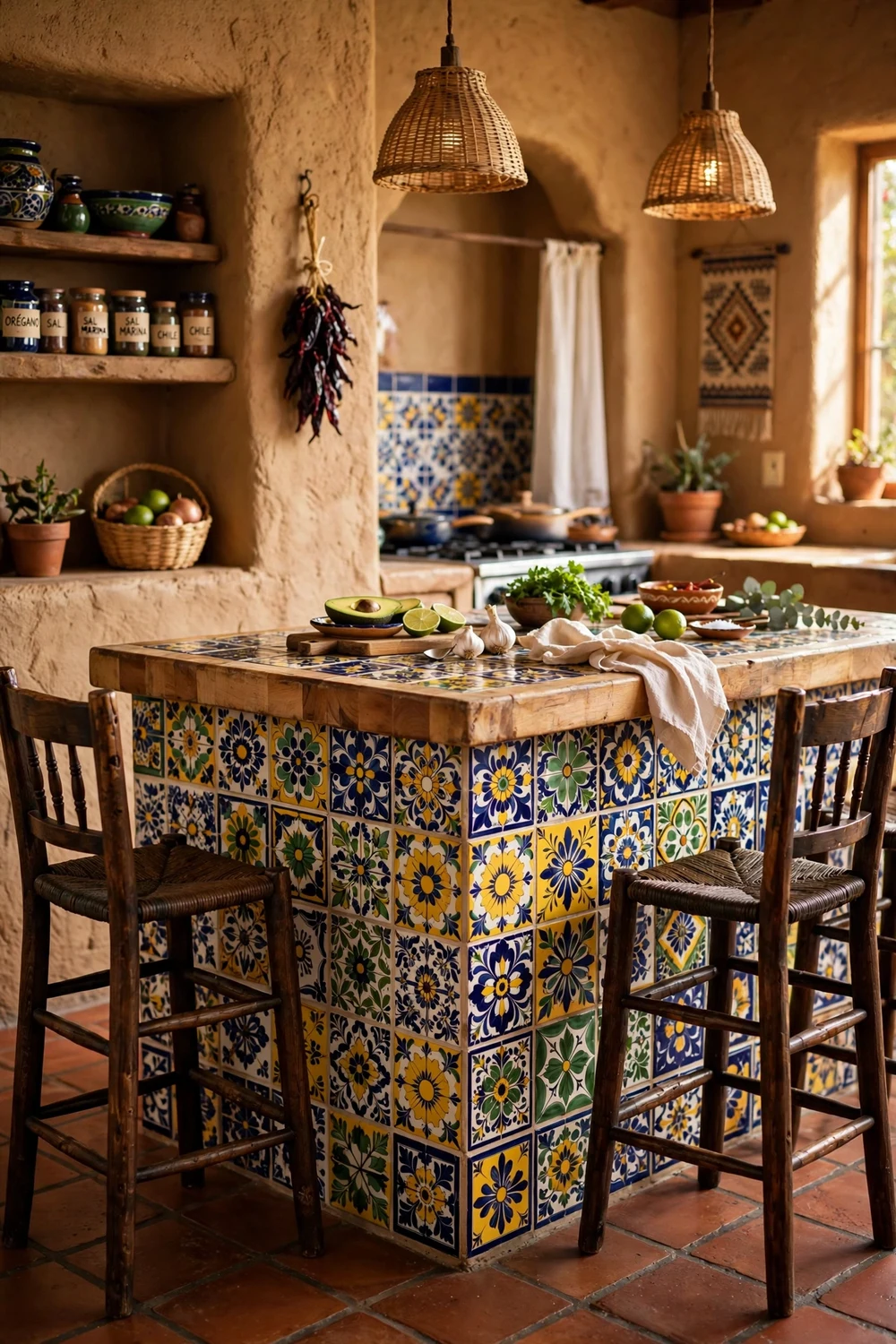
Give the island the tile treatment: cover its sides in Talavera or cement tile and it stops being cabinetry and becomes furniture. It’s the most photographed feature in Mexican kitchens for a reason — it’s art you can bump into. Solid-color tiles on the sides with a patterned border is the classic formula.
Try this: tile the side that faces the living room and paint the working side. You get the showpiece where guests see it and easy wipe-down where you cook.
Difficulty: Involved | Cost: $600-$1,800
11. A Papel Picado Banner
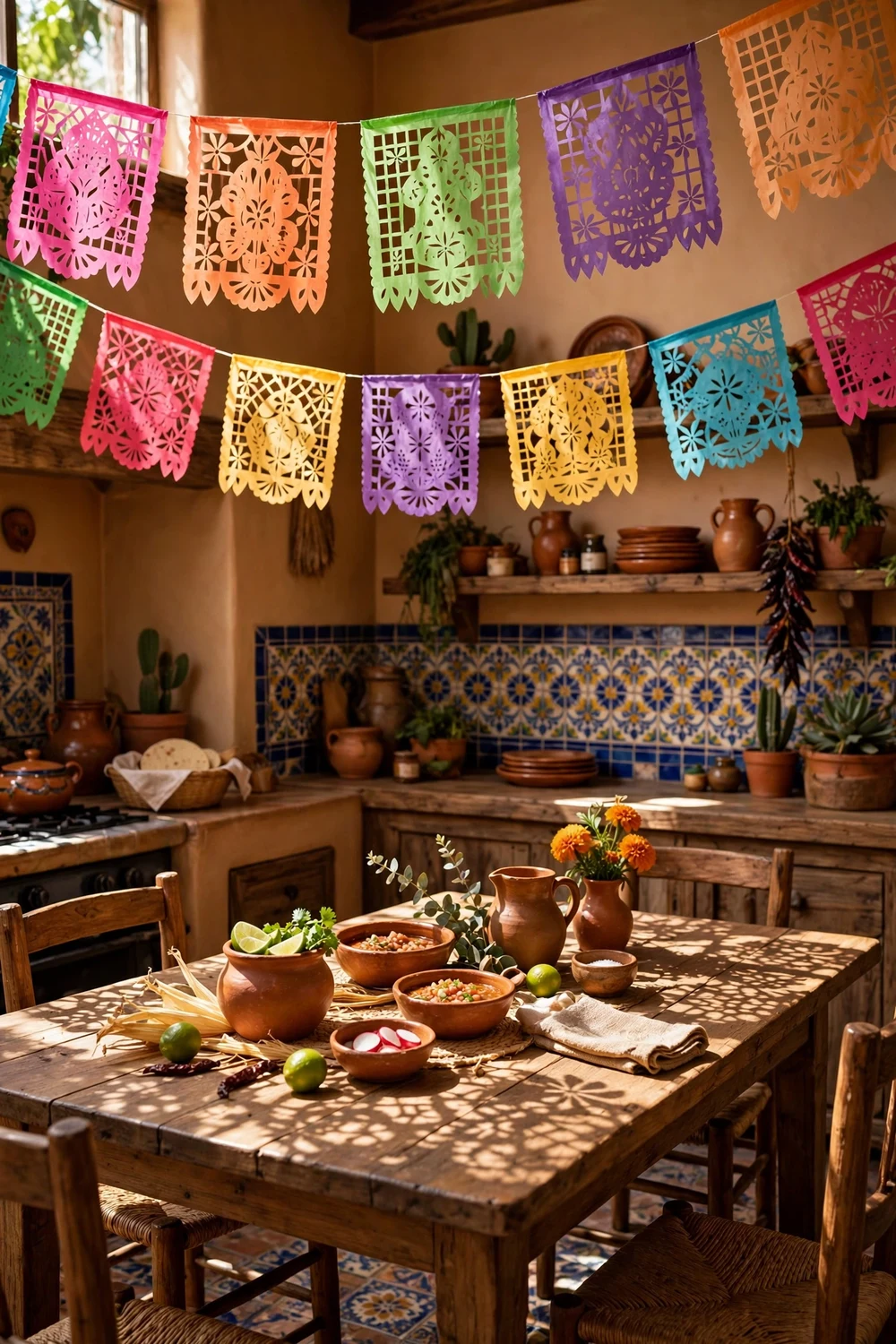
Papel picado — the cut-tissue banners from every fiesta — costs almost nothing and changes a kitchen instantly. String it across a window, over the island, or along the open shelves. Plastic versions survive steam and grease; paper ones get swapped seasonally, which is half the fun.
Try this: one strand in a single color family looks designed; five strands in five colors looks like a party. Both are correct — pick your mood.
Difficulty: Easy | Cost: $10-$40
12. A Molcajete Spice Station
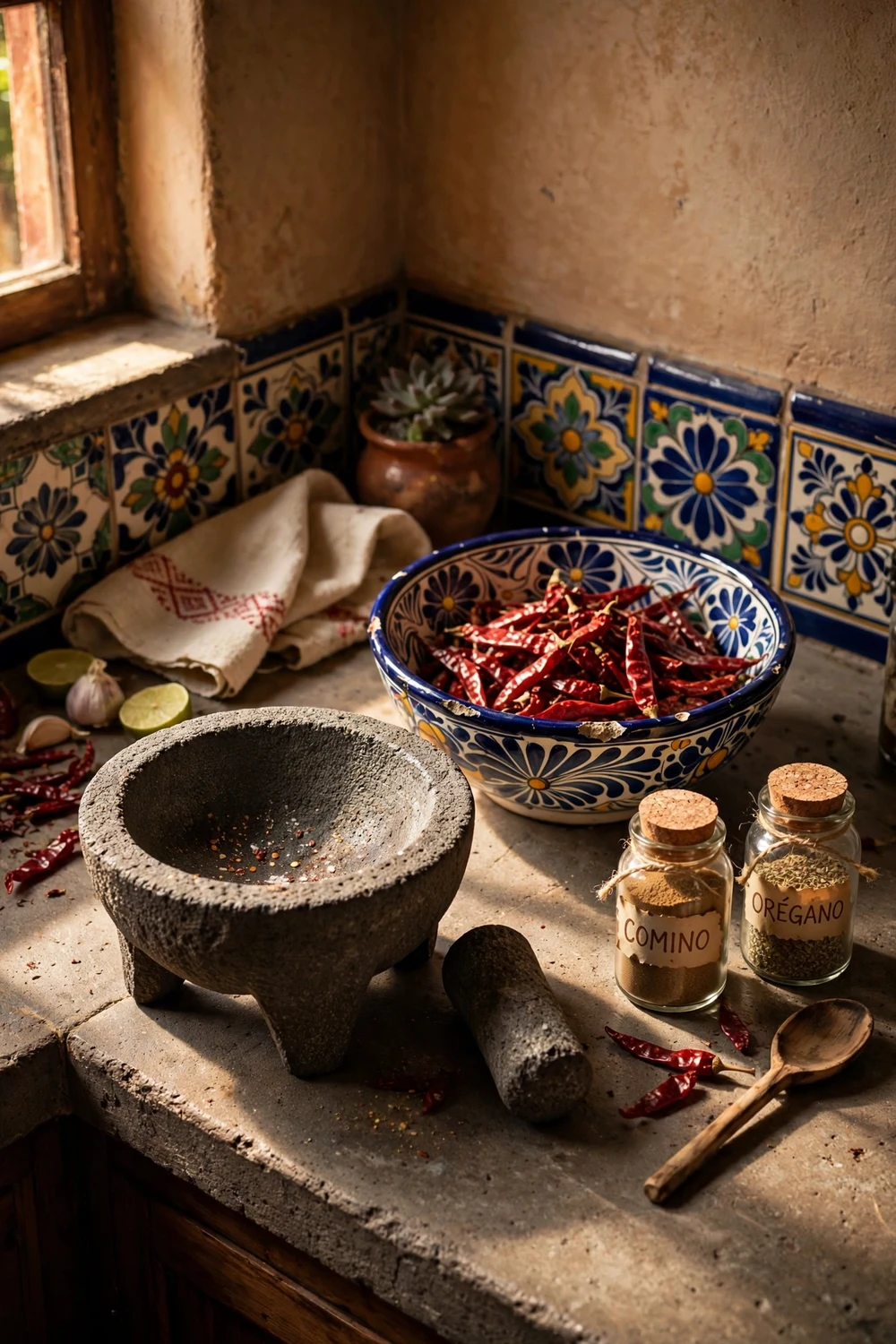
The molcajete — a mortar carved from volcanic basalt — is the symbol of real Mexican cooking, and it belongs on the counter, not in a drawer. Build a little station around it: dried chiles in glass jars, a comal leaning nearby, small clay bowls for finished salsas. It tells guests exactly what kind of cooking happens here.
Try this: season a new molcajete with rice before first use. Grinding raw rice until the dust turns white removes the grit — do it once, properly.
Difficulty: Easy | Cost: $30-$100
13. Fiesta-Painted Bar Stools
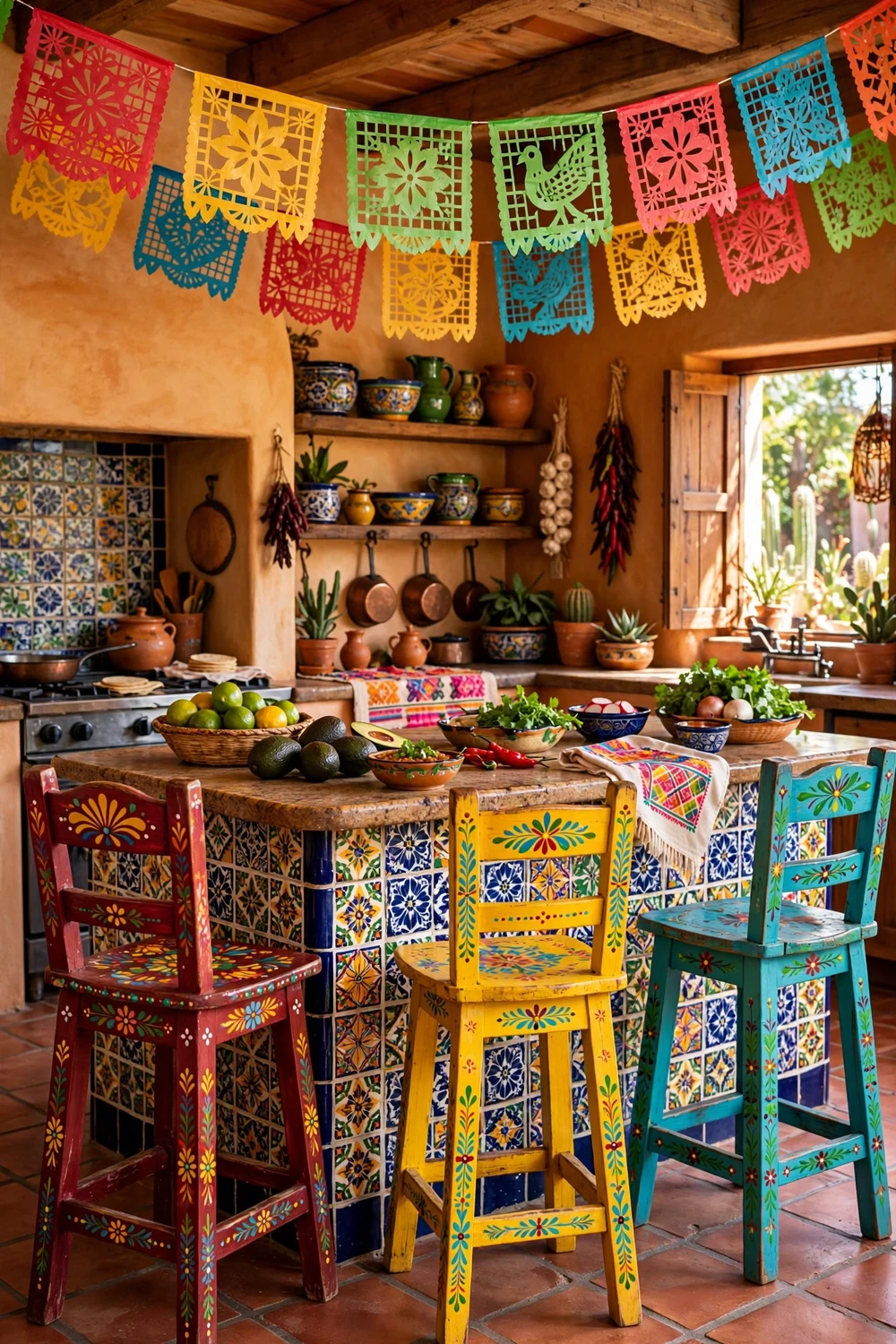
Plain wooden bar stools painted in fiesta colors — each one different, or all in the same sun-faded turquoise — are the easiest big-color move in a Mexican kitchen. Sand lightly between coats and seal well, since stools take abuse. Start with a bonding primer on varnished stools so the bright color grabs hold and survives daily scooting.
Try this: paint the stools one color but distress the edges. The worn look forgives every future chip and ding.
Difficulty: Easy | Cost: $40-$150
14. A Serape Table Runner
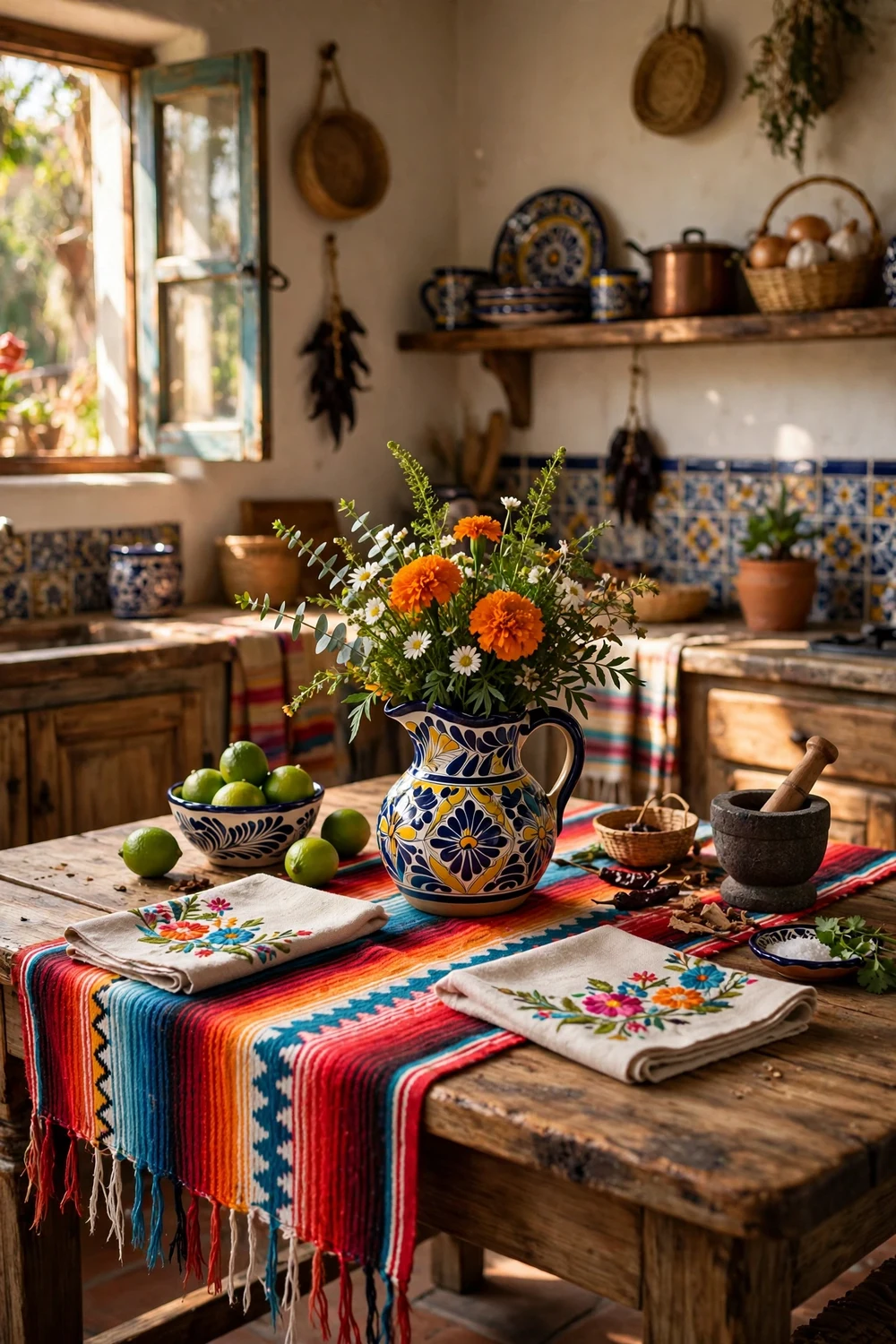
A striped serape runner across the island or the breakfast table is instant Mexico — those bright woven stripes need no introduction. Wool serapes are naturally stain-resistant and wipeable, and they protect wood from hot dishes while they’re at it. Fold it in thirds for a narrower runner on a small table, or let the full width drape over the sides.
Try this: layer the runner over a plain jute or linen base. The texture contrast makes both pieces look more expensive.
Difficulty: Easy | Cost: $20-$70
15. Arched Wall Niches
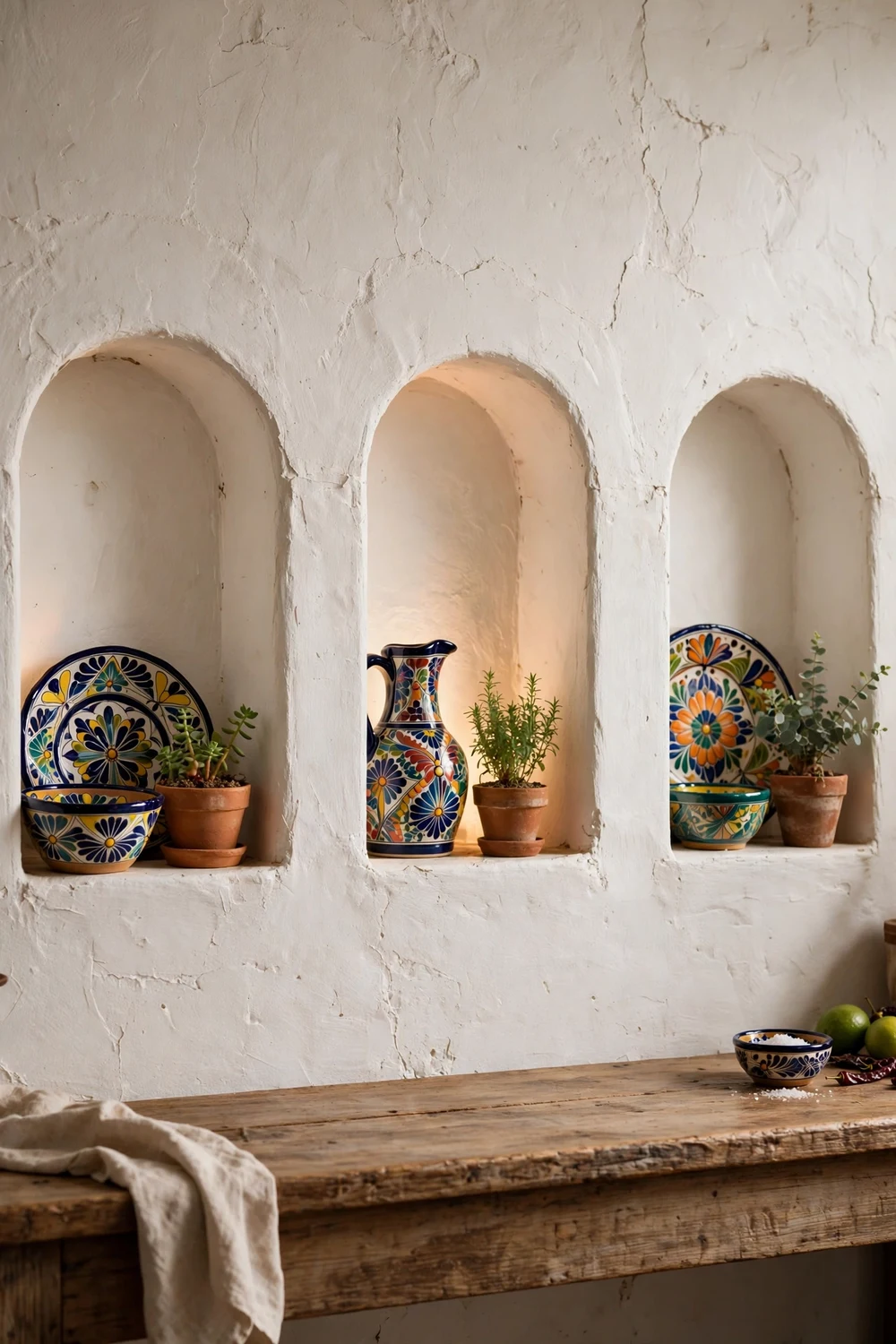
Built-in nichos — shallow arched niches in plaster walls — are pure hacienda architecture. Even one niche with a candle or a piece of pottery gives the wall a sculpted, old-world feel. No plaster walls? A deep shadow-box frame painted the wall color fakes the look convincingly. Cluster two or three at different heights for a rhythm that feels intentional, not random.
Try this: put a small puck light inside each niche. Glowing niches at night are pure magic.
Difficulty: Involved | Cost: $400-$1,200
16. Green Painted Cabinets
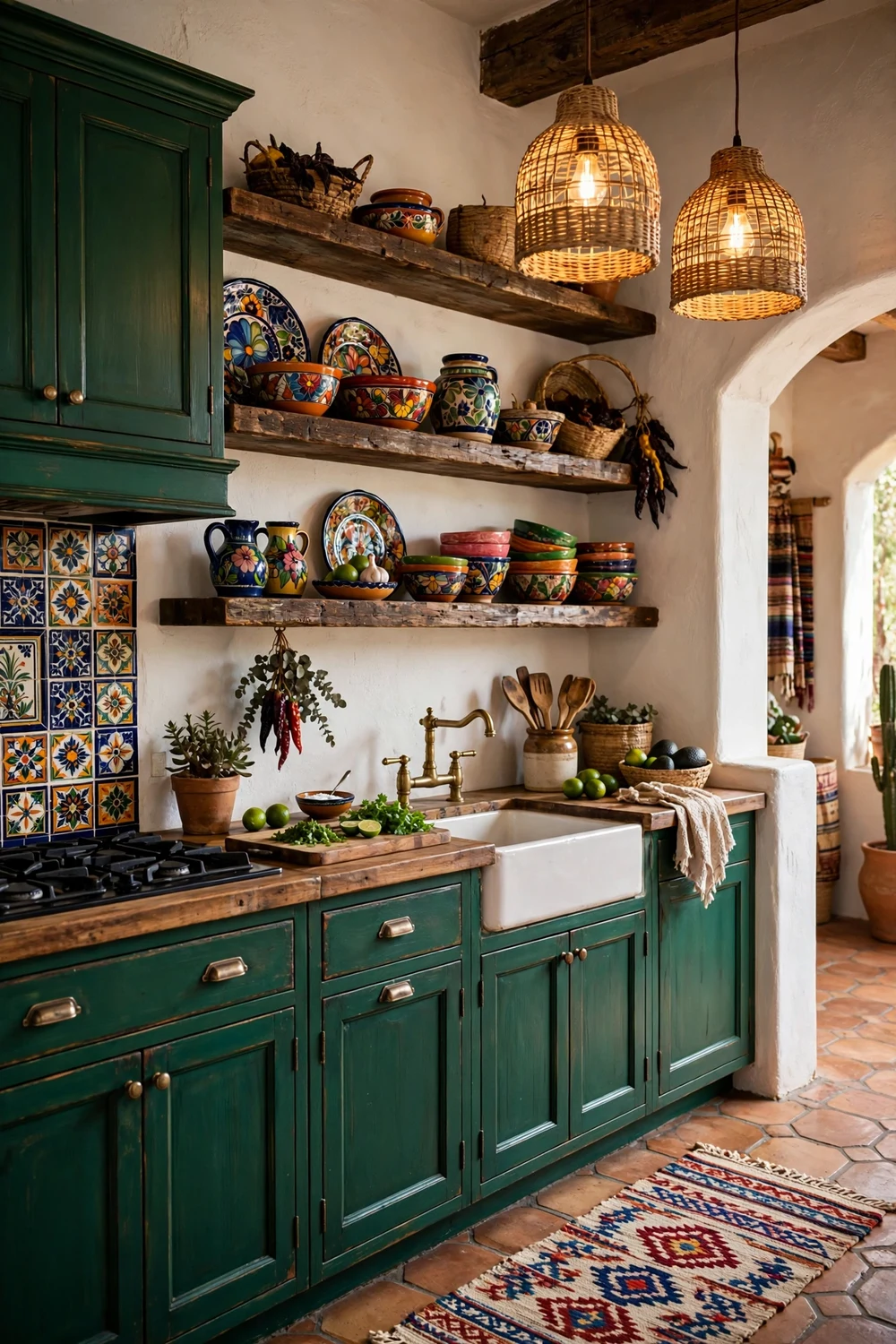
Turquoise isn’t the only option. A deep, earthy green on cabinets — think agave, olive, or the green of old painted furniture — gives the same boldness in a moodier key. It pairs beautifully with copper, terracotta floors, and warm wood, and it reads slightly more grown-up and grounded than bright blue.
Try this: go satin or semi-gloss on painted cabinets. Flat paint in a kitchen shows every fingerprint and splatter.
Difficulty: Moderate | Cost: $300-$900
17. Hand-Painted Tile Countertops
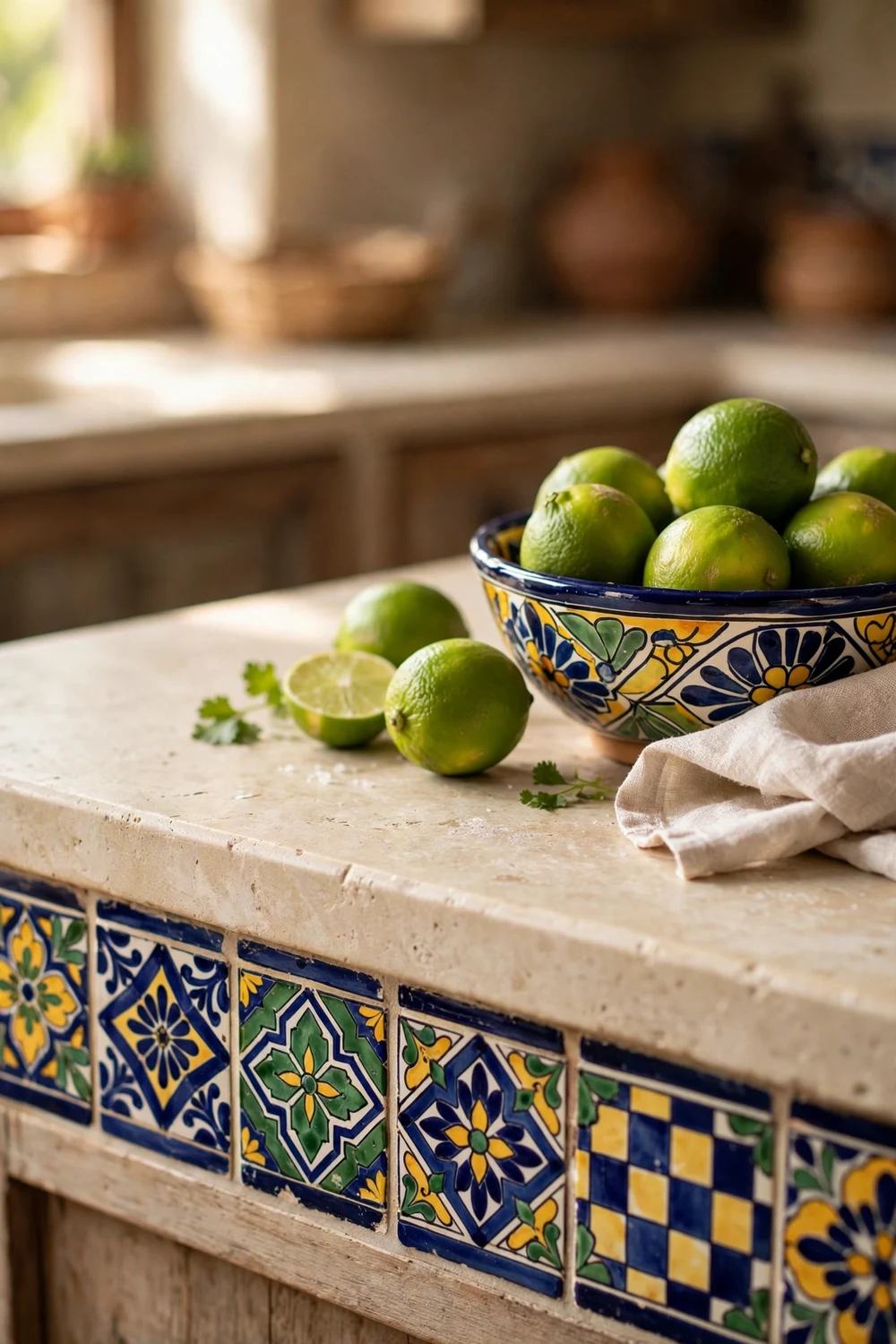
Talavera countertops are the boldest move on this list — and the most divisive, because grout lines and rolling dough don’t mix. The compromise: tile the perimeter or the island, and keep one solid-surface zone for serious prep. Epoxy grout makes the whole thing nearly as practical as stone.
Try this: a wooden cutting-board insert set into a tile counter gives you a flat prep surface without hiding the pattern.
Difficulty: Involved | Cost: $700-$2,000
18. Hanging Dried Chiles and Garlic
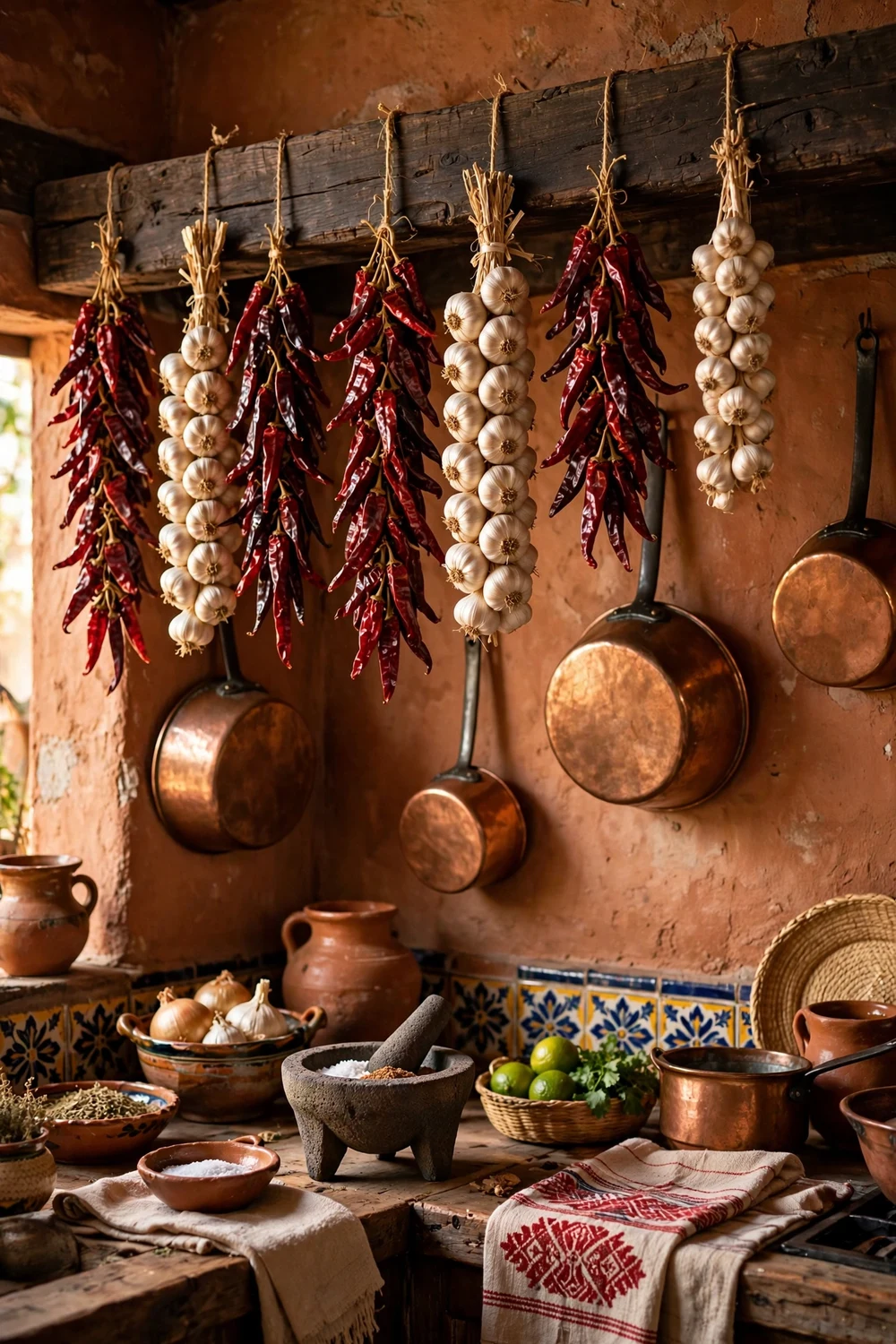
Strings of dried chiles and braided garlic hanging by the stove are decor you can cook with — and they’ve hung in Mexican kitchens for centuries. They cost almost nothing, smell wonderful, and signal authenticity better than any purchased decoration. Replace the chiles each fall when the new harvest arrives so the color stays vivid year-round.
Try this: hang chiles where steam won’t reach them — near a window or on an open wall, not directly over the stove.
Difficulty: Easy | Cost: $10-$30
19. Colorful Kitchenware on Display
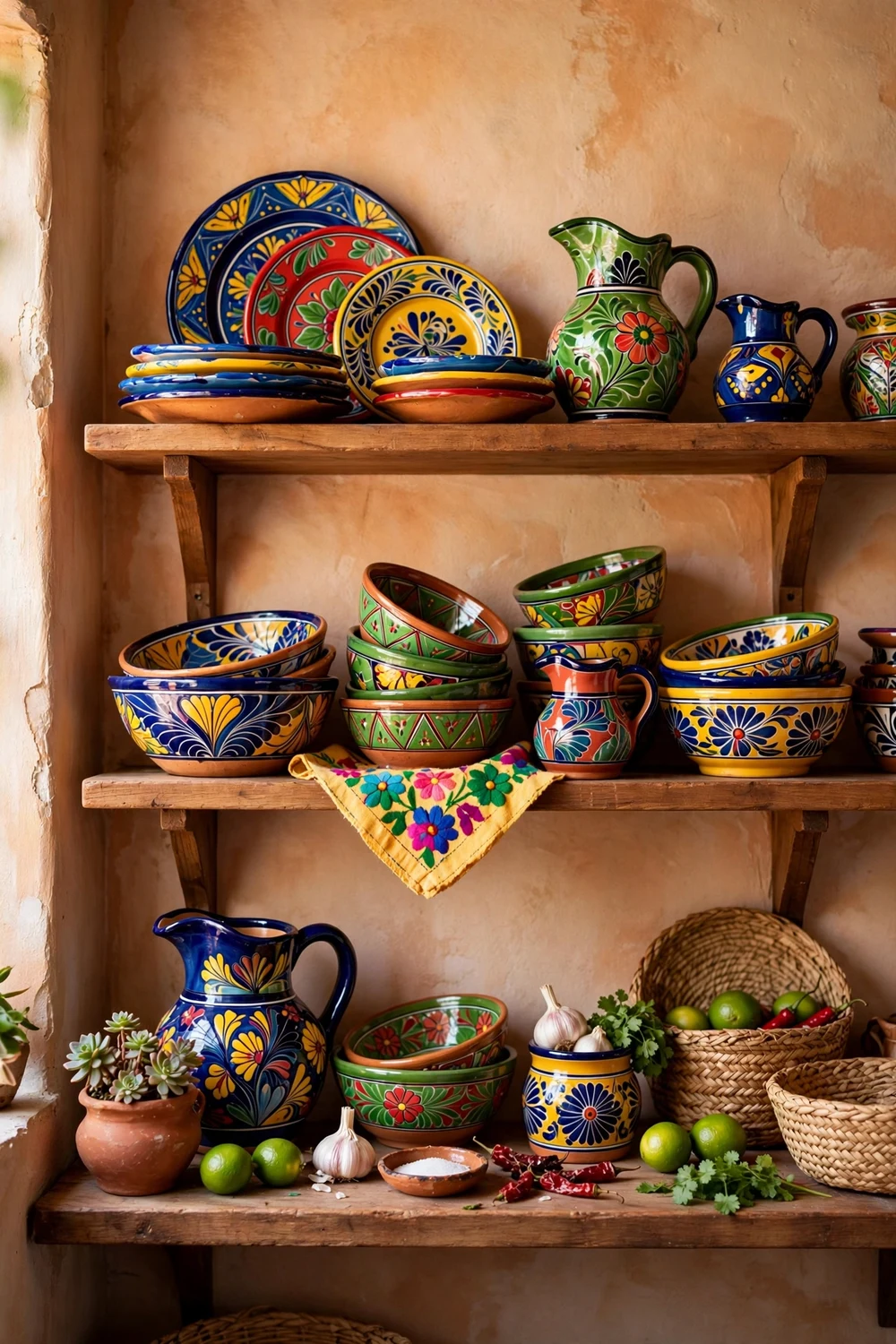
Mismatched is the point. Mexican kitchens pile colorful bowls, plates, and cups on open shelves with no apology — the variety IS the pattern. Start with what you have and add one piece at a time from flea markets and import shops.
If you’re renting and can’t drill shelves, these creative renter-friendly upgrades are full of no-damage ways to display collections and add color without touching the walls.
Try this: group by color instead of by set — all the blues together, all the yellows together. Mismatched but organized reads intentional.
Difficulty: Easy | Cost: $50-$200
20. A Clay Cookware Display
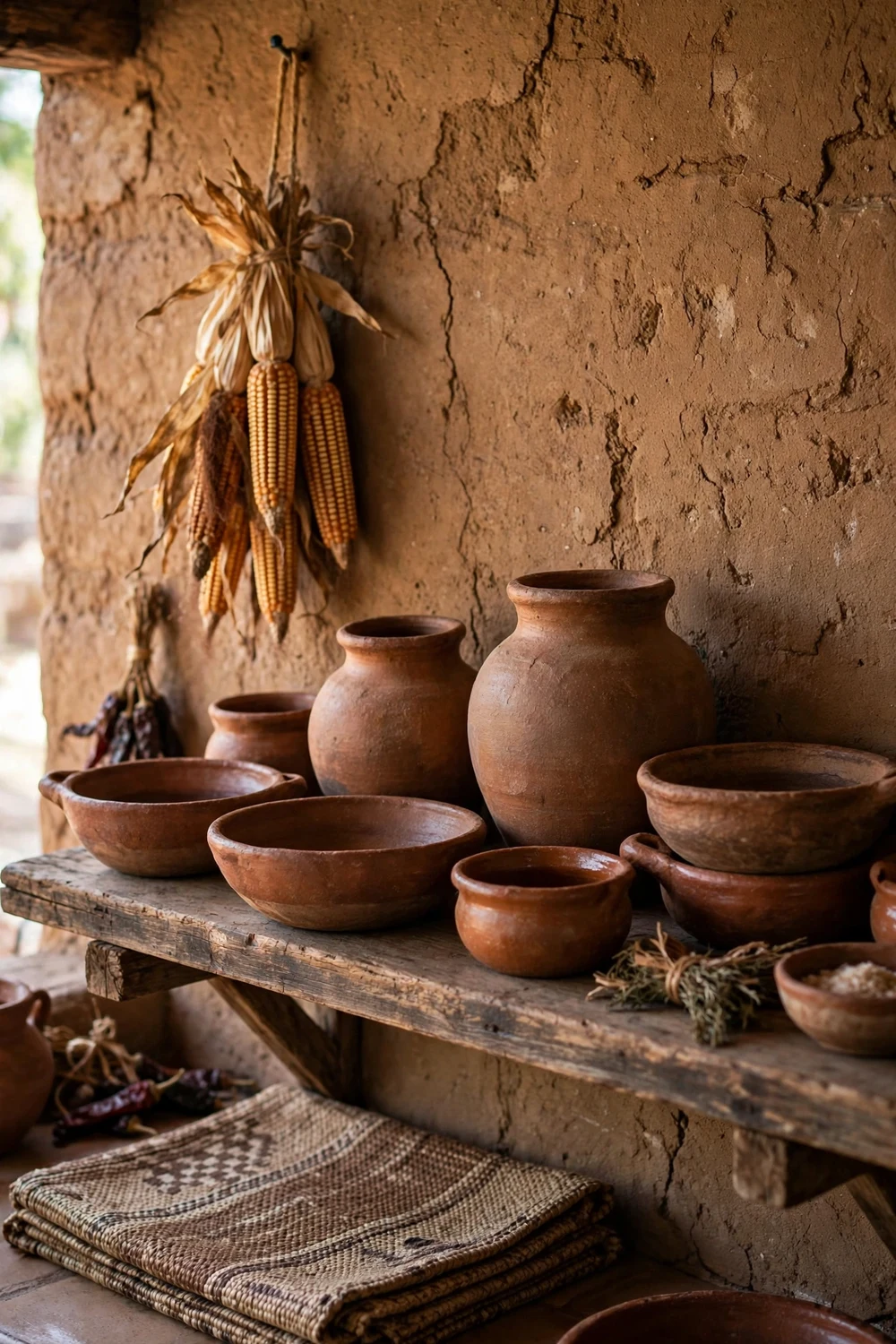
Clay ollas and cazuelas — the rounded pots and shallow dishes of traditional Mexican cooking — deserve a showcase. A dedicated shelf or a wall of hooks near the stove keeps them within reach and turns your actual cooking vessels into the decor. They’re beautiful and they make beans taste better. That’s not science, but it’s true.
Try this: never shock clay with cold water while hot, and always temper new pieces. Cared-for clay lasts generations.
Difficulty: Easy | Cost: $60-$250
21. Punched-Tin Pendant Lights
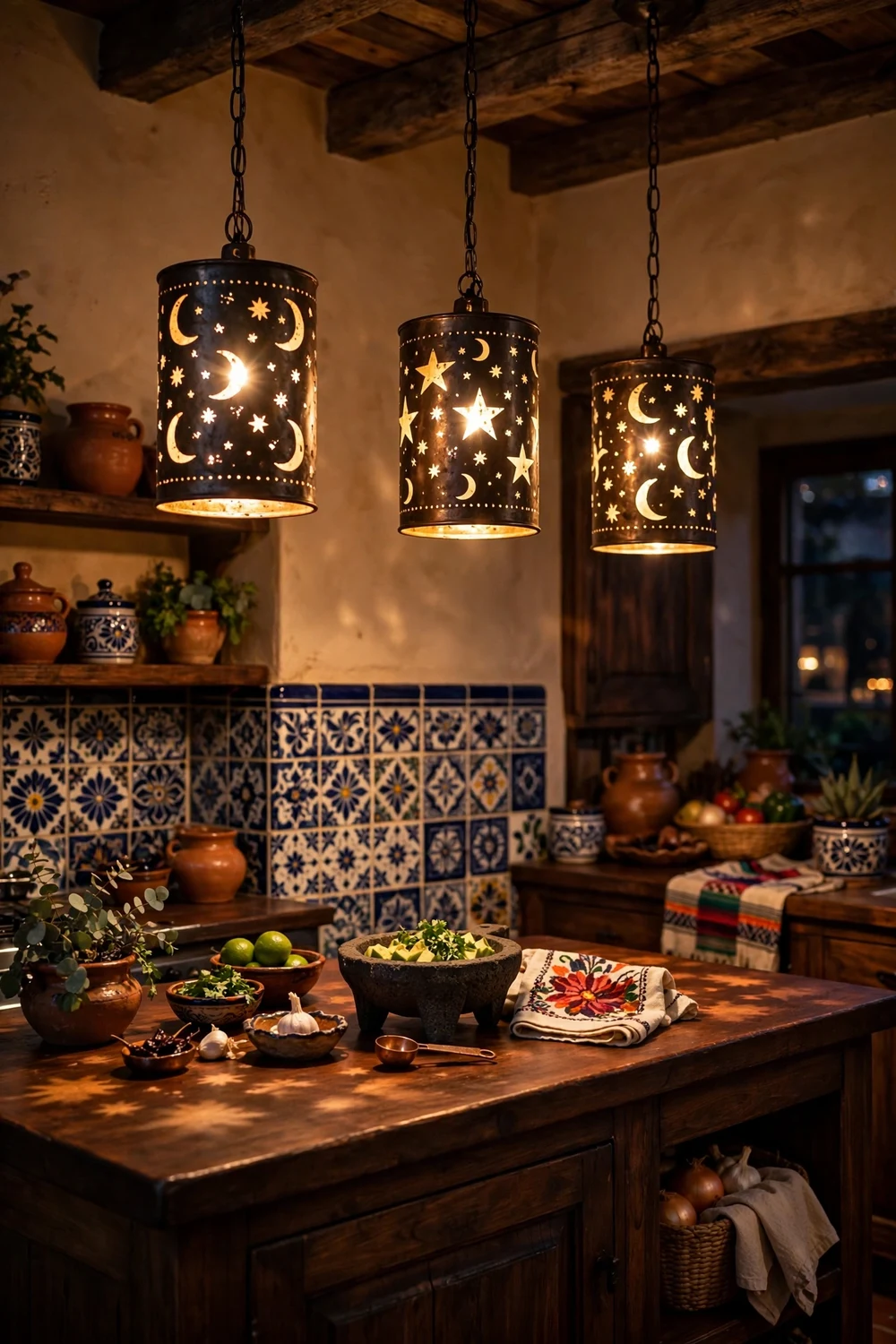
Punched tin — lámina — shades throw star-patterned light across the ceiling like a constellation. Three of them over the island at staggered heights is the classic arrangement, and they look handmade because they are. The warm, dappled light is flattering to everything. Keep the bulbs dimmable so the starlight can go from task-bright to candle-soft.
Try this: use warm-white bulbs only. Cool white through punched tin looks like a dental office, not a hacienda.
Difficulty: Moderate | Cost: $120-$450
22. Built-In Stucco Shelving
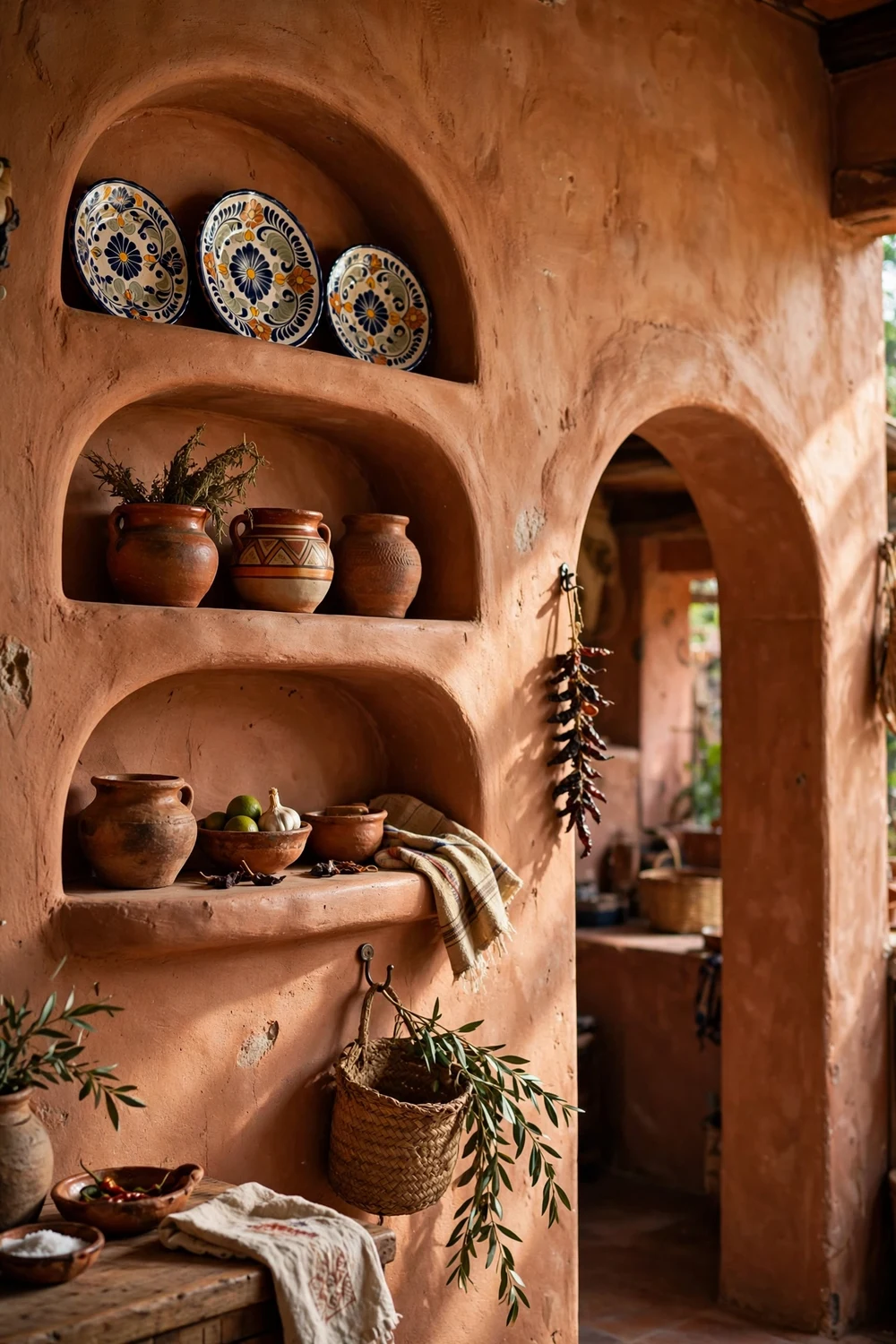
If you’re renovating anyway, skip some cabinets for built-in stucco shelving — thick plaster shelves that look carved out of the wall itself. They hold pottery, cookbooks, and plants, and they make the kitchen feel like it was built by hand centuries ago, in the best way. Round the shelf edges slightly when the plaster is wet for that soft, centuries-old profile.
Try this: keep the shelf depth to 10 inches. Deeper built-ins swallow small pottery into shadow.
Difficulty: Involved | Cost: $500-$1,500
23. An Arched Doorway
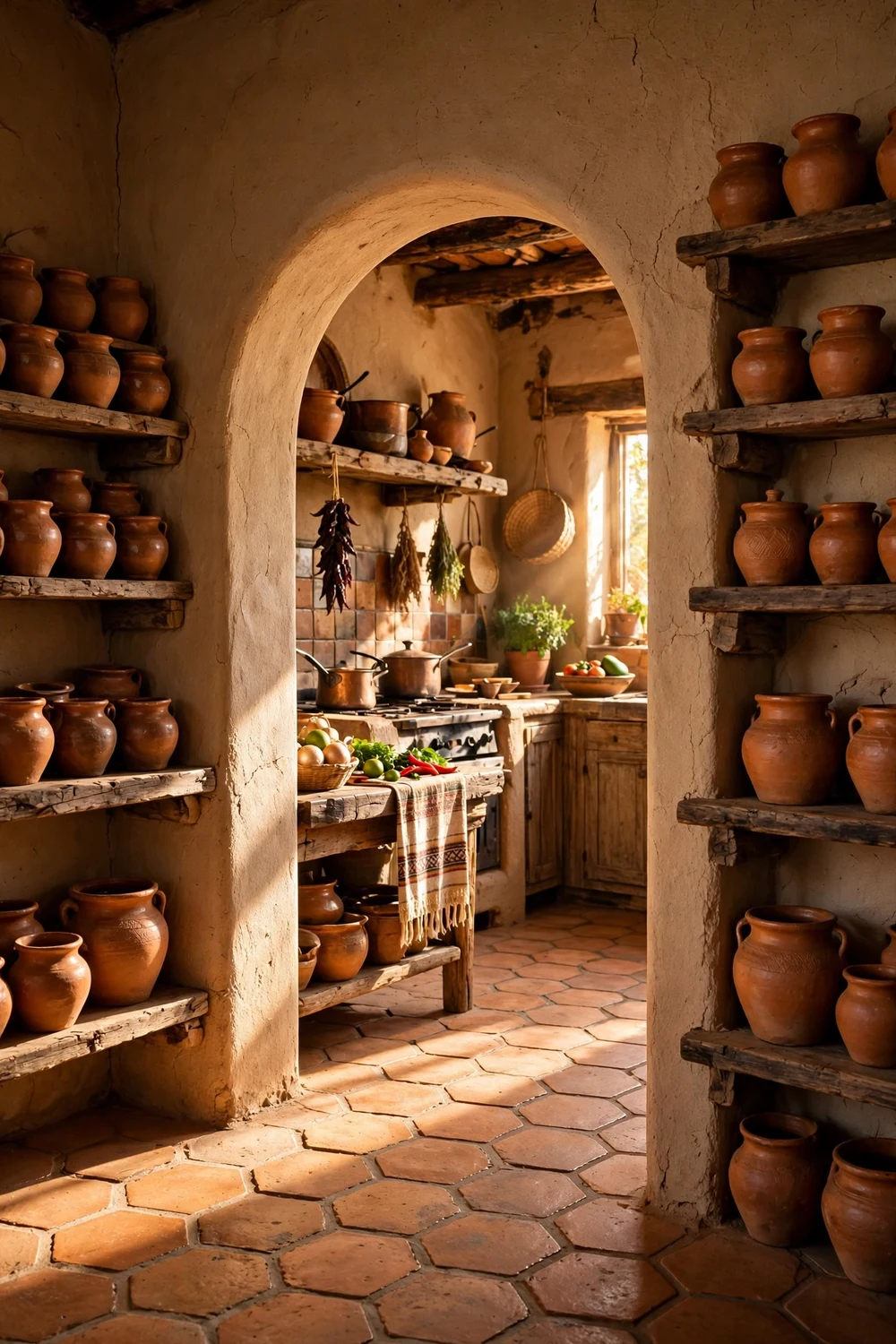
The arch is the signature move of Spanish colonial architecture, and one arched doorway or pass-through changes the whole feel of a kitchen. It’s a bigger project, but drywall arches are simpler than people think — a weekend with a good saw and some patience.
For the rest of the house, these hacienda-style house ideas carry the same arches, courtyards, and adobe warmth through every room.
Try this: frame the arch with a row of small Talavera tiles. It turns a drywall detail into a handcrafted one.
Difficulty: Involved | Cost: $800-$2,500
24. Terracotta Herb Planters
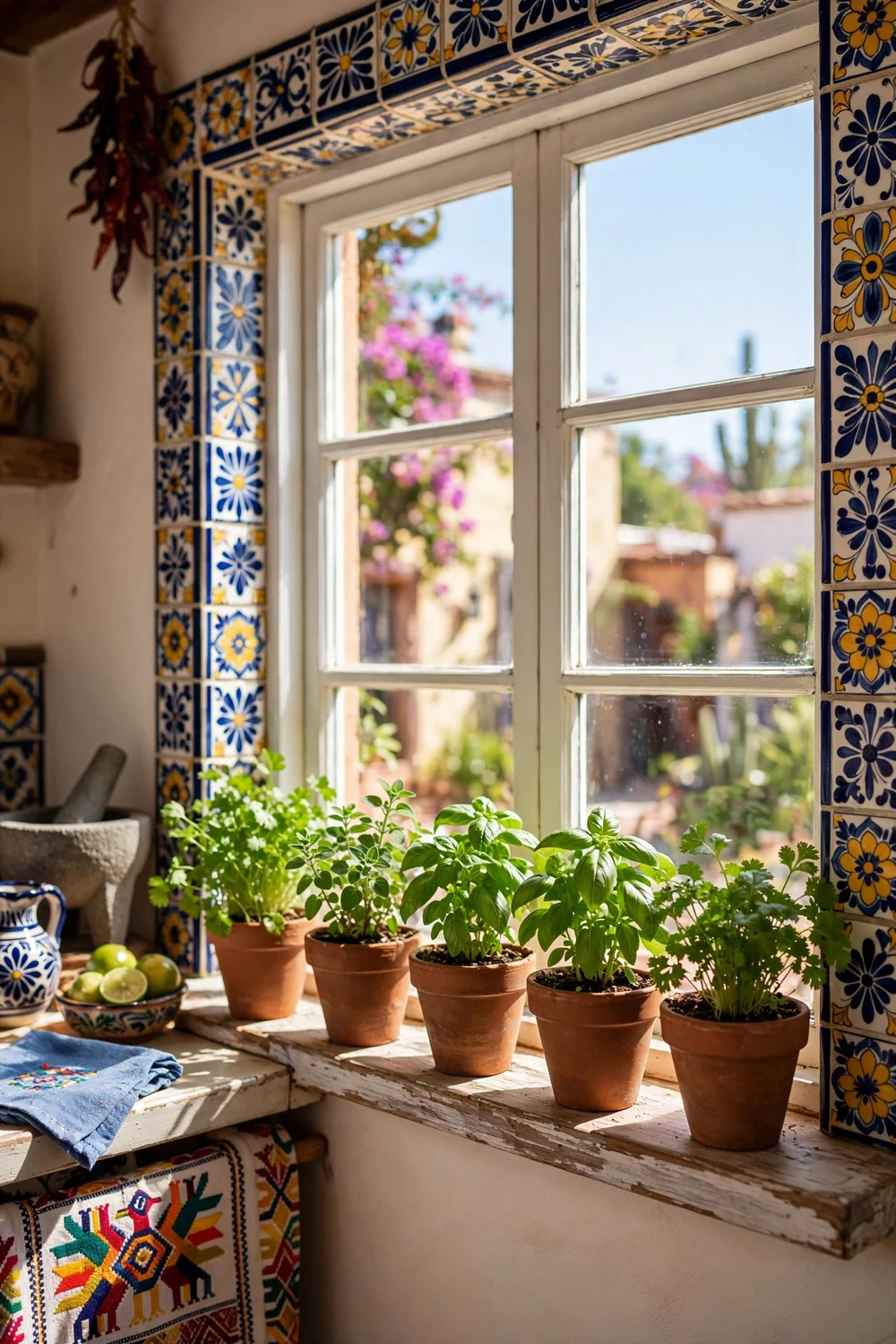
Cilantro, epazote, chiles, and tomatoes in terracotta pots on the windowsill or a sunny shelf — a Mexican kitchen should smell like a garden. Clay pots breathe, which herbs love, and the terracotta color is decor in itself. Group pots in odd numbers and vary the heights — three small pots and one tall chile plant beats a straight row.
Try this: plant cilantro in succession every three weeks. It bolts fast; a rolling supply means you’re never without.
Difficulty: Easy | Cost: $15-$60
25. A Folk Art Gallery Wall
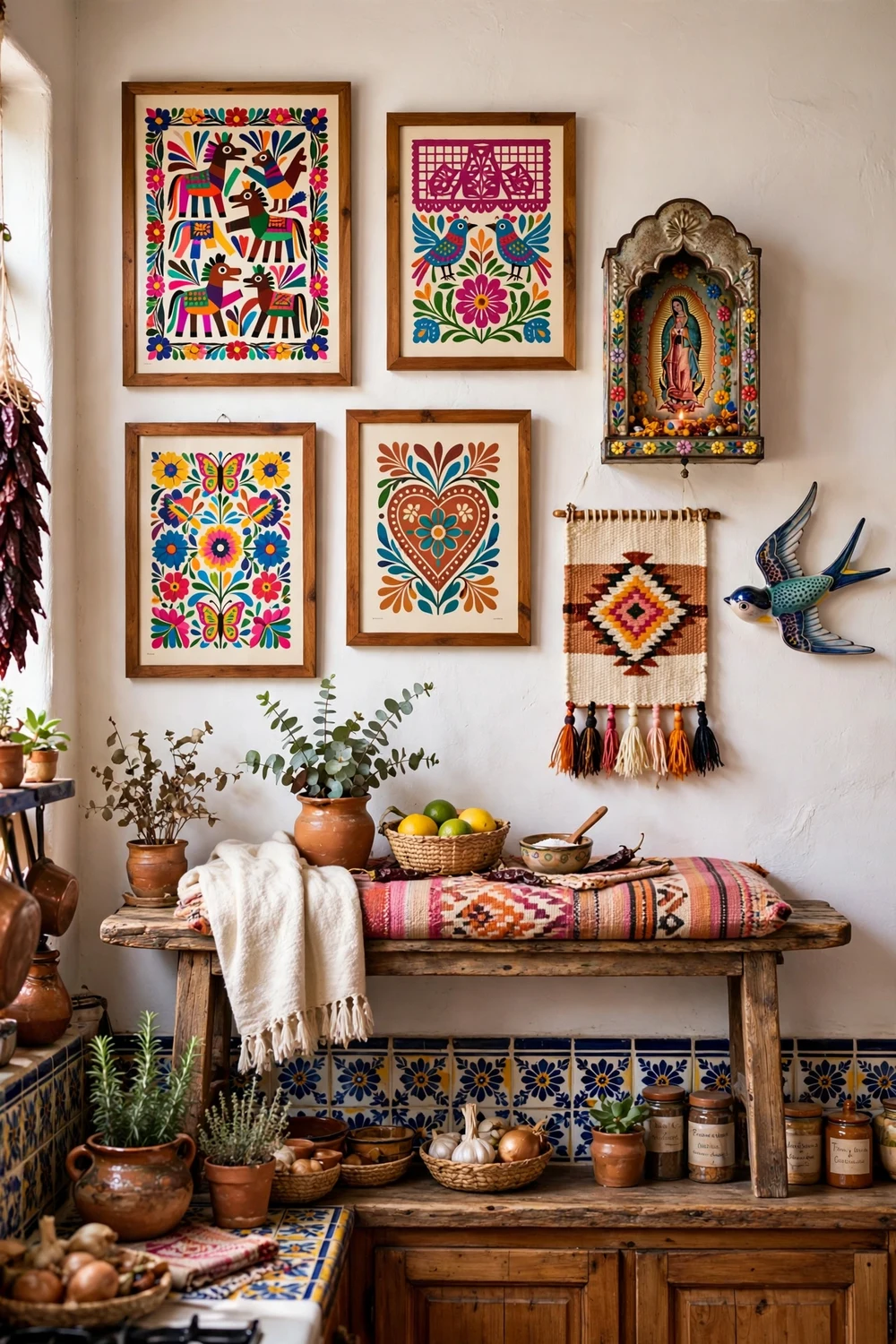
Finish with the soul: a wall of Mexican folk art. Punched-tin mirrors, painted retablos, small Oaxacan wood carvings (alebrijes), embroidered textiles in frames. This is the layer that makes the kitchen yours — collected over years, never bought all at once. Leave breathing room between pieces; folk art reads richer with a little air around each treasure.
Try this: hang the biggest piece first, off-center, and build around it. Gallery walls grow best from one anchor.
Difficulty: Easy | Cost: $50-$300
Quick-Pick Cheat Sheet
Not sure where to start? Match your situation to the right move:
| Your Situation | Start With This | Why It Wins | Rough Cost |
|---|---|---|---|
| Renting, no renovations | Papel picado, textiles, herb pots | All the fiesta, zero damage | Under $50 |
| Weekend warrior | Painted cabinets or bar stools | Biggest color change per dollar | $50–$200 |
| One statement move | Talavera backsplash | The signature look, forever | $300–$900 |
| Love warm materials | Saltillo floors | Glowing foundation for decades | $8–$15/sq ft |
| Cooking is the point | Molcajete station + clay pots | Real tools, real flavor | $40–$120 |
| Full renovation | Beams, stucco shelves, arch | The real hacienda architecture | $2,000+ |
Frequently Asked Questions
What defines a Mexican style kitchen?
Handmade materials and warm color: hand-painted Talavera tiles, Saltillo terracotta floors, distressed wood, wrought iron, and copper, in a palette of terracotta, cobalt blue, turquoise, and mustard. Open shelving and displayed cookware replace hidden storage, and the overall feeling is festive, layered, and deeply personal.
What types of tiles are used in Mexican kitchens?
Talavera (hand-painted tin-glazed tiles in bright patterns), Saltillo (handmade terracotta floor tiles from river clay), and Mexican cement tiles (patterned encaustic-style tiles). Talavera suits backsplashes and accents; Saltillo is for floors; cement tiles work on floors, islands, and counters.
How can I get the Mexican kitchen look on a budget?
Start with the cheap layers: papel picado banners, a serape runner, terracotta herb pots, and painted bar stools all cost under $100 combined. Peel-and-stick Talavera-look tiles give you the backsplash without the tile bill, and thrifted copper and clay pieces show up everywhere.
What colors work best in a Mexican style kitchen?
Terracotta, cobalt blue, turquoise, mustard yellow, and deep red — the colors of Mexican folk art and the desert landscape. Warm whites and natural wood balance them. The rule: one or two bold colors plus warm neutrals, not every color at once.
Do Mexican style kitchens work in modern homes?
Absolutely — the style is about materials and warmth, not period accuracy. A Talavera backsplash or Saltillo floor works beautifully with modern flat-front cabinets and stainless appliances. Keep the architecture clean and let the handmade materials supply the character.
Final Thoughts
Here’s what that Arizona rental taught me and my own kitchen confirmed: Mexican style is the opposite of precious. It’s meant to be cooked in, spilled in, gathered in. The materials are forgiving, the colors hide sins, and everything looks better with a little wear. Don’t wait for the perfect renovation — hang the papel picado this weekend, put the molcajete on the counter, and let the kitchen start telling its story. And when you’re ready to go deeper on the architectural side — the arches, courtyards, and adobe bones that make the style complete — this guide to Spanish colonial architecture walks through the structural elements, from wall construction to porch roofs, one by one.


