



Most backyards have one dead corner. It gets sun, it gets shade, and nobody sits in it because there is nothing to sit on. A hammock fixes that corner for less than a patio chair set, and it takes about 20 minutes to hang once you know your anchor points.
This guide covers 25 hammock ideas for backyards of every size, from a two-tree classic to a no-tree stand setup, a kids’ low hang, and a full evening setup with lights. I hung my first hammock too low and spent a week stepping over it, so the hanging and safety notes at the end come from that kind of small, avoidable mistake. Pick the setup that fits your space, your budget, and how you actually plan to use it.
Quick takeaways
- Measure your hammock before you buy anchors: most full-size hammocks need 12 to 15 feet between anchor points.
- No trees is not a problem. A freestanding stand, two posts, a pergola, or a porch beam all work.
- Cotton feels soft but needs dry storage; polyester and olefin dry fast and handle rain better.
- Hang the seat about 18 inches off the ground with a visible sag curve, and always check the weight limit.
- Call 811 before you dig post holes, and use wide tree straps instead of thin rope on live trees.
1. Classic rope hammock between two trees
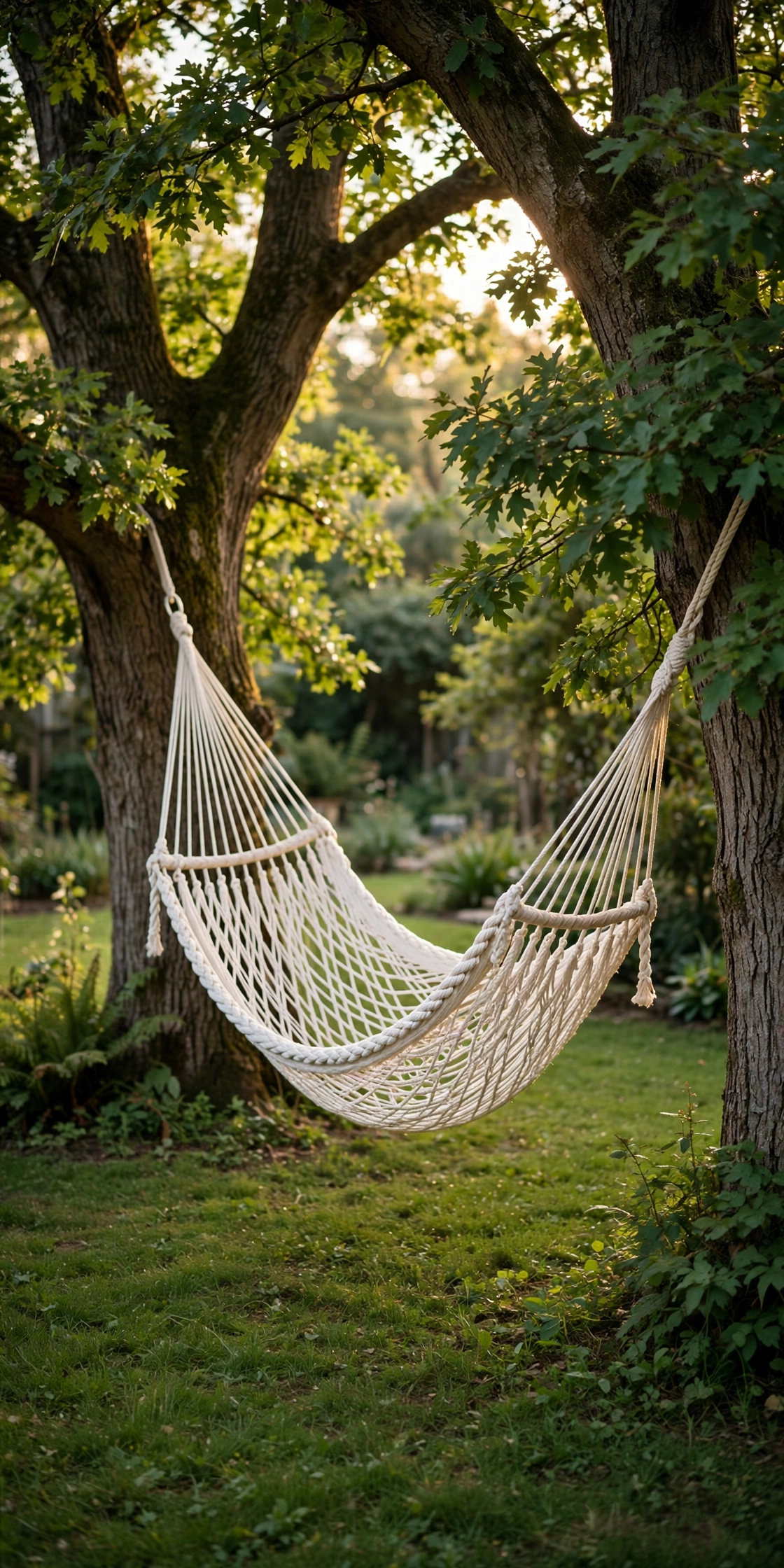
A rope hammock strung between two healthy trees is the setup most people picture, and it still earns its place. Rope breathes in summer heat, dries fast after rain, and costs less than most outdoor chairs. Pick trees at least 6 inches across, wrap them with wide tree straps, and hang the bed so it sits near chair height when you sit in it. Rope can feel firm at first, so add a thin pad if you nap in it.
Try this: Lay diagonally across the bed instead of straight down the middle. Your body stays flatter and your back will thank you.
Difficulty: Easy | Cost: $$
2. Brazilian cotton hammock

Brazilian hammocks use a tight cotton weave that cradles your body instead of letting you sink through gaps. The fabric bed runs wider than a rope hammock, so two people can share it without a fight over the middle. Cotton fades in strong sun and stays damp after rain, so bring it inside during wet weeks or keep it under a tree canopy. Wash it cold and line dry it to keep the weave tight.
Try this: Choose a double size even if you mostly lounge alone. The extra width is what makes the diagonal lay work.
Difficulty: Easy | Cost: $$$
3. Freestanding steel stand hammock
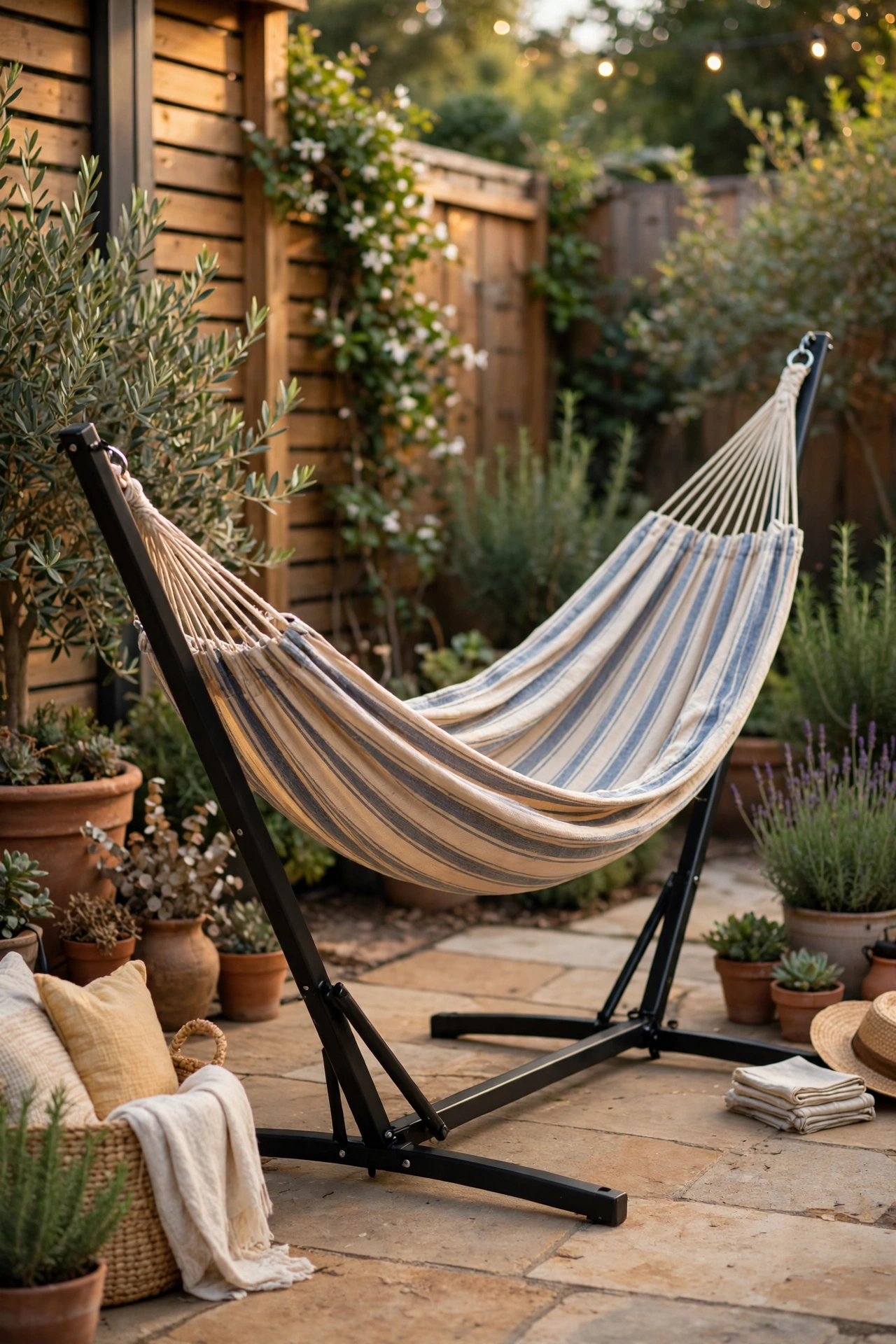
A steel stand removes the tree question entirely. You set it on a patio, a lawn, or a deck, and you move it when the sun moves. Look for a 9-foot or 12-foot stand matched to your hammock length, and check the rated capacity before two people pile in. Steel stands run about $90 to $180 with the hammock included in many kits. Add rubber feet pads if the frame sits on soft lawn after rain.
Try this: Face the stand toward your best view, not toward the house wall. You will use it twice as often.
Difficulty: Easy | Cost: $$$
4. Curved wooden stand hammock

A curved wooden stand looks like garden furniture instead of camping gear, which matters if the hammock lives on a visible patio. Cedar and acacia hold up outdoors with a yearly oil or seal coat. Wooden stands cost more than steel and weigh more, so pick its spot with care. The arc shape also gives a deeper, steadier swing than a straight bar frame.
Try this: Oil the wood once a season and store the fabric bed indoors over winter to double its life.
Difficulty: Easy | Cost: $$$
5. Pergola hammock retreat

If you already have a pergola, its posts or beams give you ready-made anchors with shade built in. Hang the hammock across the pergola, train a fast vine like jasmine over the top, and add an outdoor rug underneath to mark the spot as a room. Check that the beam or post can carry the load before you hang; a decorative lattice top is not an anchor. This setup turns a plain pergola into the most-used seat in the yard.
Try this: Hang a small lantern from the pergola beam above the hammock for evening reading light.
Difficulty: Moderate | Cost: $$$
6. Poolside quick-dry hammock
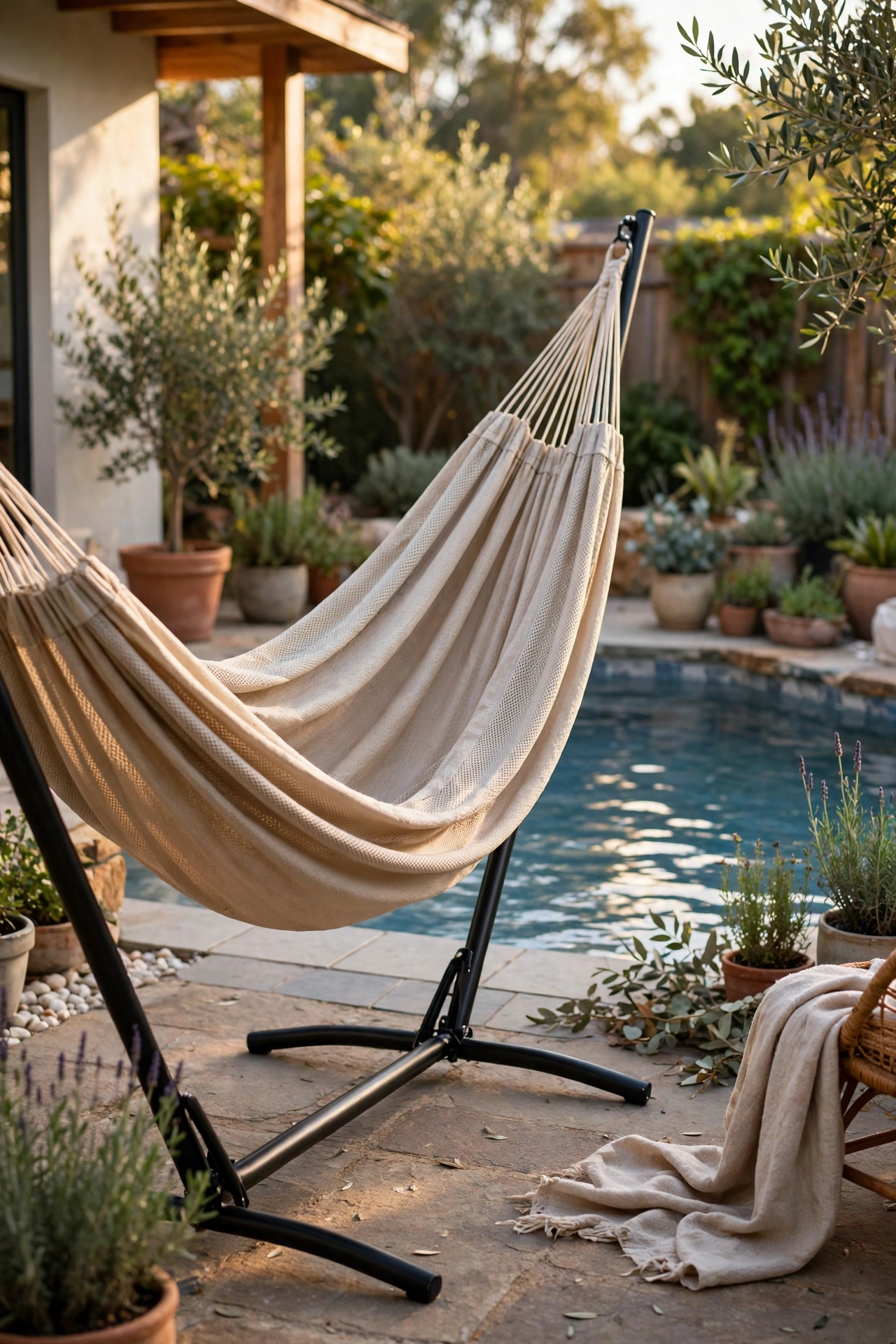
A poolside hammock needs fabric that shrugs off splashes. Polyester and olefin dry within an hour or two, resist mildew, and keep their color in chlorine air better than cotton. Put it on a stand with wheels so you can roll it into shade at midday, and keep it a few feet back from the pool edge so wet feet do not turn the ground under it to mud. A waterproof pillow finishes the setup.
Try this: Rinse the fabric with fresh water once a week in pool season to stop chlorine buildup.
Difficulty: Easy | Cost: $$$
7. Boho macramé hammock

A macramé hammock brings texture that a plain fabric bed cannot match. The knotted cotton fringe and open weave read as decor even when nobody is lying in it. Macramé suits covered spots best, since the knots hold water and take a long time to dry. Pair it with neutral throw pillows and a woven rug, and keep it out of full sun so the cotton stays soft.
Try this: Bring a macramé hammock under cover before storms. Dry knots last years; soaked knots sag and mildew.
Difficulty: Easy | Cost: $$$
8. Family spreader bar hammock
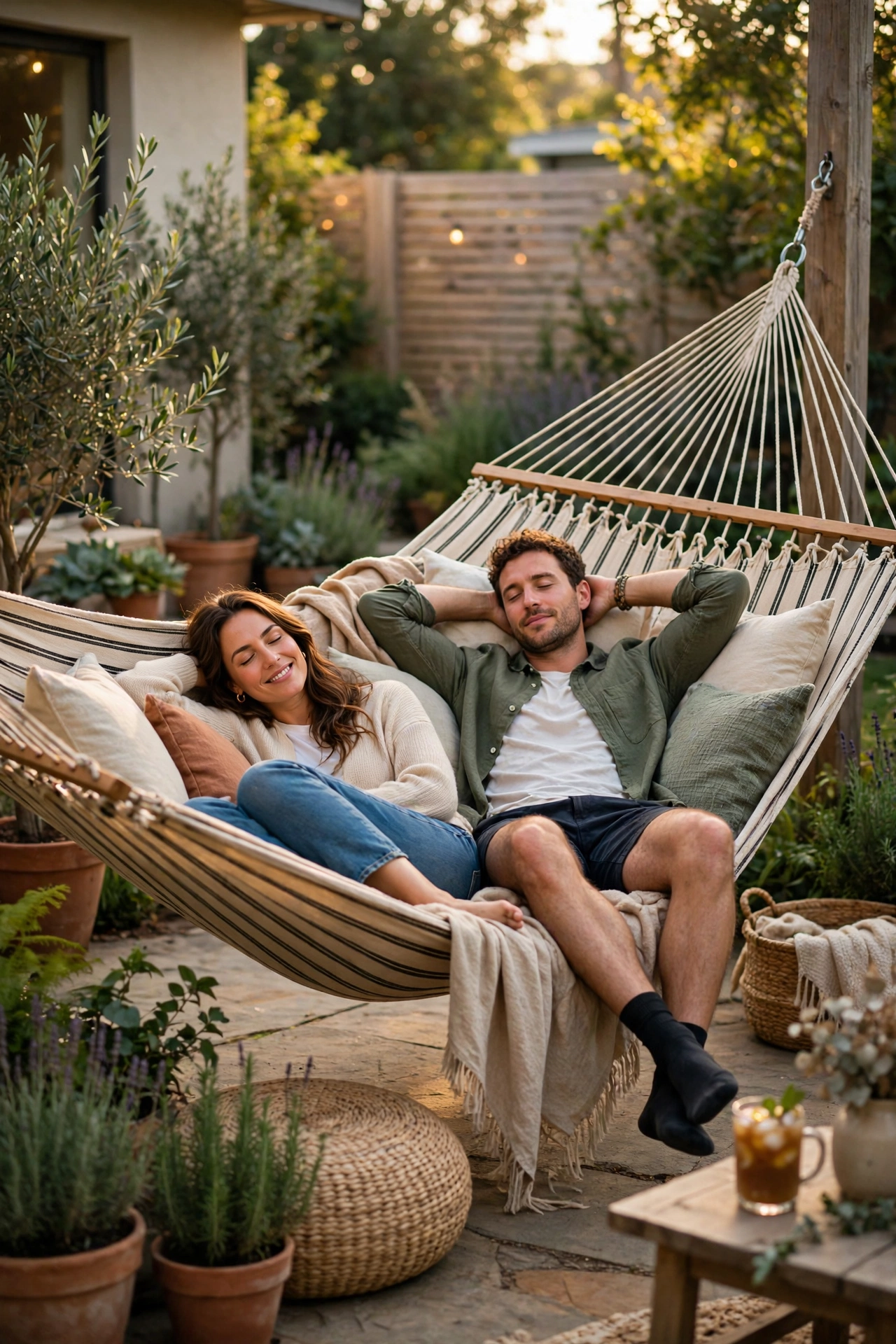
A spreader bar holds the bed open and flat, so getting in feels like sitting on a bed instead of climbing into a sack. That flat lay is why families pick this style: kids get in without help, and two adults can share it without rolling together. The trade-off is balance. Sit in the center first, then swing your legs up, and never stand on the bar. A 15-foot stand suits most family-size beds.
Try this: Teach kids the center-sit entry on day one. It stops the classic spreader bar flip.
Difficulty: Easy | Cost: $$$
9. Hanging hammock chair

A hammock chair hangs from one point, so it fits porches, small patios, and yards with only one good branch. You sit upright with back support, which suits reading and morning coffee better than a flat nap. The chair swings gently and turns slowly, so leave a full arm’s length of clear space around it. A stand version costs little more and works where no branch is in reach.
Try this: Add a small footrest or stool. Your legs will tire faster than your back in a hanging chair.
Difficulty: Easy | Cost: $$$
10. DIY pallet stand hammock
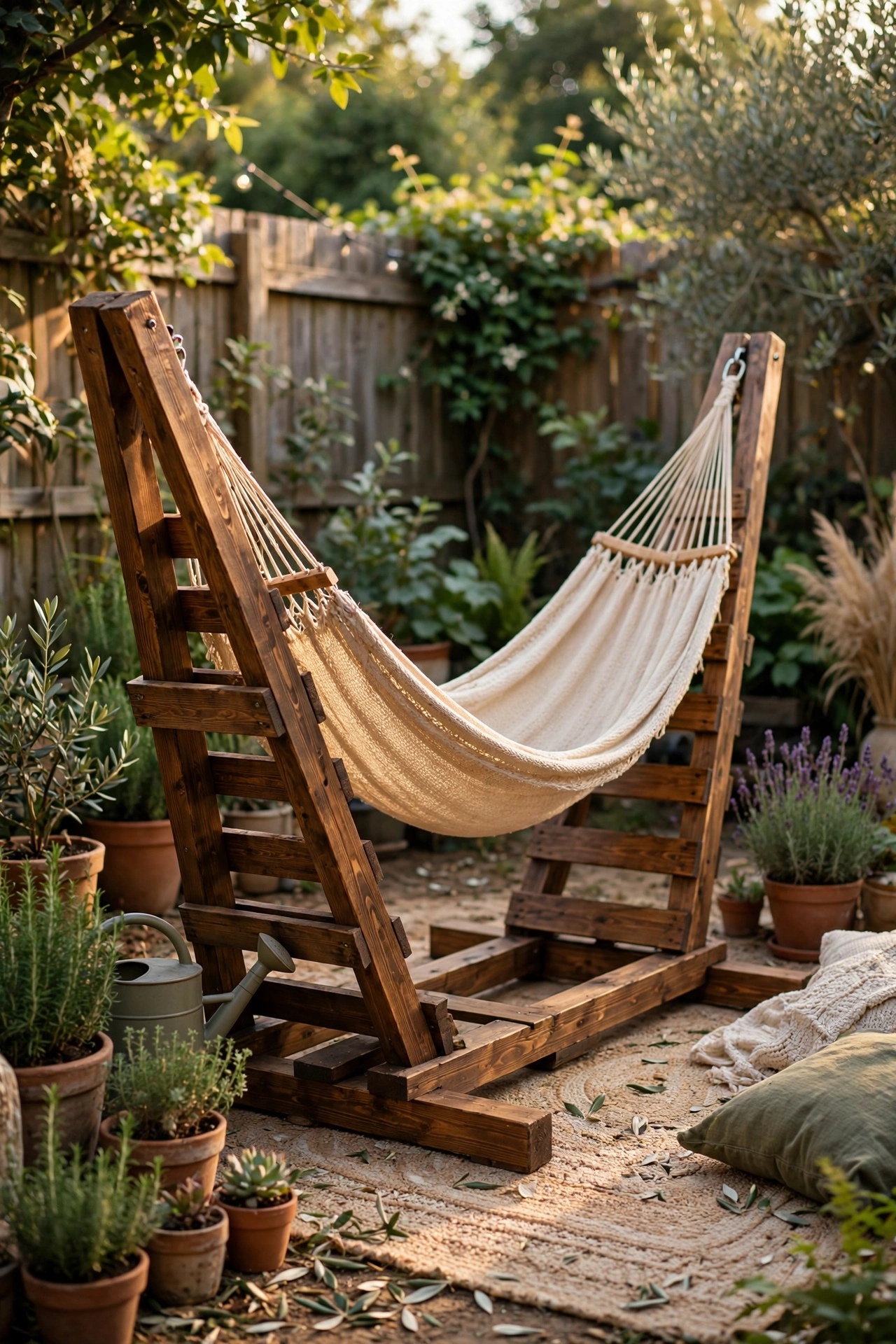
Four to six reclaimed pallets, screws, and diagonal braces make a sturdy hammock stand for about half the price of a store frame. Sand every surface, stain or paint it, and brace the joints in both directions so the frame cannot rack sideways under load. Use heat-treated pallets marked HT, not chemically treated ones, and check the stamp before you build. The result looks rough in a good way and fits a garden full of other handmade pieces.
Try this: Set the pallet feet on flat pavers so the frame stays level on soft ground.
Difficulty: Moderate | Cost: $$$
11. Zen garden hammock

A hammock in a zen-style corner works when everything around it stays quiet: raked gravel, a stone lantern, bamboo screening, and one or two pruned shrubs. Choose a solid neutral bed in beige, gray, or olive so the hammock does not fight the calm palette. The point here is stillness, so skip bright pillows and string lights in this corner and let the shade and the sway do the work.
Try this: Rake a gravel bed under the hammock. It drains well and marks the quiet zone clearly.
Difficulty: Easy | Cost: $$$
12. Striped cotton backyard hammock
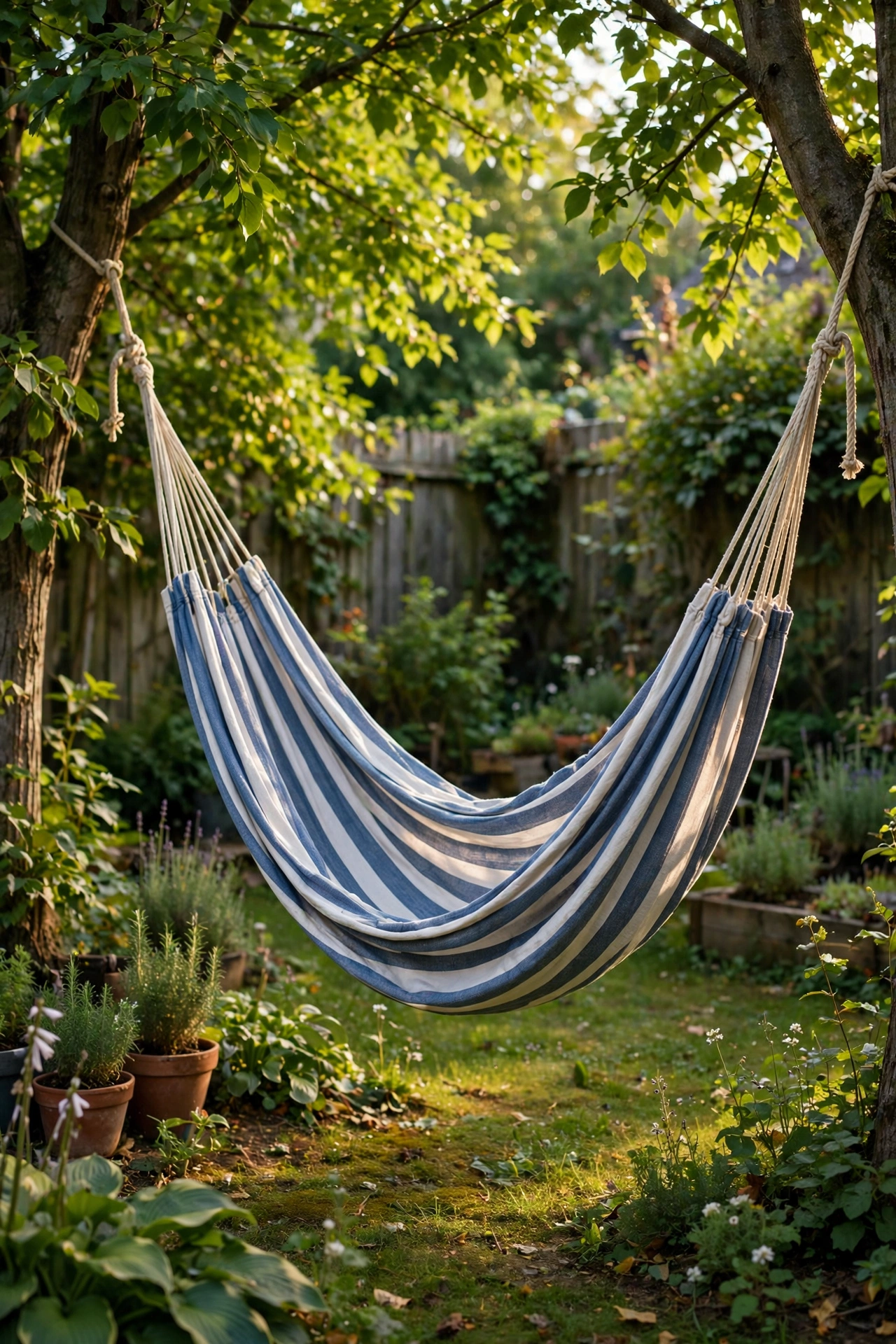
Stripes are the easiest way to make a hammock look planned instead of improvised. A blue and white or terracotta stripe ties the hammock to patio cushions, umbrellas, and planters without any extra decor. Cotton stripes fade faster than solution-dyed synthetics, so this pick suits a yard with afternoon shade or a habit of bringing the bed inside. The classic look also photographs well if you share your yard online.
Try this: Match the stripe color to one existing accent, like a planter or a door, and leave the rest neutral.
Difficulty: Easy | Cost: $$$
13. Mosquito-net camping hammock
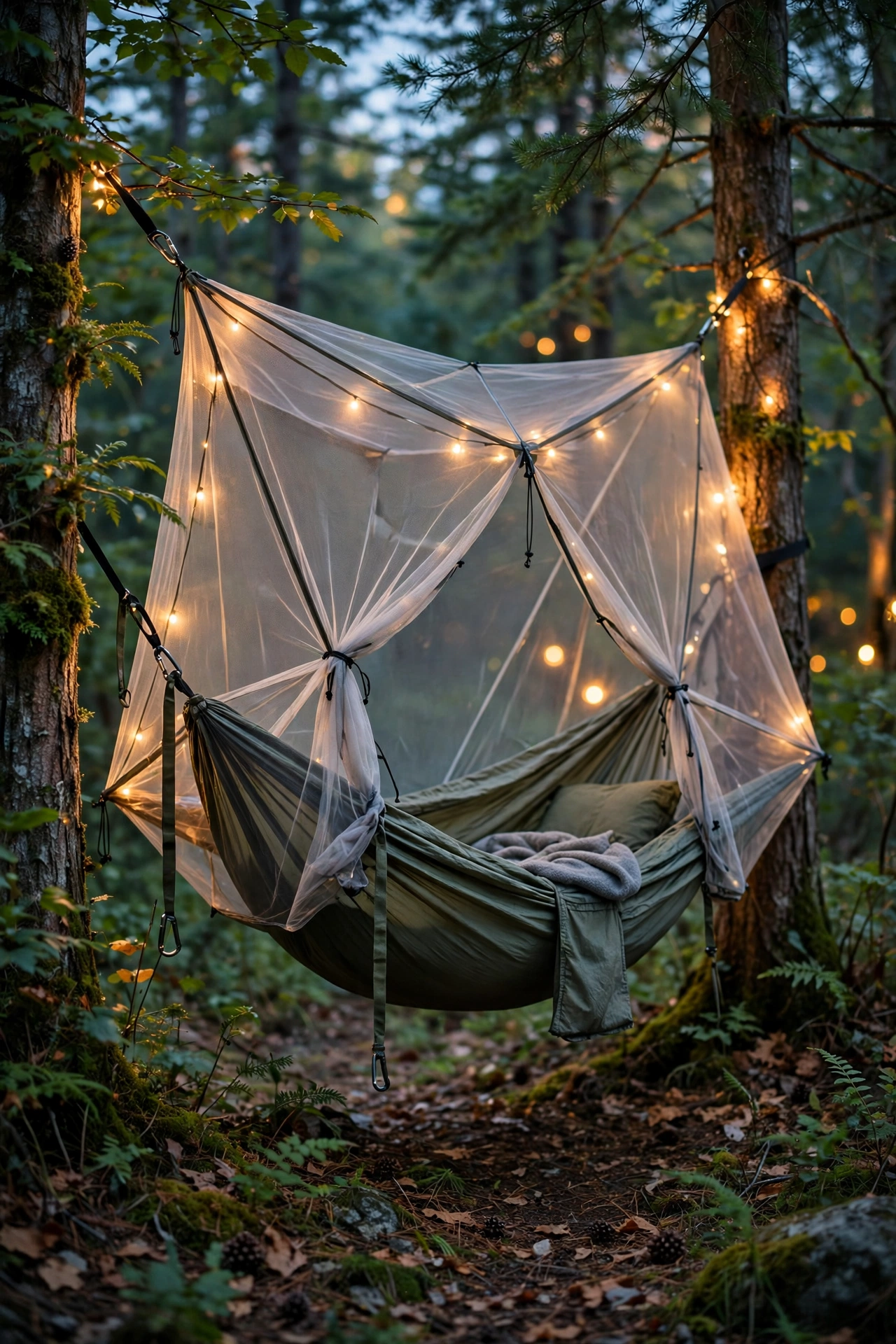
If bugs cut your evenings short, a hammock with a built-in net changes the math. The net zips closed around the bed, so you can nap at dusk without repellent on your skin. Many models add a rainfly that doubles as a sun shade. The bed runs narrower than a backyard fabric hammock, so this pick suits solo lounging and backyard camp-outs more than couples. Hang it with tree straps, same as any other hammock.
Try this: Zip the net closed before you lie down, not after. Mosquitoes enter in the seconds you leave it open.
Difficulty: Easy | Cost: $$$
14. Built-in canopy shade hammock

Yards without mature trees still deserve a hammock, and a built-in canopy is the simplest answer. The adjustable shade top blocks midday sun and tilts as the sun moves, so you do not need a separate umbrella or shade sail. Look for a canopy fabric with a UPF rating and a frame rated for the same weight as the bed. Detachable canopies store flat in winter, which keeps the fabric from cracking in cold.
Try this: Angle the canopy toward the afternoon sun, not straight overhead, for longer shade coverage.
Difficulty: Easy | Cost: $$$
15. String-light evening hammock
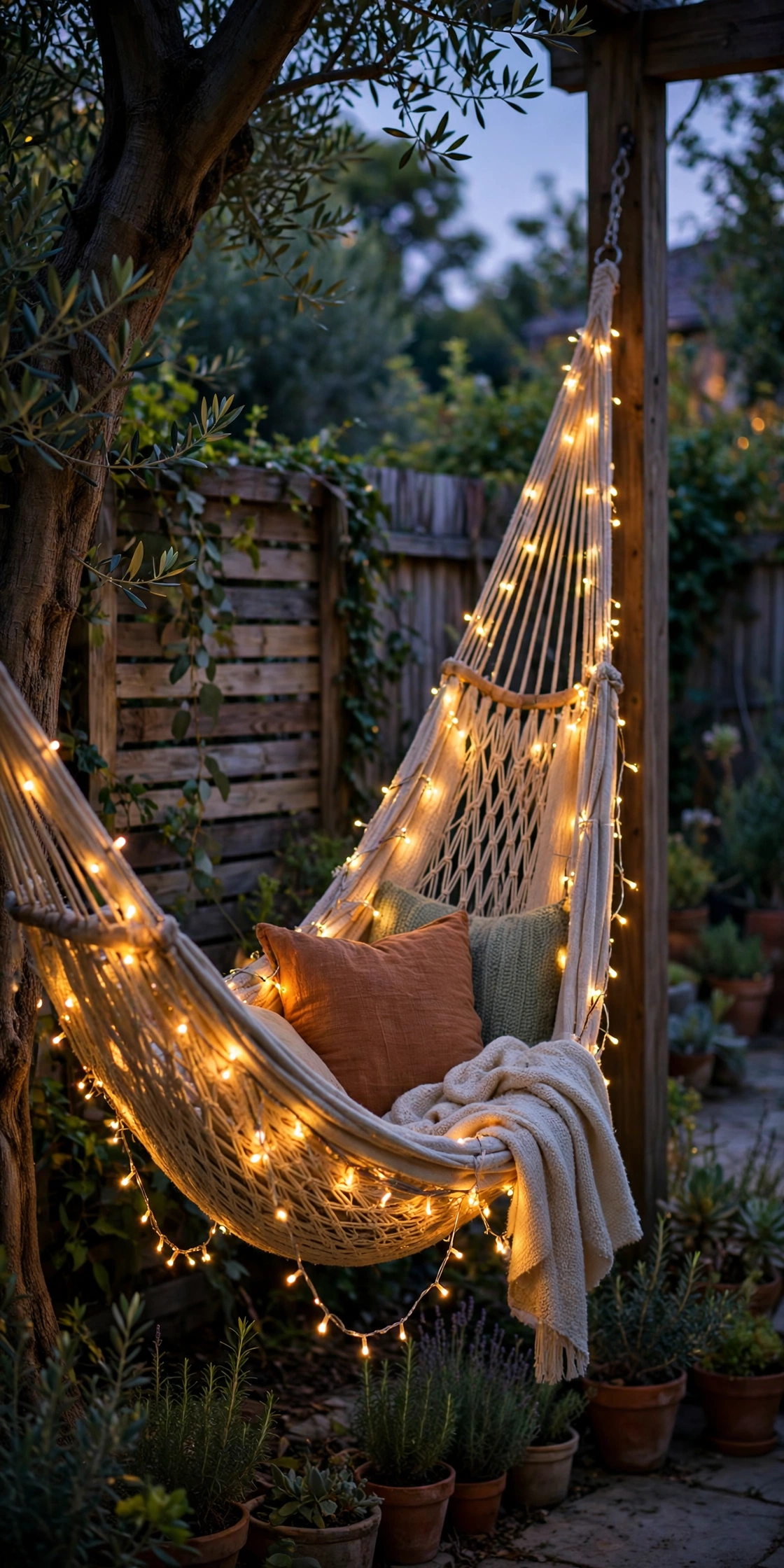
String lights turn a daytime hammock into an evening spot without any building work. Drape them along the anchor ropes or between the two trees, and use warm white LEDs so the light stays soft. Solar strings charge by day and switch on at dusk, which means no outdoor outlet and no cord across the lawn. Keep lights clear of the bed itself so nobody tangles in them while getting in or out.
Try this: Put the lights on a timer or a solar sensor so you never walk out to a dark yard.
Difficulty: Easy | Cost: $$$
16. Porch beam hammock
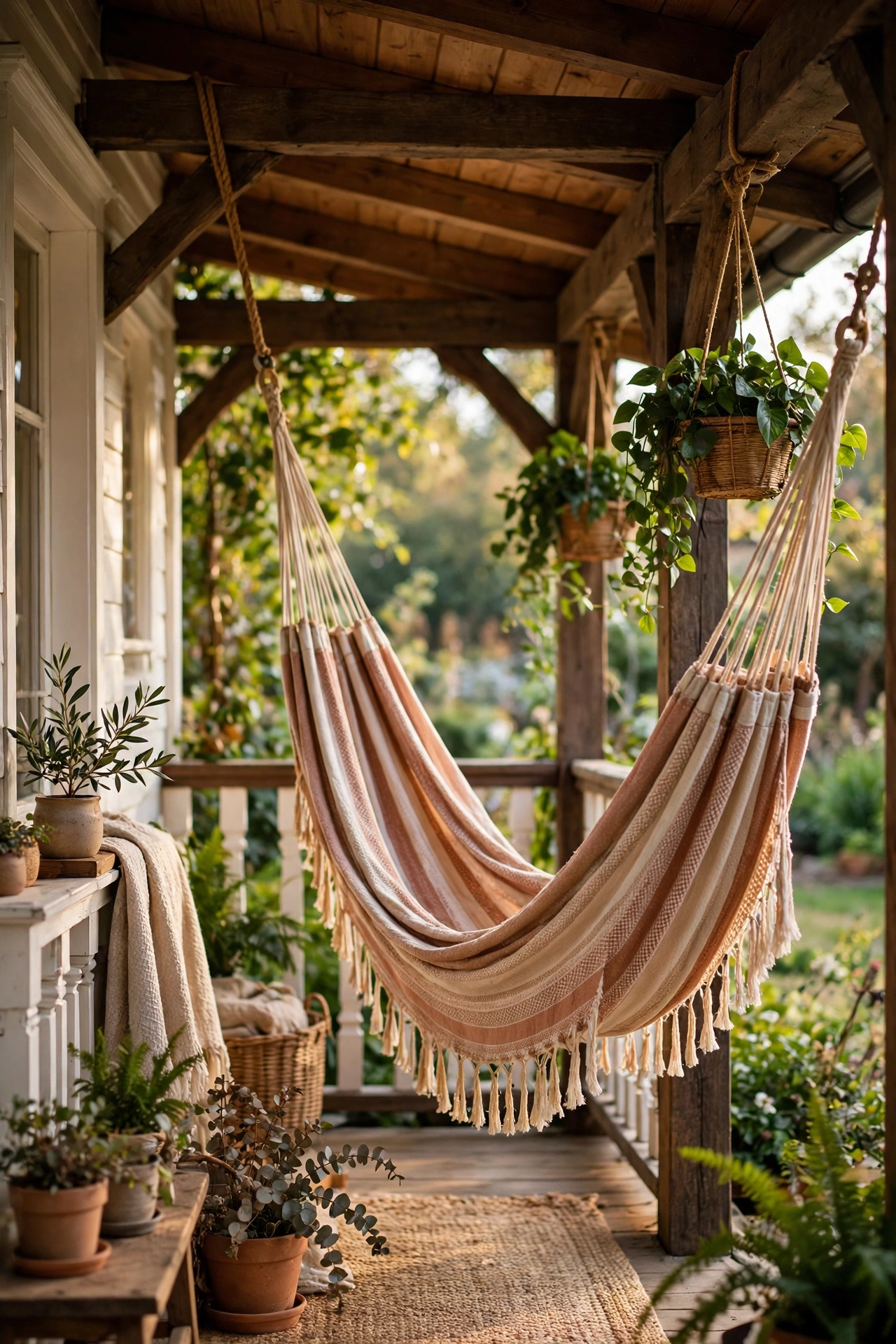
A covered porch gives you a hammock spot that works in rain and harsh sun alike. Hang from the main beam, not from a rafter tail or a decorative trim board, and use through-bolts with washers instead of screw hooks. If you rent or cannot drill, a stand on the porch floor gives the same seat without holes. Porch hammocks sit close to the house, so they get used on work calls and rainy afternoons when the yard hammock stays empty.
Try this: Hang the porch hammock near the steps, not against the wall, so you can get in from the side.
Difficulty: Moderate | Cost: $$$
17. Small-space balcony hammock chair

A full hammock needs 12 feet or more, but a balcony rarely gives you that. A hanging chair needs one overhead anchor and about 6 feet of clear space, which fits most balconies and tiny patios. Check your building rules before you drill into a balcony ceiling, and use a stand if drilling is off limits. A chair also works as the only outdoor seat in a rental, since it comes down in minutes when you move.
Try this: Measure your balcony depth before ordering. The chair needs room to swing without hitting the rail.
Difficulty: Easy | Cost: $$$
18. Garden nook hammock
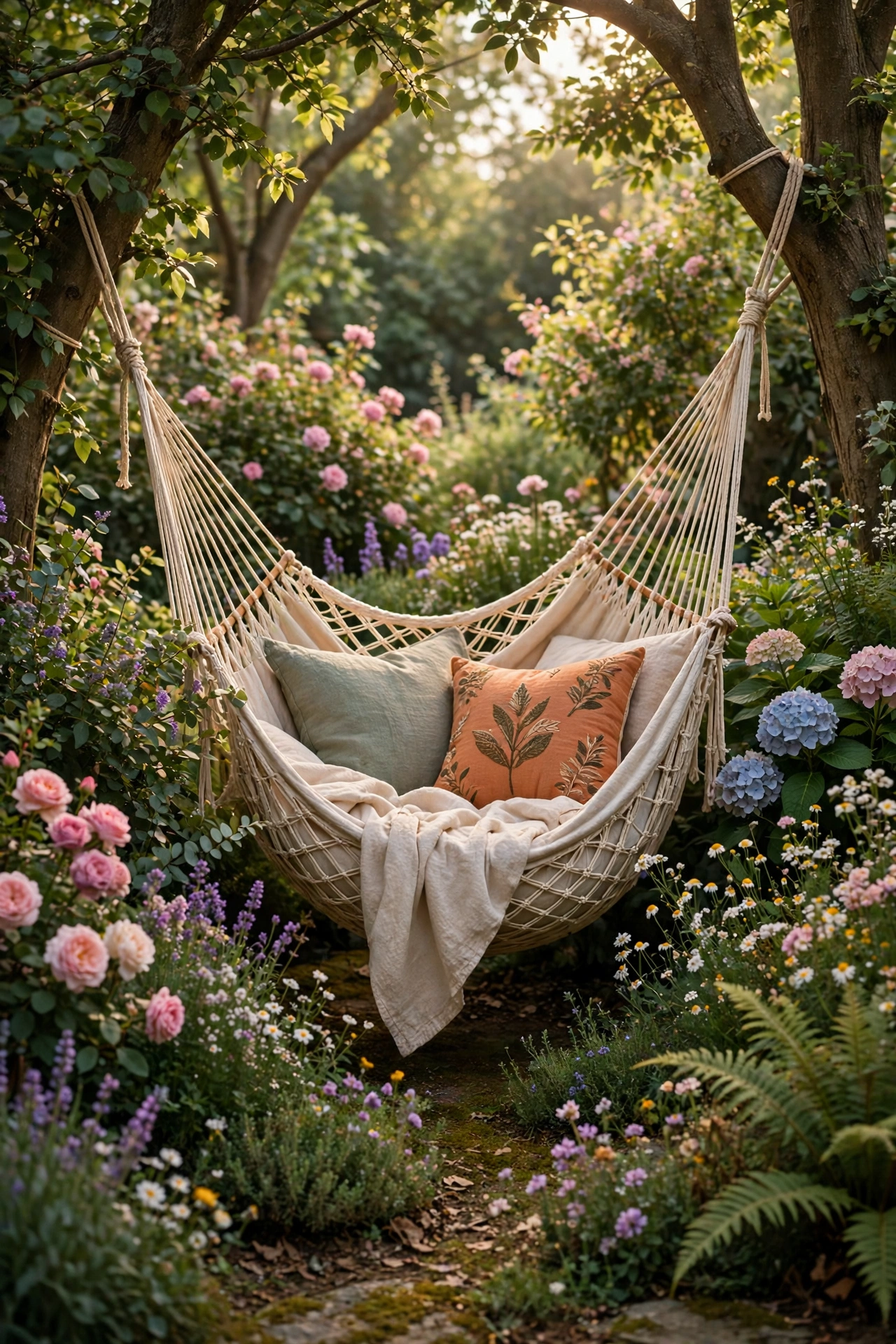
Tuck a hammock into a planted corner and it reads as part of the garden instead of furniture dropped on a lawn. Pick a spot where shrubs screen two sides, leave the third side open for the breeze, and lay stepping stones to the hammock so you do not wear a mud path through the bed. This setup pairs well with fragrant plants near the anchors, since you sit still long enough to notice them.
Try this: Plant lavender or jasmine near the hammock anchors for scent without any extra work.
Difficulty: Easy | Cost: $$$
19. Fire pit hammock pairing

A hammock near a fire pit extends the season by months, since the fire covers cool evenings that would otherwise send you inside. Keep the hammock at least 10 feet from open flame, and never hang it downwind where sparks drift into the fabric. Synthetic hammock fabric melts fast near heat, so cotton or a treated canvas bed is the safer pick for this corner. A side table for drinks keeps the fire circle tidy.
Try this: Use battery candles or lanterns near the hammock itself, and keep real flame at the pit only.
Difficulty: Easy | Cost: $$$
20. Double hammock for two
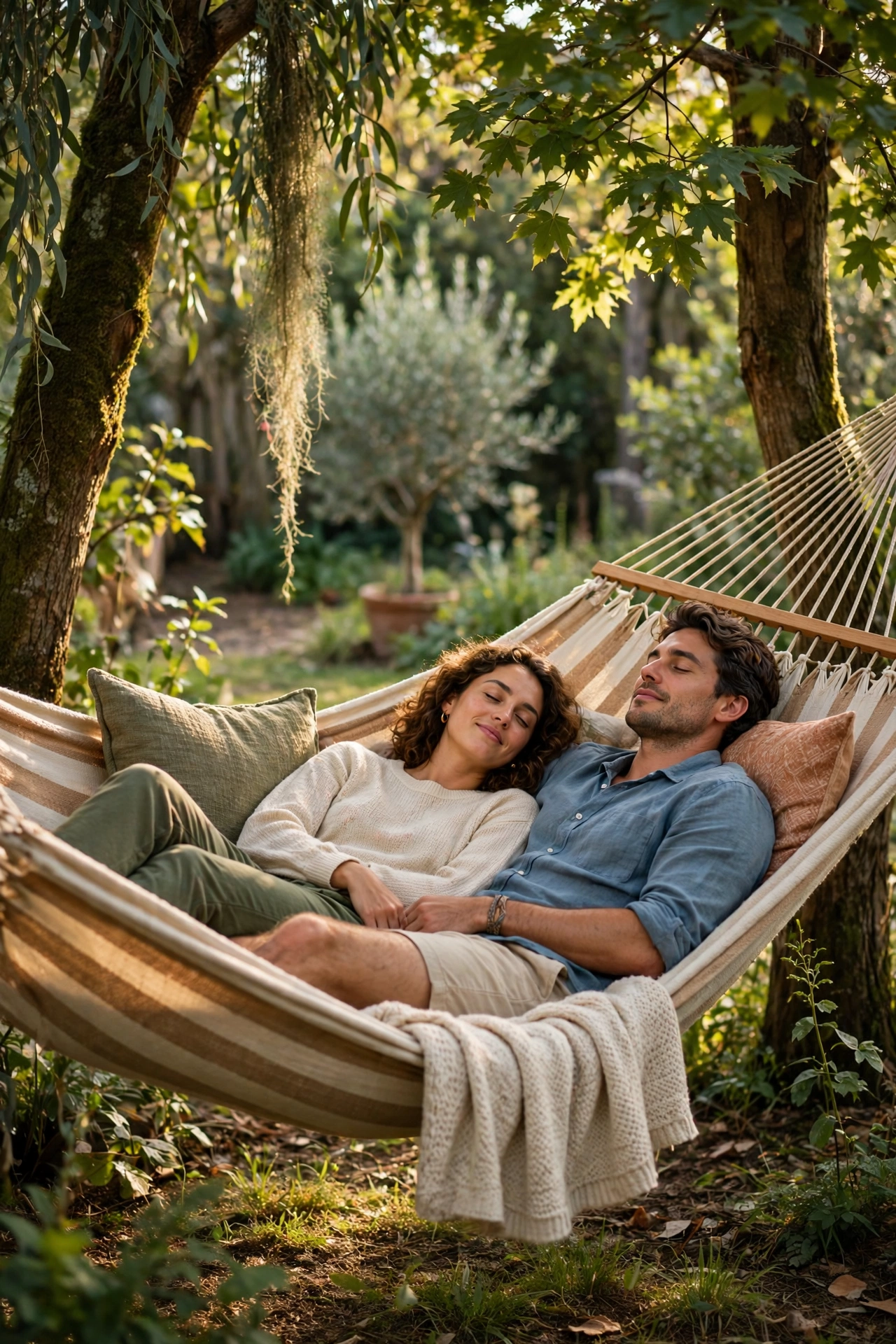
A double hammock runs about 5 feet wide or more, which is the difference between sharing a seat and sharing a squeeze. Two people lie best at a slight diagonal in opposite directions, which balances the weight and stops the roll-together effect. Check the rated capacity for two adults plus a margin, since many “double” beds rate for 400 pounds total. This is the pick for couples who actually plan to share, not just pose.
Try this: Lie head to foot instead of side by side. Both of you get a flatter lay and more elbow room.
Difficulty: Easy | Cost: $$$
21. Quilted padded hammock
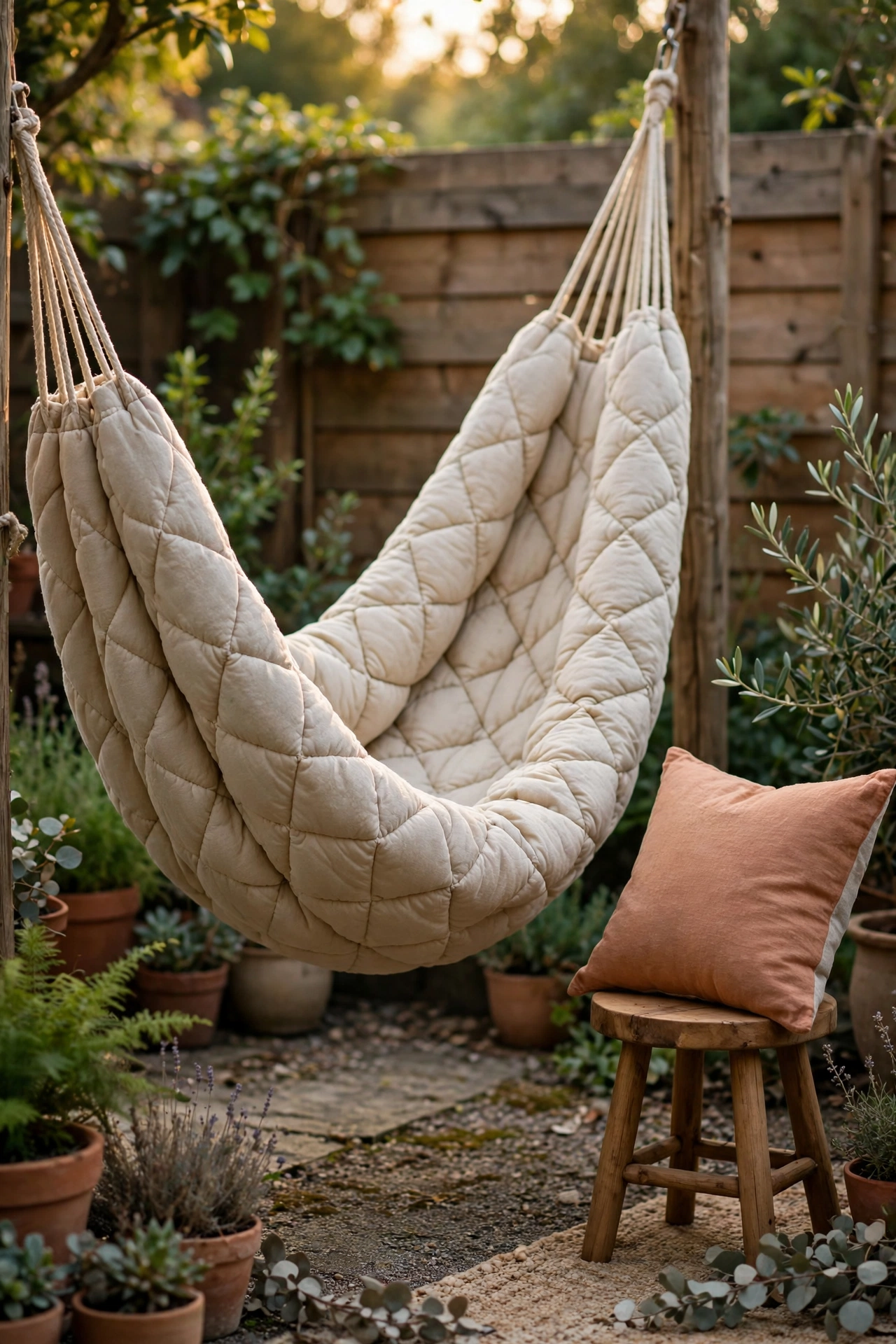
A quilted hammock adds padding layers to the bed, so it feels like a lounge chair instead of a sling. The padding helps on cool evenings and for anyone with a sore back, and many quilted models include a built-in pillow. The trade-off is drying time: thick padding holds water after rain, so this pick belongs under a tree canopy, a pergola, or a canopy top. Store it dry and it keeps its loft for years.
Try this: Shake the padding out after rain and let it air dry flat before you fold it away.
Difficulty: Easy | Cost: $$$
22. Hanging daybed swing

A hanging daybed is a hammock scaled up to a full mattress platform, hung from a porch frame or a heavy stand. It seats three people or fits one person flat for a real nap, and it reads as outdoor furniture rather than camping gear. The frame must carry 600 pounds or more, and the ropes or chains need rated hardware, not clothesline. This is the biggest investment on the list, but it replaces a sofa and a lounger in one piece.
Try this: Use outdoor-rated cushions with removable covers. A daybed collects pollen and dust faster than a hammock.
Difficulty: Moderate | Cost: $$$
23. Low kids’ hammock
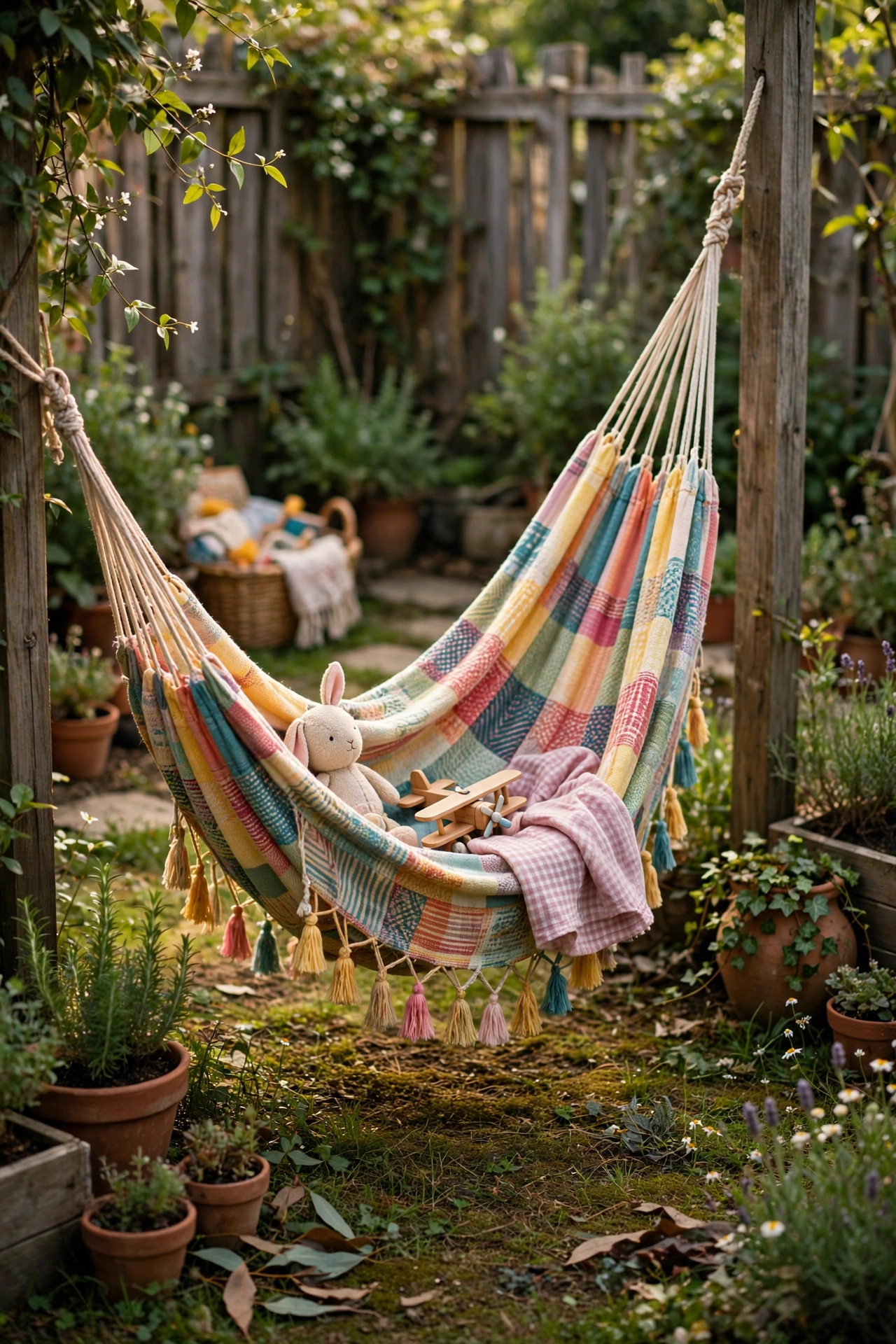
Kids love hammocks, and a low hang makes them safe to use alone. Hang the bed 12 inches or less off soft ground like grass or rubber mulch, keep it away from hard patio edges, and pick a bed rated for at least twice the child’s weight. A bright striped bed also marks it as theirs, which keeps adults from borrowing it. Check the ropes monthly, since kids swing harder than adults and wear hardware faster.
Try this: Set a simple rule: one child at a time unless the bed is rated for two.
Difficulty: Easy | Cost: $$
24. Reading nook hammock with side table

A hammock becomes a reading nook when you add three things: a small side table, a shade source, and a place to put the book down without it sliding off. A stump, a crate, or a $25 side table all work. Clip-on book lights beat lanterns for reading after dark, since the light points at the page instead of your eyes. This setup is the one most likely to become a daily habit, since it ties the hammock to something you already do.
Try this: Keep a small basket at the table for the current book, a pencil, and sunscreen.
Difficulty: Easy | Cost: $$$
25. Backyard camp-out hammock with rainfly
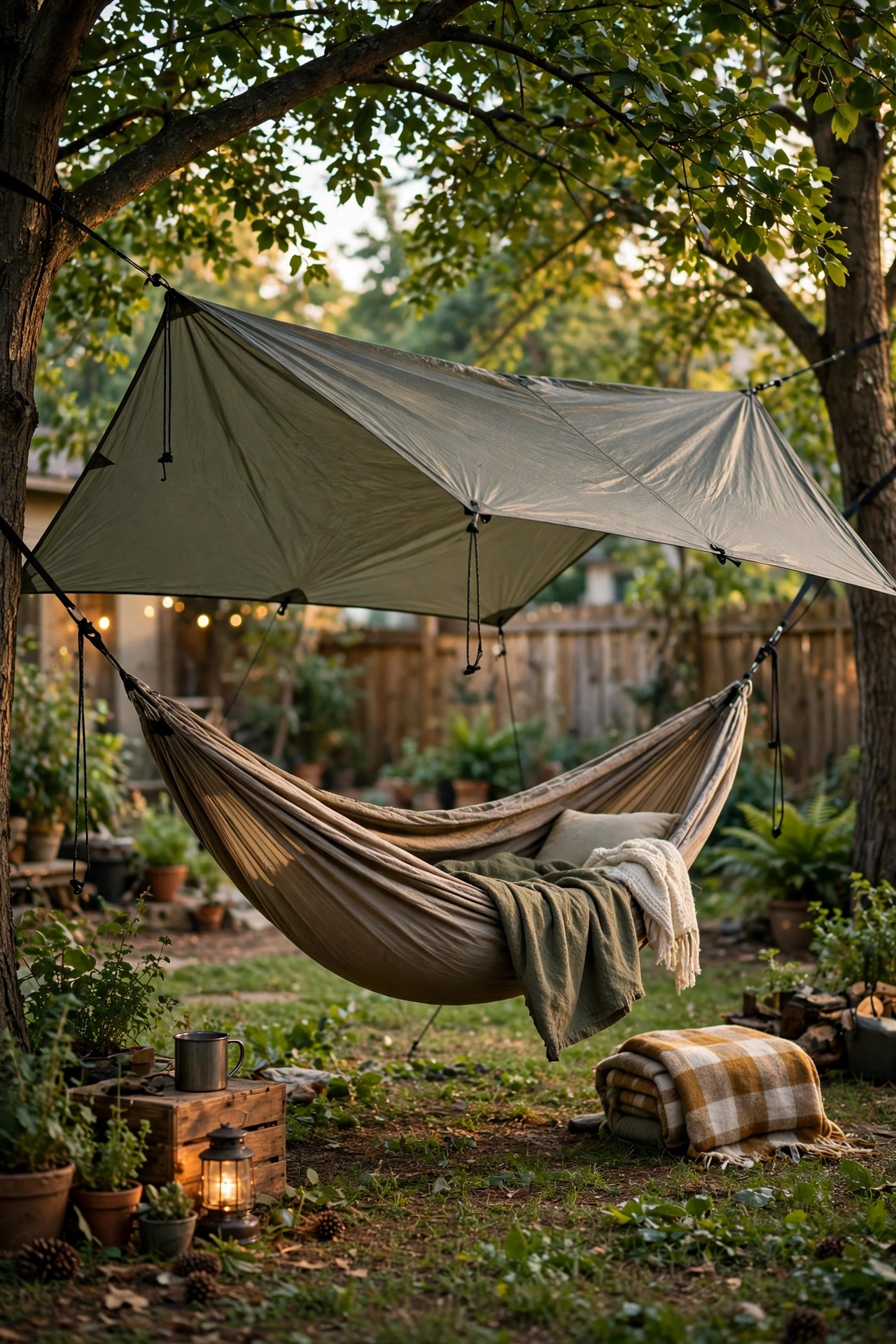
A hammock with a rainfly turns a backyard into a camp-out without leaving home, which is a gentle first camping trip for kids. The rainfly tarp hangs above the bed on a ridge line and sheds rain and dew, while an underquilt or sleeping pad keeps your back warm from below. Practice the setup once in daylight before a sleep-out, and pick a calm night for the first try. The whole kit packs into a bag when the kids outgrow backyard camping.
Try this: Hang the rainfly with a slight tilt so rain runs off one end instead of pooling.
Difficulty: Easy | Cost: $$$
How to hang a hammock safely
Most hammock problems come from the hang, not the hammock. Start with anchor spacing: a standard gathered-end hammock needs 12 to 15 feet between trees or posts, while shorter fabric beds need 8 to 12 feet. Always measure your hammock first, since brands vary by a foot or more.
Hang the empty bed so the lowest point sits about 18 inches off the ground, with a sag curve that drops roughly 30 degrees from each anchor. A bed hung drum-tight feels hard and strains the anchors; a bed hung too low drags on the ground once you lie in it. Use wide tree straps, at least 1 inch across, around live trees, and never wrap thin rope or wire around bark. For posts, dig at least 2 feet deep, set them in concrete, and let the concrete cure fully before you hang.
Before you dig any post hole, call 811 so local utilities can mark buried lines at no charge. For digging safety details, see the 811 residential digging guide. Check the rated weight capacity of the hammock, straps, and hardware together, and use the lowest number as your limit. Inspect ropes, straps, and carabiners once a season for fraying, rust, or sun damage, and replace worn parts before they fail.
Sun matters too. A shaded hammock still leaves your face and arms exposed, so sunscreen and a hat stay useful even under trees. The CDC guide to spending time outdoors covers shade, clothing, and sunscreen basics for long afternoons outside.
Hammock ideas at a glance
| Idea | Cost | Difficulty | Best for |
|---|---|---|---|
| Classic rope hammock between two trees | $40-$90 | Easy | Yards with two healthy trees |
| Brazilian cotton hammock | $60-$140 | Easy | Soft, cradling comfort |
| Freestanding steel stand hammock | $90-$180 | Easy | No-tree yards, movable setup |
| Curved wooden stand hammock | $150-$300 | Easy | Patios where looks matter |
| Pergola hammock retreat | $120-$400 | Moderate | Shaded, vine-covered corners |
| Poolside quick-dry hammock | $70-$160 | Easy | Pool areas, wet conditions |
| Boho macramé hammock | $80-$200 | Easy | Covered, decorative spots |
| Family spreader bar hammock | $100-$220 | Easy | Couples and families |
| Hanging hammock chair | $50-$130 | Easy | Small spaces, reading |
| DIY pallet stand hammock | $60-$150 | Moderate | Budget builds, handmade yards |
| Zen garden hammock | $70-$160 | Easy | Quiet, calm corners |
| Striped cotton backyard hammock | $40-$100 | Easy | Classic look, shaded yards |
| Mosquito-net camping hammock | $50-$120 | Easy | Buggy evenings, camp-outs |
| Built-in canopy shade hammock | $110-$230 | Easy | Sunny, treeless yards |
| String-light evening hammock | $60-$150 | Easy | Evening use, atmosphere |
| Porch beam hammock | $50-$120 | Moderate | Rain-proof, all-weather use |
| Small-space balcony hammock chair | $45-$110 | Easy | Balconies, rentals |
| Garden nook hammock | $50-$130 | Easy | Planted, private corners |
| Fire pit hammock pairing | $60-$140 | Easy | Cool evenings, gatherings |
| Double hammock for two | $80-$180 | Easy | Sharing with a partner |
| Quilted padded hammock | $90-$200 | Easy | Extra cushioning, sore backs |
| Hanging daybed swing | $200-$450 | Moderate | Full naps, group seating |
| Low kids’ hammock | $35-$80 | Easy | Children, safe low hangs |
| Reading nook hammock with side table | $70-$160 | Easy | Daily reading habit |
| Backyard camp-out hammock with rainfly | $70-$150 | Easy | First camping trips at home |
Common mistakes to avoid
Hanging the bed drum-tight is the top mistake. A tight hang feels hard, strains anchors, and makes the hammock tip sideways when you get in. Let it sag in a visible curve. The second mistake is skipping the weight check: the hammock, straps, and hardware each carry a rating, and the lowest one sets the real limit for two people.
Third, thin rope around a live tree cuts bark and weakens the tree over a season. Wide straps spread the load and come off clean. Fourth, cotton beds left out through wet months grow mildew that never fully washes out. If your yard stays damp, pick polyester or bring cotton inside. Fifth, digging post holes without calling 811 risks buried gas, electric, and water lines. The call is free, and most states require it a few days before digging.
More backyard ideas
If your hammock is part of a bigger yard plan, these guides pair well with it. For a full budget lounge zone around the hammock, see these DIY backyard oasis ideas.
For a planted seating corner that frames a hammock nicely, browse these beautiful garden nook seating ideas.
For the evening lighting that makes a hammock usable after dark, check these creative DIY poles for outdoor lights.
For a water feature near the hammock corner, look at these water features for stunning garden design.
For the overall yard style around your hammock spot, explore these aesthetic backyard ideas.
Frequently asked questions
How far apart should trees or posts be for a hammock?
Most full-size gathered-end hammocks need 12 to 15 feet between anchors, while shorter fabric beds need 8 to 12 feet. Measure your hammock end to end first, then pick anchors that match. If your trees sit closer than the hammock needs, hang the straps higher on the trunks to take up the extra length.
How high should a hammock hang?
Hang the empty bed so its lowest point sits about 18 inches off the ground. That height lets you sit in it like a chair and stand up without a drop. The suspension lines should leave each anchor at roughly a 30-degree angle, which gives the bed its comfortable sag curve.
Can I hang a hammock without trees?
Yes. A freestanding stand works on any flat ground, two posts set in concrete give a permanent no-tree option, and a pergola beam or porch beam works if the structure can carry the load. For tiny spaces, a hanging chair needs only one overhead anchor instead of two.
What hammock material holds up best outdoors?
Polyester and olefin hold up best in rain and sun. They dry fast, resist mildew, and keep their color longer than cotton. Cotton feels softer and breathes better in heat, but it fades and stays damp, so it suits covered spots or yards where you bring the bed inside during wet weather.
How do I keep a hammock from flipping?
Sit in the center of the bed first, then swing your legs up. That single habit stops most flips, including the classic spreader bar tip. Keep the bed low, near 18 inches, and stay under the rated weight limit. With a spreader bar hammock, never stand on the bar or sit on one edge.
Final thoughts
Start with the anchor question, not the hammock itself. Trees, a stand, posts, or a beam decide which ideas fit your yard, and the right fabric follows from how much rain and sun that spot gets. My first hammock taught me that a low, sagging hang beats a tight, high one every time, and a hammock you can reach in 30 seconds gets used daily while a fussy one gathers dust. Pick one setup from this list, hang it this weekend, and let the yard earn its keep.
For a gentler sway than a swing, see these tree swing ideas for small yards — or the other way round, hammocks pair well with swings too.


