



Every December I watch my neighborhood split into two camps: houses with cheerful winter planters by the door, and houses that look like everyone moved out in November. I spent years in the second camp, mostly because I assumed planters were a fair-weather thing.
They are not. Winter planters are some of the lowest-effort, highest-impact decorating you can do, because evergreens ask for almost nothing once they are arranged. These 15 winter planter ideas are organized by container type and where to put it, from whiskey barrels to hanging baskets, with notes on which containers actually survive freeze and thaw.
Quick takeaways
- Match the container to the spot: barrels and tall planters for entryways, hanging baskets for covered porches, small pots for stairs.
- Fiberglass, concrete, wood, and metal handle freeze and thaw. Thin terracotta often cracks.
- Evergreens, red twigs, berries, and pinecones are the core materials for almost every idea here.
- Anchor tall or top-heavy planters. Winter wind is stronger than you think.
- Several classic winter berries are toxic to pets, so plan placement with animals in mind.
1. Whiskey barrel entry planter

A half whiskey barrel by the front door is the workhorse of winter planters. It is big enough for a real arrangement, heavy enough to stay put in wind, and the wood looks better with age. Plant a dwarf spruce in the center in potting soil, surround it with red twig dogwood stems, and tuck pinecones around the base. The spruce can go into the garden in spring.
Try this: drill extra drainage holes if the barrel does not have them. Sitting water freezes, expands, and can split even sturdy wood. Difficulty: Easy. Cost: $$
2. Galvanized bucket trio
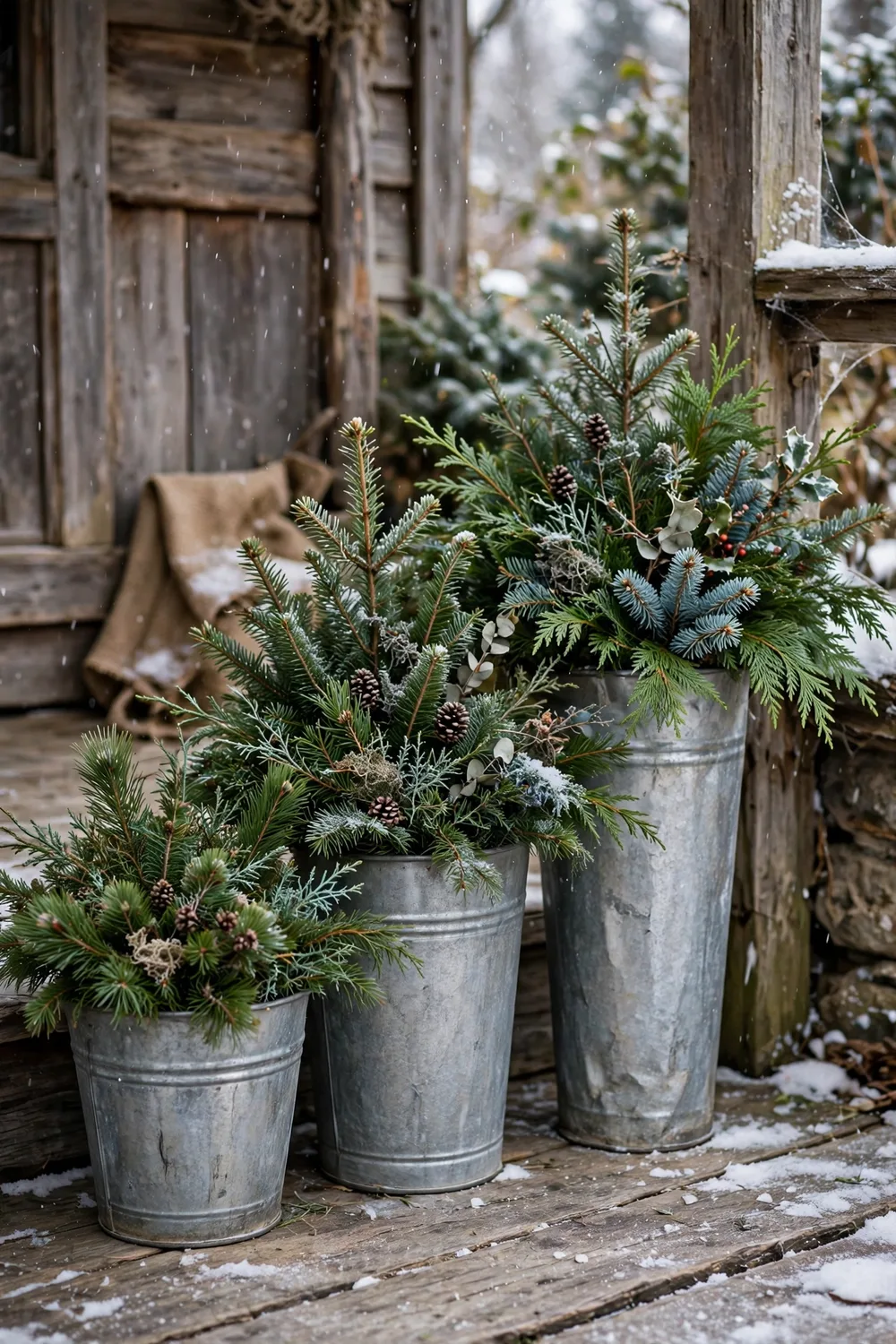
Three galvanized buckets in descending heights make a casual grouping that suits farmhouse and cottage porches. Fill each with evergreen boughs, vary the contents slightly (one with red berries, one with pinecones, one with birch twigs), and cluster them by the door. Metal handles winter well and the zinc finish does not rust through a single season.
Try this: put a brick in the bottom of each bucket before adding greenery. It lowers the center of gravity so wind cannot tip them. Difficulty: Easy. Cost: $$
3. Tall tapered planter with birch

A tall tapered planter flanking each side of the front door frames the entryway beautifully. White birch branches give height, pine boughs fill the middle, and red berries add the color pop. Because the planter is tall and narrow, it needs weight at the base: fill the bottom third with sand or gravel before adding soil or foam.
Try this: use a matching pair, not a single planter. Symmetry at the front door reads intentional and doubles the impact. Difficulty: Easy. Cost: $$
4. Winter hanging basket

Hanging baskets are not just for summer. A wire basket lined with coco fiber, filled with cedar, pine, red berries, and pinecones, looks great hanging from a covered porch all winter. The cover matters: it keeps snow from flattening the arrangement and extends its life by weeks. Mist the greens occasionally since covered porches stay dry.
Try this: hang the basket where you can see it from inside. A winter basket in the sightline of your favorite window pays off daily. Difficulty: Easy. Cost: $$
5. Shepherd’s hook planter
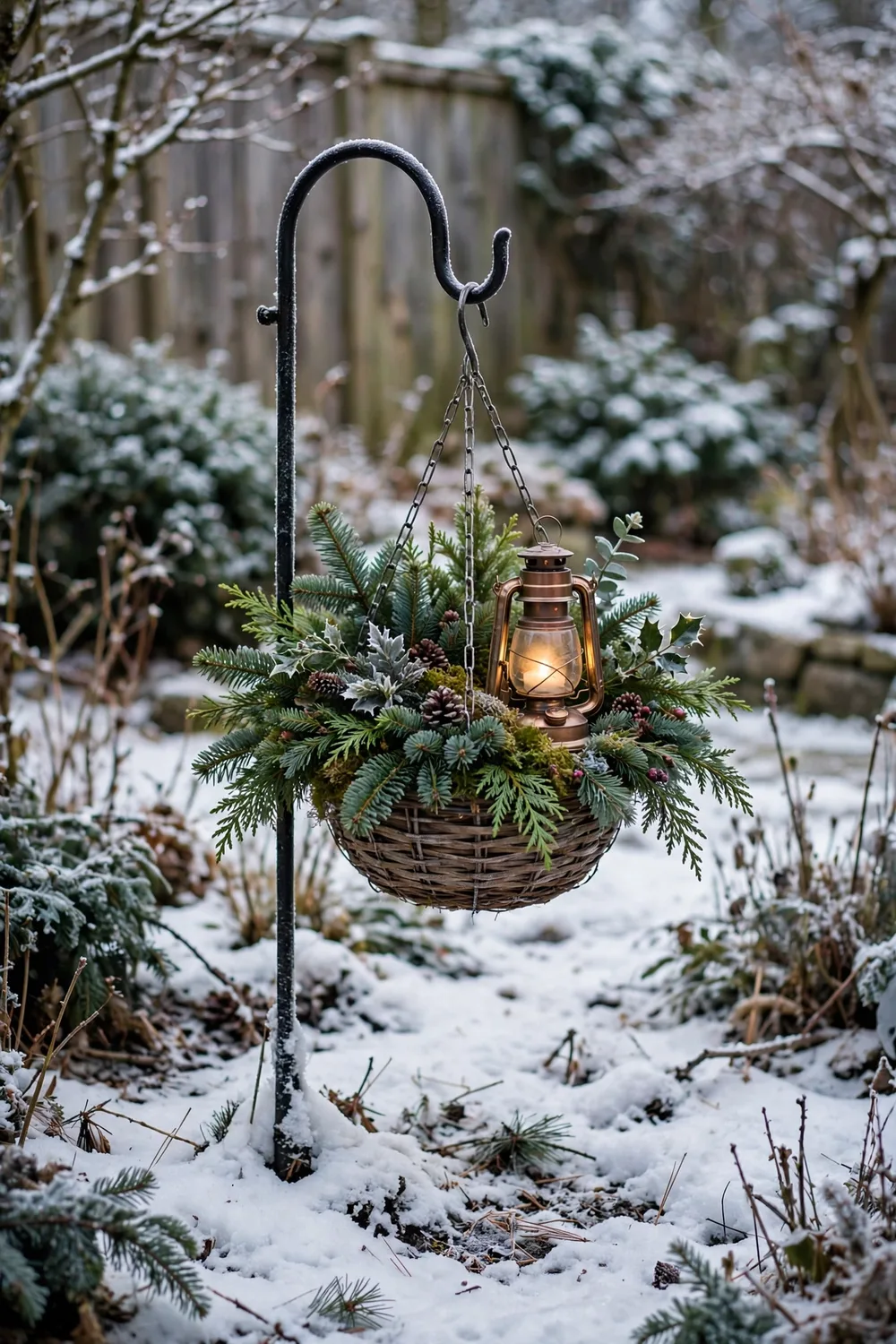
A shepherd’s hook in a garden bed with a hanging planter of evergreens marks a path or bed edge through the snow. Hang the planter on one side and a lantern with a battery candle on the other for balance. Push the hook at least 12 inches into the ground so winter wind cannot lever it out. This is one of the prettiest ways to keep a garden visible in January.
Try this: use a battery lantern, never a real flame. Dry evergreens and an open flame are a bad combination. Difficulty: Easy. Cost: $$
6. Wooden crate planter

An old wooden crate lined with burlap and filled with cedar branches, pinecones, and red berries has instant rustic charm. The low wide shape suits porch floors and stair landings where tall planters would block the way. Line the crate so soil does not sift through the slats, and set it on pot feet so the bottom does not sit in meltwater.
Try this: stain or seal the crate before winter. Raw wood soaks up moisture and rots fast in freeze-thaw cycles. Difficulty: Easy. Cost: $
7. Concrete cube with boxwood

A concrete cube with a clipped boxwood ball is the minimalist winter planter. The geometry does the work: the clean cube, the round topiary, and a dusting of snow. Concrete shrugs off freeze and thaw, and boxwood stays green all winter. Water the boxwood during thaws, since evergreens still lose moisture through their leaves in winter.
Try this: choose a boxwood variety hardy to your zone, and wrap the pot (not the plant) in burlap in the coldest snaps to protect the roots. Difficulty: Easy. Cost: $$
8. Tiered plant stand

A three-tier metal plant stand turns small pots into a full display. Put a dwarf spruce on top, winterberry and pine pots in the middle, and trailing ivy on the bottom tier. The vertical arrangement fits tight patio corners and looks abundant without needing one huge planter. Bring the whole stand against the house wall for wind shelter.
Try this: put the heaviest pot on the bottom tier. A top-heavy stand tips in the first real storm. Difficulty: Easy. Cost: $$
9. Mailbox planter

The mailbox is the most-seen planter spot on many properties, and a small box of winter greenery there greets everyone who passes. Mount a small planter on the post below the box, fill it with pine, red berries, and a pinecone or two, and keep it simple since people see it at a glance from the street. Check local rules about attachments to mailbox posts before drilling.
Try this: use artificial berries here. Real berries at the curb get eaten by birds within days, which is charming but short-lived. Difficulty: Easy. Cost: $$
10. Lamp post hanging planter

A hanging planter on a lamp post bracket puts winter greenery at eye level along a path or driveway. Fill a small basket with pine and berries, hang it from a sturdy bracket, and let the lamp light it after dark. The glow through the branches is genuinely lovely. Keep the basket small so it does not block the light.
Try this: use a quick-link carabiner instead of an S-hook. It cannot bounce off in wind the way an open hook can. Difficulty: Easy. Cost: $$
11. Stair-flanking pair
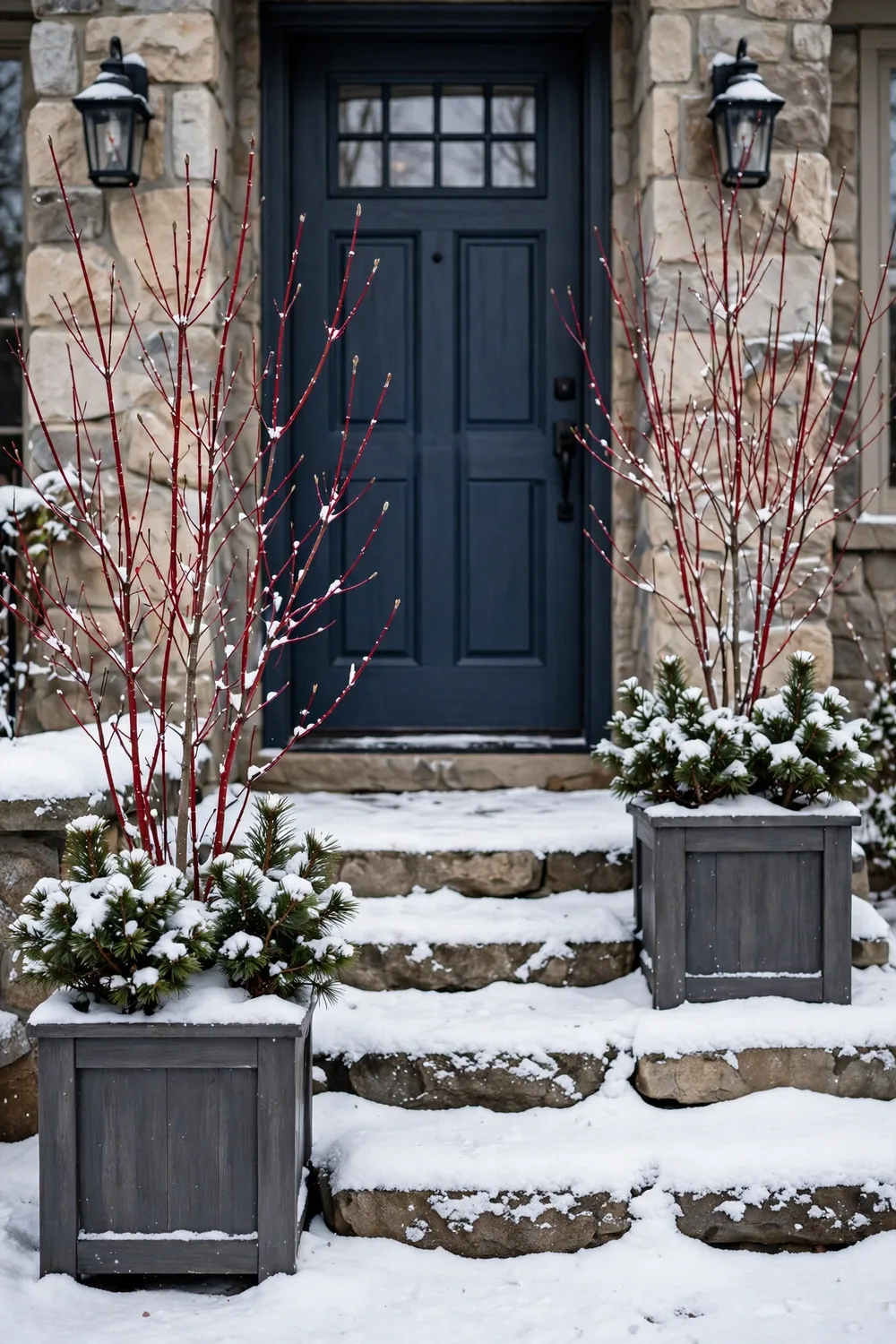
Matching planters on either side of the front steps guide the eye to the door and make the whole entry feel finished. Dwarf evergreens with red twig accents work in any style of home. Keep the planters clear of the walking path and the handrail, and choose wide-based pots that cannot be knocked over by a stray foot in the dark.
Try this: add a strand of battery fairy lights to each planter. Lit stairs are safer stairs on dark winter evenings. Difficulty: Easy. Cost: $$
12. Wagon planter

A vintage wagon or cart filled with evergreens is a statement piece for a front yard. Pile in pine boughs, add pinecones and red berries, and lean a small sled against it for the full nostalgic scene. Line the wagon bed with a tarp so soil and moisture do not rot the wood. This one is pure curb appeal.
Try this: park the wagon where it is visible from the road but not blocking the sidewalk. Corner lots get the most out of this display. Difficulty: Easy. Cost: $$
13. Woven basket with dried hydrangeas

A big woven basket of dried hydrangeas, grasses, and pine sprigs suits covered porches and neutral-style homes. Nothing in it needs water, so it lasts all season with zero care. Keep it under cover, since rain and snow will eventually break down dried flowers. The texture mix of papery hydrangeas and soft grasses is the whole appeal.
Try this: spray the dried heads with clear matte sealant before arranging. It keeps them from shattering when the basket gets bumped. Difficulty: Easy. Cost: $$
14. Modern steel planter
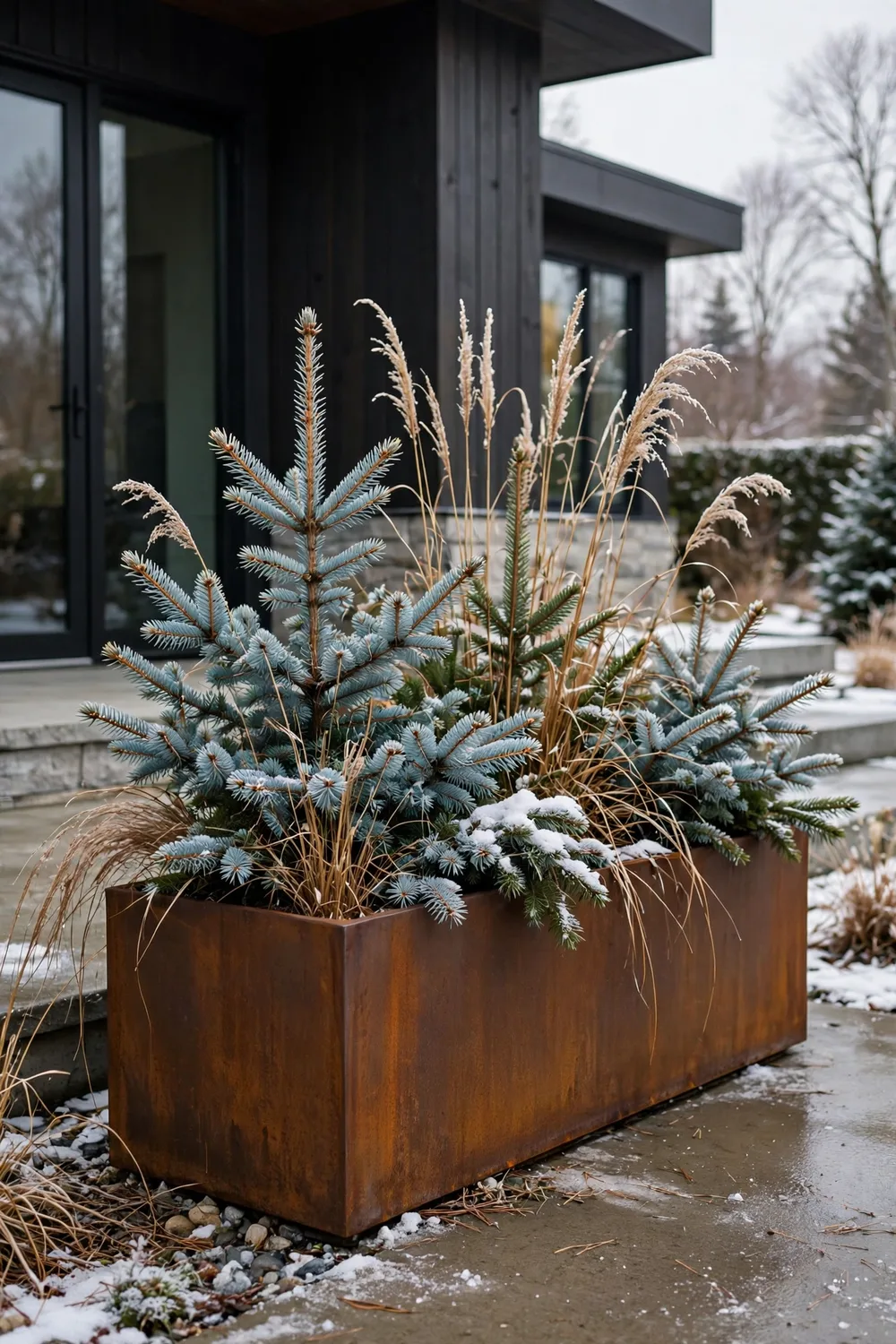
Corten steel planters with their rusty patina look striking against snow, and the metal handles winter without a scratch. Fill with blue spruce branches and ornamental grasses for a cool-toned arrangement that suits modern architecture. Steel is heavy even empty, which is an advantage: this planter is not going anywhere in a storm.
Try this: let the steel weather naturally. The patina deepens over the first winter and then stabilizes. Difficulty: Easy. Cost: $$
15. Hellebore pot for sheltered spots

Hellebores bloom in late winter, which makes a pot of them the only true flowering planter on this list. Use a frost-proof fiberglass or concrete pot, plant 3 hellebores together, and set the pot in a sheltered corner near the house where it gets a little warmth. White Christmas rose types start blooming as early as December in mild zones.
Try this: mulch the pot surface with pine needles after planting. It insulates the roots and looks tidy. Difficulty: Easy. Cost: $$
Winter planters at a glance
| Planter idea | Best spot | Container material | Cost |
|---|---|---|---|
| Whiskey barrel | Entryway | Wood | $30-50+ |
| Galvanized trio | Porch | Metal | $24-45 |
| Tapered pair | Front door | Fiberglass/resin | $50-80 |
| Hanging basket | Covered porch | Wire + fiber | $10-18+ |
| Shepherd’s hook | Garden bed | Metal | $15-25+ |
| Wooden crate | Porch floor | Wood | $0-10 |
| Concrete cube | Modern entry | Concrete | $45-85 |
| Tiered stand | Patio corner | Metal | $25-45+ |
| Mailbox planter | Curb | Wood/metal | $10-15 |
| Lamp post basket | Path/driveway | Wire + fiber | $12-20 |
| Stair pair | Front steps | Fiberglass/resin | $40-70 |
| Wagon | Front yard | Wood | $0-60 |
| Woven basket | Covered porch | Wicker | $10-20 |
| Steel planter | Modern garden | Corten steel | $40-80 |
| Hellebore pot | Sheltered patio | Fiberglass/concrete | $30-45+ |
Choosing containers that survive winter
The container matters as much as the plants. Fiberglass and resin planters are the safest all-around choice: light, frost-proof, and available in every style. Concrete and stone handle freeze-thaw well but are heavy to move. Wood looks great and insulates roots, but seal it first. Metal is tough and windproof by weight. Thin terracotta is the one to avoid outdoors in freezing zones, since absorbed water expands and cracks it.
Whatever the material, drainage is non-negotiable. A planter that holds water becomes a block of ice that kills roots and can split the container. Check that drainage holes are clear before winter, and set pots on pot feet so water can escape from the bottom. For window and railing boxes specifically, these winter planter box ideas go deeper on box-style planters.
Mistakes to avoid (and safety notes)
The most common mistake is a top-heavy planter in a windy spot. Tall narrow planters full of branches catch wind like sails, so weight the base with sand or gravel and site them against a wall. Second, do not forget living plants entirely. Boxwood, dwarf conifers, and hellebores still need water during winter thaws. Third, keep dried arrangements under cover. Rain and snow break down dried hydrangeas and grasses fast.
On safety: use battery candles and outdoor-rated LED lights only, never open flames near dried greenery, per the National Fire Protection Association candle safety guidance. Holly berries, winterberry, and yew are toxic to dogs and cats, so keep planters out of reach of pets that chew, and check the ASPCA toxic plant list for anything you are unsure about. For the front porch specifically, these charming winter planter ideas for the front porch offer more entryway inspiration, and my winter flower arrangement ideas bring the same seasonal look indoors.
Frequently asked questions
What do you put in outdoor planters in winter?
Evergreen branches, dwarf conifers, red twig dogwood, holly, winterberry, pinecones, and birch are the core materials. Living options include boxwood, dwarf spruce, ivy, ornamental cabbage, and hellebores in sheltered spots.
What kind of planter survives winter outdoors?
Fiberglass, resin, concrete, stone, wood, and metal all handle freeze and thaw. Avoid thin terracotta in freezing zones, since absorbed water expands and cracks it. Whatever you use, make sure it drains.
How do you keep a winter planter from blowing over?
Weight the base with sand, gravel, or bricks, choose wide-based containers for exposed spots, and site tall planters against a wall. Hanging baskets should use locking carabiners rather than open hooks.
Do winter planters need watering?
Cut greenery needs almost none. Living plants like boxwood, conifers, and hellebores need water whenever the soil thaws enough to absorb it, usually every few weeks in winter.
When should I set up winter planters?
Late November to early December, after fall cleanup and before the ground freezes hard. Cut greenery arranged in December typically looks good through February.
Are winter planters safe around pets?
Some materials are not. Holly berries, winterberry, and yew are toxic to dogs and cats. If pets can reach the planter, use pine, cedar, spruce, pinecones, and birch, and check the ASPCA list for anything else.
A good winter planter is the difference between a house that looks alive in January and one that looks abandoned. Pick the container that fits your spot, gather your greenery, and give your home its winter welcome.


