


The wall behind your couch is the first thing your eye lands on when you walk into a living room, and it is the wall most people leave blank the longest. A bare stretch above the sofa makes even a well-chosen couch look unfinished, while a piece that is too small or hung too high makes the whole seating area feel off balance.
This guide covers 23 ways to decorate the wall behind a couch, with the sizing rules that keep each one grounded to the sofa below it. You will find single statement pieces, gallery systems, mirrors, shelves, sconces, and renter-safe options, each with a real cost range and difficulty label so you can pick one that fits your wall, your budget, and your comfort with a drill.
Quick takeaways
- Size wall decor to the couch, not the wall: aim for a total width about two-thirds of the sofa width.
- Hang the bottom of the piece 6 to 8 inches above the sofa back so it reads as part of the seating area.
- Center the arrangement on the sofa midpoint, even when the wall itself is longer than the couch.
- Treat a group of frames as one piece: measure the full outer width of the group, gaps included.
- Heavy pieces above a couch need stud anchors, and renters can get the same look with leaning art and adhesive strips.
How to size wall decor for your couch
Measure the sofa first. A standard three-seat sofa runs about 84 inches wide, so two-thirds of that is 56 inches. That number is your target for the total width of whatever hangs above it, whether it is one canvas, a pair of prints, or a full gallery group measured edge to edge.
Height matters just as much. The bottom edge of the decor should sit 6 to 8 inches above the sofa back. On a sofa with a 36-inch back height, that puts the bottom of the art around 42 to 44 inches from the floor, with the center of the piece landing near 57 to 60 inches from the floor. Hang higher and the art floats away from the couch. Hang lower and seated heads get close to the frame.
Sectionals change the math. Size the decor to the longest run of the sectional, and let a gallery wrap the corner if the sectional turns. A single small print centered over a 120-inch sectional leaves both ends bare, so plan for a triptych, a wide group, or a shelf run that spans the full length.
1. Oversized landscape canvas

One large horizontal canvas is the simplest way to finish a couch wall, because a single piece sized right needs no arranging. Look for a canvas around 48 to 60 inches wide for a standard sofa, with a subject that pulls two or three colors you already own in cushions or a rug.
Hang it with two wall hooks rated above the canvas weight, and check the center height from a seated position. A canvas that looks right standing up can read too high once you sit down, so step back and sit on the couch before you commit to the second hook.
Try this: Tape a paper outline the size of the canvas on the wall first and live with it for a day before you buy.
Cost: $$ | Difficulty: Easy
2. Matching vertical art pair

Two tall prints hung side by side give you the width of one statement piece. Choose prints in the same frame and the same mat color, with images that relate without matching exactly, such as two coastal photographs or two botanical studies. Leave 2 to 3 inches between the frames so the pair reads as one unit instead of two separate pictures.
Measure the pair as a group: the outer edges should land near two-thirds of the sofa width. Center the gap between the two frames on the sofa midpoint, then hang both frames at the same height using a level across the tops.
Try this: Lay the pair on the floor, measure the full outer width, and compare it to your sofa width before hanging.
Cost: $$ | Difficulty: Easy
3. Triptych set for a wide sectional

A triptych spreads one image or one theme across three panels, which suits a sectional better than a single canvas that would need to be enormous. Three 20-inch panels with 3-inch gaps between them span about 66 inches, a good width for a sectional run of 96 to 108 inches. The gaps give the wall breathing room while the shared palette keeps the set unified.
Hang the center panel first, centered on the longest sectional run, then place the side panels at equal gaps. Keep the bottom edges level across all three, and use the same hanging hardware on each panel so the set stays even over time.
Try this: Cut three paper panels to size and tape them up to test the span before ordering.
Cost: $$ | Difficulty: Easy
4. Round mirror centered over the sofa
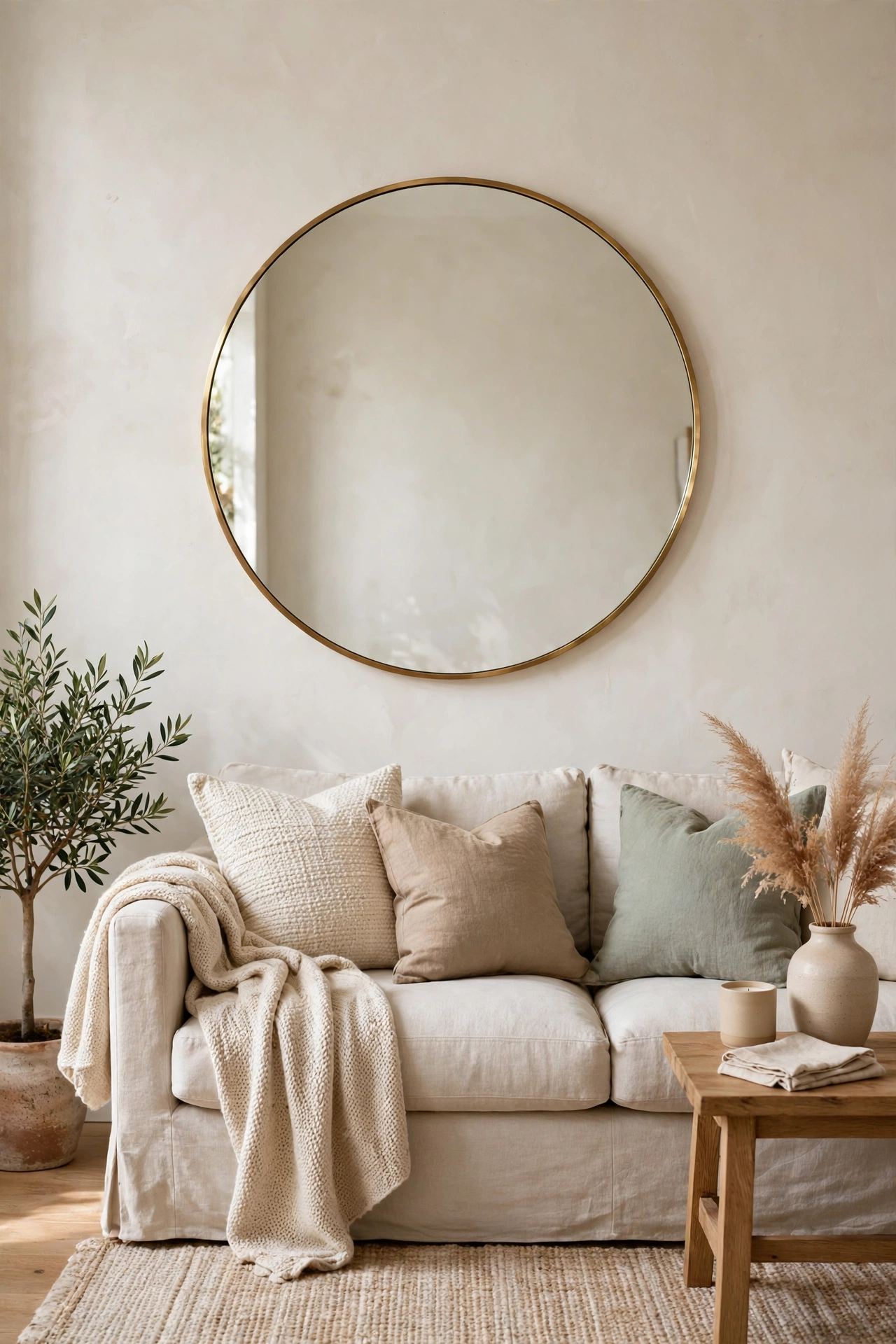
A round mirror breaks up the straight lines of a sofa, a rug, and a coffee table, and it bounces daylight deeper into the room. A 30- to 36-inch round mirror suits a standard sofa, while a loveseat pairs better with a 24- to 28-inch round. A thin metal or wood frame keeps the mirror light in feel.
Check what the mirror will reflect before you hang it. A mirror facing a window doubles the daylight, while one facing a blank wall or a television doubles a view you may not want. Shift it a few inches left or right until the reflection shows something worth repeating.
Try this: Hold the mirror in place and check the reflection from the seat where you sit most.
Cost: $$ | Difficulty: Easy
5. Arched mirror flanked by sconces
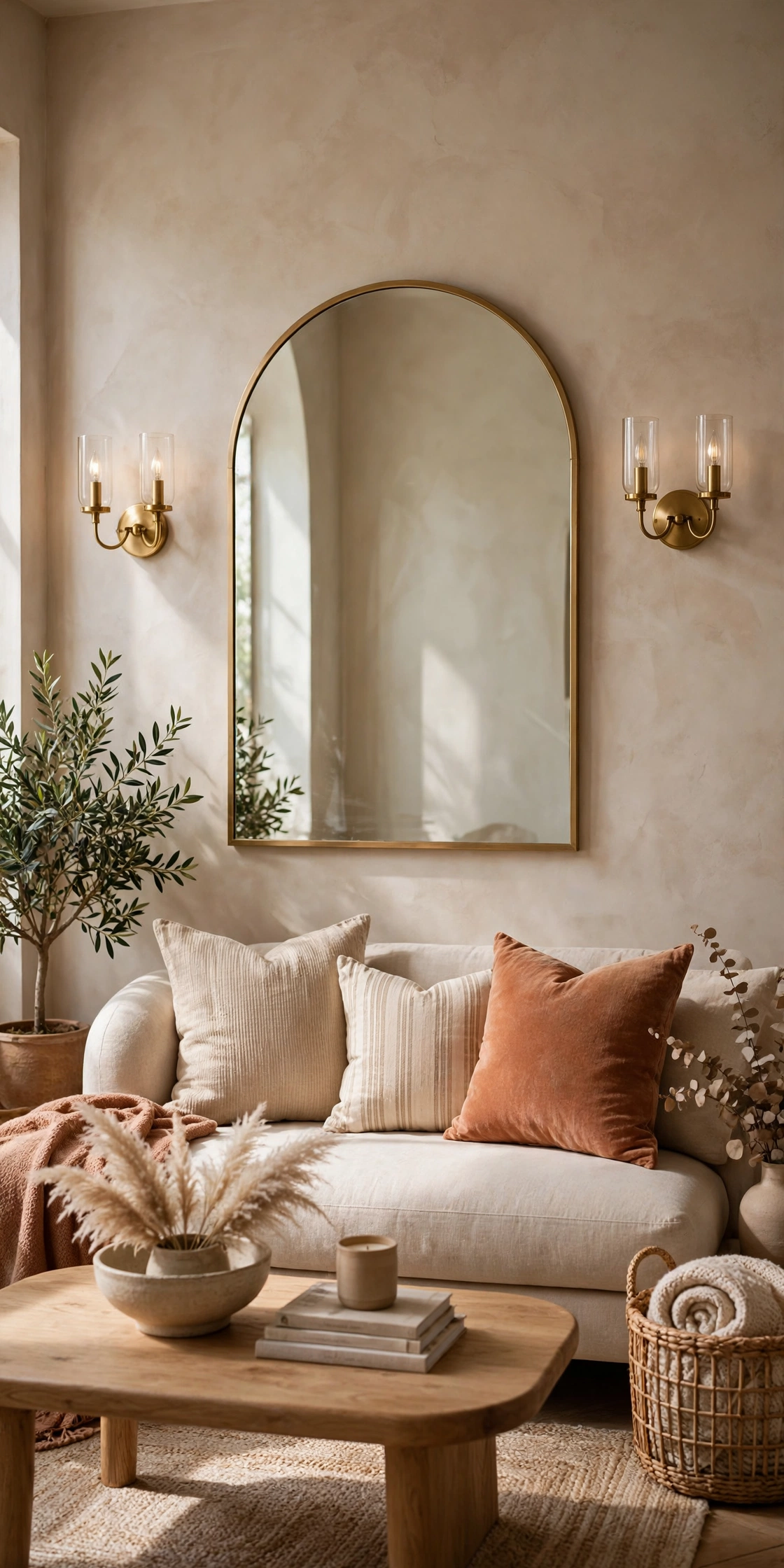
An arched mirror with a sconce on each side turns the couch wall into a framed composition, with light built into the arrangement. The arch softens a boxy room, and the sconces add evening light at seated eye level without taking floor space. Keep the sconces at the same height as the middle of the mirror, with 8 to 12 inches of clear wall between each sconce and the mirror frame.
Plug-in sconces with cord covers suit renters and rooms without wall wiring, while hardwired sconces need a licensed electrician. Either way, choose warm white bulbs near 2700K so the light flatters skin tones and the sofa fabric.
Try this: Mark sconce positions with painter’s tape and sit on the couch at night to check for glare.
Cost: $$$ | Difficulty: Moderate
6. Mixed-round mirror cluster

A cluster of round mirrors in three or four sizes fills a wide couch wall and costs less than one enormous mirror. Start with the largest round near the center, then build outward with smaller rounds, keeping 2 to 4 inches between frames. Repeating one finish, such as brushed brass or black metal, keeps the mixed sizes feeling planned.
Map the cluster on the floor first, tracing each mirror on paper and taping the paper shapes to the wall. The paper test shows whether the cluster spans enough of the sofa width before you drill a single hole, and it lets you shift pieces without patching.
Try this: Trace each mirror on kraft paper and tape the shapes up for a full day before hanging.
Cost: $$ | Difficulty: Moderate
7. Same-frame grid gallery
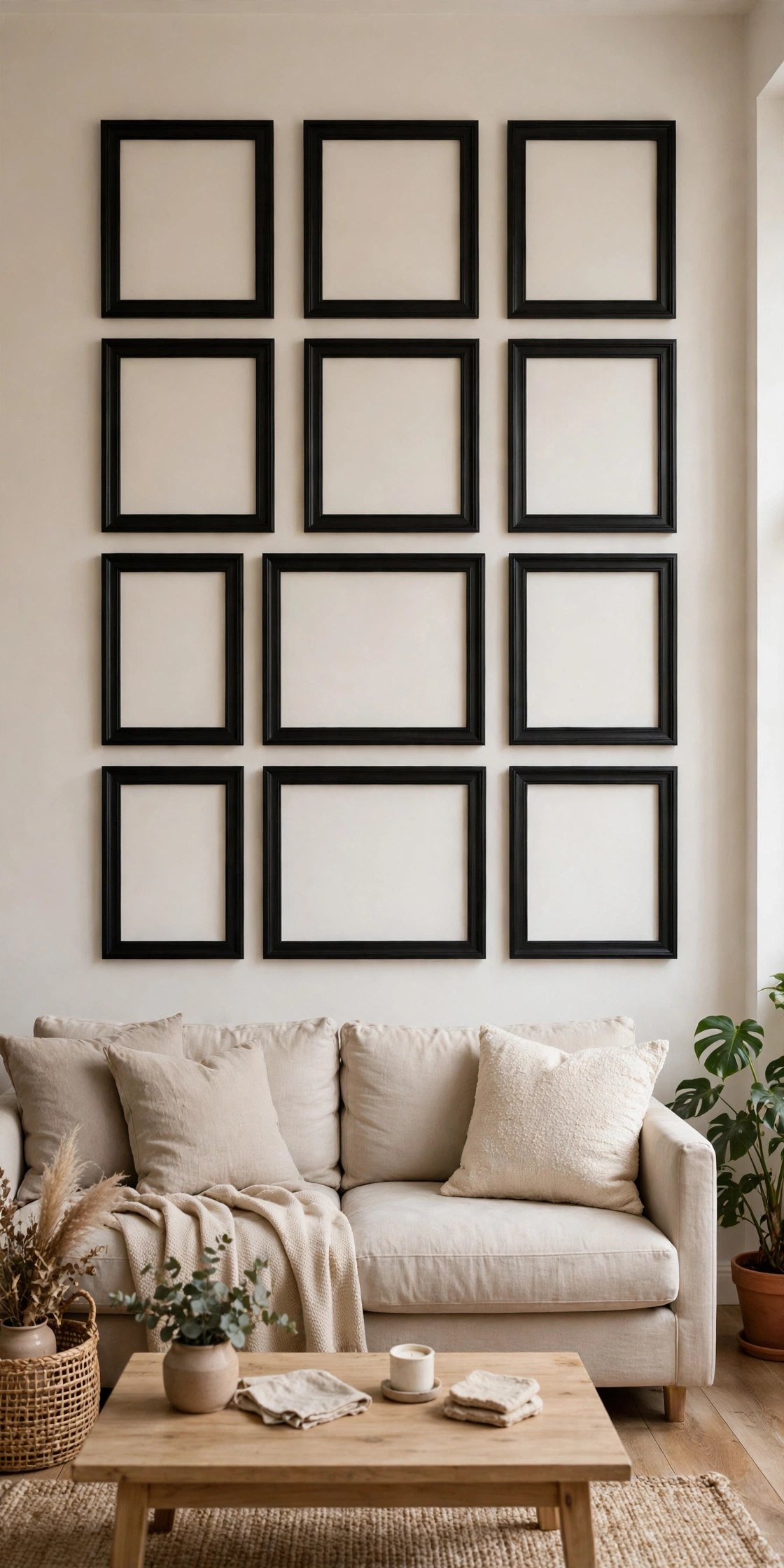
A grid of matching frames gives a couch wall a calm, orderly feel and works well for photo sets, print series, or collected art in one palette. A grid of six frames (three across, two down) or nine frames (three across, three down) suits most sofas, with 2 inches between frames. Identical frames and mats matter more than identical art, since the grid itself supplies the structure.
Measure the full outer dimensions of the grid and aim for two-thirds of the sofa width. Use a paper template for the whole grid, mark every hook through the paper, and hang the bottom row first so the spacing stays true.
Try this: Build the grid on the floor, photograph it, and check the photo for any frame that breaks the pattern.
Cost: $$ | Difficulty: Moderate
8. Collected salon gallery

A salon gallery mixes frame sizes, orientations, and art styles in a loose arrangement, which suits a collected home better than a strict grid. One shared thread holds it together: a single frame color, a repeated mat color, or a narrow color palette across the art. Without that thread, mixed pieces can read as clutter instead of collection.
Start with the largest piece slightly off center, then fill outward with medium and small frames, keeping gaps between 2 and 4 inches. Step back after every third frame, since a salon wall is judged as a whole shape, not frame by frame.
Try this: Lay the full arrangement on the floor inside a tape outline of your sofa width.
Cost: $$ | Difficulty: Moderate
9. Corner-wrap gallery for a sectional

When a sectional turns a corner, the gallery can turn with it instead of stopping at the sofa edge. Continue the arrangement onto the adjoining wall, placing one or two pieces close to the corner so both walls read as one display. The corner piece visually joins the two sides, which keeps the shorter sectional run from looking bare.
Keep frame spacing and the shared color or frame thread consistent across both walls, and keep the bottom line of frames level as the display turns. A corner-wrap gallery suits a large art collection, since it uses vertical space and two walls instead of squeezing everything above one sofa run.
Try this: Place the corner piece first, then build each wall outward from it.
Cost: $$ | Difficulty: Moderate
10. Picture ledge with leaning frames

A picture ledge lets you lean frames instead of hanging them, so you can swap art without new holes. A ledge near two-thirds of the sofa width holds three to five frames in overlapping layers, with the largest at the back and smaller frames in front. A thin lip on the ledge front keeps frames from sliding forward.
Mount the ledge into studs, since leaning frames plus books or vases add up in weight fast. Keep the ledge bottom 8 to 12 inches above the sofa back so tall frames clear seated heads, and leave the top of the ledge clear of anything that could topple forward.
Try this: Style the ledge on the floor first, then transfer the exact order to the wall.
Cost: $ | Difficulty: Easy
11. Floating shelves with books and ceramics
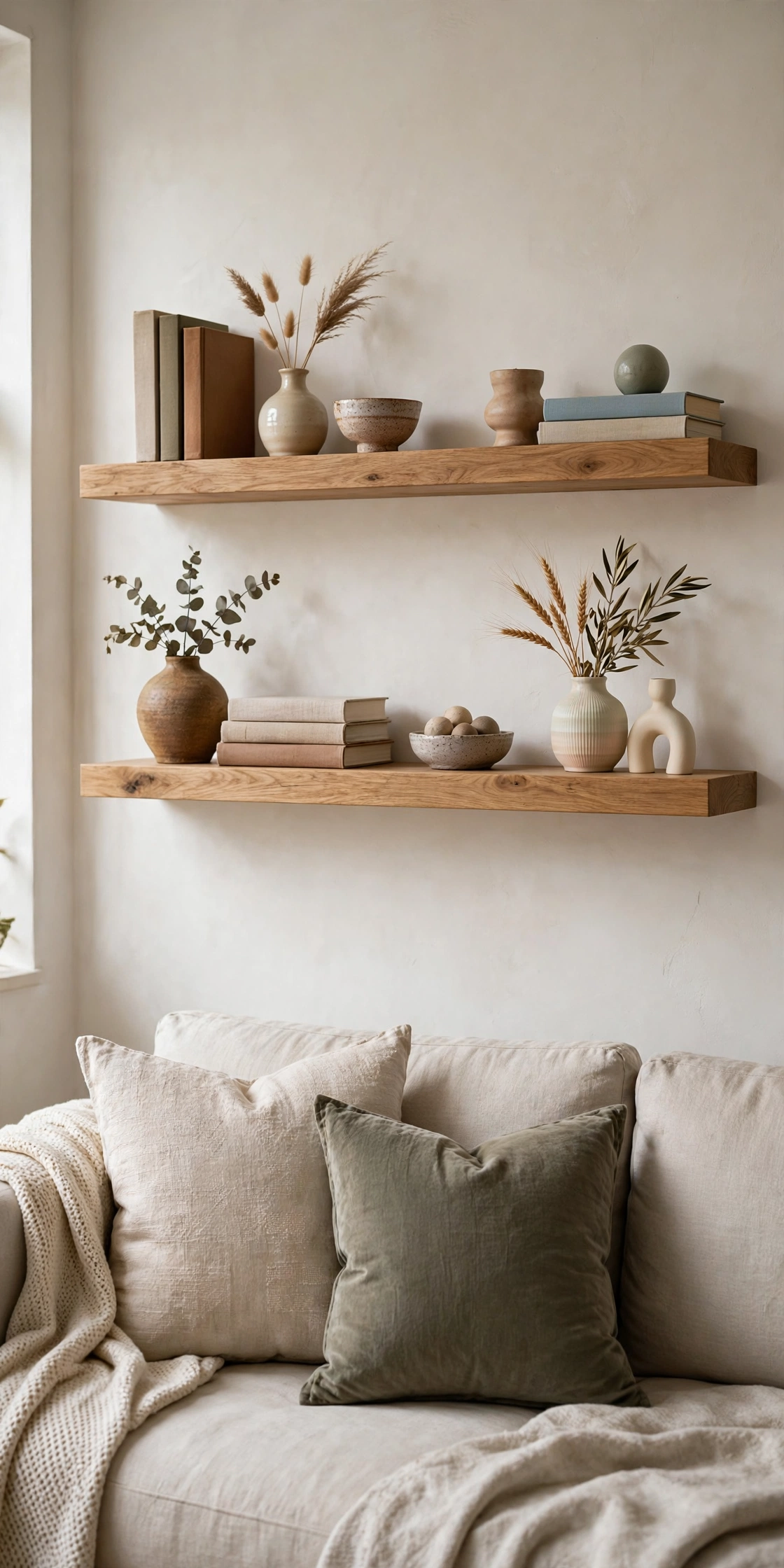
Two floating shelves above a couch give you display space plus storage for books, vases, and small ceramics. Space the shelves 12 to 15 inches apart, with the lower shelf 10 to 12 inches above the sofa back. Style in odd-numbered groups, mix tall and short objects, and leave one open stretch on each shelf so the display breathes.
Anchor each shelf bracket into studs, and check the weight rating against the full load of books and ceramics. Keep heavy books near the bracket ends and lighter objects in the middle, and never place anything directly above a seated head that could fall forward.
Try this: Load the shelves on the floor first and weigh the heaviest group before choosing anchors.
Cost: $$ | Difficulty: Moderate
12. Bookcase pair flanking the sofa
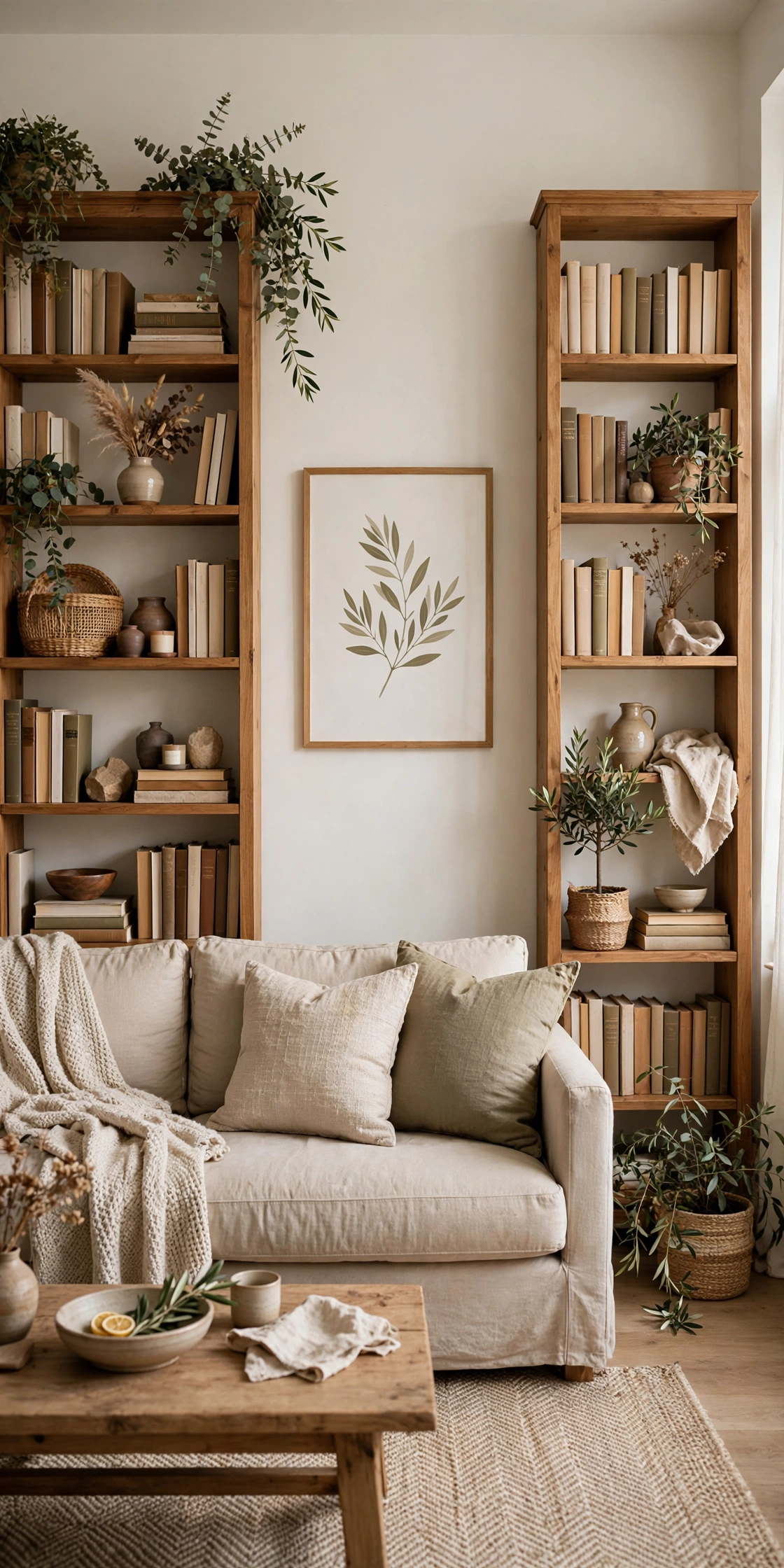
Two tall bookcases flanking the sofa frame the seating area like architecture, and they turn the couch wall into storage and display at once. Place one bookcase on each side of the sofa, anchor both to the wall with anti-tip hardware, and hang one centered print in the open wall space between them. The bookcases carry the width, so the center print can be smaller than a standalone piece.
Style the shelves with books upright and a few horizontal stacks, repeating one or two accent colors from the sofa cushions. Keep the top shelves light, since heavy objects up high raise the center of gravity and make tipping more likely.
Try this: Anchor both bookcases before styling a single shelf.
Cost: $$$ | Difficulty: Moderate
13. Sconce pair flanking a single print

Two sconces flanking one print widen a small piece into a full couch-wall arrangement, which helps when you already own art that is narrower than two-thirds of the sofa. The sconces act as visual brackets, and they add a second layer of light for evening reading. Keep the print centered on the sofa and the sconces equidistant from its edges.
Match the sconce finish to another metal in the room, such as the coffee table legs or curtain rod, so the pair feels connected to the space. Choose shades that direct light up and down the wall rather than straight out, which avoids glare for seated viewers.
Try this: Tape sconce outlines on the wall and check the spread from across the room.
Cost: $$ | Difficulty: Moderate
14. Plug-in swing-arm sconces

Plug-in swing-arm sconces give a couch wall real reading light without an electrician, which makes them a strong choice for renters and for rooms with no wall wiring. The arms swing out over the sofa arms for reading and fold back flat when not in use. Mount each sconce 12 to 18 inches from the sofa edge at seated shoulder height.
Run cords down to the outlet inside paintable cord covers, clipped along the baseboard and away from walkways. Check that the arm clears the sofa back through its full swing before you drill, and choose a shade that keeps the bulb out of direct sight lines.
Try this: Hold the sconce at the planned height and swing the arm through its full range before mounting.
Cost: $$ | Difficulty: Easy
15. Handmade ceramic wall discs
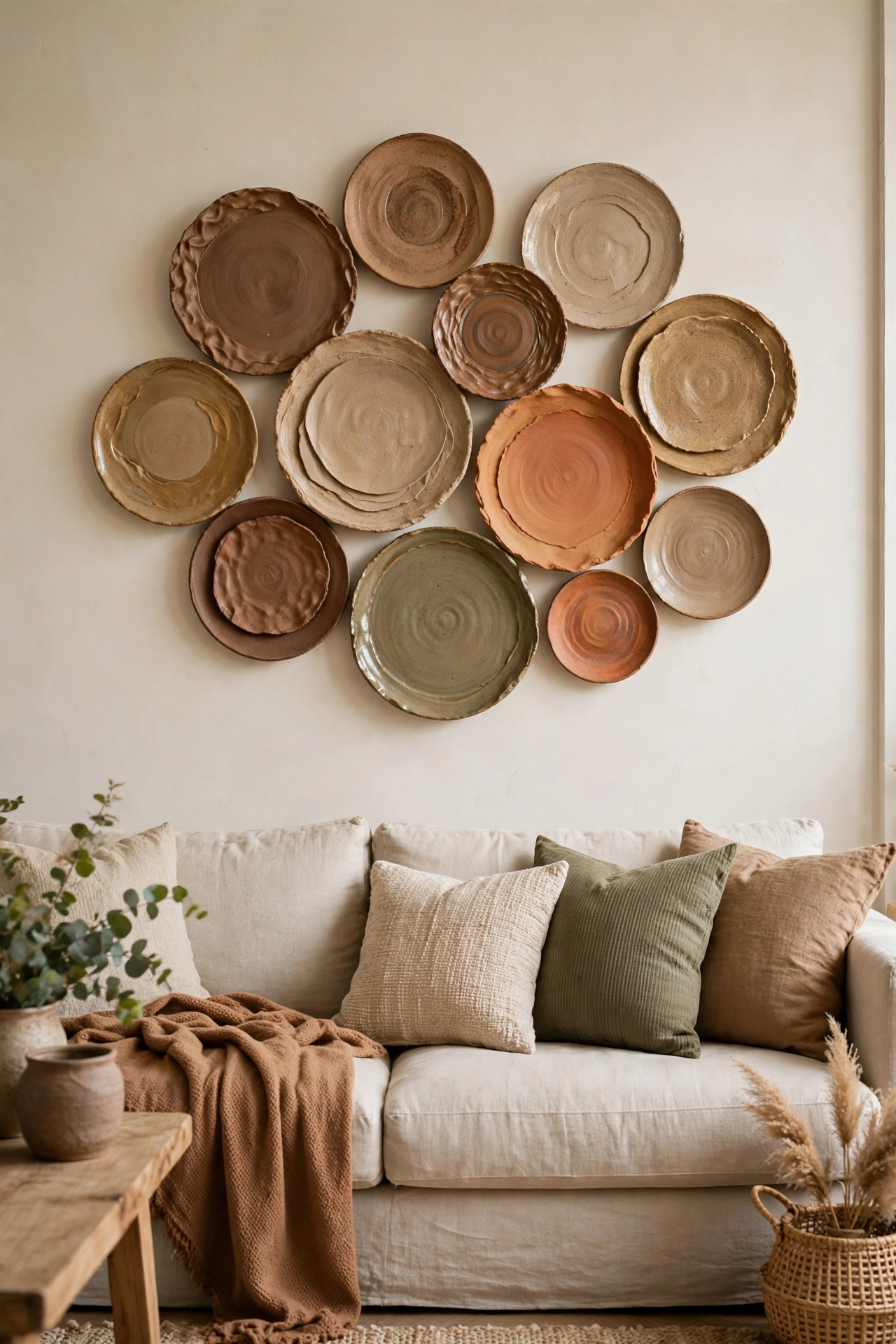
A cluster of handmade ceramic discs adds shape and texture to a couch wall without the weight of framed art. Choose five to nine discs in one glaze family, such as warm earth tones or soft celadon, and arrange them in an oval or cluster spanning two-thirds of the sofa width. The gaps between discs let wall color show through, which keeps the display light.
Hang each disc on its own hook rated above its weight, and use a paper template to test the cluster shape before drilling. Ceramic breaks on impact, so keep the lowest disc well above seated head height and away from spots where cushions get tossed.
Try this: Trace each disc on paper and arrange the paper shapes until the cluster outline feels balanced.
Cost: $$ | Difficulty: Easy
16. Oversized wall clock
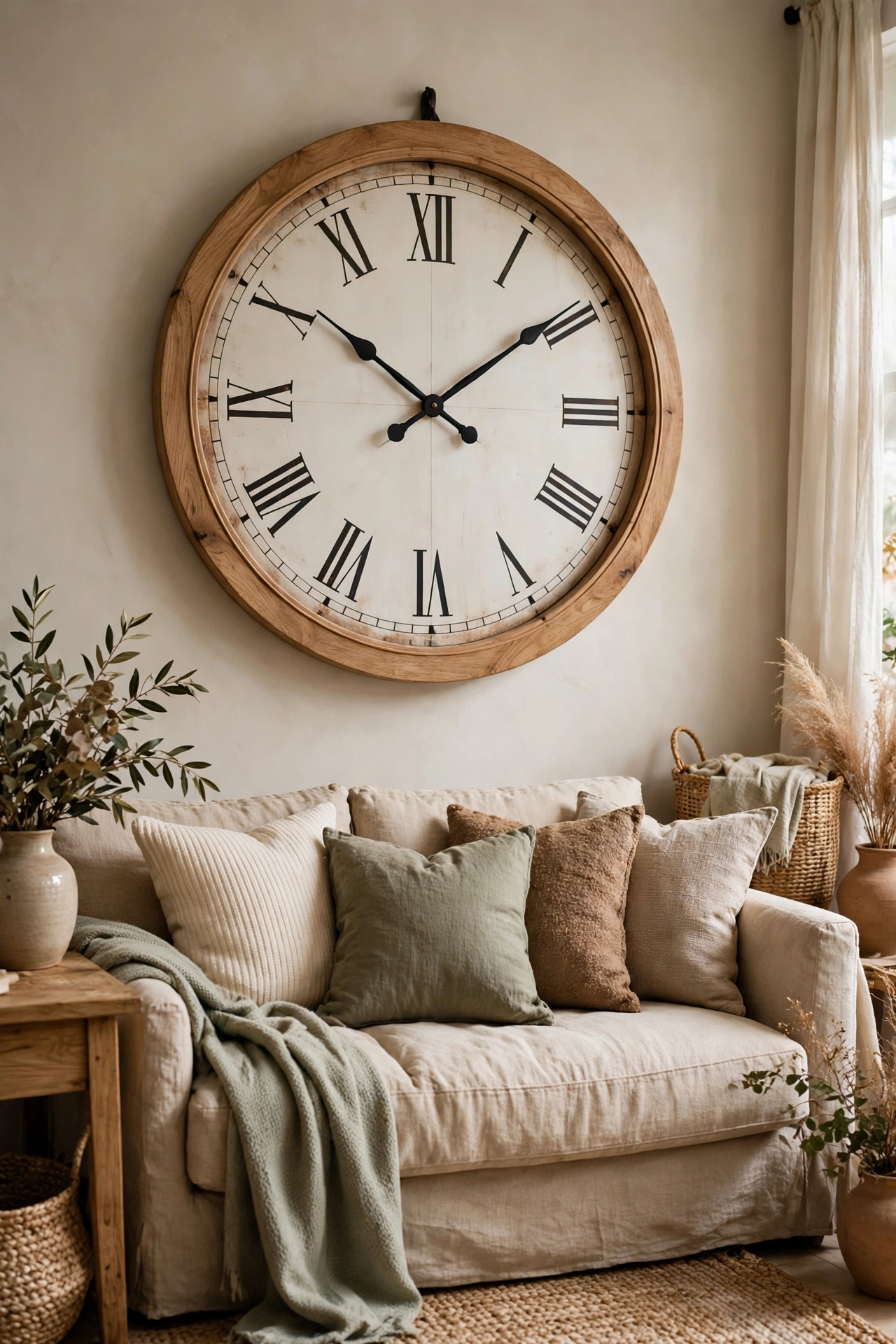
An oversized wall clock fills a couch wall with a single functional piece. A 24- to 30-inch round clock suits a standard sofa, with a frame that echoes another wood or metal tone in the room. Roman numerals read traditional, plain baton markers read modern, and an open-face design keeps the wall feeling light.
Hang the clock on a hook rated above its weight, centered on the sofa midpoint, with the bottom edge 6 to 8 inches above the sofa back like any other piece. Check the ticking volume in the shop if the sofa sits near a bedroom, since a loud movement carries in a quiet house.
Try this: Cut a paper circle the size of the clock and tape it up to test the scale.
Cost: $ | Difficulty: Easy
17. Framed vintage textile panel

A framed textile panel brings softness and pattern to a couch wall, which suits rooms where framed prints feel too flat. Vintage embroidered panels, block-printed cloth, and woven yardage all frame well behind glass or acrylic, and a wide mat gives the textile room to breathe. Choose a panel wide enough to reach near two-thirds of the sofa width, or frame two matching panels as a pair.
Keep textiles out of direct sun, which fades dyes fast, and use UV-filtering glazing if the couch wall faces a window. Mount the frame on two hooks for stability, since textile frames run heavier than a plain print of the same size.
Try this: Hold the panel against the wall at different times of day to check sun exposure.
Cost: $$ | Difficulty: Easy
18. Carved wood wall panel

A carved wood panel adds depth to a couch wall through shadow and relief, which flat art cannot match. One wide panel with a geometric or botanical carving suits a modern or global-style room, while a set of three narrow carved panels spans a sectional. Natural wood tones warm up a gray or white sofa, and a stained finish can pick up the coffee table or floor color.
Weigh the panel before choosing hardware, since solid wood panels run heavy. Mount into studs with screws rated above the panel weight, and check that the bottom edge clears seated heads by the same 6 to 8 inches used for framed art.
Try this: Lean the panel on the sofa back and step across the room to judge its visual weight.
Cost: $$$ | Difficulty: Moderate
19. Metal branch wall sculpture
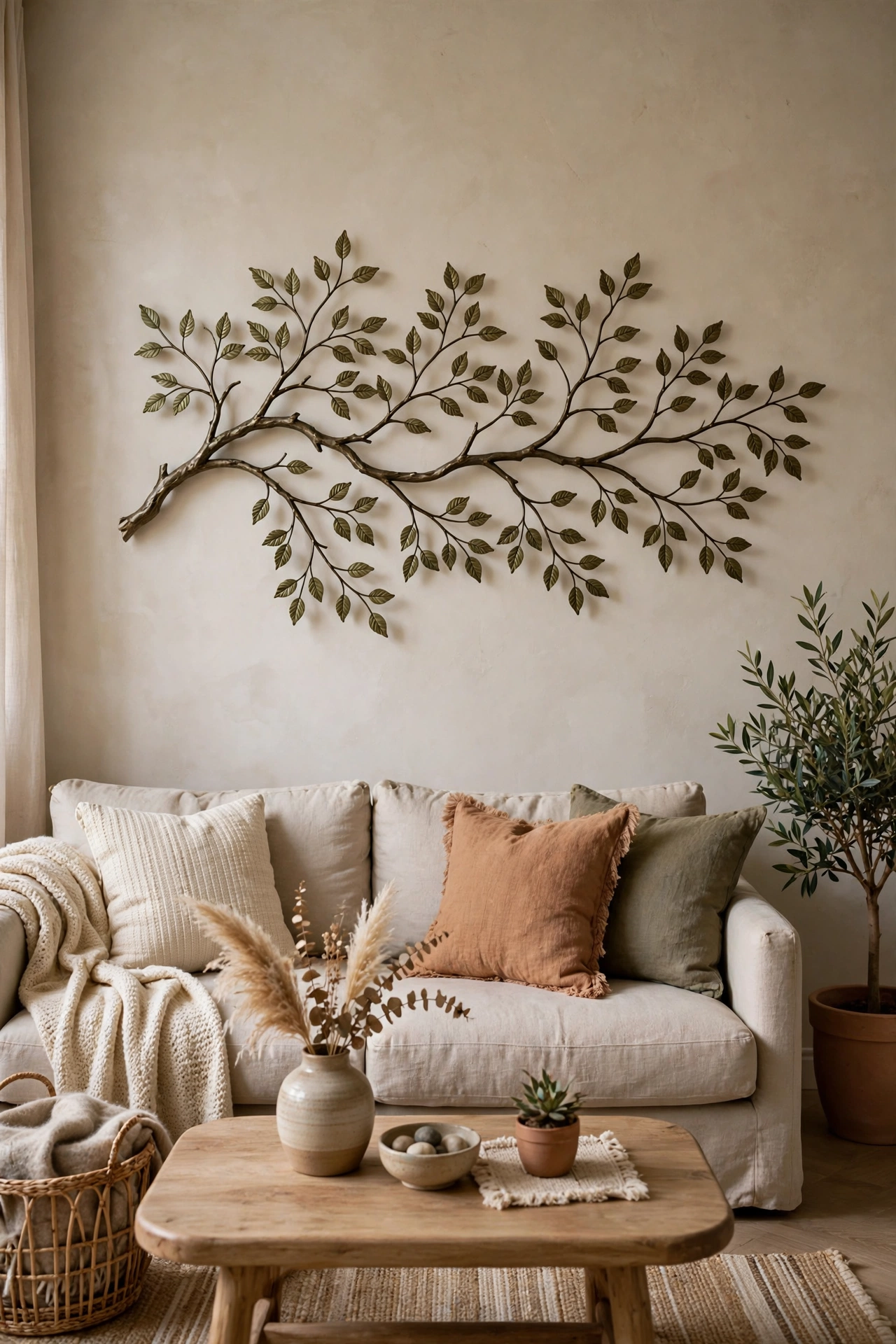
A metal branch sculpture gives a couch wall a three-dimensional focal point with a slim profile. Branch, leaf, and vine forms in blackened steel or brass cast soft shadows on the wall, and the open design keeps the wall feeling airy. Size the sculpture to two-thirds of the sofa width, since open metalwork reads smaller than a solid canvas of the same dimensions.
Mount the sculpture on at least two stud-anchored screws, since metal pieces concentrate their weight at a few mounting points. Check that no sharp leaf edge sits at seated head height, and keep the lowest point above the 6- to 8-inch clearance used for other wall decor.
Try this: Trace the sculpture outline on paper and tape it up to test the span at night with lamps on.
Cost: $$ | Difficulty: Moderate
20. Botanical print set in oak frames
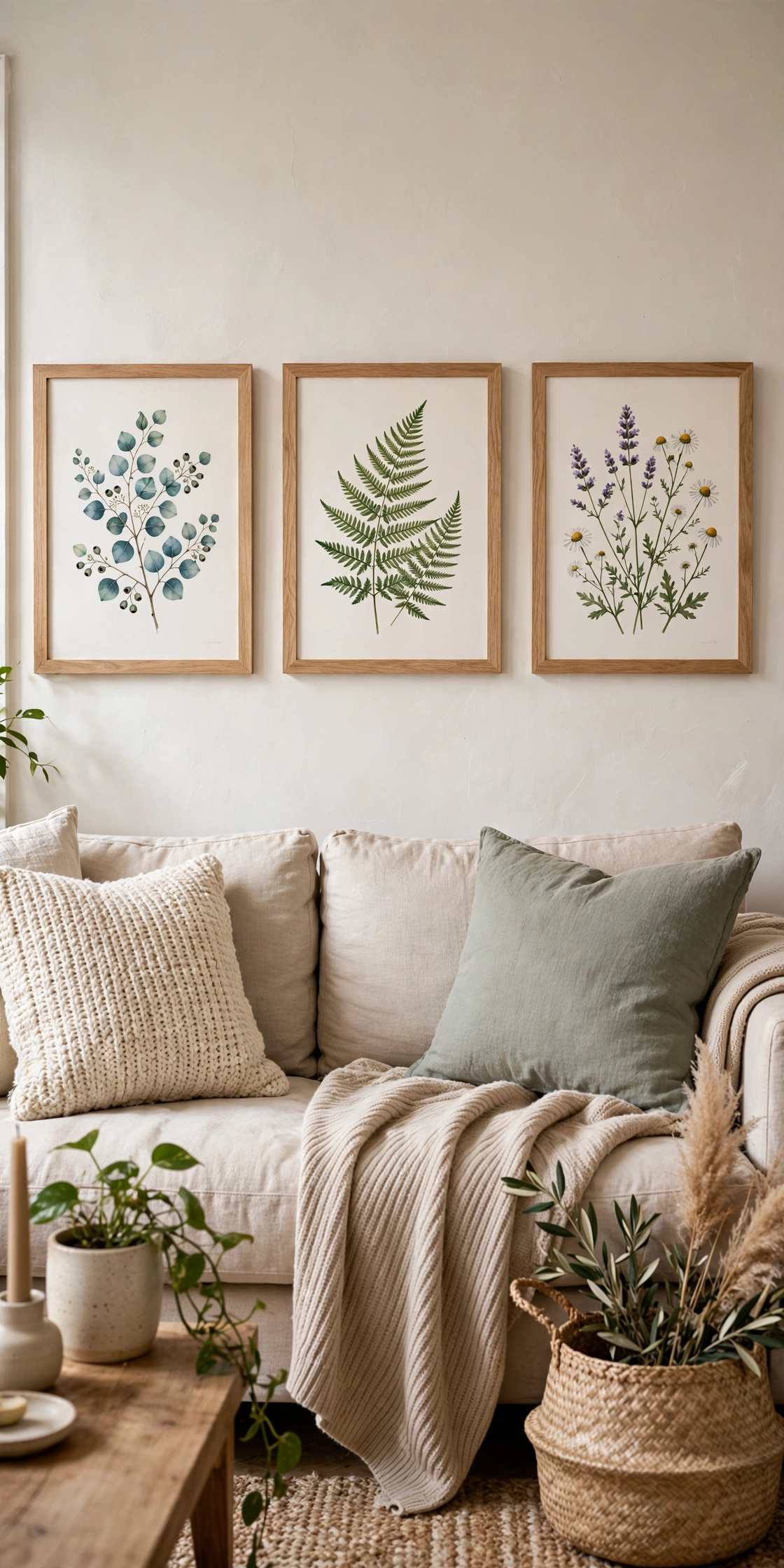
A set of botanical prints in light oak frames brings a natural feel to a couch wall. Three or four prints in a row suit a standard sofa, with each print 12 to 16 inches wide and 2 to 3 inches between frames. Oak frames warm up white walls, and a white mat inside each frame keeps plant imagery from feeling busy.
Pick prints with a shared background tone, such as cream or pale sage, so the row reads as one piece. Hang the row with bottoms level and the group centered on the sofa midpoint, using a long level or a taut string line across the frame bottoms.
Try this: Lay the row on the floor against a tape measure to confirm the total width before hanging.
Cost: $$ | Difficulty: Easy
21. Black-and-white photo series in matching frames

A black-and-white photo series turns personal photographs into a unified couch-wall display, since the shared monochrome palette ties different images together. Choose five to seven photos from one trip, one season, or one family milestone, print them at the same size, and frame them in identical black or white frames. A single row suits a standard sofa, while two staggered rows suit a wide sectional wall.
Keep the row width near two-thirds of the sofa width, with 2 inches between frames. Print at a resolution that stays sharp at the chosen size, and use the same mat width in every frame so no single photo pulls ahead of the rest.
Try this: Print small test copies first and arrange them on the floor to check the sequence.
Cost: $ | Difficulty: Easy
22. Adhesive-strip gallery for renters

Adhesive strips let renters build a real gallery above the couch, as long as every frame stays within the strip weight rating. Lightweight frames under 3 pounds each work best, with two strips per frame on clean, dry paint. Plan five to seven small frames in a grid or a loose row, and keep the total group width near two-thirds of the sofa width.
Clean the wall with rubbing alcohol before applying strips, then press each strip for 30 seconds and wait an hour before hanging. Check the strip rating against the frame plus glass weight, and skip adhesive mounting for heavy frames, mirrors, or anything above a seat.
Try this: Weigh one framed piece on a kitchen scale and compare it to the strip rating on the pack.
Cost: $ | Difficulty: Easy
23. Leaning art on a console behind a floating sofa
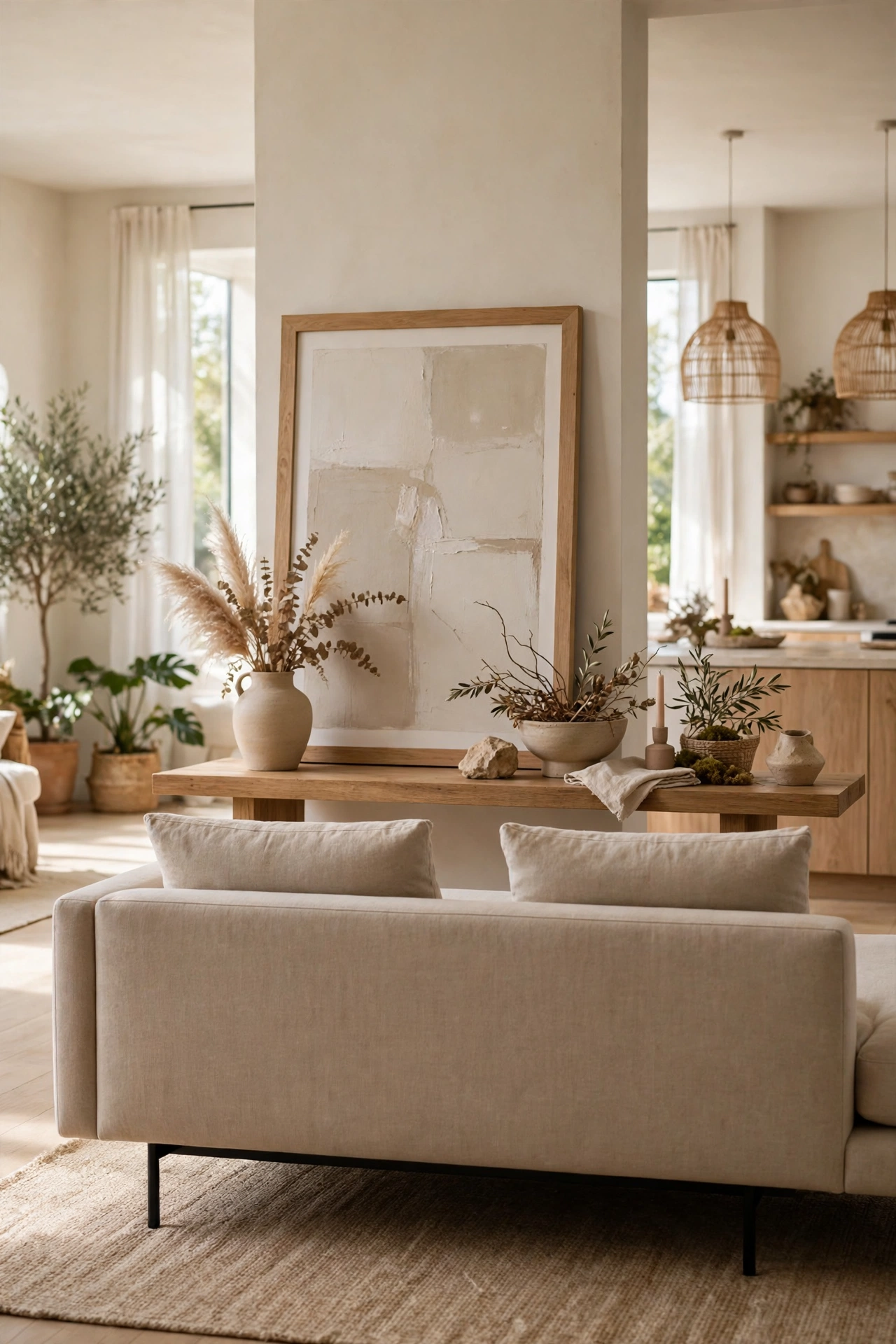
When a sofa floats away from the wall, a slim console behind it creates a surface for leaning art. A console 10 to 12 inches deep and near the sofa width holds one large leaning frame plus a lamp. The leaning frame should rise 12 to 18 inches above the console top, with its top edge resting against the wall at a slight angle.
Anchor the console to the wall with anti-tip hardware, since a leaning frame shifts weight toward the front edge. Keep the walkway behind the console clear, and choose a frame with acrylic glazing instead of glass for a high-traffic spot where bumps happen.
Try this: Test the lean angle with the frame empty of glass first, then add glazing once the angle holds.
Cost: $$ | Difficulty: Easy
Couch wall decor compared
Use this table to narrow the list by budget, effort, and whether you can drill. Prices cover a standard sofa width unless noted.
| Idea | Cost | Difficulty | Best for |
|---|---|---|---|
| Oversized landscape canvas | $$ | Easy | One-and-done walls |
| Matching vertical art pair | $$ | Easy | Narrower budgets, easy sizing |
| Triptych set for a sectional | $$ | Easy | Wide sectional walls |
| Round mirror | $$ | Easy | Small or dark rooms |
| Arched mirror with sconces | $$$ | Moderate | Evening light plus a focal point |
| Mixed-round mirror cluster | $$ | Moderate | Collected, light-filled walls |
| Same-frame grid gallery | $$ | Moderate | Orderly photo or print sets |
| Collected salon gallery | $$ | Moderate | Mixed collections |
| Corner-wrap gallery | $$ | Moderate | Sectionals in a corner |
| Picture ledge | $ | Easy | Swapping art often |
| Floating shelves | $$ | Moderate | Display plus storage |
| Bookcase pair | $$$ | Moderate | Storage-heavy rooms |
| Sconce pair with a print | $$ | Moderate | Widening a small print |
| Plug-in swing-arm sconces | $$ | Easy | Renters, reading light |
| Ceramic wall discs | $$ | Easy | Texture without frames |
| Oversized wall clock | $ | Easy | Functional single piece |
| Framed textile panel | $$ | Easy | Softness and pattern |
| Carved wood panel | $$$ | Moderate | Depth and shadow |
| Metal branch sculpture | $$ | Moderate | Slim three-dimensional focal point |
| Botanical print set | $$ | Easy | Calm, natural rooms |
| Black-and-white photo series | $ | Easy | Personal photos, unified look |
| Adhesive-strip gallery | $ | Easy | Renters, no holes |
| Leaning art on a console | $$ | Easy | Floating sofas, no drilling |
Cost key: $ means $1 to $10, $$ means $11 to $99, $$$ means $100 to $999, $$$$ means $1,000 and up. Costs cover typical retail prices for a standard sofa width and exclude the sofa itself.
Common mistakes to avoid
The most common mistake is hanging art too small or too high. A single 16-inch print centered over an 84-inch sofa leaves wide bare stretches on both sides, and art centered on the wall instead of the sofa floats above seated heads. Measure the sofa, use the two-thirds guide, and keep the bottom edge 6 to 8 inches above the sofa back.
Overcrowding runs a close second. A gallery that fills every inch of wall above the couch competes with the sofa instead of complementing it, so leave open wall at the ends of the group and breathing room between frames. When in doubt, remove one frame and step back before deciding the wall needs more.
Safety notes for hanging above a couch
Anchor heavy wall decor into studs with hardware rated above the load, and never hang a heavy mirror, shelf, or sculpture above a couch on drywall anchors alone. The U.S. Consumer Product Safety Commission publishes anchoring guidance for heavy wall items, and it is worth reading before you hang anything that could hurt someone if it fell. For more on safe anchoring, see the CPSC Anchor It guidance.
Anchor bookcases, consoles, and tall shelving behind or beside the sofa with anti-tip hardware, and keep cords from plug-in sconces clipped along baseboards away from walkways. For homes built before 1978, test for lead paint and follow lead-safe rules before sanding or drilling into painted walls, as described in the EPA Renovation, Repair and Painting program. Hire a licensed electrician for new outlets or hardwired sconces, and keep the bottom edge of every piece high enough that seated heads clear it.
Frequently asked questions
How wide should wall decor be above a couch?
Aim for a total width about two-thirds of the sofa width, measured across the full group including gaps between frames. For an 84-inch sofa, that means roughly 56 inches of decor. A group much narrower than that leaves bare wall on both sides, while a group wider than the sofa can overpower the seating area.
How high should I hang art above a sofa?
Hang the bottom edge 6 to 8 inches above the sofa back. On most sofas, that puts the center of the piece near 57 to 60 inches from the floor. This height keeps the art visually connected to the couch instead of floating high on the wall, and it keeps frames clear of seated heads.
Should I use one large piece or a gallery wall above my couch?
One large piece suits a calm or minimal room and needs the least planning, while a gallery wall suits a collected home and a large art collection. Both work when sized to two-thirds of the sofa width. When you are unsure, a single oversized piece is the safer starting point, since a gallery needs careful spacing to read as one unit.
Can I decorate a couch wall in a rental without drilling?
Yes. Use adhesive strips rated above each frame weight for lightweight frames, lean large art on a console behind a floating sofa, or use plug-in sconces with cord covers. Keep heavy mirrors and shelves out of the adhesive-only plan, since a fall above a seat is a real safety risk.
What should I hang above a sectional sofa?
Size the decor to the longest run of the sectional, and use a triptych, a wide gallery, or a shelf run that spans that length. When the sectional turns a corner, let the gallery wrap onto the adjoining wall so the shorter run does not look bare.
More living room and wall ideas
If your couch itself still needs softening before you dress the wall, start with the styling guide for the seat below. For more on making a leather sofa feel soft instead of stiff, see 21 Leather Couch Decor Ideas for a Sofa That Feels Soft, Not Stiff.
Once the wall is set, the rest of the room should echo it rather than compete with it. For a relaxed coastal version of the whole room, see 20 Coastal Casual Living Room Ideas for a Relaxed, Barefoot Room.
If your taste runs warmer and more collected, the boho living room guide shows how layered textiles and wood tones fill a room around a sofa. For that collected look, see 30 Chic Cozy Boho Living Room Ideas for 2026 for a Warm, Collected Room.
The sizing rules in this guide also work on bedroom walls, where each wall is sized to the furniture below it instead of treated the same. For the bedroom version of that system, see 13 Ideas To Decorate Your Bedroom Walls for a Room That Feels Finished.
Finally, a styled couch wall pairs with a styled coffee table, since the two sit in the same sight line. For rules that cover every table shape and season, see 26 Coffee Table Styling Ideas for a Table That Looks Styled, Not Staged.
Final thoughts
Start by measuring your sofa, pick one idea from this list that fits your wall and your comfort with tools, and test the size on paper before you drill. A couch wall that is sized to the sofa below it makes the whole living room feel finished, even when everything else in the room stays exactly the same.
For a wall that glows, see our guide to 8 Neon Decor Ideas for a Home That Glows Without Looking Like a Bar for a word sign above the sofa, a soft glow above the headboard, a bar cart backdrop, and a weatherproof patio sign.
For trays on ottomans specifically, see our guide to 7 Ottoman Tray Ideas for an Ottoman That Finally Works Like a Table for a classic wood tray with books and a candle, a round mirrored tray, a woven rattan tray, a game night tray, and an entryway catchall.
For gold leaf on canvas specifically, see our guide to 18 Gold Leaf Canvas Ideas for a Wall That Catches the Light for a torn gold abstract on white plaster, a gold horizon band on navy, moon phases, kintsugi cracks, and mixed-metal leaf.


