

Two years sounds long until you try to hold it in your head. Work, money, health, family, and the house all pull in different directions, and without a written plan the urgent stuff eats every week while the bigger goals wait for “someday.” A 2-year life plan fixes that by turning a vague wish for a better life into a short list of goals with dates attached. I once wrote my first plan on a single notebook page during naptime, and it stayed on my fridge for two years because it was short enough to actually use.
This guide gives you 5 simple steps to build your 2 year life plan: take stock of today, name your values and picture the future, set a few measurable goals, break them into milestones, and review on a rhythm you can keep. It is written for busy moms and anyone starting from scratch, and it needs nothing but a notebook and an hour or two across a week.
Quick takeaways
- A 2-year plan works best with 3 priority goals, not 10.
- Start with an honest stock-take of 6 life areas before you set any goal.
- Every goal needs a number and a date, or it stays a wish.
- Quarterly milestones turn a 2-year goal into 8 small deadlines.
- A 20-minute monthly review keeps the plan alive when life shifts.
1. Take an honest stock-take of your life today

Before you plan forward, write down where you stand. Rate 6 areas from 1 to 10: health, money, work or study, relationships, home, and personal growth. Add one line under each score that says why you gave it, such as “money is a 4 because the credit card balance grew for 3 months straight.” This takes the guesswork out of goal setting, because your lowest scores point straight at the goals that matter most right now. Be honest rather than kind here. A plan built on a flattering score will aim at the wrong target for two years.
Try this: set a timer for 20 minutes, score all 6 areas, and circle the 2 lowest scores. Those 2 areas get first pick when you set goals in step 3.
Cost: $| Difficulty: Easy | Time: 45 minutes
If your weeks feel scattered before you even start, a weekly checklist can steady the routine while you build the bigger plan. See these 20 checklist ideas for getting your life together for small systems that hold the everyday stuff together.
2. Name your values, then picture your life in 2 years

Goals fail when they belong to someone else’s idea of a good life, so write your top 5 values first. Pick from words like family time, health, learning, calm mornings, financial safety, creativity, or faith, and keep only the ones you would defend when a week gets hard. Then write one paragraph about an ordinary Tuesday two years from now: where you wake up, what work you do, who you eat dinner with, and how you feel by bedtime. That paragraph becomes the test for every goal that follows. If a goal does not move you closer to that Tuesday, it does not make the plan.
Try this: write your values on one page and your Tuesday paragraph on the next, then read them aloud. Cut any value that sounds good but changes nothing about how you spend your time.
Cost: $| Difficulty: Easy | Time: 30 minutes
3. Turn the vision into 3 measurable goals

Pick only 3 goals for the full two years, one for each of your weakest or most important areas. Write each goal with a number and a date, such as “save $4,800 for an emergency fund by December 2027” or “walk 8,000 steps a day, 5 days a week, for 6 months.” Vague goals like “get healthier” or “save more” cannot be tracked, so they quietly die by month three. Three goals also protect your attention. A plan with 12 goals is a to-do list in disguise, and it will lose to real life in the first busy month.
Try this: rewrite each goal until it passes this test: a friend could check whether you hit it just by looking at your bank balance, calendar, or step counter.
Cost: $| Difficulty: Medium | Time: 40 minutes
The SMART method gives this step its shape, and a university worksheet walks through each letter with examples. See the University of Nebraska-Lincoln S.M.A.R.T. goals worksheet to turn a vague wish into a specific, measurable goal. If one of your 3 goals involves money, the Consumer Financial Protection Bureau explains how to set a goal and start a savings habit with small automatic transfers.
4. Break each goal into yearly and quarterly milestones
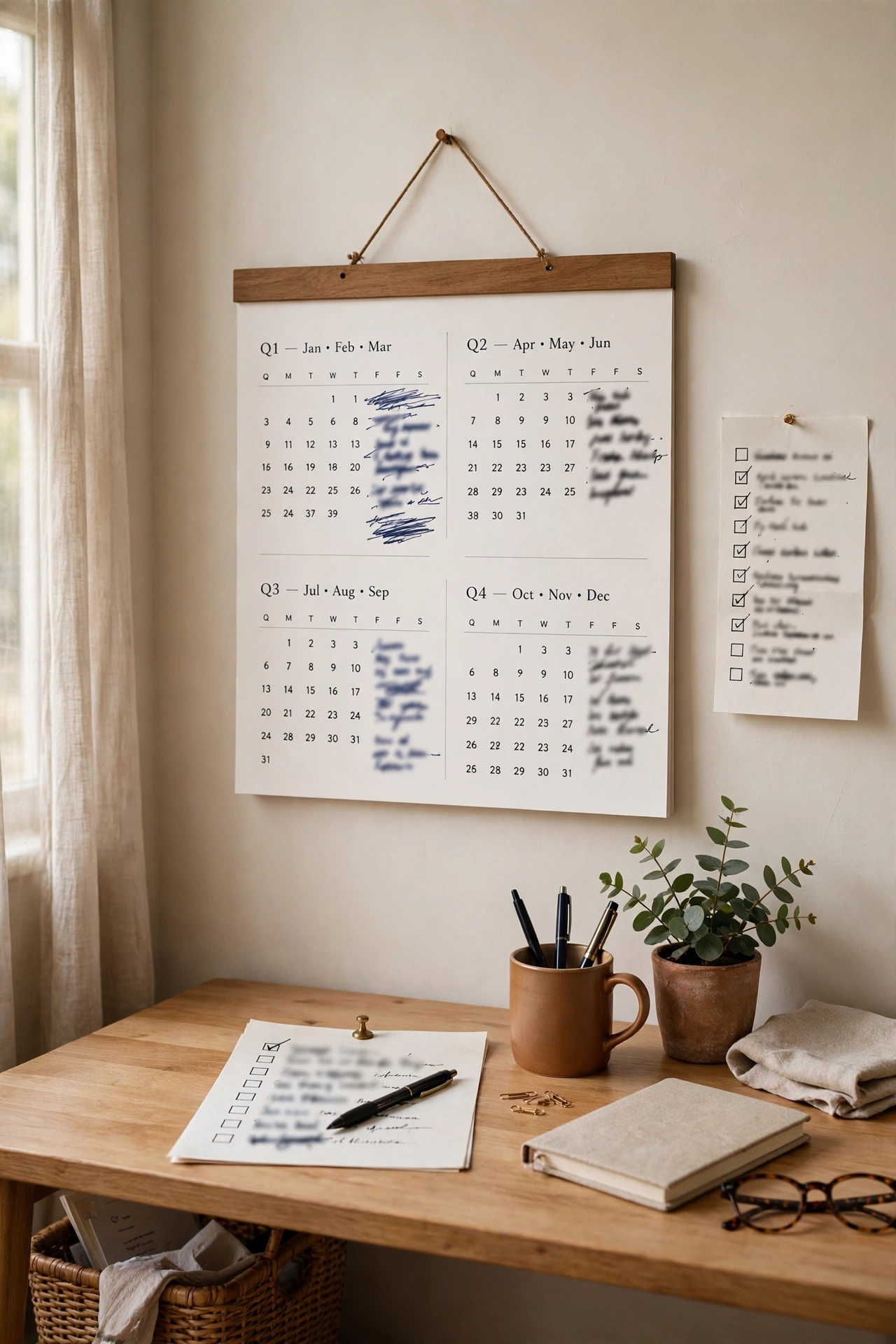
A 2-year goal feels far away, so split it into 2 yearly targets and then 8 quarterly milestones. A $4,800 savings goal becomes $2,400 in year one and $600 per quarter, which is $200 a month. A fitness goal becomes a 5K walk in quarter one and a longer weekly walk by quarter four. Write each milestone on a calendar with its date, and attach one weekly habit that feeds it, such as a Sunday money check or three evening walks. Milestones give you 8 chances to notice drift early instead of one big disappointment at the end of year two.
Try this: take your hardest goal and write its 8 quarterly milestones now, even if the later ones are rough guesses. You can revise them at each review.
Cost: $| Difficulty: Medium | Time: 1 hour
A paper tracker makes milestones easy to see at a glance, and a journal layout keeps all 8 quarters in one place. See these bullet journal design ideas for spreads that track goals, habits, and milestones month by month.
5. Review monthly, get support, and adjust without quitting

A plan only works if you look at it. Book a 20-minute review on the same day each month, check each milestone, and mark what moved and what stalled. Tell one trusted person your 3 goals and ask them to check in monthly, because a goal spoken aloud is harder to quietly drop. When life shifts, change the milestone, not the whole plan: a new job, a move, or a baby changes dates and amounts, but your values and direction usually stay. Quitting the plan after one bad month is the most common way 2-year plans die, and a shorter review cycle is the fix.
Try this: put your monthly review on your calendar for the next 12 months right now, and text your accountability person today with your 3 goals.
Cost: $| Difficulty: Easy | Time: 20 minutes a month
A clear desk makes the monthly review easier to sit down to, and one cleared surface is often enough to start. See these 8 point of clutter ideas to inspire your decluttering for small starting points like a kitchen counter or a nightstand.
Compare the 5 steps
| Step | Time it takes | Cost | Best for |
|---|---|---|---|
| 1. Stock-take | 45 minutes | Free | Finding where to aim |
| 2. Values and vision | 30 minutes | Free | Choosing goals that last |
| 3. Measurable goals | 40 minutes | Free | Making goals trackable |
| 4. Milestones | 1 hour | Free | Breaking big goals down |
| 5. Review and adjust | 20 minutes a month | Free | Staying on track for 2 years |
Mistakes that stall a 2-year plan
Setting 10 goals at once is the fastest stall, because attention splits and nothing gets a full effort. Skipping the stock-take is the second, because goals chosen without it often fix areas that were already fine. The third is writing the plan and never opening it again, which turns it into a document instead of a tool. The fourth is treating a missed milestone as proof the plan failed, when it usually means only the date or amount needs adjusting. Keep the goal list short, the review date fixed, and the edits small, and the plan survives the messy middle of year one.
Frequently asked questions
How long does it take to build a 2-year life plan?
The first draft takes about 3 hours spread across a week: 45 minutes for the stock-take, 30 minutes for values and vision, 40 minutes for goals, and 1 hour for milestones. After that, the monthly review takes 20 minutes. A plan you finish in one sitting usually stays vague, so spreading the steps across a few evenings gives each one a fair hearing.
How many goals should a 2-year plan have?
Three priority goals is the sweet spot for most people. Three goals fit real weeks that already hold work, family, and rest, and each one still gets real attention. If you have more ideas, keep them on a waiting list and promote one only when a current goal is finished or dropped on purpose.
What if my life changes in the middle of the plan?
Change the milestone, not the whole plan. A new job, a move, or a health change may shift dates and amounts, but your values and direction usually stay steady. Use the next monthly review to rewrite the affected milestones, keep the goals that still fit, and replace only the ones that no longer match your life.
Do I need a vision board for a 2-year plan?
No. A written plan stands on its own, and the steps in this guide work without pictures on a board. A vision board can sit beside a plan as a daily reminder if you enjoy making one, but it never replaces the goals, numbers, and dates that make progress measurable.
How often should I review my 2-year plan?
Review monthly and revise quarterly. The monthly check catches drift early and takes 20 minutes, while the quarterly review is the right moment to rewrite milestones, adjust amounts, or swap a goal that no longer fits. Skipping reviews for 6 months is how plans quietly expire.
Final thoughts
Start with the stock-take this week, even if the rest of the plan waits until next week. Three honest goals, eight quarterly milestones, and one monthly review date will carry you further in two years than a perfect plan you never open, and the first small milestone is closer than it looks.

Want your quiet goals somewhere visible? See these 6 mental health vision board goal ideas, from calm mornings to confident boundaries.