
Fall is the friendliest season to start sewing. The projects are small, the fabrics are forgiving, and every finished piece makes your home feel warmer. You do not need a fancy machine or years of practice to join in.
My first sewing project was a crooked pillowcase in pumpkin fabric, and I still use it every October. These 15 easy fall sewing projects for beginners stick to straight seams and simple shapes. Most take under two hours and cost less than $10 in fabric.
Quick takeaways
- Stick to straight seams and quilting cotton; skip zippers and stretchy knits for now.
- Fat quarters (about $3 each) cover most projects on this list.
- Press every seam; it is the fastest way to make your work look neat.
- Test your stitch on scrap fabric before each project.
- Keep pins in a pincushion and your fingers clear of the needle.
Beginner sewing basics for fall projects
Every project below uses the same short skill list: cut straight, sew a straight seam with a 1/4-inch or 1/2-inch allowance, press the seam, and finish the edges. Choose quilting cotton for your first projects; it does not stretch, it feeds through the machine evenly, and it presses crisp.
Singer’s beginner sewing guide recommends starting small with straight-stitch projects like pillowcases and tote bags, and practicing threading, bobbin winding, and tension on scrap fabric first. That advice fits this list exactly. If you are setting up a permanent spot for your machine, these IKEA craft room hacks help you carve out a sewing corner on a budget.
1. Plush fabric pumpkins
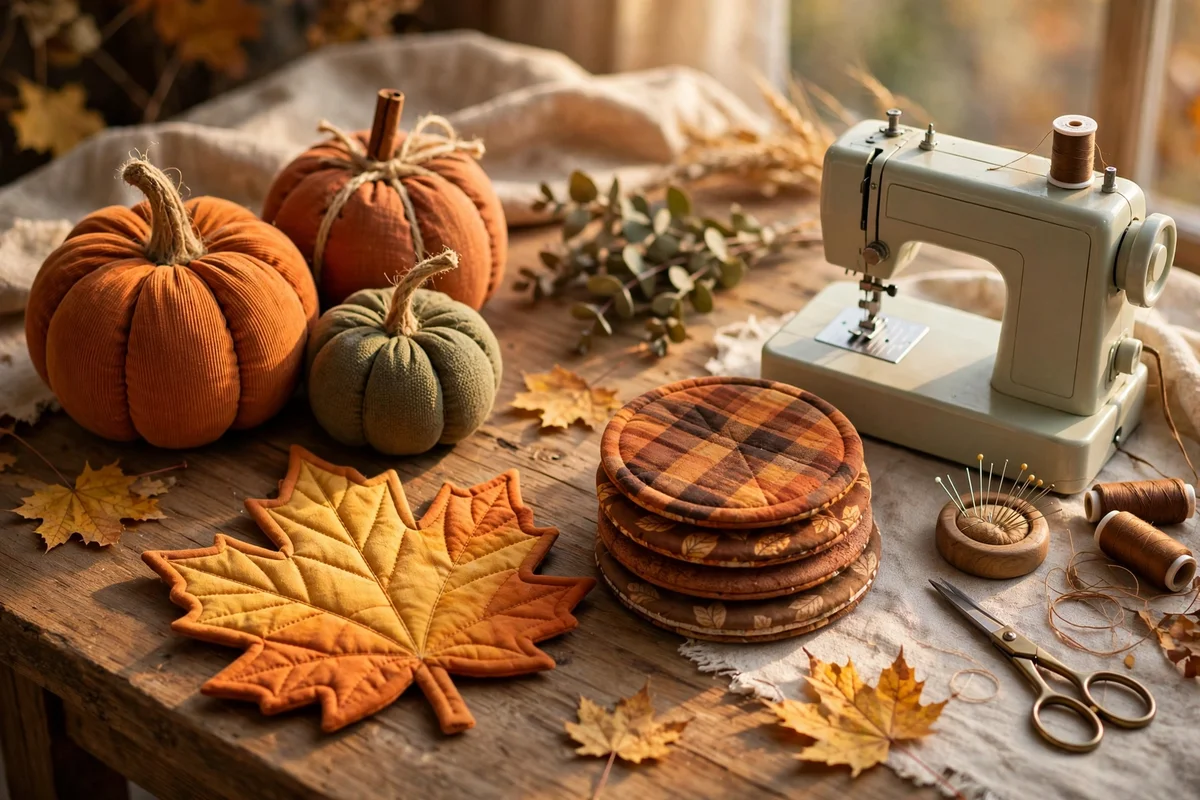
Cut an 8-inch circle of orange quilting cotton, run a gathering stitch around the edge, and pull it closed around a handful of polyfill. Push a cinnamon stick into the center for the stem and tie the gathers tight. The round shape hides uneven stitching, which makes this the classic first project.

Make them in rust, cream, and mustard for a grouped display. One fat quarter yields two medium pumpkins. They sell well at craft fairs too, if you catch the making bug.
Try this: wrap embroidery floss around the pumpkin in segments to create the ridges before adding the stem.
Difficulty: Easy | Cost: Under $10
2. Felt leaf garland
Cut leaf shapes from craft felt in red, orange, gold, and brown, then stitch them onto a length of jute twine with a simple running stitch. Felt does not fray, so there are no hems to finish and no edges to bind. Space the leaves 3 inches apart for a full garland.

Hang the finished garland across a mantel, a window, or a doorway. This project works entirely by hand, so it is ideal if your machine is still in the box.
Try this: stitch a center vein down each leaf with contrasting thread for a more finished look.
Difficulty: Easy | Cost: Under $5
3. Quilted leaf potholders
Trace a leaf template onto two pieces of fall fabric and one layer of Insul-Bright heat-resistant batting. Stitch around the edge, turn, and topstitch a vein down the center. The leaf shape is just a pointed oval, so the cutting stays simple.

Use real heat-resistant batting, not regular quilt batting, since these handle hot pans. They make thoughtful hostess gifts through Thanksgiving. Cut two leaves from each fat quarter so one quarter yields a matching pair.
Try this: add a small fabric loop at the stem end so the potholder can hang by the stove.
Difficulty: Easy | Cost: Under $10
4. Fall fabric coasters
Cut 5-inch squares from two coordinating fall fabrics and one layer of cotton batting. Stitch around all four sides, turn through a small opening, and topstitch the edge closed. The whole project is four straight seams.

A set of four takes under an hour and uses up scraps from bigger projects. They protect wood tables from mugs all season and wash well. Mix plaid, leaf, and solid fabrics in one set so they match any fall table.
Try this: round the corners slightly with scissors before turning for a softer shape.
Difficulty: Easy | Cost: Under $5
5. Fall mug rug
A mug rug is a small quilted mat, about 6 by 9 inches, that holds a mug and a cookie. Layer fall fabric, batting, and backing, then quilt straight lines across the top. Bind the edges or turn and topstitch.

Straight-line quilting teaches you to guide fabric evenly, a skill every later project needs. Make a stack of them; they are popular small gifts. A 6 by 9 inch size fits most mugs with room for a spoon beside it.
Try this: quilt on the diagonal instead of straight across for a different look with the same skill.
Difficulty: Easy | Cost: Under $5
6. Candy corn pillow
Sew three fabric triangles in white, orange, and yellow into one big triangle, add a backing, stuff with polyfill, and close. A 12-inch candy corn pillow needs only straight seams, and the color blocks do all the visual work.

Kids love this one, and it looks great on a porch bench or entryway chair. Match the thread to each section or use orange throughout. Stuff it firmly so the triangle holds its shape on the couch.
Try this: clip the corners before turning so the triangle points come out sharp.
Difficulty: Easy | Cost: Under $10
7. Simple fall table runner
Cut one long rectangle of fall fabric, about 14 by 72 inches for a standard table. Hem all four edges with a twice-turned hem and press. That is the entire project, and it transforms a dining table.

Choose a print you love, since the fabric does all the work here. If you like the rustic look, these burlap projects for a cozy farmhouse home use the same straight-stitch skills with a different texture.
Try this: sew a second runner in a Christmas print now while your machine is out; the steps are identical.
Difficulty: Easy | Cost: Under $15
8. Pumpkin patchwork placemats
Strip-piece orange, brown, and cream fabric strips into a 12 by 18 inch rectangle, then layer with batting and backing and quilt along the seams. The strips form a simple pumpkin-block pattern with no templates.

Make four to six for a full table setting. Press each strip before sewing the next one on; pressed strips line up more evenly. If little ones are joining the table, these Thanksgiving entertaining ideas for kids keep them busy while dinner finishes.
Try this: chain-piece the strips (sew one after another without cutting threads) to speed up a set of six.
Difficulty: Easy | Cost: Under $15
9. Rice hand warmers
Sew two 4 by 5 inch flannel rectangles together on three sides, fill two-thirds full with plain white rice, and stitch the opening closed. Microwave for 20 to 30 seconds for warm hands on chilly mornings.

Use 100 percent cotton fabric and thread, since synthetics can melt in the microwave. These make easy teacher and neighbor gifts in sets of two. Tie each pair with twine and a small tag for a finished gift.
Try this: add a drop of dried lavender to the rice for a lightly scented warmer.
Difficulty: Easy | Cost: Under $5
10. Drawstring treat bags
Sew two 6 by 8 inch rectangles into a small pouch, fold down a casing at the top, and thread ribbon through it. Fill with candy for Halloween or potpourri for Thanksgiving table favors.

This project teaches casings, a skill you will reuse on curtains and bags later. Make a dozen in an afternoon from one yard of fabric. Sew the side seams with a 1/2-inch allowance so little hands can tug the ribbon freely.
Try this: use a safety pin on the ribbon end to thread it through the casing easily.
Difficulty: Easy | Cost: Under $10
11. Envelope pillow covers
Cut one front square and two overlapping back rectangles from fall fabric, hem the overlap edges, and sew the whole thing into an 18-inch cover. The overlapping back holds the pillow form with no zipper to install.

Swap covers each season instead of storing whole pillows. Cut the pillow form one inch smaller than the cover for a full, plump look. Prewash the fabric first so the finished cover does not shrink later.
Try this: overlap the back pieces by 5 inches so the pillow form never peeks out.
Difficulty: Easy | Cost: Under $10
12. Felt acorn ornaments
Cut two acorn shapes from brown felt, stitch around the edge, stuff lightly with polyfill, and add a tan felt cap with a twine loop. They hang on branches, wreaths, or a small tabletop tree.

Hand-stitch these with a simple whipstitch; no machine needed. A dozen acorns take about two hours and cost almost nothing in felt scraps. Vary the felt shades from tan to dark brown for a natural gathered look.
Try this: use a real acorn cap glued over the felt cap for a natural touch.
Difficulty: Easy | Cost: Under $5
13. Fabric bookmarks
Cut 2 by 7 inch strips of fall fabric, fuse light interfacing to the back, fold, and topstitch around all edges. Add a ribbon tassel at the top for a finished gift.

The interfacing keeps the bookmark stiff enough to slide into a book. These are great first gifts for teachers and book-club friends. Cut several strips at once with a rotary cutter to make a whole batch in one sitting.
Try this: stitch two different fabrics back to back for a reversible bookmark.
Difficulty: Easy | Cost: Under $5
14. Harvest tote bag
Sew two 15 by 16 inch rectangles of canvas or home-dec fabric into a bag, box the bottom corners for depth, and attach sturdy webbing handles. It carries farmers market hauls, library books, and craft supplies.

Boxed corners sound advanced, but they are just one straight seam across each corner. Reinforce the handle stitching with an X-box for strength. Choose canvas or home-dec weight fabric so the bag holds its shape when loaded.
Try this: add an inside pocket from a 6-inch square before sewing the sides together.
Difficulty: Easy | Cost: Under $15
15. Quilted hot pads
Layer two 8-inch squares of fall fabric with Insul-Bright batting between them, quilt diagonal lines across, and bind the edges. They protect your table from hot dishes all season.

Binding the edges is the newest skill here; go slowly and it comes out clean. Make them in matching sets of two or four. Quilt the layers before trimming to size so the edges stay even all around.
Try this: use pre-made bias tape for the binding to skip making your own.
Difficulty: Easy | Cost: Under $10
Fall sewing projects compared
Pick your first project by how much time you have this weekend.
Sewing safety for beginners
Sewing is safe when you build a few habits from day one.
- Keep pins and needles in a pincushion or magnetic holder, never loose on the table or in your mouth. Count them back in when you finish.
- Never sew over pins. Stop the machine and pull each pin out just before the needle reaches it; hitting a pin can snap the needle.
- Keep your fingers to the sides of the presser foot, never directly in front of the needle. Let the feed dogs move the fabric; do not push or pull it.
- Unplug the machine when you change the needle, clean lint from the bobbin area, or finish for the day.
- Rest a hot iron upright on its heel, never face-down, and unplug it when you step away. Keep the cord clear of the ironing surface.
- Supervise children closely around machines, irons, and sharp tools; store everything out of reach when you are done.
Frequently asked questions
What is the easiest fall sewing project for a total beginner?
Fabric coasters or a mug rug. Both use only straight seams, finish in under an hour, and need just fabric scraps and batting. They teach cutting, seam allowances, and pressing without any shaping or closures.
What fabric should beginners use for fall projects?
Quilting cotton. It does not stretch, it feeds through the machine evenly, and it presses into crisp seams. Singer’s beginner guide recommends cotton or cotton blends for early projects for exactly these reasons. Save knits, satin, and slippery fabrics for later.
Do I need a sewing machine for these projects?
Most projects on this list are faster by machine, but the felt leaf garland, felt acorn ornaments, and simple coasters can be sewn entirely by hand. If you are unsure about buying a machine yet, start with the hand-sewing projects first.
How much fabric do I need for beginner fall projects?
Fat quarters, which measure about 18 by 22 inches and cost around $3, cover nearly every small project here. Buy one yard each of two or three coordinating fall prints and you can make coasters, a mug rug, treat bags, and hand warmers from the same bundle.
How do I keep pins and needles safe while sewing?
Store every pin and needle in a pincushion or magnetic holder when it is not in your fabric. Never hold pins in your mouth and never sew over them; remove each pin just before the needle reaches it. Keep fingers to the sides of the presser foot, and unplug the machine when you change needles or finish sewing.
Can I wash the things I sew?
Cotton and batting projects like coasters, placemats, and pillow covers machine-wash well. Rice hand warmers should only be spot-cleaned, since the rice filling cannot get wet. Felt ornaments do best with a gentle hand wash or just a lint roller.
Thread your machine, pick one small project, and finish it this weekend. That first finished piece builds more confidence than any tutorial, and fall gives you the perfect excuse to keep going.
For sewing gifts for friends, see our guide to 15 Thoughtful DIY Sewing Gifts for Friends That Feel Personal, Not Store-Bought for a monogrammed zipper pouch, a key fob wristlet, lavender drawer sachets, a padded eyeglass case, and a market tote with a pocket.


