


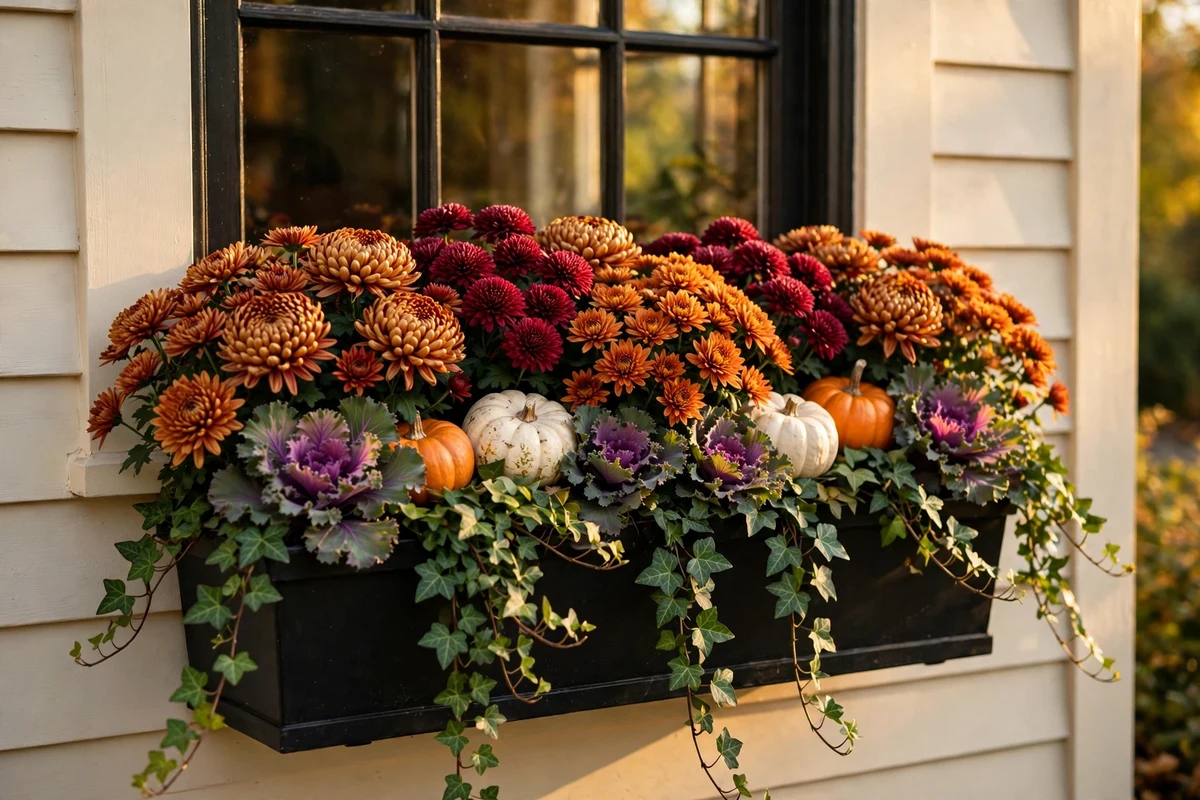
Summer window boxes fade fast. By late September the petunias look tired, the sweet potato vine has quit, and the whole front of the house feels a little neglected. Replanting for fall fixes that in one afternoon, and fall plants are far more forgiving than summer ones.
This list gives you 20 fall window box combinations that actually work: the exact plants, the colors that look good together, what each one costs, and how to keep it alive until Thanksgiving. Every box below fits a standard 24 to 36 inch window box, and most cost under $40 in plants.
Quick takeaways
- Buy mums with tight buds, not full blooms, so they flower for weeks instead of days.
- Ornamental kale, pansies, and violas survive light frost; most warm-season annuals do not.
- Thriller-filler-spiller (tall back, mounded middle, trailing front) keeps boxes from looking flat.
- Small pumpkins and gourds go in last, nestled between plants, and get swapped out once they soften.
- Several classic fall plants are toxic to cats and dogs, so check the safety section before you plant.
1. Classic mum trio in bronze, burgundy, and burnt orange
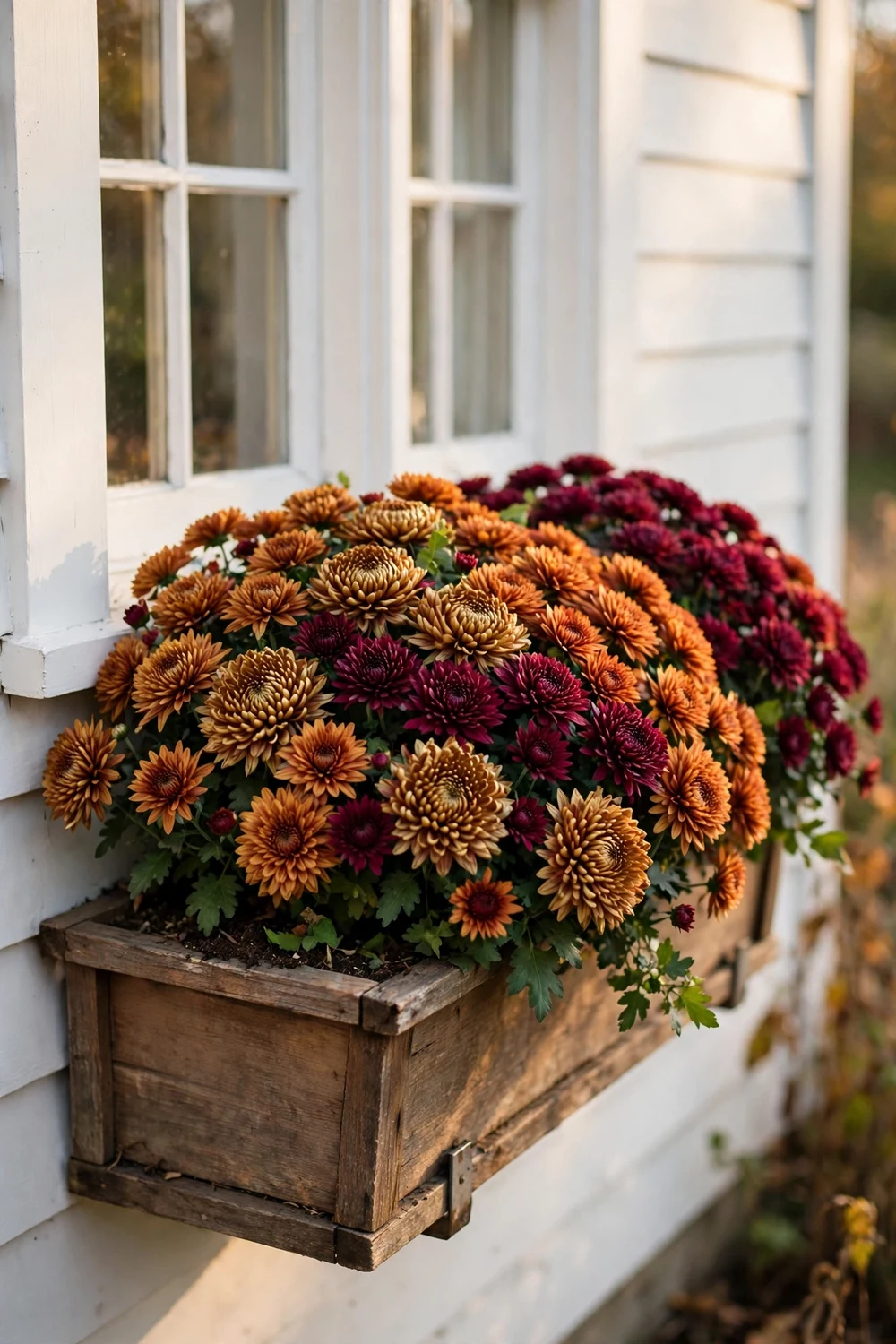
This is the fall window box most people picture, and it earns its reputation. Three garden mums in bronze, burgundy, and burnt orange fill a box fast and look planned instead of thrown together. Buy 4-inch nursery pots, usually $5 to $8 each, and pick plants with mostly unopened buds so the blooms open over several weeks. Keep them in their pots, tuck them in close, and hide the plastic rims with sheet moss. Water every other day while September is still warm. Pet note: mums are toxic to cats and dogs, so keep the box out of reach if pets climb nearby (more in the safety section below).
Try this: set all three pots on the sill before planting and shuffle until no two neighboring shades clash.
Difficulty: easy · Cost: $$
2. Ruffled ornamental kale with ivory mums

Ornamental kale is the plant that carries a fall box through October. The ruffled rosettes in purple, cream, and green actually get richer after a light frost, when most flowers are done. Pair them with ivory or pale yellow mums for contrast, and top the soil with sphagnum moss so it reads finished. A 4-inch kale runs $4 to $6, and one plant makes a big visual statement. This combo also works in shade, which most mum-heavy boxes cannot claim. Pet note: mums are toxic to cats and dogs, so check the safety section before planting near pets.
Try this: plant the kale slightly deeper than it sat in the pot; the rosettes get heavy as they mature.
Difficulty: easy · Cost: $$
3. Mini pumpkins tucked into trailing ivy

Sometimes the simplest box wins. Plant a base of hardy green ivy in early September, let it spill over the front edge, then tuck 5 to 7 mini pumpkins and gourds between the vines in October. Mixing sizes and stripes keeps it from looking staged, and the whole thing costs about $10 in pumpkins if you buy at a farm stand. Replace any pumpkin that softens after a freeze, and pull real pumpkins by Thanksgiving if squirrels start gnawing them. Pet note: ivy (Hedera helix) is toxic to cats and dogs, so keep this one where pets cannot chew it.
Try this: use faux pumpkins if squirrels raid your yard; real ones tend to vanish within a week in squirrel-heavy areas.
Difficulty: easy · Cost: $$
4. All-white farmhouse box with Baby Boo pumpkins

White on white sounds plain until you see it against a dark house. Small Baby Boo pumpkins, white mums, and silver dusty miller make a box that photographs beautifully in low fall light and works with almost any siding color. Add a few dried wheat stems for height and you have the full farmhouse look without a single orange pumpkin. White mums can be harder to find than orange, so call the nursery before you drive. This palette carries straight through Thanksgiving without looking tired. Pet note: mums are toxic to cats and dogs; see the safety section before planting near pets.
Try this: contrast the pale plants with a dark box (black or stained wood) so the whites read clearly from the street.
Difficulty: easy · Cost: $$
5. Purple pansies with silver dusty miller

Pansies and violas are the underrated workhorses of fall containers. They tolerate light frost, bloom through chilly October days, and often push out a second flush in early spring. Deep purple pansies next to silver dusty miller give a cool, calm box that stands out among all the orange on the block. Six-packs of pansies run $4 to $6, so a 30-inch box costs under $15 in flowers. Deadhead spent blooms weekly to keep new ones coming. Pansies and violas are non-toxic to pets, which makes this one of the safest boxes on the list.
Try this: plant pansies in early September while the soil is still warm; they root faster and bloom harder.
Difficulty: easy · Cost: $$
6. Burgundy coleus over orange mums
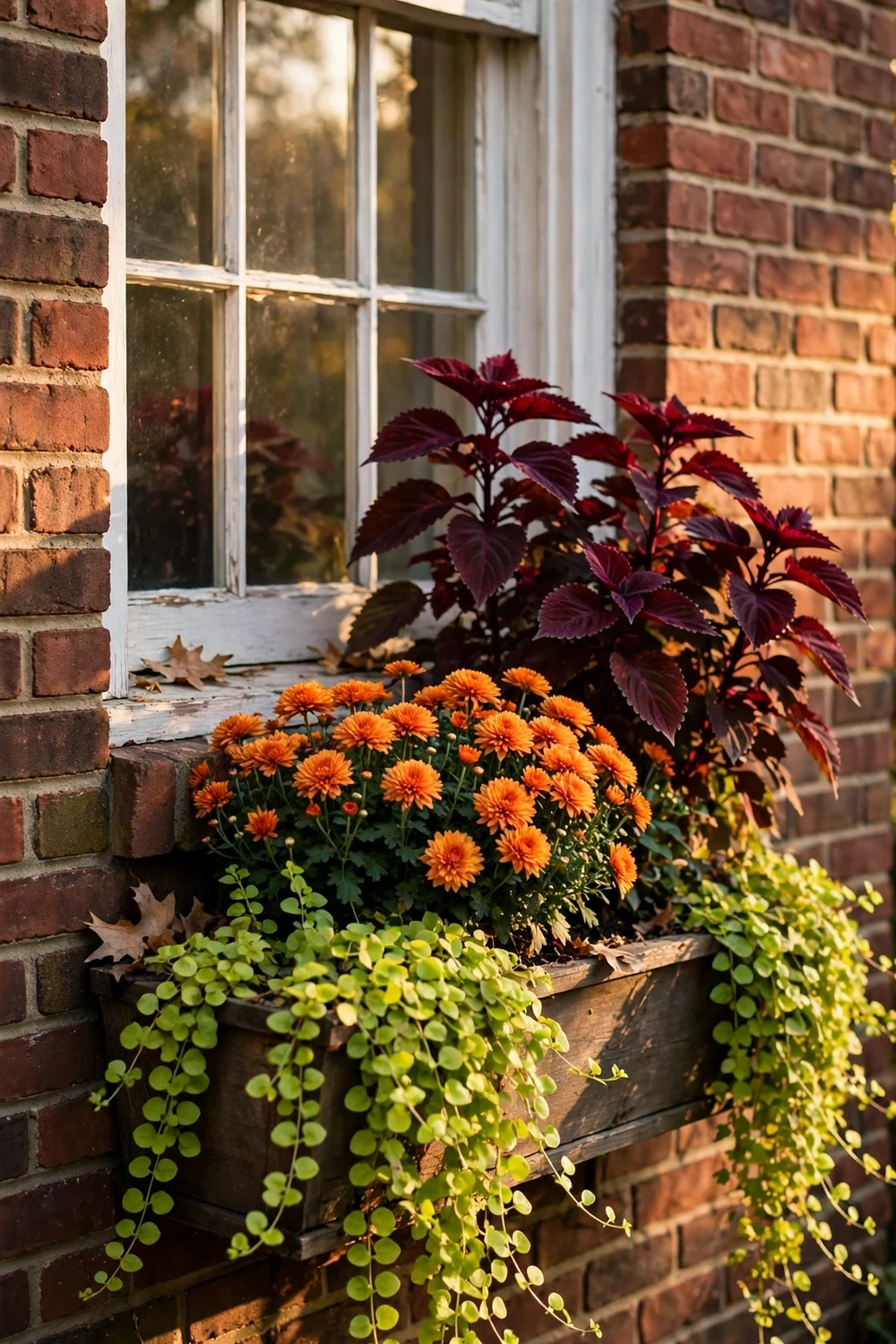
Coleus usually gets pulled in August, but burgundy varieties earn a second act in fall. The dark foliage makes a moody backdrop that makes orange mums glow, and lime-green creeping jenny spilling over the front edge keeps the whole box from going too dark. Coleus fades fast once nights drop near freezing, so treat it as a 6 to 8 week plant and enjoy it while it lasts. Pinch the growing tips once to keep it bushy instead of leggy. Pet note: coleus is toxic to cats and dogs, and mums are too, so keep this box away from curious pets.
Try this: water coleus in the morning; wet foliage overnight in cool air invites mildew.
Difficulty: easy · Cost: $$
7. Purple fountain grass with heirloom pumpkins

Height changes everything in a window box. Three purple fountain grass plants at the back give this box a full foot of lift, heirloom pumpkins in blue-gray and orange fill the middle, and ivy softens the front edge. The grass plumes catch the wind and turn copper as the season goes, so the box looks different every week. Fountain grass in a 1-gallon pot costs $8 to $12; buy the grass first, since it sets the scale for everything else. Pet note: ivy is toxic to cats and dogs, so site this box where pets cannot reach it.
Try this: leave the grass plumes standing all fall; cut them back only when you swap the box for winter.
Difficulty: easy · Cost: $$
8. Marigolds and mums for a golden glow
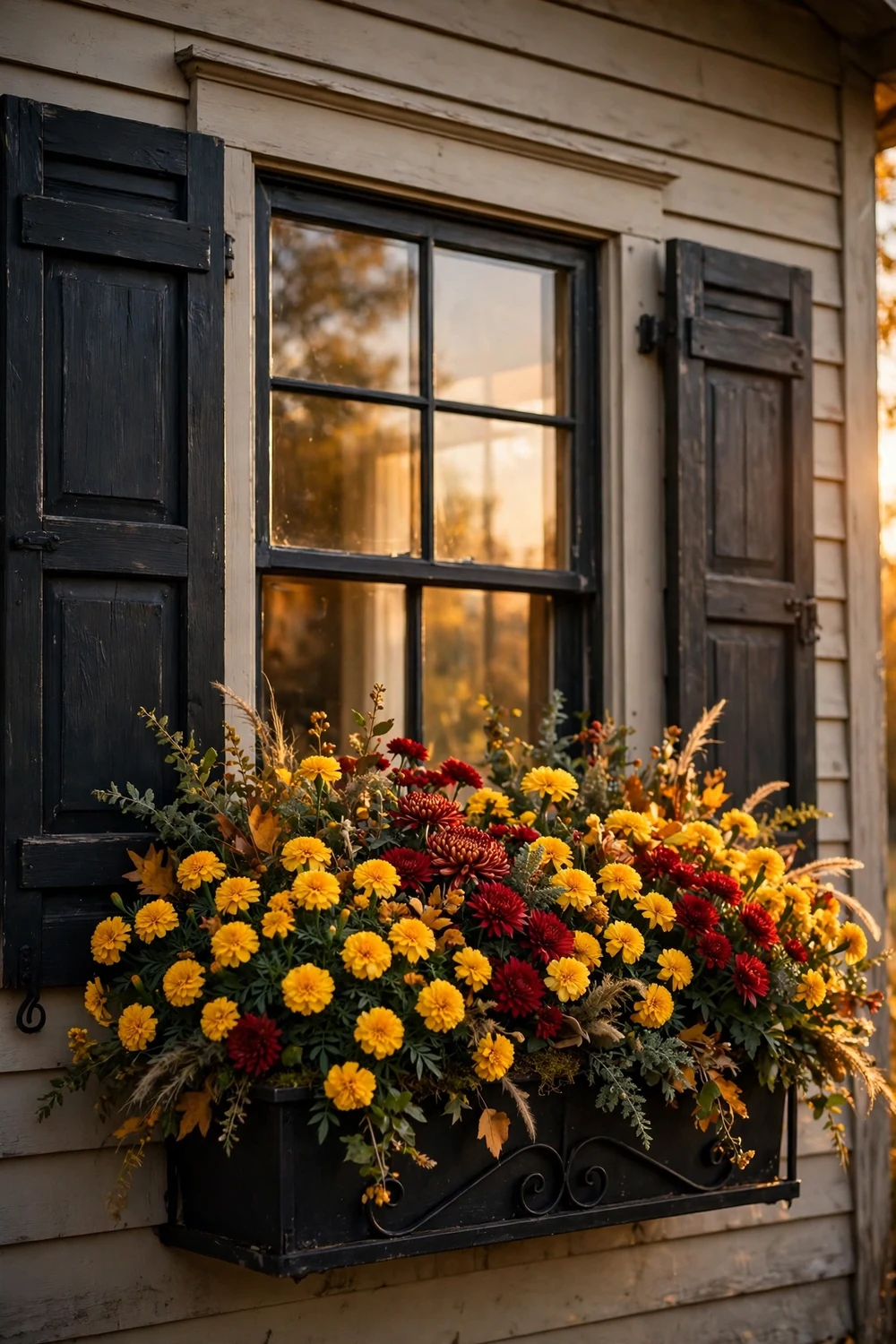
If your house faces west, lean into it. Golden marigolds and deep red mums in a black or bronze box glow in late-afternoon sun and carry their color from the curb. Marigolds are cheap (flats run under $10) and bloom until a hard freeze, which makes them the best value filler in fall containers. Plant them slightly forward so they spill a little, with taller mums behind. Both plants want full sun, so save this one for your sunniest window. Pet note: mums are toxic to cats and dogs, so keep this box out of their reach.
Try this: pinch off faded marigold heads every few days; they rebloom fast when deadheaded.
Difficulty: easy · Cost: $$
9. Crotons for warm-climate boxes
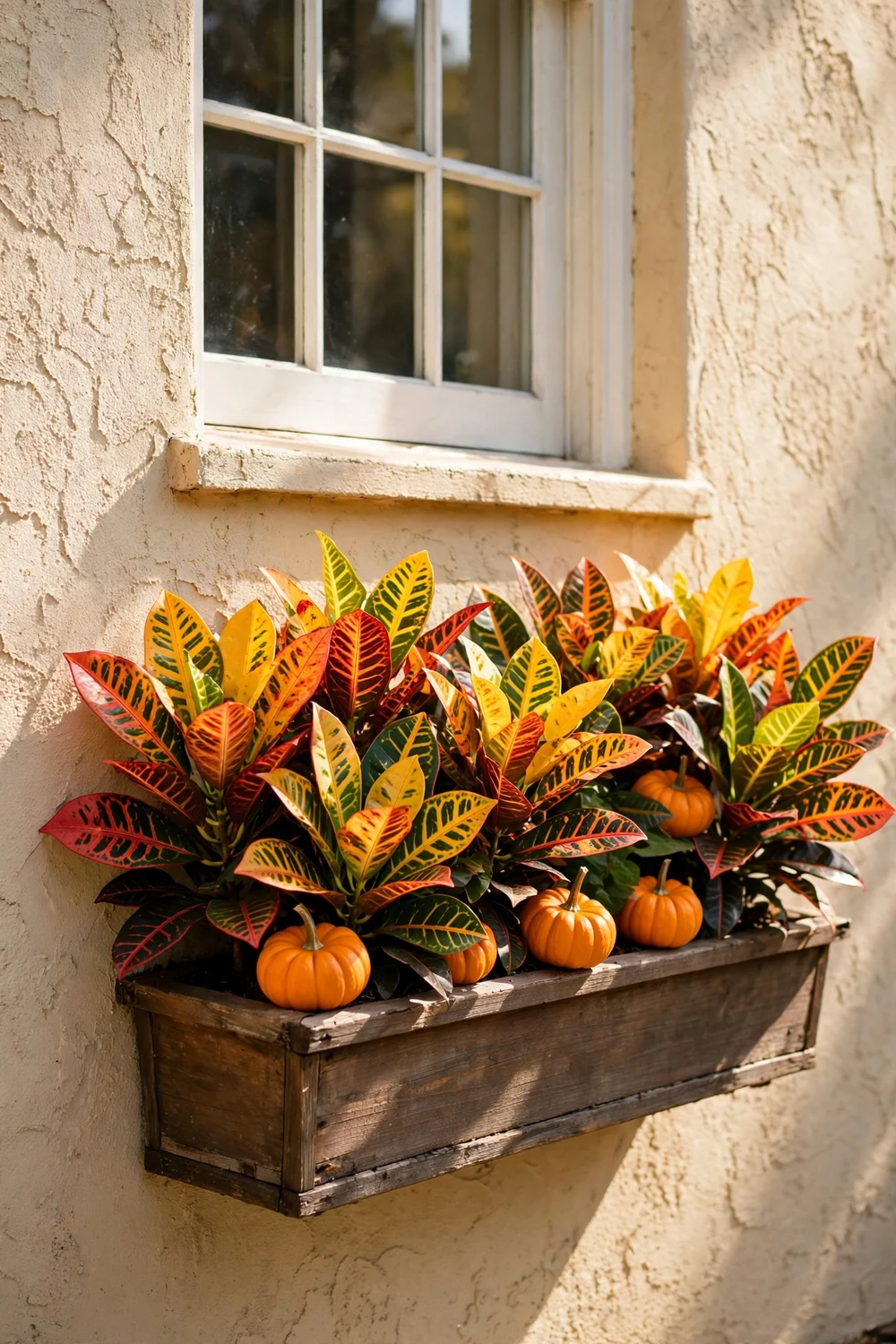
In zones 9 and warmer, fall does not mean frost, and crotons give you autumn color without pretending it is cold. The red, yellow, and orange variegated leaves read as fall foliage all on their own, and a couple of mini pumpkins tucked in sell the season. Crotons stall below about 50 degrees, so this box is strictly for mild climates; in colder zones they fade within weeks. Small 4-inch crotons cost $5 to $9. Keep the soil evenly moist, since dry air makes them drop leaves. Pet note: croton leaves are toxic to cats and dogs, so use this box only where pets cannot chew it.
Try this: mist the leaves on dry days or group pots so the foliage shades itself and holds humidity.
Difficulty: moderate · Cost: $$
10. Foraged dried hydrangea and birch branches
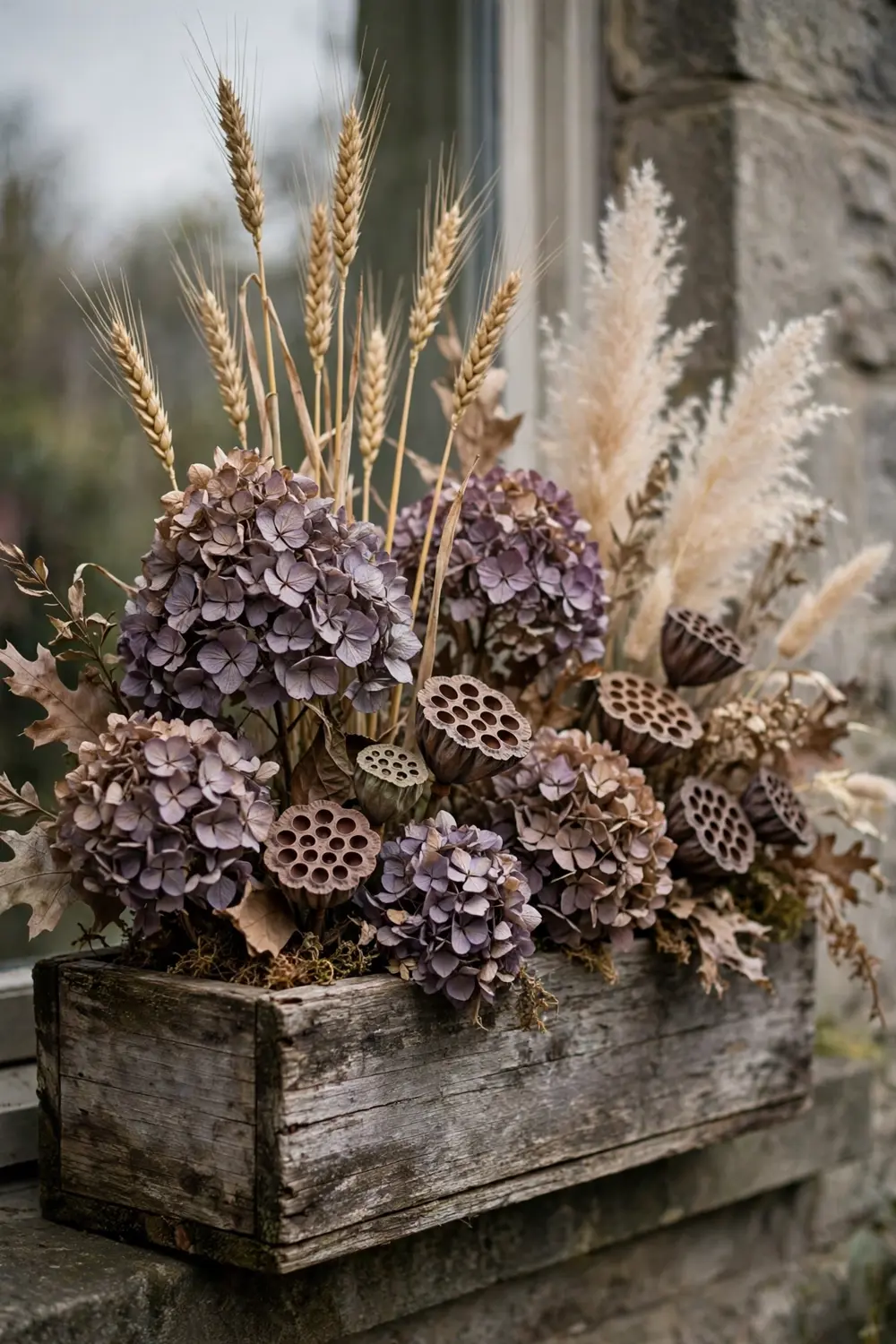
The cheapest box on this list costs nothing. Dried hydrangea heads from your own bushes fill volume fast, birch branches add height, and dried seed heads from the garden give texture. Push the stems into a base of floral foam or packed soil so wind cannot topple them. Everything here lasts the whole season because nothing is alive to die. Swap in fresh greenery cuttings in November to carry it toward winter. Pet note: dried hydrangea is toxic to cats and dogs, so keep foraged stems where pets cannot reach them.
Try this: cut hydrangea heads in late August when they feel papery; earlier cuts wilt instead of drying.
Difficulty: easy · Cost: $
11. Wheat bundles and corn husks for Thanksgiving

This box is built for the two weeks around Thanksgiving. Upright bundles of dried wheat give height, corn husks add that harvest texture, and a few orange mums at the base keep it from looking like a craft project. Bundle wheat with twine before you place it, or the stems splay everywhere. Wheat and husks are light, so anchor them in damp soil or foam. This is a short-lived arrangement by design: build it the weekend before Thanksgiving and compost the dried material after. Everything here is pet-safe, but keep an eye on dogs that like to chew wheat stems.
Try this: buy wheat at a craft store in October before the holiday rush clears the shelves.
Difficulty: easy · Cost: $$
12. Edible ornamental peppers and Swiss chard
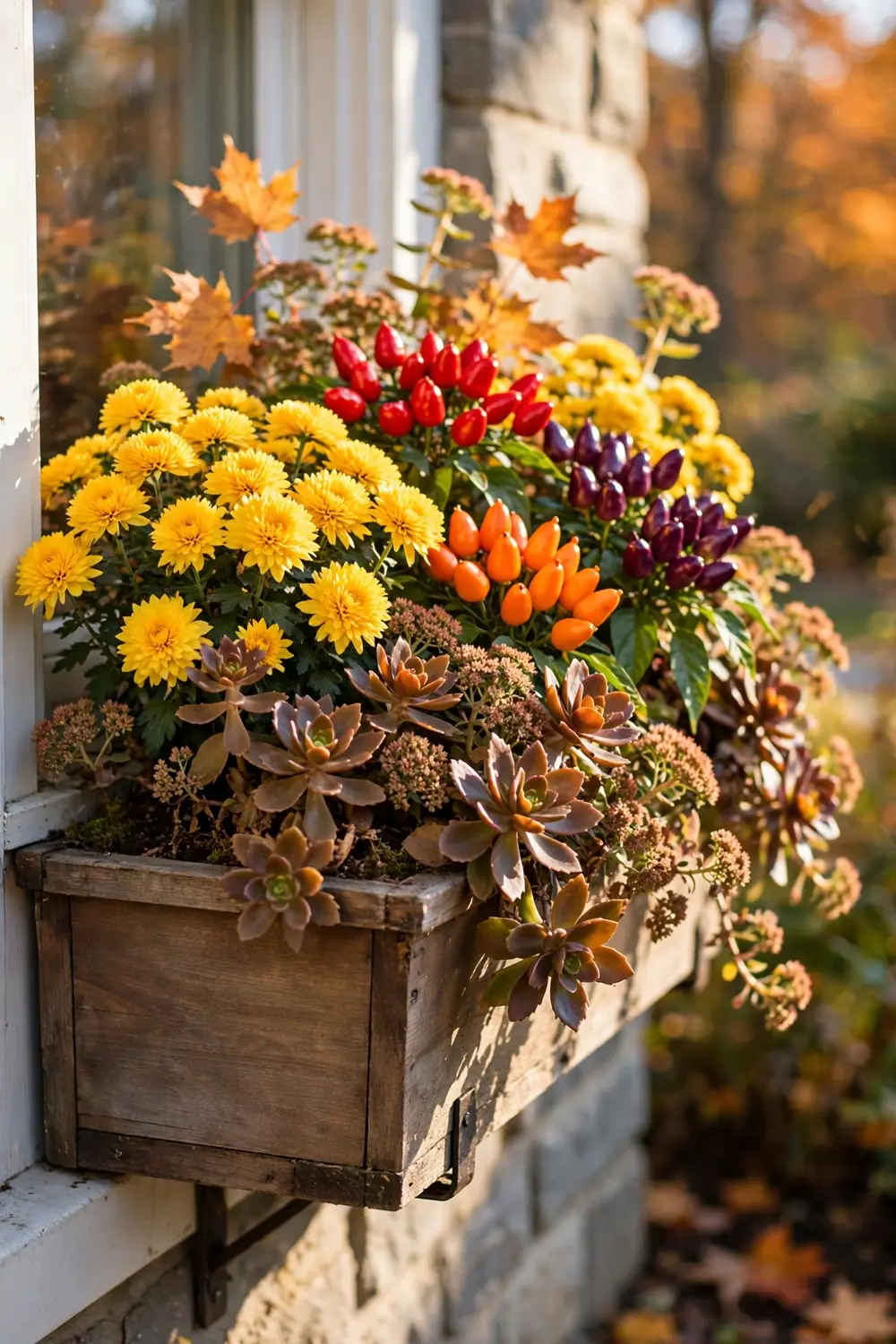
A kitchen window box can look good and work for dinner. Ornamental peppers in red, orange, and purple hold their color for weeks, rainbow Swiss chard gives big glossy leaves, and creeping jenny trails over the front. The peppers are technically edible but bred for looks, so grow them for color and harvest the chard instead. Both tolerate cool nights down to the 40s. One 6-pack of chard and two pepper plants fill a 24-inch box for about $15. This box earns its keep in more ways than one, and everything in it is safe around pets.
Try this: pick the outer chard leaves first so the center keeps producing into November.
Difficulty: easy · Cost: $$
13. Succulent box for frost-free porches

Succulents and fall are not an obvious pair, but in frost-free climates they make the lowest-maintenance box on this list. Blue-green echeveria, dusty-rose sedum, and cream-toned haworthia in a white or concrete box look clean and modern, and they need water maybe twice a month. Gravel top dressing keeps the leaves dry and finishes the look. Use a gritty cactus mix, not regular potting soil, or the roots rot in fall rain. Individual succulents run $3 to $6, so a full box lands around $25. Most common succulents are pet-safe, but keep echeveria away from cats that chew leaves.
Try this: tilt the box slightly forward when you mount it so rain drains off instead of pooling at the roots.
Difficulty: easy · Cost: $$
14. Spring bulbs layered under fall blooms

Plant once, enjoy twice. In October, tuck daffodil and tulip bulbs 4 to 6 inches deep in the box, then plant pansies or violas over them for fall color. The fall flowers bloom now; the bulbs sleep through winter and push up through the same box in March. Mark where you planted the bulbs with small sticks so you do not dig them up when you refresh the box in spring. A bag of 20 daffodil bulbs costs about $8, and pansies on top run another $10. Use a box at least 8 inches deep so the bulbs have real soil below them.
Try this: choose early daffodil varieties like February Gold so the spring show starts before you lose patience.
Difficulty: moderate · Cost: $$
15. Cool-weather herb box: rosemary, sage, and thyme
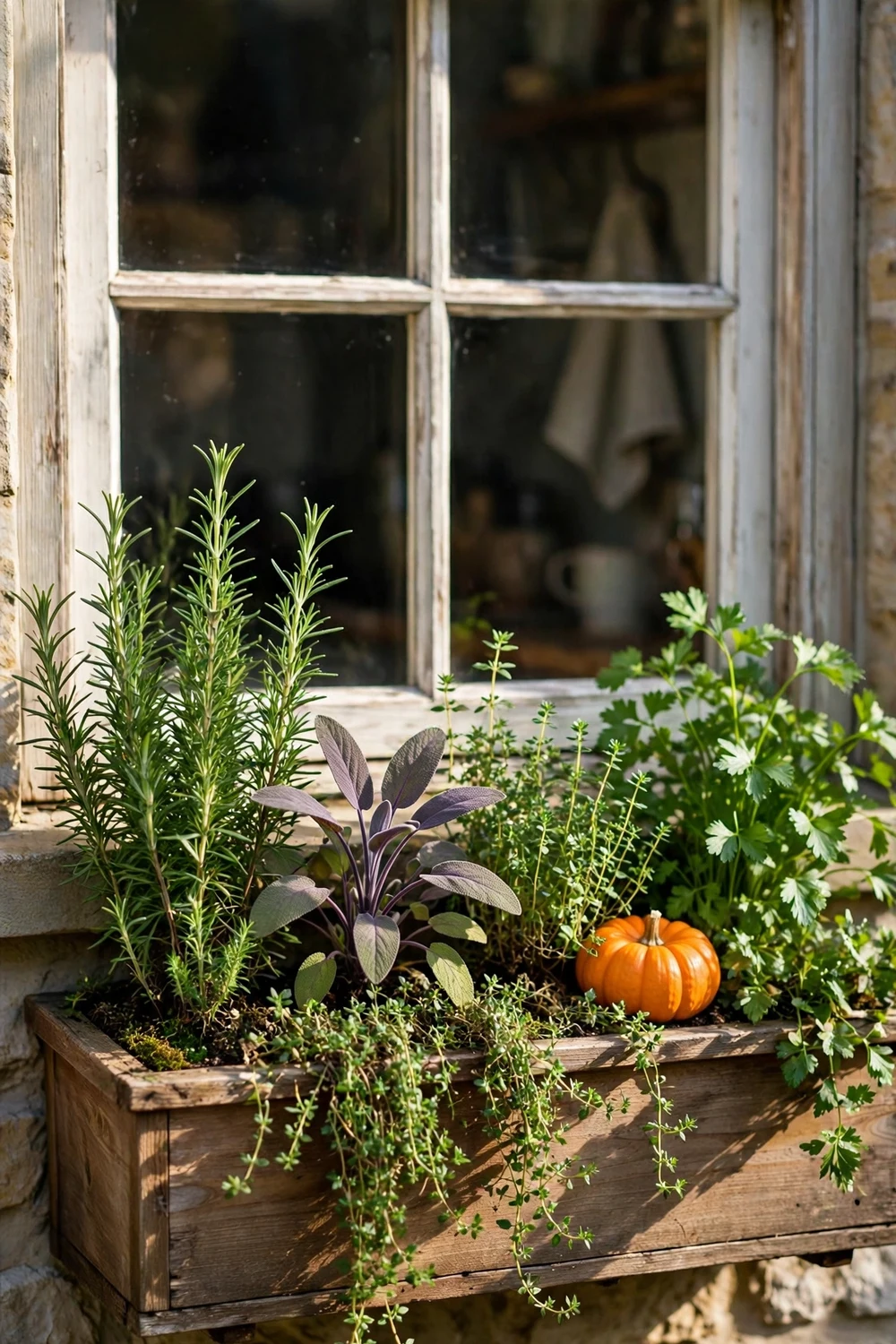
Rosemary, sage, thyme, and parsley all shrug off cool fall weather, which makes them perfect for a kitchen window box you actually use. Upright rosemary gives height at the back, purple sage adds color, thyme spills over the front, and parsley fills the gaps. Snip what you need for cooking and the plants keep growing into November. A 4-inch herb pot costs $3 to $5, so the whole box runs under $20. In cold zones, bring the rosemary pot indoors before the first hard freeze; the rest can stay out. All four herbs are safe around pets.
Try this: harvest in the morning when the oils are strongest, and never take more than a third of any plant at once.
Difficulty: easy · Cost: $$
16. Snapdragons with purple violas

Snapdragons bloom best in cool weather, which makes fall their season. Tall spikes in pink, orange, and yellow rise above a low carpet of purple and yellow violas for a cottage-garden look that keeps flowering until a hard freeze. Buy snapdragons already budding (about $5 per 4-inch pot) and plant them toward the back so they do not shade the violas. Stake the tallest spikes if your window gets wind. Both plants tolerate light frost, and violas often survive winter entirely in mild zones. Snapdragons and violas are both non-toxic to pets.
Try this: cut a few snapdragon stems for a vase; cutting encourages the plant to send up more spikes.
Difficulty: easy · Cost: $$
17. Heuchera and dianthus that return next year
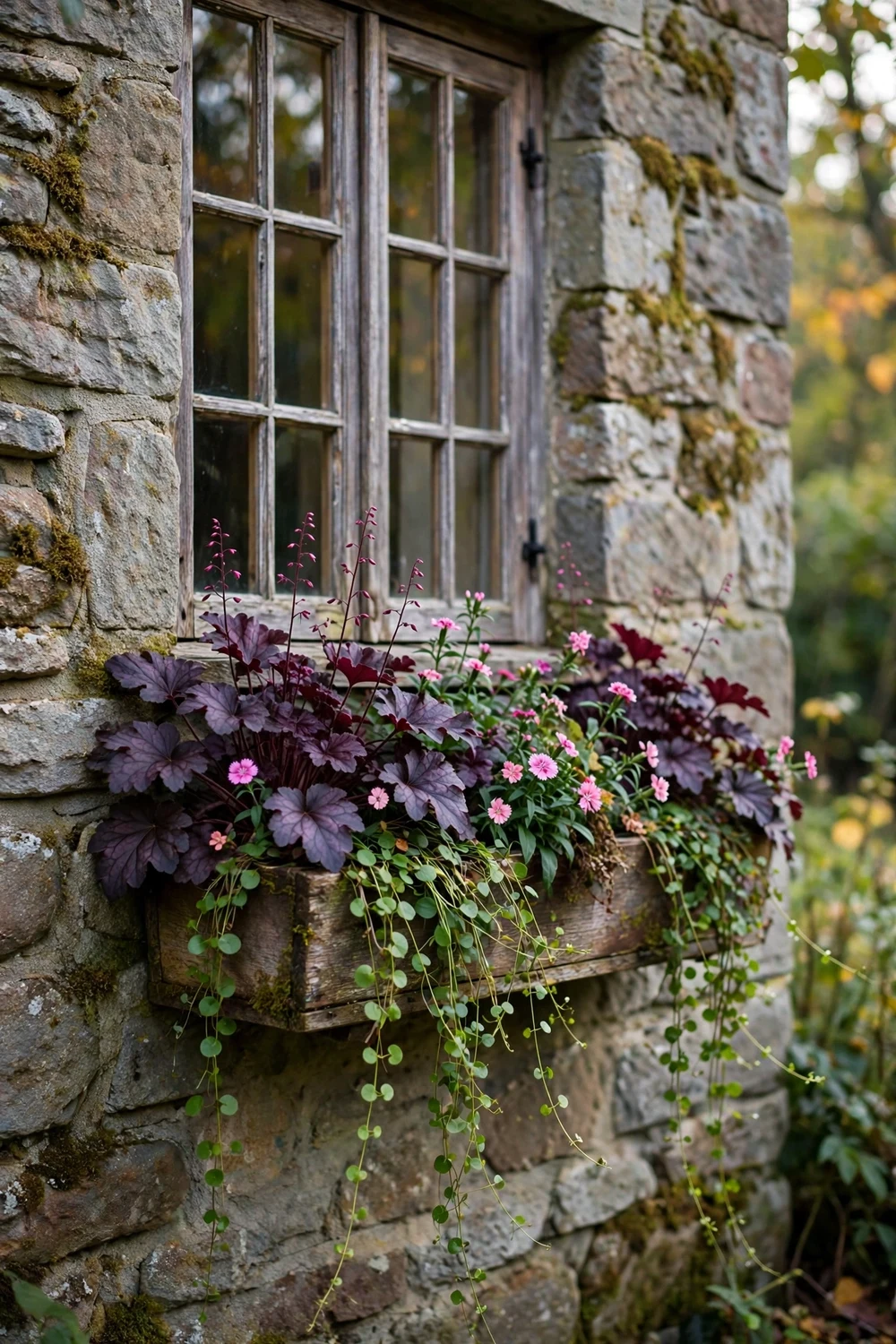
Most fall boxes get composted in December. This one does not have to be. Dark purple heuchera (coral bells) and pink dianthus are hardy perennials that look good all fall and come back the following year in zones 4 through 9. Add trailing wire vine over the front edge for softness. The box will look a little quieter than a mum explosion, but you buy the plants once instead of every September. One-gallon heuchera costs $10 to $14; dianthus 4-inch pots run $5. Pet note: dianthus is mildly toxic to cats and dogs, so keep this box out of chewing range.
Try this: in late fall, mulch the box with shredded leaves to protect the roots through winter.
Difficulty: moderate · Cost: $$
18. Dwarf sunflowers for a late-season pop

Sunflowers in a window box sound wrong until you see the dwarf varieties. Types like Teddy Bear and Sunspot stay under 2 feet tall, with golden blooms that face the street and pull every eye on the block. Plant them in a deep box (10 inches or more) with low orange marigolds at their feet. They need full sun and about 60 days from seed, so start them in July for a September show, or buy started plants in late August. One packet of seed costs $3; started 4-inch pots run $5 to $7. Sunflowers are non-toxic to pets.
Try this: deadhead spent blooms to stretch the show, but leave the last heads standing for visiting birds.
Difficulty: moderate · Cost: $$
19. Moody burgundy and cream palette
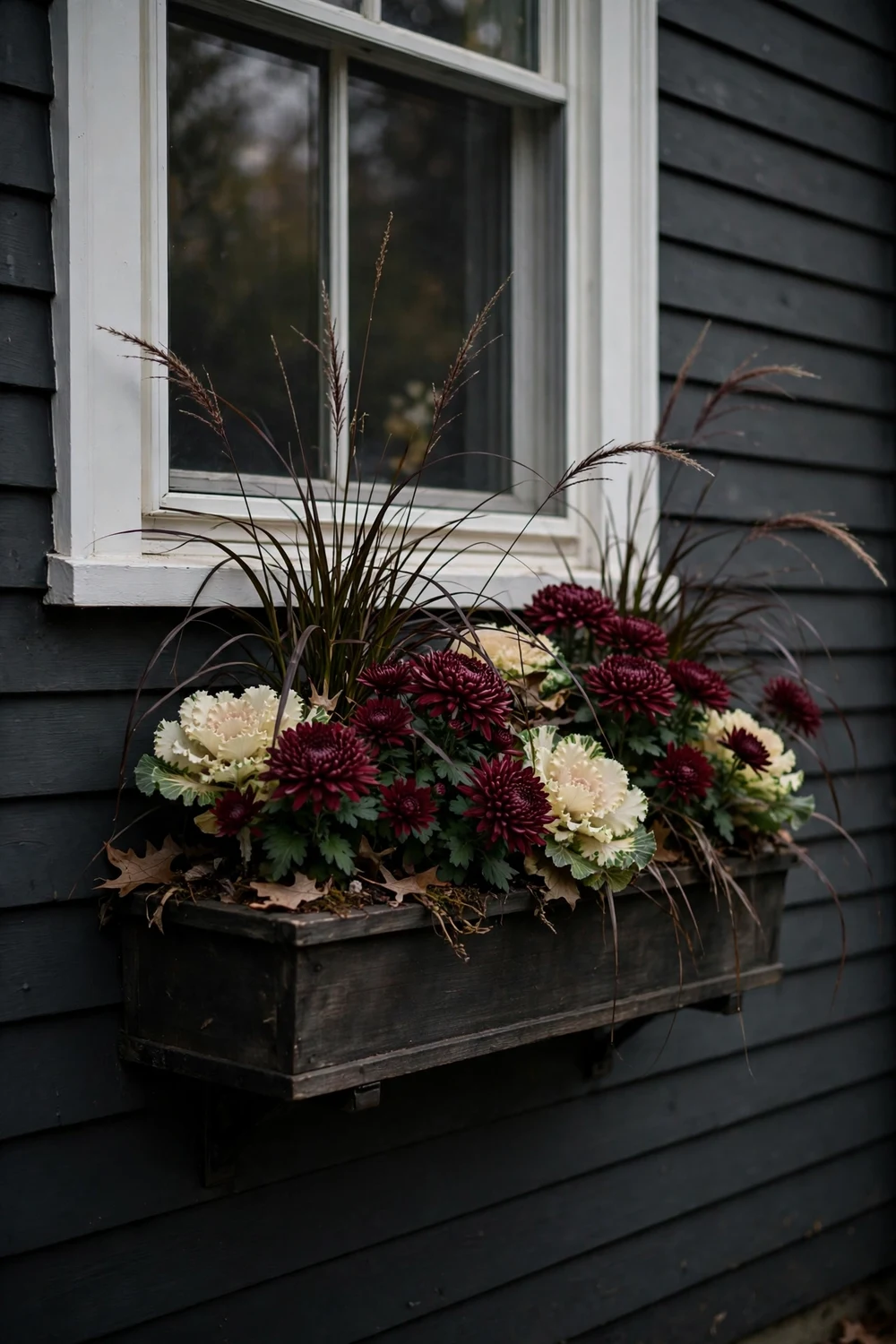
Not every fall box has to shout orange. Deep burgundy mums, cream ornamental kale, and dark bronze grasses make a moody, designer-looking box that pairs beautifully with charcoal or navy siding. The trick is keeping the values close: all dark and all light, with the cream kale as the bridge. This palette photographs well and looks intentional even to people who know nothing about plants. Burgundy mums can sell out early, so shop in the first two weeks of September. Expect to spend $30 to $45 for a full 30-inch box. Pet note: mums are toxic to cats and dogs; see the safety section below.
Try this: limit yourself to three plant types; restraint is what makes this palette work.
Difficulty: easy · Cost: $$
20. Fairy lights woven through fall greenery

The box that gets compliments after dark. Build any simple base, dark green ivy with orange mums and small pumpkins works well, then weave a string of warm-white battery fairy lights through the foliage. A 20-foot copper-wire strand costs about $8 and the tiny battery pack hides behind the box. Use a strand with a built-in timer so it clicks on at dusk and off after 6 hours. Keep the lights off the pumpkins so condensation does not short the battery pack. This is the one box on the list your neighbors will ask about. Pet note: ivy and mums are both toxic to pets, so keep this box out of their reach.
this box where pets cannot reach it.
Try this: warm white beats cool white here; cool white makes fall colors look washed out.
Difficulty: easy · Cost: $$
How to choose plants for fall window boxes
Start with your window, not the nursery. Note how many hours of direct sun the box gets, then buy plants that match: mums, marigolds, and sunflowers want 6 or more hours, while kale, pansies, heuchera, and ivy handle part shade. Measure the box depth too; bulbs and fountain grass need 8 to 10 inches of soil, while pansies and violas do fine in 6.
Use the thriller-filler-spiller formula in thirds. One tall plant at the back or center (grass, snapdragons, wheat), mounded color in the middle (mums, kale, pansies), and one trailer over the front edge (ivy, creeping jenny, wire vine). Pick a box color that contrasts your siding: black boxes pop on white clapboard, white boxes pop on brick, and natural wood works on almost everything.
Window boxes look best when the rest of the entry pulls its weight. If your porch needs help too, these small front porch decor ideas pair well with any box on this list. And if the walkway leading up to the house needs work, concrete paver front yard ideas show how to handle the ground plane while the boxes handle the windows.
Mistakes to avoid with fall window boxes
Buying mums in full bloom. A mum that looks perfect at the store is usually done in two weeks. Buy tight buds and let them open at home; the show lasts 4 to 8 weeks instead.
Skipping drainage. Fall rain is heavier than summer rain. Every box needs drainage holes, and a 1-inch layer of gravel or a coco liner keeps roots from sitting in water.
Planting warm-season annuals. Petunias, sweet potato vine, and begonias stall or die at the first cold snap. Pull them in September instead of hoping they recover.
Forgetting to water. Cool air does not mean wet soil. Mums in particular dry out fast in their nursery pots; check the soil every other day through September.
Overcrowding the box. Plants need airflow to survive autumn temperature swings. One thriller, a few fillers, and one spiller per box is plenty.
Fall window box plant safety notes
Several fall favorites are toxic to pets. Chrysanthemums (mums), ivy, hydrangea, coleus, croton, and dianthus are all listed as toxic to cats and/or dogs by the ASPCA, so mount window boxes out of reach if pets climb, jump, or chew near your windows. The ASPCA toxic and non-toxic plant database lets you check any plant by name before you buy.
Two more practical notes. First, a planted 30-inch window box can weigh 30 to 50 pounds when the soil is wet, so check that the brackets and mounting screws are solid before the season starts, and have someone check them if you are not sure. Second, if you add fairy lights, use battery-operated strands rated for outdoor use and keep the battery pack tucked behind the box where rain cannot pool around it.
Frequently asked questions
When should I plant fall window boxes?
Early September through early October is the sweet spot in most of the US. Planting while the soil is still warm helps roots establish before cold nights arrive. In warm climates (zones 8 and up), you can plant well into October; in cold zones, aim for at least a few weeks before your average first hard freeze.
How long do fall window boxes last?
A box planted in early September usually looks full until the first hard freeze, which in most climates means October or November. Frost-hardy plants like ornamental kale, pansies, and heuchera keep going even longer, sometimes into December in mild areas. Dried arrangements (idea 10) last the entire season since nothing in them is alive.
Do mums come back every year?
Sometimes. Hardy garden mums planted early enough to establish roots can return in zones 5 through 9, especially with mulch. But the florist mums sold in full bloom each fall are bred for flowers, not winter survival, and often do not make it. For reliable perennials in a window box, heuchera and dianthus (idea 17) are a safer bet. The Royal Horticultural Society chrysanthemum growing guide covers the difference between garden and florist types.
Can you put real pumpkins in a window box?
Yes. Mini and pie-size pumpkins work best because they do not overload the box. Nestle them in last, between the plants, and check them weekly once temperatures drop below freezing. Swap out any pumpkin that develops soft spots; one rotting pumpkin can take its neighbors down with it.
How often should I water fall window boxes?
Check the soil every other day through September, then ease off as temperatures drop. Poke a finger an inch into the soil: water if it feels dry. Mums are the thirstiest fall plant and can crisp up fast in warm spells, while succulents and established kale need far less.
What fall window box plants survive frost?
Ornamental kale and cabbage handle hard frost and often look better after it. Pansies, violas, and snapdragons tolerate light frost. Heuchera and dianthus are hardy perennials that survive winter outright. Mums, marigolds, and coleus give up at the first hard freeze, so enjoy them early in the season.
Once the outside of the house is dressed for fall, carry the palette indoors too. These fall mantel decorating ideas use the same warm colors and natural textures as the window boxes above.
One September afternoon, a bag of potting soil, and twenty dollars at the nursery turned my tired summer boxes into the best-looking part of my house. Pick the one box on this list that matches your window’s sun, plant it this weekend, and the whole front of your home will feel ready for the season.


