


A fireplace wall can carry a whole living room, or it can sit there looking unfinished while everything else in the room works hard. Most of the time the problem is not the firebox. It is the wall around it: flat paint, a dated surround, or a mantel that stops halfway up a tall wall.
This guide covers 26 fireplace wall ideas for every budget and skill level, from a weekend paint job to a full stone wall. Each idea names the material, the cost range, and the difficulty, so you can pick one that fits your wall, your fireplace type, and your timeline.
Quick takeaways
- The wall material sets the whole look, so choose it before you pick mantel decor.
- Run the treatment floor to ceiling on tall walls, or the wall reads as half finished.
- Keep flammable decor outside the manufacturer’s clearance zone around the firebox.
- A TV above the fireplace needs a heat check first, and a side wall is often the better seat.
- Renters can get the same look with peel-and-stick panels, paint, or a leaning mirror.
1. Floor-to-ceiling limestone slab wall
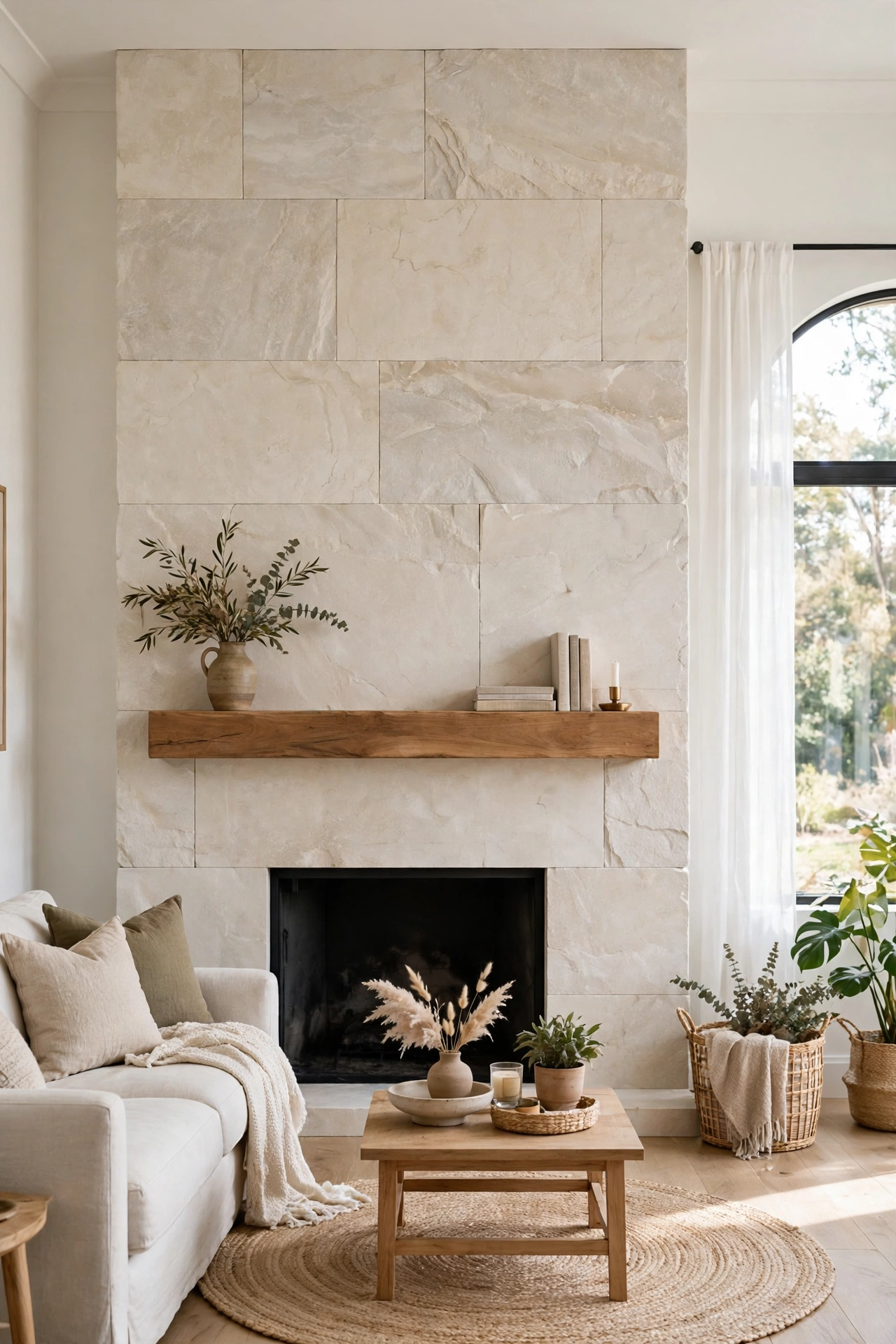
Large limestone slabs run from the floor to the ceiling with only a few seams, which gives the wall a calm, solid face. A honed finish keeps the stone soft to the eye, and the warm gray beige tone works with oak, walnut, and painted cabinetry. The firebox sits in a simple rectangular cutout, so the stone does the talking and the room stays quiet around it. The pale stone also hides dust better than dark marble, and a quick wipe with a stone cleaner keeps the face even over years of fires.
Try this: ask the stone yard for slabs cut from one block so the tone stays even across the wall.
Cost: $$$ | Difficulty: Pro install.
2. Herringbone brick surround
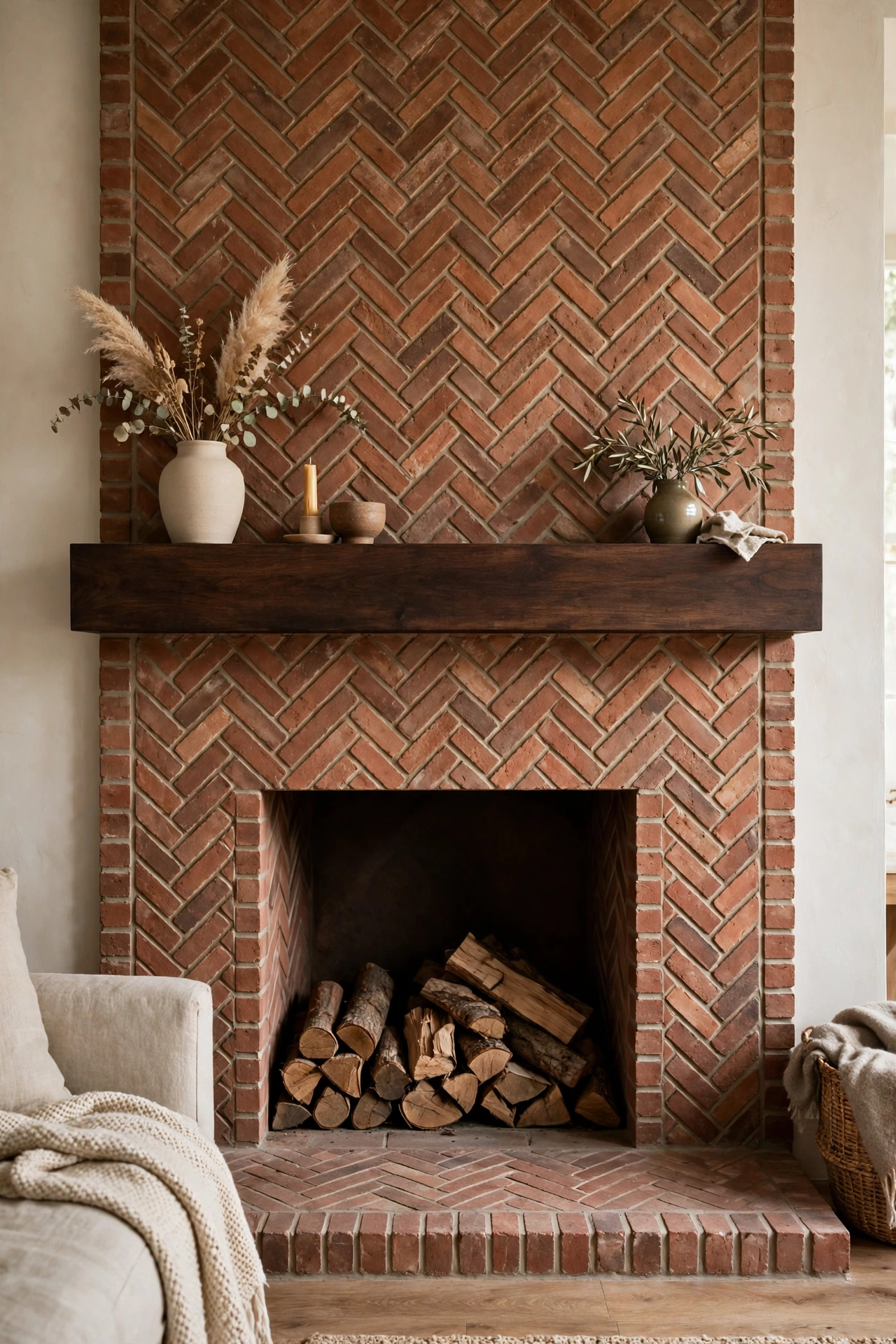
A herringbone brick layout turns an ordinary brick surround into a pattern wall. The angled bricks catch light differently across the day, which adds movement without adding color. It suits transitional rooms and modern farmhouse rooms alike, and it pairs well with a simple wood mantel that lets the pattern hold the focus. Brick also holds up well to heat, and the mortar joints give the surround a crafted edge that flat tile panels lack.
Try this: lay the herringbone only on the surround and keep the rest of the wall flat, so the pattern reads as a frame.
Cost: $$ | Difficulty: Moderate.
3. Whitewashed brick wall
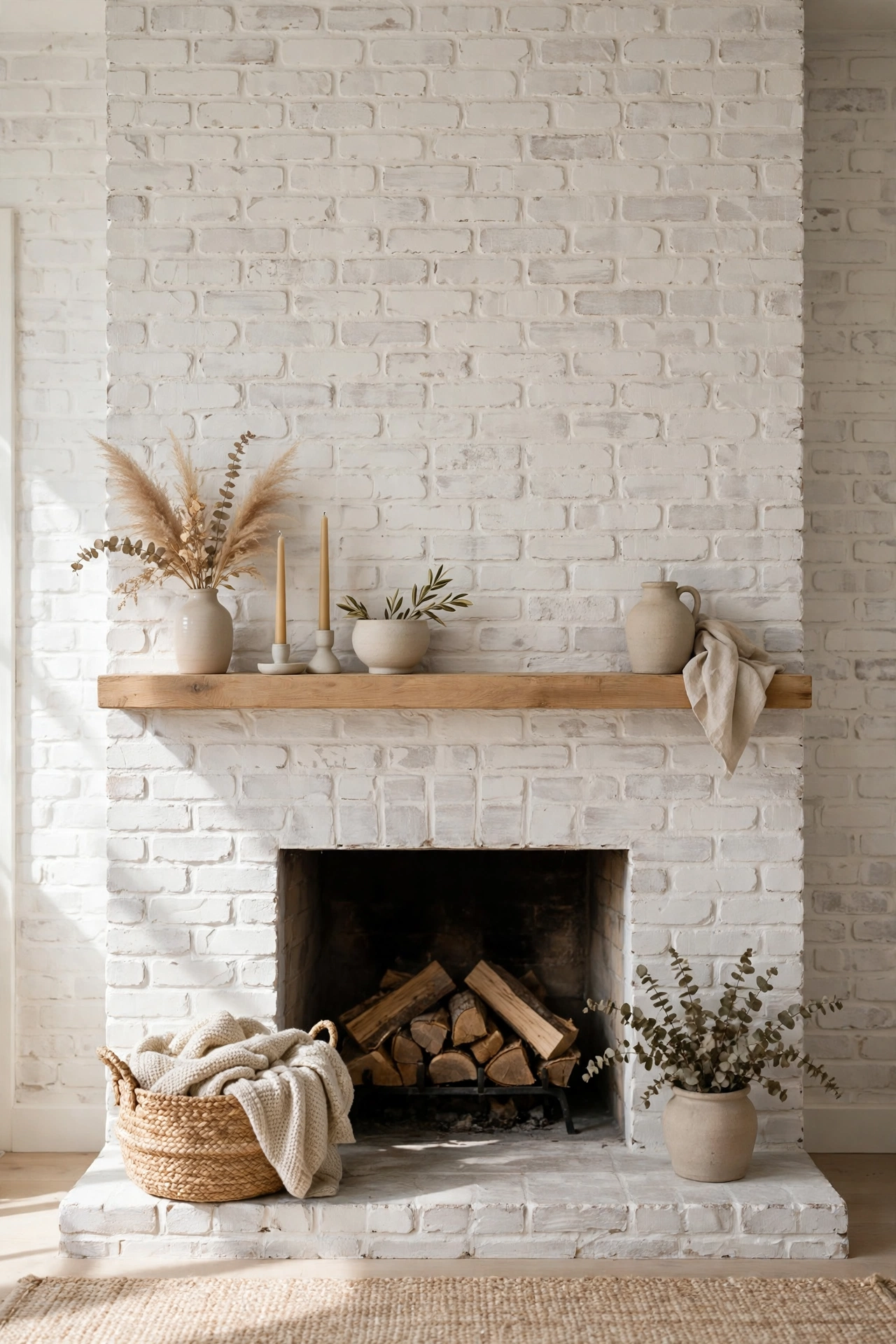
Whitewash softens red brick without hiding its texture. A thin wash lets the brick shape show through while the color shifts to a pale, chalky tone that lifts a dark room. It is one of the fastest ways to update a dated brick fireplace, and it costs far less than refacing the whole wall. Whitewash also lets you change the tone later, since a second coat lightens the wall further without stripping the first.
Try this: test the wash on two bricks first, since brick absorbs it unevenly and the tone deepens as it dries.
Cost: $ | Difficulty: Easy.
4. River rock surround
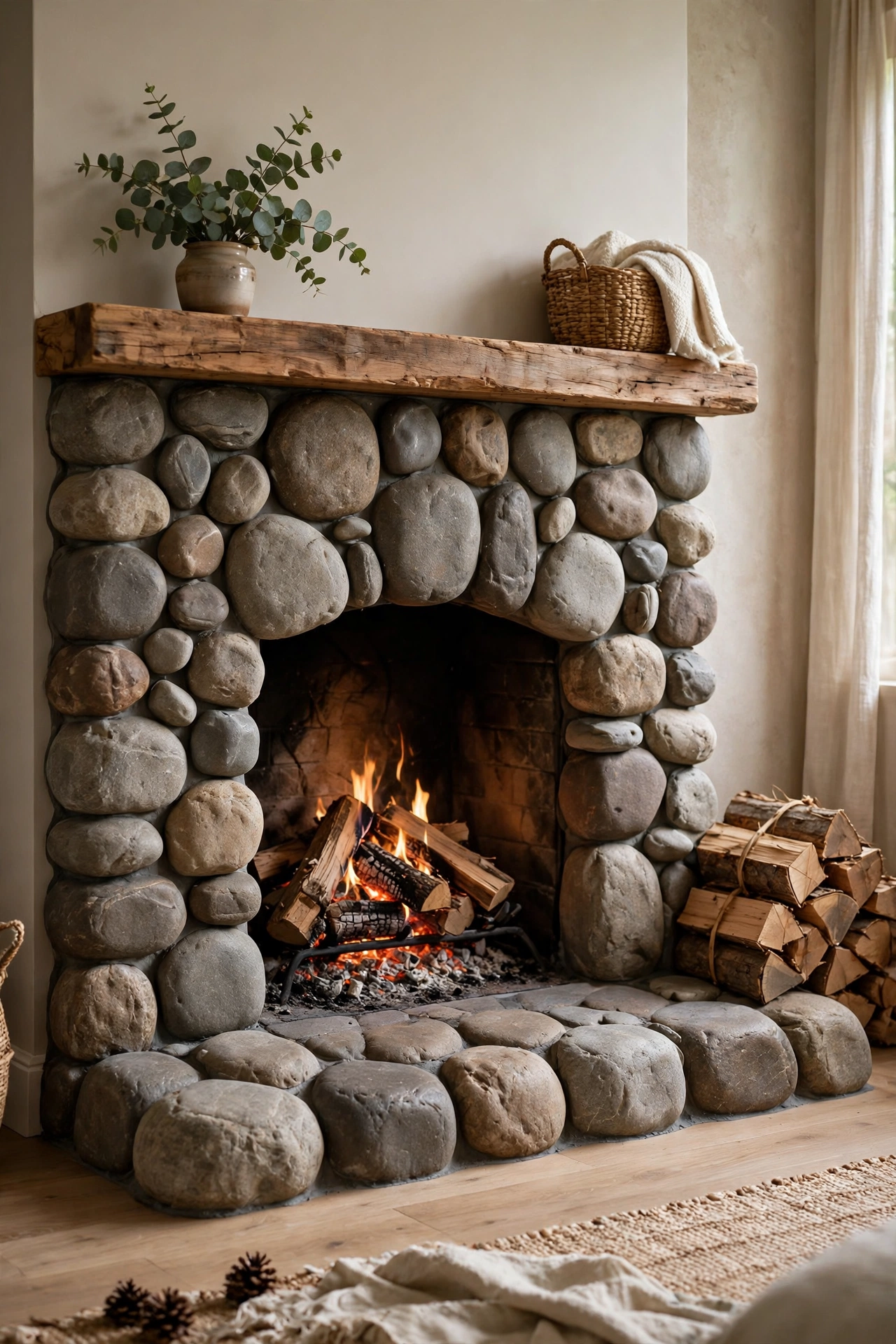
Rounded river rocks give a fireplace wall a rugged, cabin feel that flat stone cannot match. The varied shapes and gray brown tones make the wall read as a natural feature, and the rough surface hides soot marks near the firebox better than smooth tile. A wood mantel on top keeps the look grounded instead of rough. The uneven surface also breaks up sound in a hard-floored room, which helps a stone wall feel less echoey at night.
Try this: use mesh-backed river rock sheets for a faster install, and seal the stone so soot wipes off with a damp cloth.
Cost: $$ | Difficulty: Moderate.
5. Terracotta tile wall
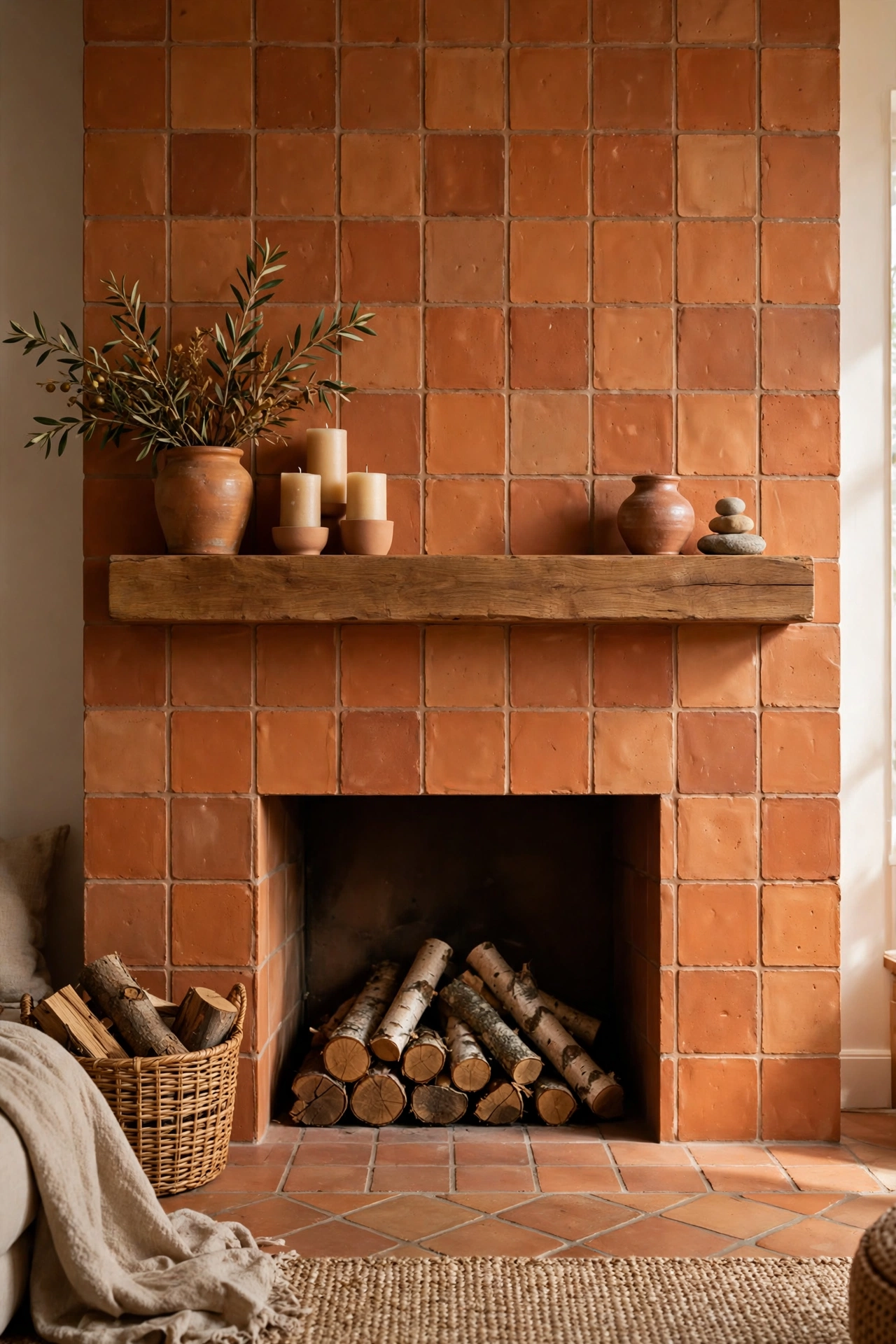
Terracotta tiles bring warm, earthy color to a fireplace wall in a way paint cannot. The fired clay tone ranges from soft peach to deep rust, and the slight variation between tiles keeps the wall from looking flat. It suits Mediterranean rooms, Southwestern rooms, and any living room that needs warmth without a full remodel. Terracotta also pairs well with wood mantels and woven baskets, which keeps the wall warm without adding more color.
Try this: pick a matte terracotta and seal it before the first fire, since unsealed clay stains fast near a firebox.
Cost: $$ | Difficulty: Moderate.
6. Glossy subway tile surround

Glossy subway tile is a clean, low-cost surround that brightens the wall around the firebox. The reflective glaze bounces firelight across the room, and the small tile size lets you wrap corners and curves without special cuts. White is the safe pick, but a soft green or navy glaze gives the same clean lines with more character. The small format also makes repairs cheap, since a cracked tile swaps out without disturbing the rest of the surround.
Try this: stack the tiles vertically instead of in running bond for a taller, more current look.
Cost: $ | Difficulty: Easy.
7. Sage zellige tile wall

Zellige tiles are handmade, so each one has a slightly uneven glaze that catches light in a different way. A sage green zellige wall feels soft and crafted, and the small square format lets the wall read as texture rather than pattern. It works in boho rooms, Mediterranean rooms, and quiet modern rooms that need one warm surface. The glaze variation also means no two walls look alike, which suits rooms where a handmade feel matters more than a uniform finish.
Try this: keep the grout close to the tile color so the glaze variation shows and the grout lines stay quiet.
Cost: $$ | Difficulty: Moderate.
8. Book-matched marble slab wall

Book-matched marble uses two slabs cut from one block and mirrored at the center seam, so the veining forms a near-symmetrical pattern across the firebox. The result reads as a single piece of art rather than a tiled wall. A simple black firebox and a slim mantel keep the focus on the stone, and the wall needs almost no decor. Marble also ages well, since the veining hides minor marks that would show plainly on a flat painted wall.
Try this: view the full slabs at the yard before cutting, since veining varies a lot between blocks.
Cost: $$$ | Difficulty: Pro install.
9. Blackened steel surround with charcoal limewash
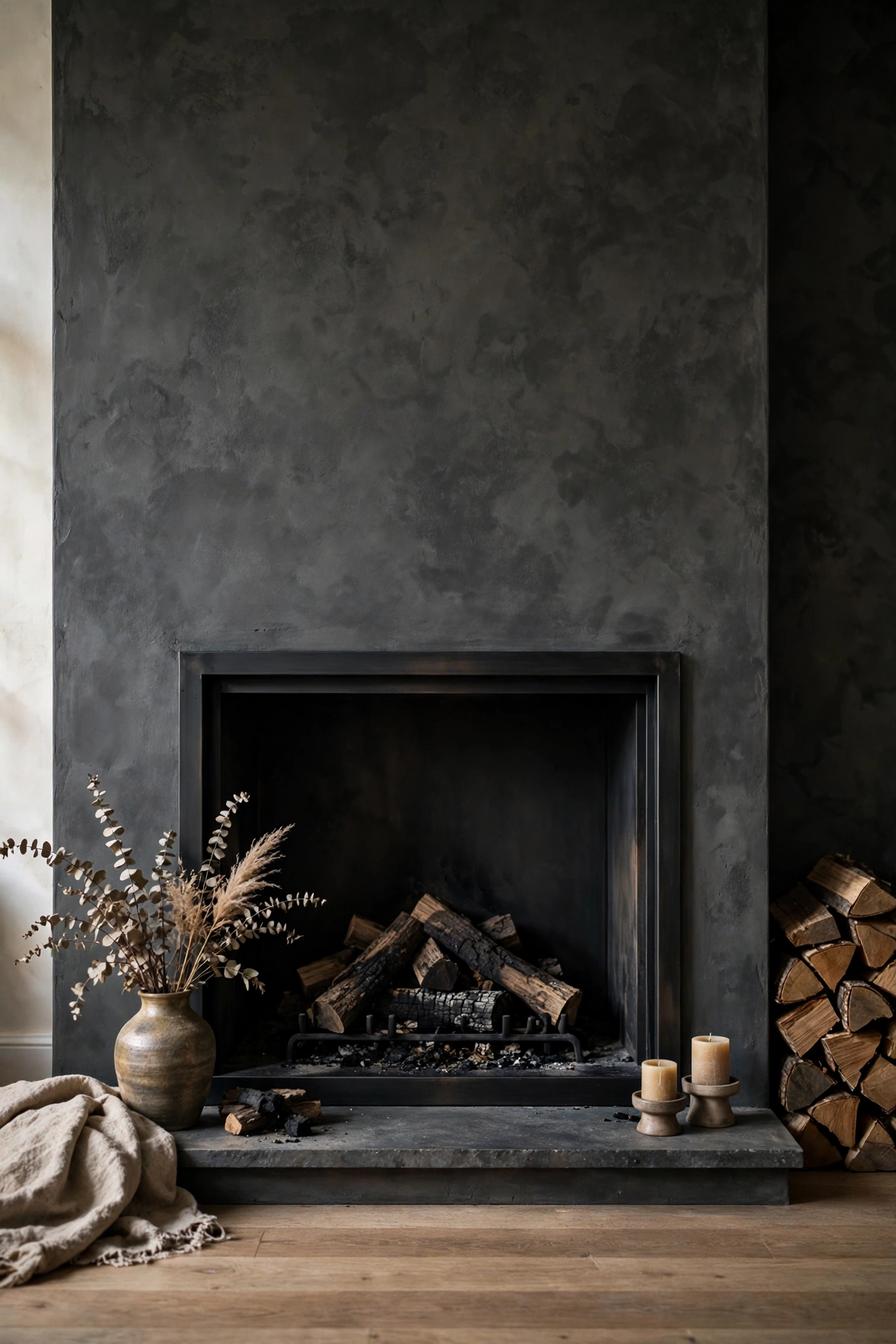
A blackened steel surround gives a fireplace wall a crisp, industrial edge without the weight of stone. The dark metal frame reads as a clean line around the firebox, and a charcoal limewash wall behind it softens the contrast with a chalky, matte texture. Together they suit lofts, modern rooms, and moody dens. Steel also wipes clean with a damp cloth, which matters near a firebox where soot settles on every nearby surface.
Try this: use heat-rated blackened steel for the surround itself, and keep the limewash off the metal so it does not flake.
Cost: $$ | Difficulty: Moderate.
10. Polished concrete wall

A polished concrete wall gives a fireplace a smooth, gray face with a faint sheen that reflects firelight. The surface has no grout lines and no pattern, so the room feels calm and the firebox becomes the only dark shape on the wall. It suits minimal rooms, lofts, and modern homes where one quiet material carries the whole wall. Concrete also works with radiant floor heat, since the wall and floor share one quiet material palette, and the gray tone pairs with both warm wood and black metal accents.
Try this: seal the concrete with a heat-rated sealer and wipe soot off early, since soot sets into unsealed concrete.
Cost: $$$ | Difficulty: Pro install.
11. Curved plaster opening
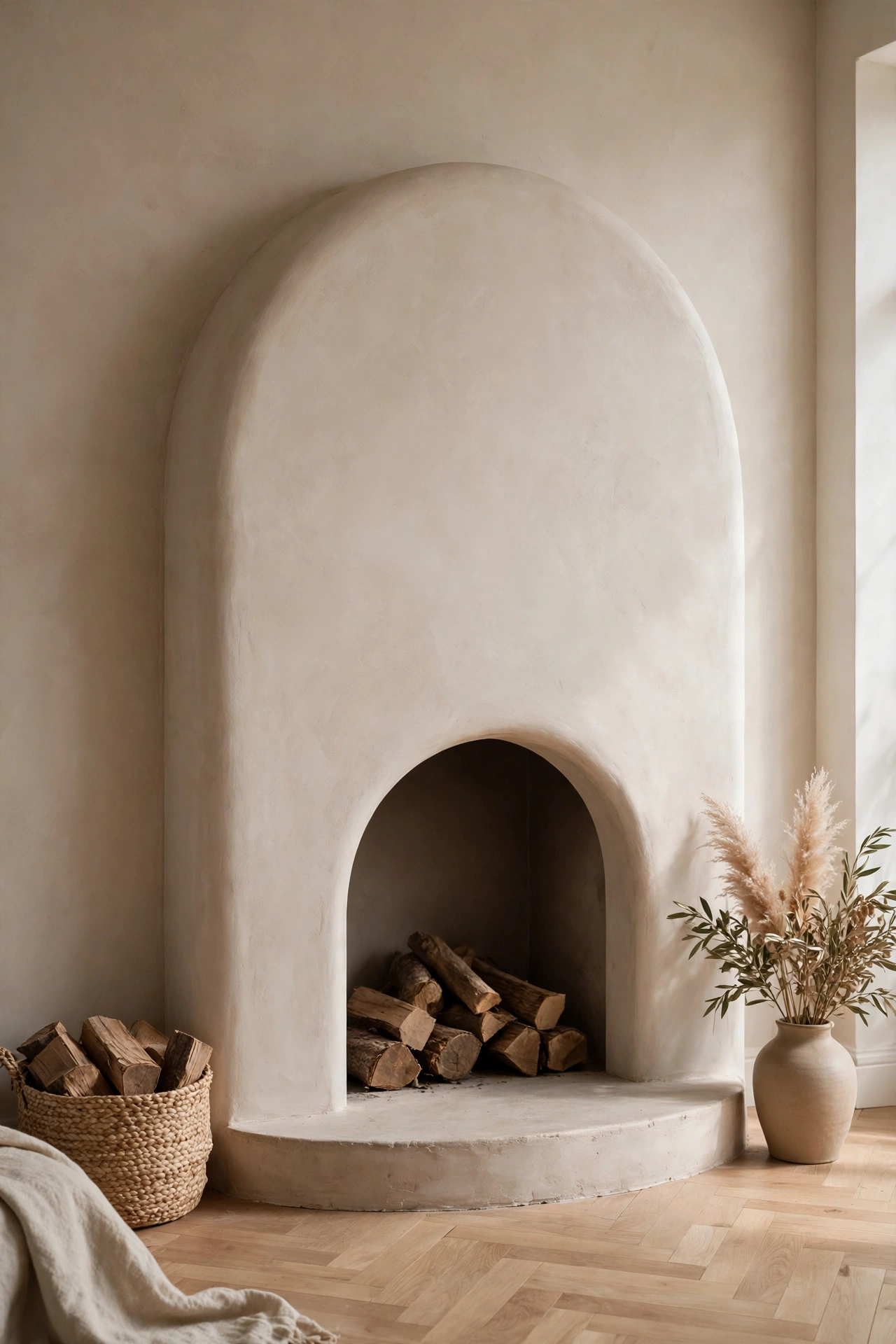
A rounded plaster opening softens a fireplace wall through shape instead of decoration. The arch curve draws the eye to the fire and gives the wall an architectural presence that flat drywall cannot match. A matte lime plaster finish keeps the surface calm, and the wall needs little decor because the curve does the work. Plaster also hides the seam where the firebox meets the wall, which gives the opening a built-in look rather than an added one.
Try this: repeat the curve once in the room, with a rounded coffee table or an arched mirror, so the opening does not sit alone.
Cost: $$ | Difficulty: Pro install.
12. Venetian plaster gradient wall

Venetian plaster laid in a soft gradient moves from a pale tone at the ceiling to a deeper tone near the hearth. The smooth, polished surface shifts with the light, which gives the wall depth without a pattern or a seam. It suits minimal rooms and classic rooms alike, since the color change is gentle rather than bold. The polished surface also reflects a soft glow from the fire, which makes the wall shift tone as the flames move.
Try this: pick two tones from one paint strip so the gradient stays in one family and never turns muddy.
Cost: $$$ | Difficulty: Pro install.
13. Walnut slat panels flanking the firebox

Vertical walnut slats on both sides of the firebox add warmth and height to a fireplace wall. The narrow gaps between slats cast thin shadow lines that change through the day, and the dark wood tone frames the fire without competing with it. A floating hearth in the same wood ties the two panels together at the base. Walnut also deepens in tone with age, so the panels look richer after a few years than they do on install day.
Try this: leave a clear gap between the slats and the firebox edge that matches the manufacturer’s clearance, and use a noncombustible board behind the slats near the opening.
Cost: $$ | Difficulty: Moderate.
14. Reclaimed beam mantel on plain plaster

A thick reclaimed beam mantel can carry a fireplace wall on its own, with no stone or tile needed. The aged wood brings grain, knots, and a warm tone that flat plaster lacks, and the beam’s weight anchors the wall visually. Keep the plaster plain and the decor sparse, so the beam stays the single strong element. A reclaimed beam also carries small marks from its first life, such as nail holes and saw cuts, which add character no new timber matches.
Try this: mount the beam into studs with a steel rod or heavy lag bolts rated above the beam’s weight, and check the clearance to the firebox first.
Cost: $$ | Difficulty: Moderate.
15. Raised stone hearth bench

A raised hearth that extends past the firebox on both sides works as a bench, a display ledge, and a guard against the fire. Stone or concrete for the bench top stands up to heat and soot, and a couple of flat cushions turn it into extra seating for a small room. The bench also gives the wall a strong horizontal line that grounds tall treatments. The bench also gives kids a perch near the fire without pulling extra chairs into a small room.
Try this: keep the bench depth near 18 inches so it seats an adult without crowding the walkway in front of the fire.
Cost: $$ | Difficulty: Moderate.
16. Round mirror with sconces above the mantel
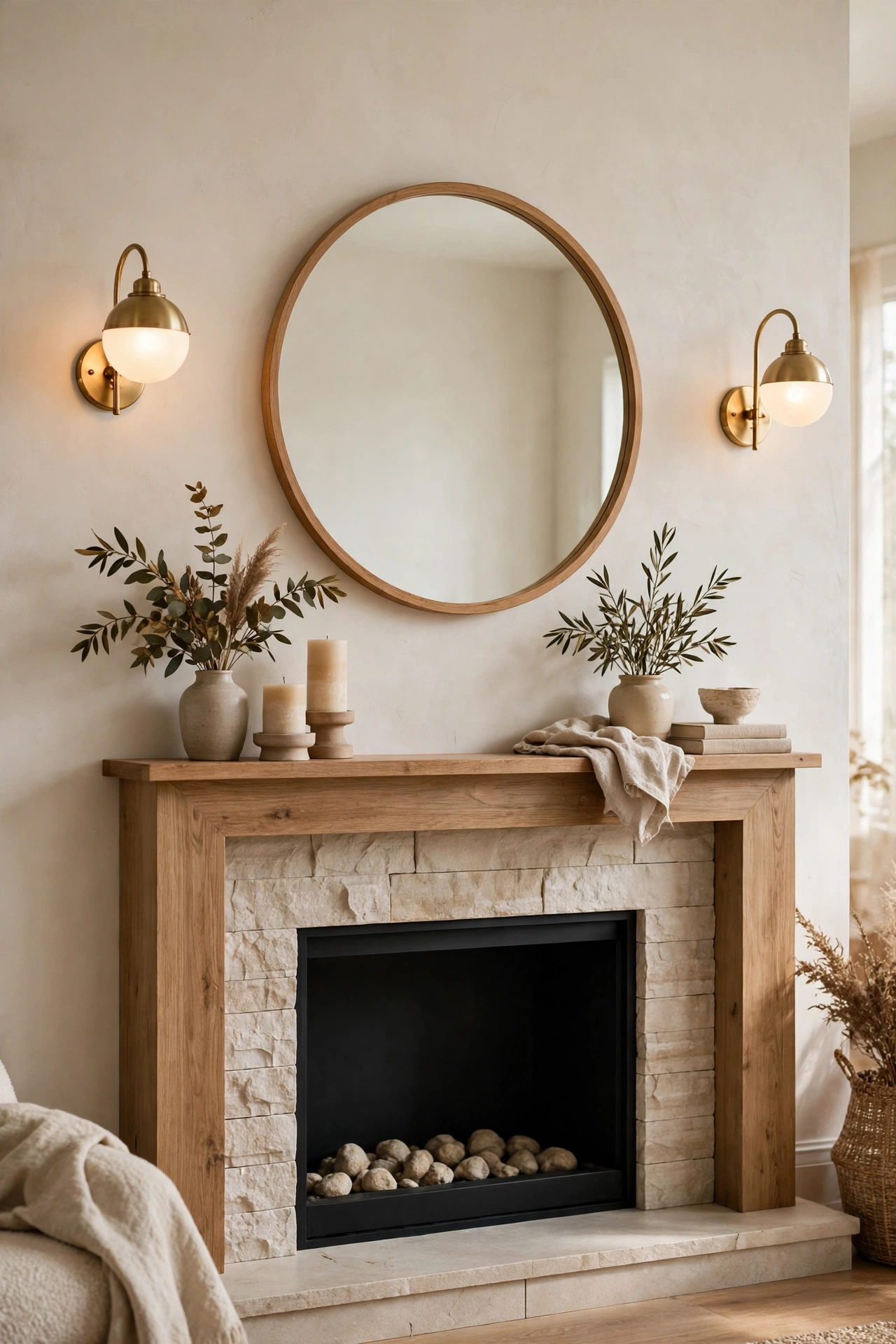
A large round mirror above the mantel adds height and light to a fireplace wall without adding pattern. Two sconces on either side give the wall symmetry and bring soft evening light to the seating area. The mirror also reflects the room back, which makes a small living room feel wider than it is. A mirror also doubles the firelight in the evening, which makes the room feel warmer without adding another lamp.
Try this: pick a mirror about two-thirds the mantel width and hang it 6 to 8 inches above the mantel, with sconces 4 to 6 inches from the mirror edges.
Cost: $$ | Difficulty: Easy.
17. Layered art above the mantel

Leaning two or three framed pieces on the mantel, with the largest at the back, gives a fireplace wall a collected look that one centered print cannot match. The overlap adds depth, and the mix of sizes keeps the eye moving across the wall. A small vase or a single candle in front finishes the group without crowding it. Leaning art also lets you swap pieces without new nail holes, which suits renters and anyone who redecorates often.
Try this: use frames in one finish family, such as all black or all natural wood, so the group reads as one arrangement.
Cost: $ | Difficulty: Easy.
18. TV on the adjacent wall

Putting the TV on the wall beside the fireplace, instead of above it, solves two problems at once. Viewing stays at a comfortable height with no neck strain, and the fireplace wall stays free for art, a mirror, or the wall treatment itself. The room still gathers around both focal points, since the seating angles toward the corner between them. A side wall TV also keeps the remote, console, and cables in one zone, away from the heat above the firebox.
Try this: angle the sofa slightly toward the fireplace corner and run the TV cables through a cord channel painted to match the wall.
Cost: $ | Difficulty: Easy.
19. Low closed cabinets flanking the firebox

Low closed cabinets on both sides of the firebox give a fireplace wall symmetry and hidden storage in one move. The cabinets hide media gear, games, and blankets, so the wall stays calm, and their flat fronts keep the focus on the fire. A stone or tile surround between them ties the whole wall together as one built piece. Closed fronts also hide the clutter that open shelves collect, which keeps the fireplace wall calm between gatherings.
Try this: match the cabinet fronts to the wall color and use push latches, so the wall reads as architecture rather than furniture.
Cost: $$ | Difficulty: Moderate.
20. Firewood niche in the wall
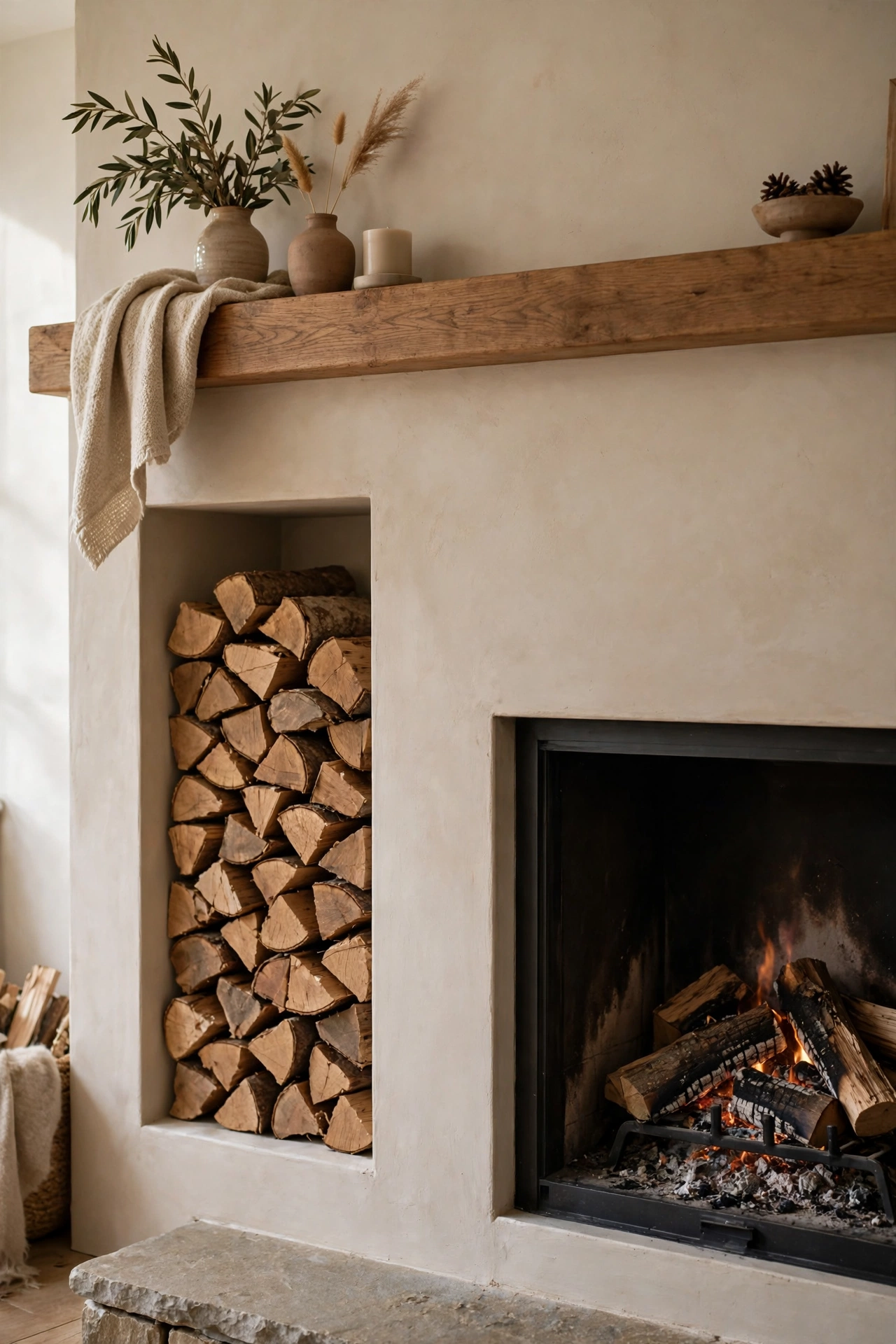
A recessed niche for firewood turns fuel storage into part of the fireplace wall design. The stacked logs add texture and a warm, natural color that no decor piece matches, and the niche keeps wood off the floor and close to the fire. A niche on one side of the firebox also balances a tall wall treatment without adding furniture. A niche also dries the wood slightly from the fire’s warmth, which helps logs catch faster on cold nights.
Try this: line the niche with a noncombustible back panel and keep the wood clear of the firebox opening per the manufacturer’s clearance.
Cost: $$ | Difficulty: Moderate.
21. Corner fireplace wall
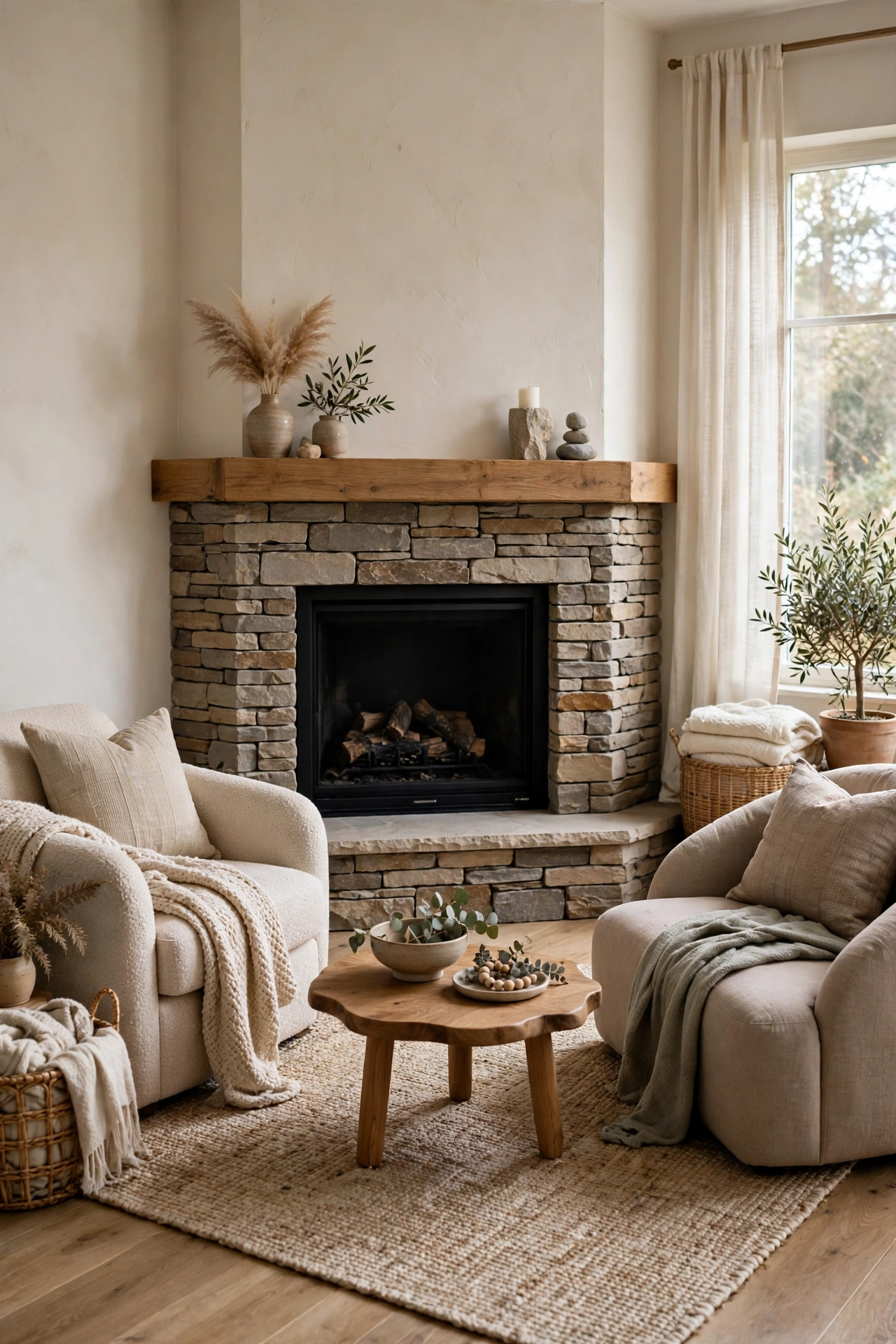
A corner fireplace wall turns an awkward corner into the room’s gathering point. The angled firebox faces the seating instead of a flat wall, which opens up floor space and lets two seating groups share the fire. A simple stone or tile surround keeps the corner clean, and a low bench on one side gives the angle a place to land. A corner firebox also leaves both flat walls free for seating, art, or storage, which opens up small living rooms.
Try this: angle the rug and the sofa toward the corner firebox, not toward the flat walls, so the seating follows the fire.
Cost: $$ | Difficulty: Moderate.
22. Double-sided fireplace wall

A double-sided firebox set into a dividing wall shares one fire between two rooms. The living room gets the flame and the dining room gets the same warmth, without a second fireplace or a second chimney. A stone or plaster face on both sides keeps the wall looking finished from either room, and the shared fire makes both spaces feel connected. A shared fire also cuts the cost of a second chimney, since one flue serves both rooms through a single vent run.
Try this: check the venting and clearance rules for a two-sided unit before framing, since they differ from a standard single-sided firebox.
Cost: $$$ | Difficulty: Pro install.
23. Peel-and-stick stone panels for renters
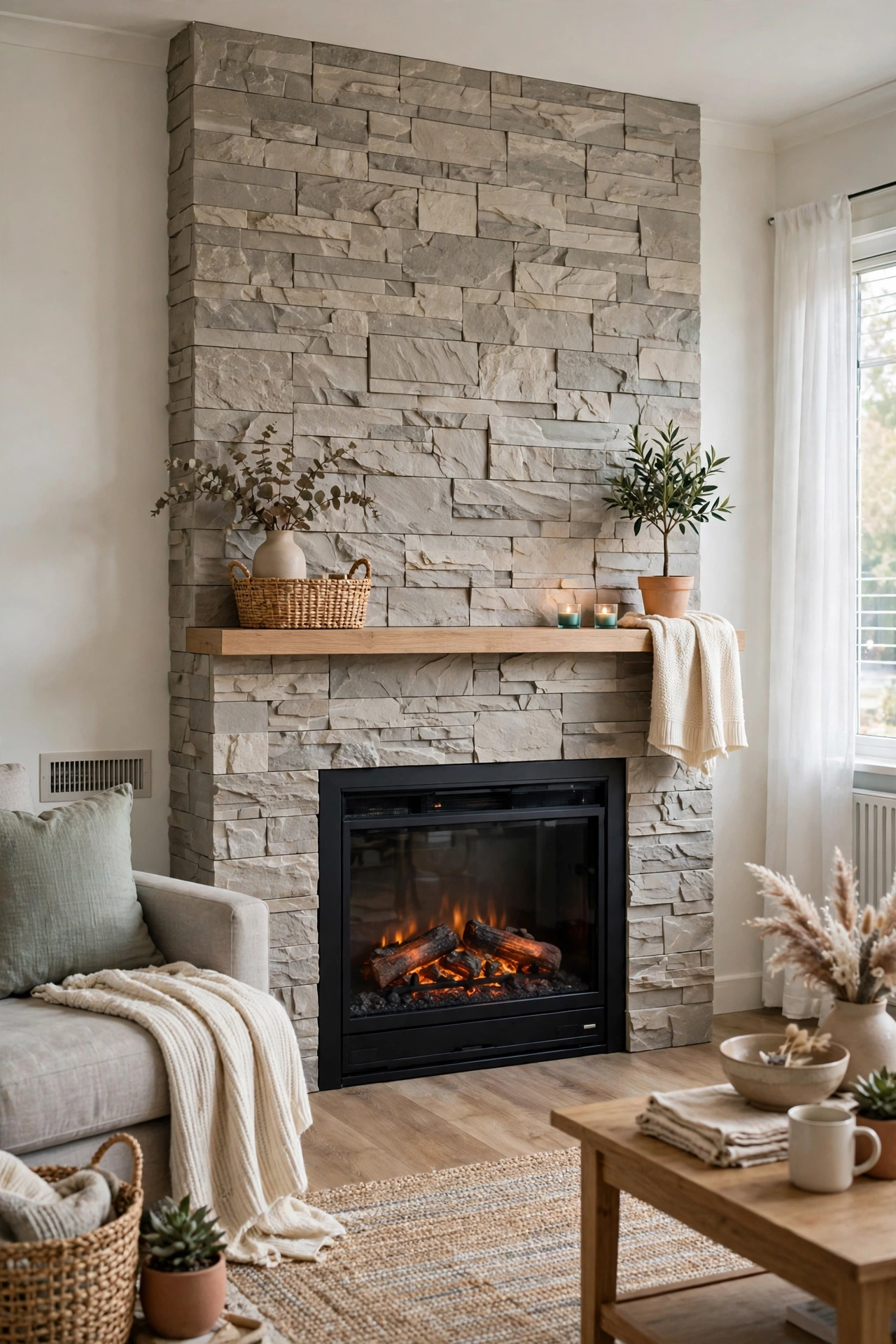
Peel-and-stick stone panels give renters a stone fireplace wall without mortar, grout, or a landlord dispute. The lightweight panels press onto a flat wall around the firebox and peel off at move-out, and the printed stone texture reads well from sofa distance. They work best on smooth drywall and on electric or sealed gas fireboxes. Peel-and-stick panels also let you test a stone look for a season before committing to real veneer or tile.
Try this: check the panel’s heat rating against your fireplace type first, and never use peel-and-stick panels on a wood-burning firebox surround.
Cost: $ | Difficulty: Easy.
24. Moody navy paint wall with a white mantel
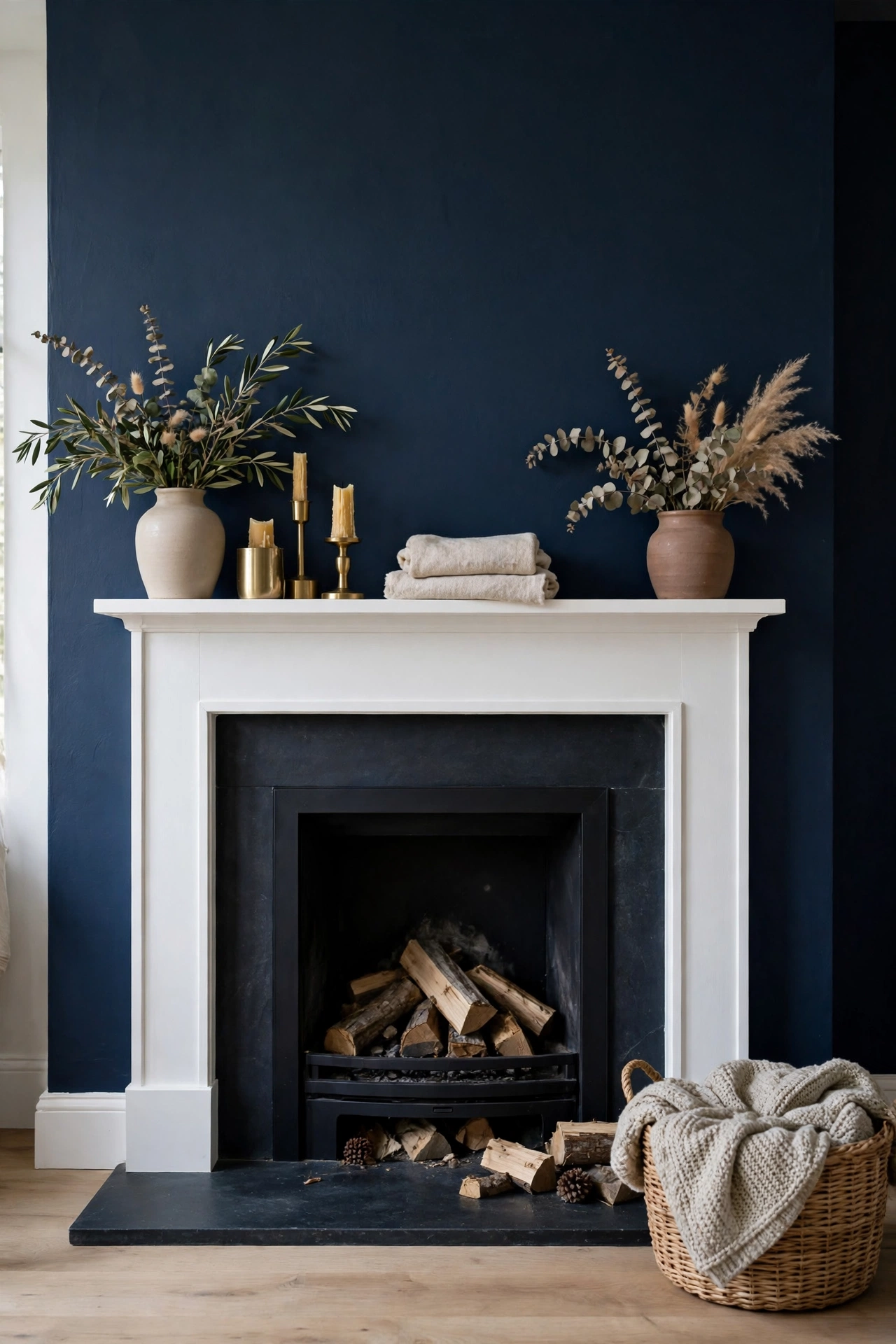
A deep navy wall with a crisp white mantel turns a plain fireplace into a focal point for the cost of two gallons of paint. The dark wall makes the fire glow brighter by contrast, and the white mantel gives the eye a clean frame to rest on. It suits small rooms too, since one dark wall reads as depth rather than gloom when the trim stays white. Navy also pairs with brass sconces and natural wood, which keeps a dark wall from reading cold in winter.
Try this: paint the wall in a matte or eggshell finish, since gloss shows every drywall flaw under firelight.
Cost: $ | Difficulty: Easy.
25. Seasonal mantel styling system

A seasonal mantel system keeps the fireplace wall fresh all year without a new wall treatment. The setup stays the same: one tall anchor piece, such as a mirror or large frame, plus two smaller pieces that swap with the season. Greenery and candles suit winter, fresh branches suit spring, and dried grasses suit fall, while the wall itself never changes. A fixed anchor piece also means the wall never looks bare between seasons, even when the swap pieces are in storage.
Try this: store the swap pieces in one labeled bin per season so the changeover takes under 20 minutes.
Cost: $ | Difficulty: Easy.
26. Grazing light across a textured wall

Grazing light from sconces or a picture light mounted close to the wall turns a textured fireplace surface into a showpiece at night. Light that rakes across stone, tile, or plaster throws small shadows into every groove, which makes the texture read far stronger than flat ceiling light ever could. The wall needs no new material, only a light placed with intent. Grazing light also costs less than a new wall finish, since two sconces and warm bulbs transform a wall you already own.
Try this: mount the sconces 8 to 12 inches from the wall face and use warm 2700K bulbs so the light matches the fire glow.
Cost: $$ | Difficulty: Moderate.
How to choose the right fireplace wall for your home
Start with your fireplace type, since it limits the material. Wood-burning fireboxes need noncombustible surrounds and strict clearances, while electric and sealed gas units accept more finishes, including peel-and-stick panels rated for their heat output. Check the manufacturer’s clearance sheet before you buy any material, and keep that sheet with your receipts.
Next, match the wall to the room’s scale. Tall walls need a treatment that runs floor to ceiling, or the top half reads as an afterthought. Small rooms do better with one strong move, such as a dark paint wall or a single slab, rather than a mix of stone, tile, and wood competing on one wall. Pick the material first, the mantel second, and the decor last, since decor is the easiest part to change.
Fireplace wall ideas at a glance
| Idea | Cost | Difficulty | Best for |
|---|---|---|---|
| 1. Floor-to-ceiling limestone slab wall | $$$ | Pro install | Tall, calm rooms |
| 2. Herringbone brick surround | $$ | Moderate | Transitional rooms |
| 3. Whitewashed brick wall | $ | Easy | Fast, low-cost updates |
| 4. River rock surround | $$ | Moderate | Cabins, rustic rooms |
| 5. Terracotta tile wall | $$ | Moderate | Warm, earthy rooms |
| 6. Glossy subway tile surround | $ | Easy | Clean, bright rooms |
| 7. Sage zellige tile wall | $$ | Moderate | Boho, Mediterranean rooms |
| 8. Book-matched marble slab wall | $$$ | Pro install | Formal, luxe rooms |
| 9. Blackened steel surround | $$ | Moderate | Lofts, moody dens |
| 10. Polished concrete wall | $$$ | Pro install | Minimal rooms |
| 11. Curved plaster opening | $$ | Pro install | Soft, architectural rooms |
| 12. Venetian plaster gradient wall | $$$ | Pro install | Minimal, classic rooms |
| 13. Walnut slat panels | $$ | Moderate | Warm modern rooms |
| 14. Reclaimed beam mantel | $$ | Moderate | Plain walls that need one star |
| 15. Raised stone hearth bench | $$ | Moderate | Small rooms needing seats |
| 16. Round mirror with sconces | $$ | Easy | Small or dark rooms |
| 17. Layered art above the mantel | $ | Easy | Collected, gallery looks |
| 18. TV on the adjacent wall | $ | Easy | Comfortable viewing |
| 19. Low closed cabinets | $$ | Moderate | Rooms needing hidden storage |
| 20. Firewood niche | $$ | Moderate | Wood-burning homes |
| 21. Corner fireplace wall | $$ | Moderate | Awkward corners |
| 22. Double-sided fireplace wall | $$$ | Pro install | Open floor plans |
| 23. Peel-and-stick stone panels | $ | Easy | Renters |
| 24. Moody navy paint wall | $ | Easy | Weekend budgets |
| 25. Seasonal mantel styling system | $ | Easy | Fresh looks all year |
| 26. Grazing light | $$ | Moderate | Textured walls at night |
Cost key: $ means $1 to $10, $$ means $11 to $99, $$$ means $100 to $999, $$$$ means $1,000 and up. Costs vary with wall size and local labor, so treat these ranges as planning guides rather than quotes.
Common mistakes to avoid
Stopping the wall treatment halfway up a tall wall is the most common error, since the bare upper half draws the eye straight to the cutoff. Hanging a TV above the fireplace without a heat check is the second, since sustained heat shortens a TV’s life and voids some warranties. A third mistake is crowding the mantel with small pieces, which hides the wall treatment you just paid for. Keep the mantel group to three pieces at most, and let the wall breathe.
Safety notes for a fireplace wall
Keep all flammable decor, including dried botanicals, curtains, and paper, outside the clearance zone listed in your fireplace manufacturer’s manual, and use battery candles near dried material. Anchor tall shelves, mirrors, and heavy mantels into studs with hardware rated above the load, following the U.S. Consumer Product Safety Commission’s Anchor It! guidance. Hire a licensed electrician for new sconce wiring or new outlets near the firebox, and keep cords clipped away from walkways. For homes built before 1978, test for lead paint and follow lead-safe work rules before sanding or drilling. Check local fire codes before mounting a TV above a fireplace, since heat limits and clearance rules vary by unit type.
More fireplace and wall ideas
If your fireplace wall uses shiplap and a TV, the shiplap guide covers that pairing in full detail. For that pairing, see our 30 Stunning Shiplap Fireplace With Tv Ideas for a Living Room That Gathers Everyone.
If you want texture ideas that work on any wall, not just a fireplace wall, the textured accent wall guide is the broader catalog. For texture options beyond the fireplace, see our 18 Perfect Textured Accent Walls for Modern Homes That Add Depth Without Clutter.
If your fireplace wall needs classic trim work, the wood trim guide covers grid, chevron, and picture-frame layouts room by room. For trim layouts that frame a fireplace well, see our 27 Elegant Wood Trim Accent Wall Ideas for a Classic, Tailored Room.
If built-in shelving around the fireplace is part of your plan, the bookshelf guide covers that storage angle in depth. For shelving that flanks a firebox, see our 25 Beautiful Bookshelves Fireplace Built In Ideas.
If you are choosing between several wall treatments for the whole house, the decorative wall catalog compares paint, paneling, murals, and shelves side by side. For a whole-house wall comparison, see our 25 Best Decorative Wall Ideas to Liven Up Your Home.
For safety guidance on anchoring heavy wall pieces, see the U.S. Consumer Product Safety Commission’s Anchor It! guidance. For lead-safe work rules in older homes, see the EPA Renovation, Repair and Painting program.
Frequently asked questions
Can I put a TV above a fireplace?
Yes, but check heat first. Hold a thermometer at the planned TV height while the fire runs for an hour, and compare the reading to the TV maker’s maximum operating temperature. If the spot runs hot, a pull-down mount, a mantel shelf that deflects heat, or a side wall placement all solve the problem.
What is the cheapest fireplace wall update?
Paint is the cheapest, at under $300 for two gallons and supplies, followed by peel-and-stick panels for renters. Whitewashing an existing brick fireplace also costs little and changes the whole wall in a weekend.
What material is safest around a wood-burning firebox?
Noncombustible materials such as stone, brick, tile, concrete, and steel are the safe picks for the surround itself. Keep wood, wallpaper, and peel-and-stick panels outside the manufacturer’s clearance zone, and use only heat-rated products near the opening.
How high should a mantel sit above the firebox?
Follow the fireplace manufacturer’s clearance sheet, since the number varies by unit and fuel type. As a rough guide, many wood-burning units call for at least 12 inches of clearance to a combustible mantel, with more clearance for deeper mantel shelves.
Can renters update a fireplace wall?
Yes. Peel-and-stick stone panels, a leaning mirror, layered art, and a seasonal mantel styling system all change the wall without drilling or mortar. Check the panel’s heat rating against your fireplace type, and keep every change removable.

Final thoughts
Pick the wall treatment that fits your fireplace type and your budget, run it floor to ceiling, and keep the mantel group small. The fire does the rest.
For styling the console under your TV, see our guide to 22 TV Console Styling Ideas for a Console That Finally Looks Finished for a matched lamp pair, a marble remote tray, woven shelf baskets, a cord cover run, and a renter-friendly no-drill setup.


