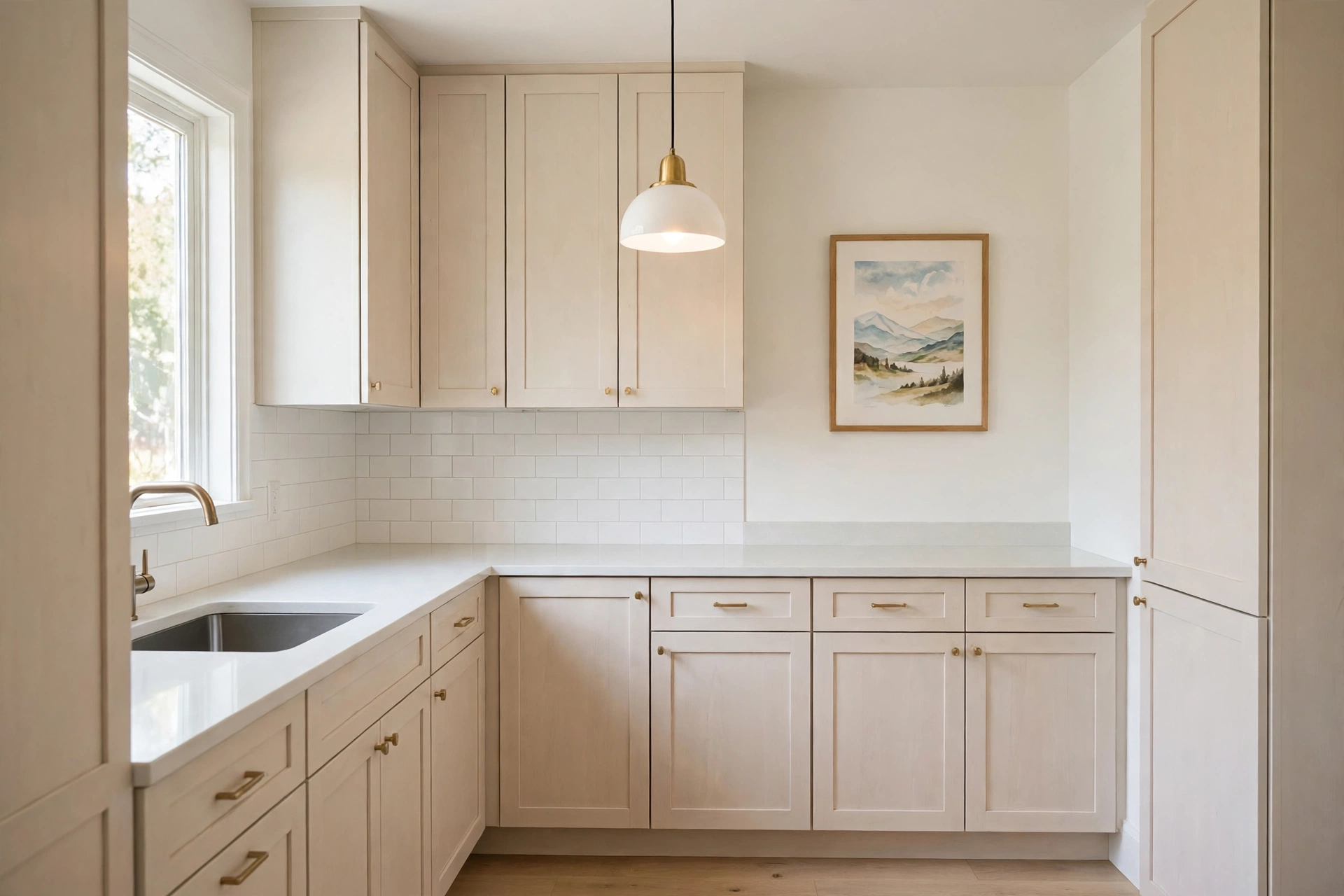

Every small kitchen seems to collect one more thing on the counter, and after a while the room looks busy even when it is clean. The mail lands by the toaster, the spice jars multiply, and the pretty things you bought to decorate end up competing with the cooking itself. In our last rental, the kitchen barely fit two people at once, so every extra object showed.
This guide covers 15 ways to decorate a small kitchen without the clutter, with each idea chosen to make the room look lighter and stay usable. You will find color moves, light moves, and storage that reads as decor, plus what to skip so the room stays calm. Pick one idea, try it for a week, and add the next only if the counters still feel clear.
Quick takeaways
- One light color across walls and cabinets stops the eye from breaking the room into small pieces.
- Keep one focal point and clear counters, and the kitchen reads as decorated rather than crowded.
- Move storage to walls and inside doors so surfaces stay open for cooking.
- Layered light and a little shine do more for a small kitchen than extra objects.
- Repeat one metal and one wood tone so everything visible looks planned.
1. One light color on walls and cabinets
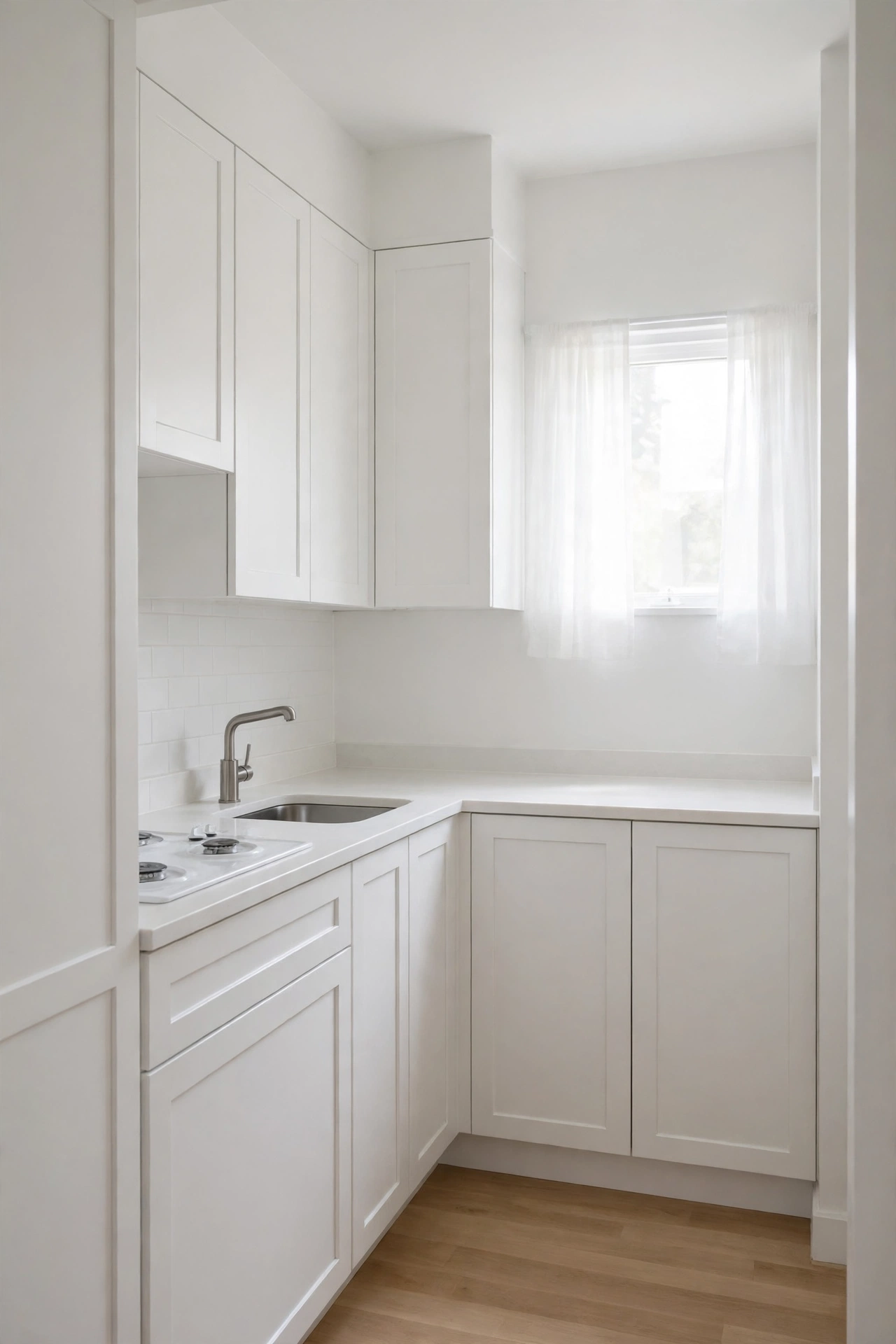
Paint the walls and the cabinets in the same light shade, such as soft white, pale greige, or light sage, and the room stops breaking into separate blocks. The eye travels across one continuous surface, so a galley kitchen that measures 8 feet by 10 feet reads wider than it is. Keep the trim in the same shade with a satin finish, and let one darker note, like a wood cutting board, carry the contrast. This move costs little when you already own a brush, and it changes the room more than any single object you could buy.
Try this: paint one wall first and live with it for three days before you commit to the cabinets, so you can check the shade in morning and evening light.
Cost: $$| Difficulty: medium | Time: one weekend
2. Cabinets that reach the ceiling

Run your cabinets visually to the ceiling, and the kitchen gains height without gaining clutter. If your cabinets stop a foot short, paint a filler panel or a strip of plywood in the exact cabinet color to close the gap, and the run reads as one tall unit. Store the rarely used items up high, such as a holiday platter or a spare blender, and keep daily dishes at eye level. The closed top also ends the dusty shelf above the cabinets, which is one less surface to style and clean.
Try this: measure the gap before you buy anything, and cut the filler panel a fraction short so it slides in without forcing the cabinet frame.
Cost: $$| Difficulty: medium | Time: 2 hours
3. Slim, clean-line hardware

Swap busy knobs and mixed pulls for one slim bar pull in a single finish, such as matte black or brushed nickel, and the cabinets calm down at once. Ornate hardware adds dozens of small shapes to a small room, while a straight 5-inch bar pull repeats one quiet line across every door. Count your doors and drawers first, buy one extra pull for mistakes, and keep the old hardware in a bag in case a renter rule asks you to restore it. The change takes an afternoon and needs only a screwdriver and a drill.
Try this: fit one pull on the most visible drawer first, step back to the doorway, and check the line before you drill the rest.
Cost: $| Difficulty: easy | Time: 2 hours
4. Layered light with under-cabinet strips and one pendant

Light the work surfaces from below and the room from one pendant, and the kitchen gains depth without gaining objects. Stick-on LED strips under the upper cabinets wash the counters in warm light for chopping and cleaning, while a single small pendant over the sink or table gives the room a finished center. Choose one warm white temperature, around 2700K, for both layers so the light matches. Battery strips work for renters, and plug-in strips work where an outlet sits inside a cabinet.
Try this: run the strips toward the back of the cabinet underside so the light falls on the counter, not into your eyes.
Cost: $$| Difficulty: easy | Time: 1 hour
5. One focal point, and only one
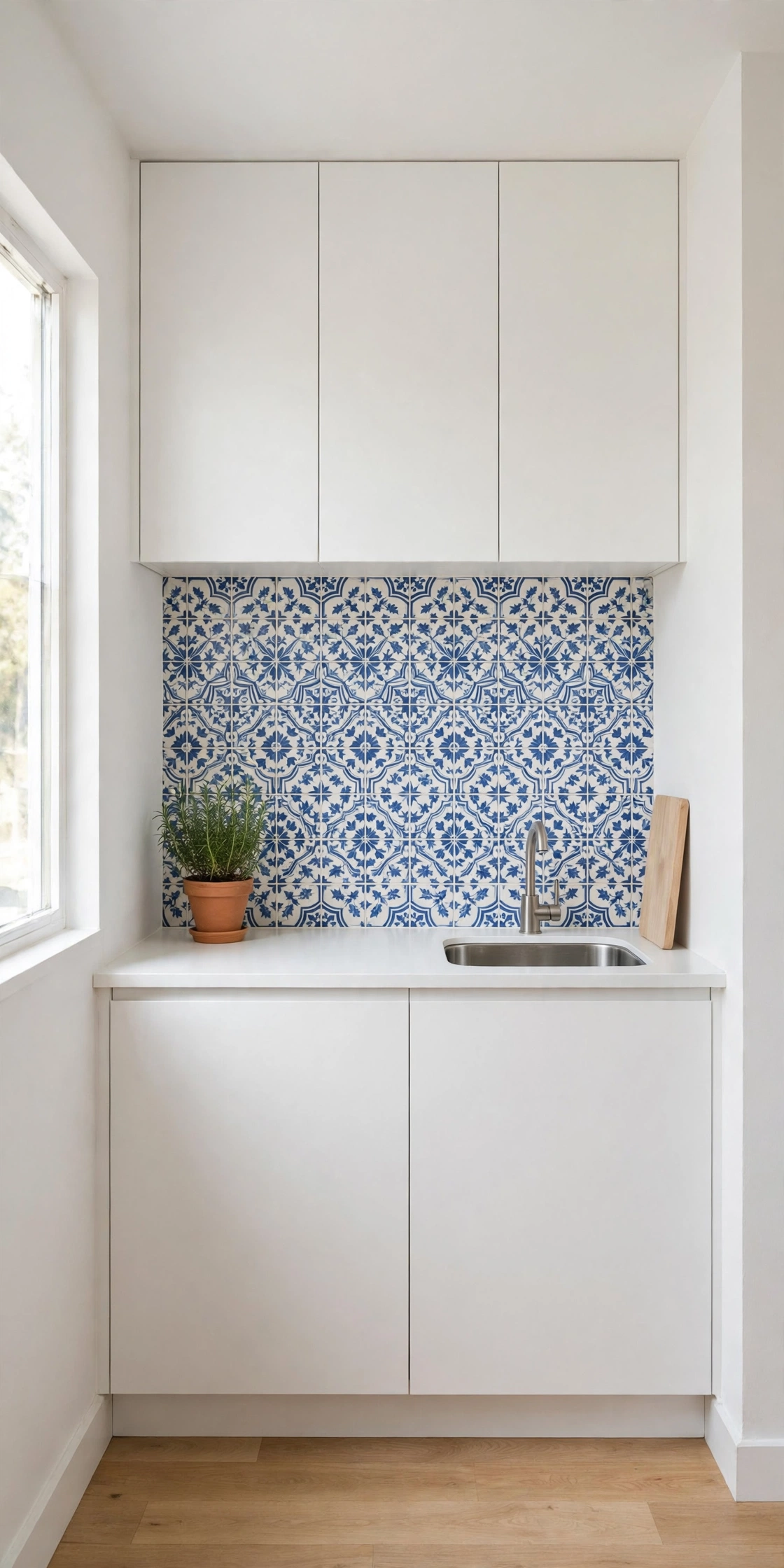
Pick one focal point for the whole kitchen, such as a patterned backsplash, one framed print, or a tiled strip behind the stove, and keep everything else plain. A small room can carry one strong moment, and a second one starts to compete for attention. If you choose the backsplash, paint the walls a quiet shade and skip wall art. If you choose art, keep the backsplash in a plain subway tile. The rule keeps decorating decisions fast, since every new object must answer one question: does it support the focal point or fight it.
Try this: tape a paper square the size of your planned art on the wall for a day, and remove it if your eye keeps landing anywhere else first.
Cost: $$| Difficulty: easy | Time: 1 hour
6. Open shelving on one wall, edited hard
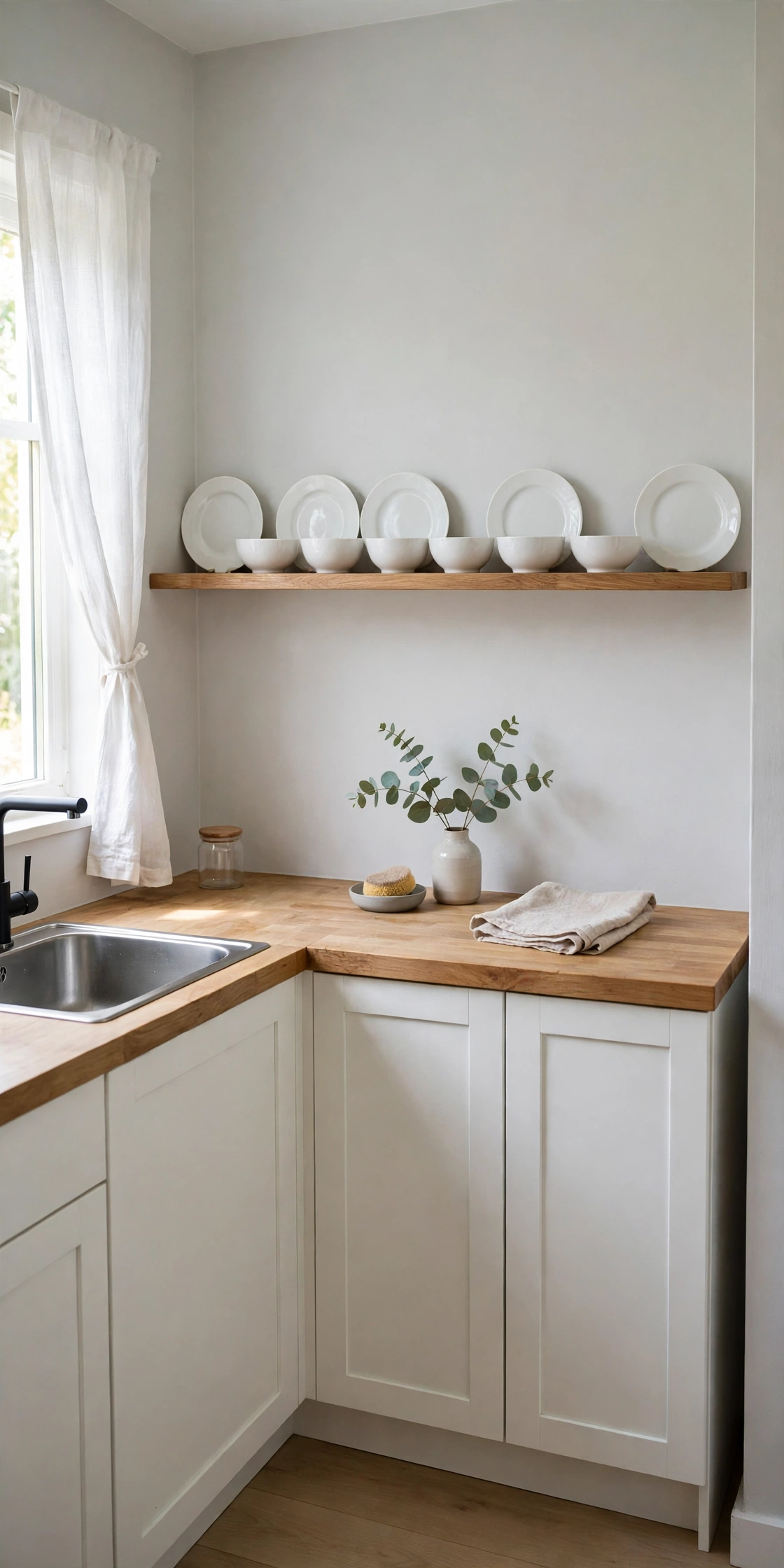
Put open shelves on one wall only, and fill them with the dishes you use every day, such as white plates, bowls, and two or three glasses per shelf. One edited wall draws the eye up and makes the room feel taller, while shelves on every wall turn into visual noise. Group plates by size, keep mugs to one row, and leave one shelf partly empty so the display can breathe. Anything chipped, stained, or unused for a month goes back into a closed cabinet.
Try this: load the shelves, photograph them from the doorway, and remove the three items your eye trips over in the photo.
Cost: $$| Difficulty: medium | Time: 3 hours
7. A wall rail for everyday tools

Hang a single steel rail on the wall by the stove, and the tools you reach for daily become part of the decor instead of drawer clutter. A 16-inch rail with five hooks holds a ladle, a spatula, a whisk, scissors, and a measuring cup set, all in matching steel so the row reads as one unit. Mount it into a stud or a proper wall anchor, and keep the rail at a height where handles clear the counter by at least 6 inches. The drawer that held those tools now holds the items you use once a week.
Try this: hang only the five tools you used in the last week, and move the rest to a drawer for a month before you decide they belong on the wall.
Cost: $$| Difficulty: easy | Time: 45 minutes
8. A magnetic knife strip in place of the block
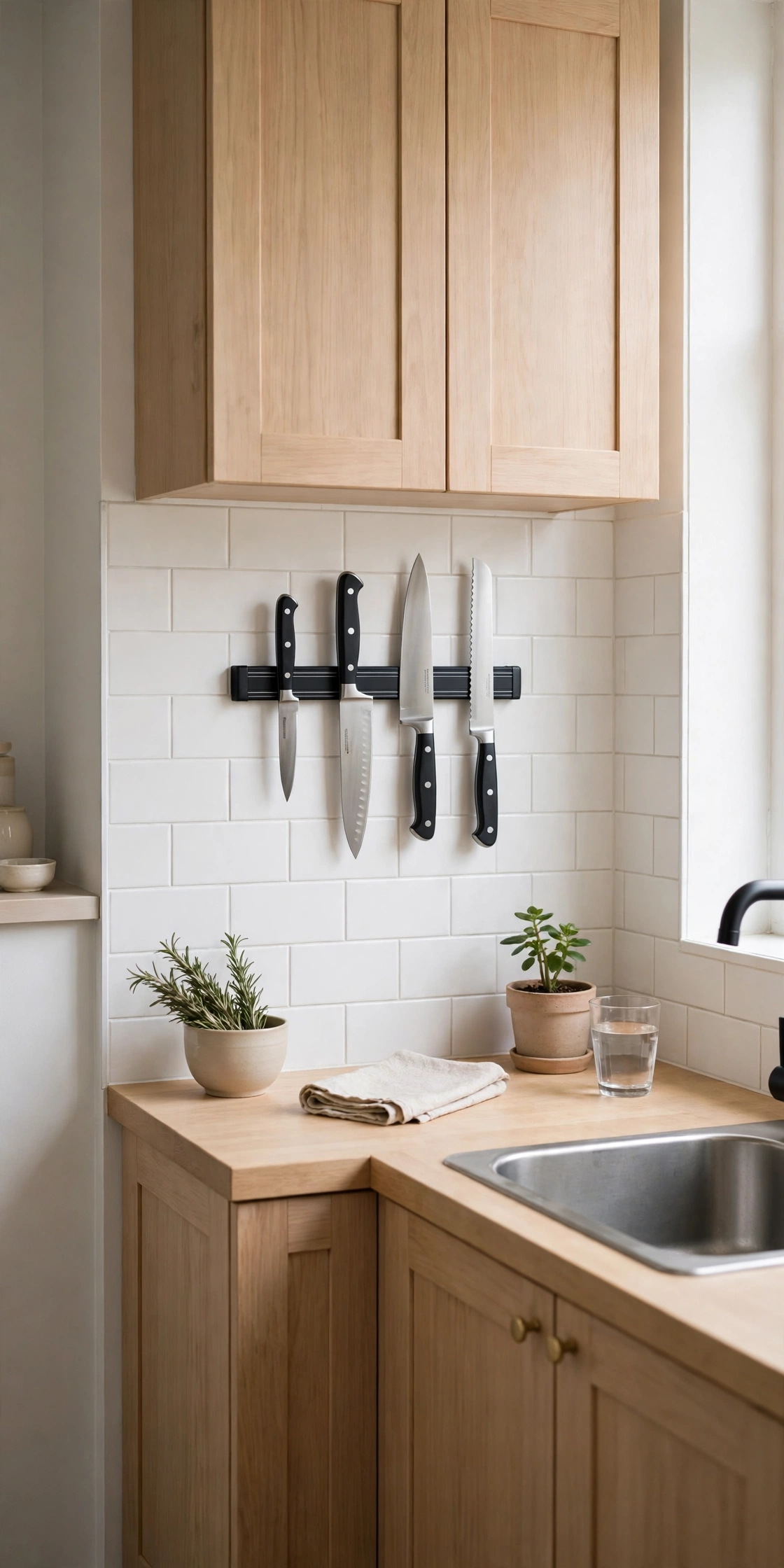
Replace the counter knife block with a magnetic strip on the wall, and you free a full square foot of counter while the knives look intentional. A 12-inch strip holds four or five daily knives in a straight row, with blades facing the wall and handles at grip height. Mount it away from the stove so heat never reaches the handles, and out of reach of small children. Wipe the strip weekly, since kitchen grease settles on any flat metal surface near cooking.
Try this: hold the strip against the wall with tape for a day to check the height, and mark the screw holes only after a full day of cooking.
Cost: $$| Difficulty: easy | Time: 30 minutes
9. One tray for the daily items, counters clear otherwise

Give the daily cooking items one tray, such as a 12-inch wood tray holding oil, salt, and a spoon rest, and clear everything else off the counters at the end of cooking. The tray turns three loose objects into one unit, so the counter reads as styled rather than scattered, and the rest of the surface stays open for prep. Keep the tray near the stove but off the main cutting zone, and set a nightly habit of returning stray items to their cabinets. When the tray fills past its edge, something in it has not earned daily status.
Try this: empty the counters completely tonight, then add back only the items you reached for during the last three dinners.
Cost: $$| Difficulty: easy | Time: 20 minutes
10. Café curtains that keep the light
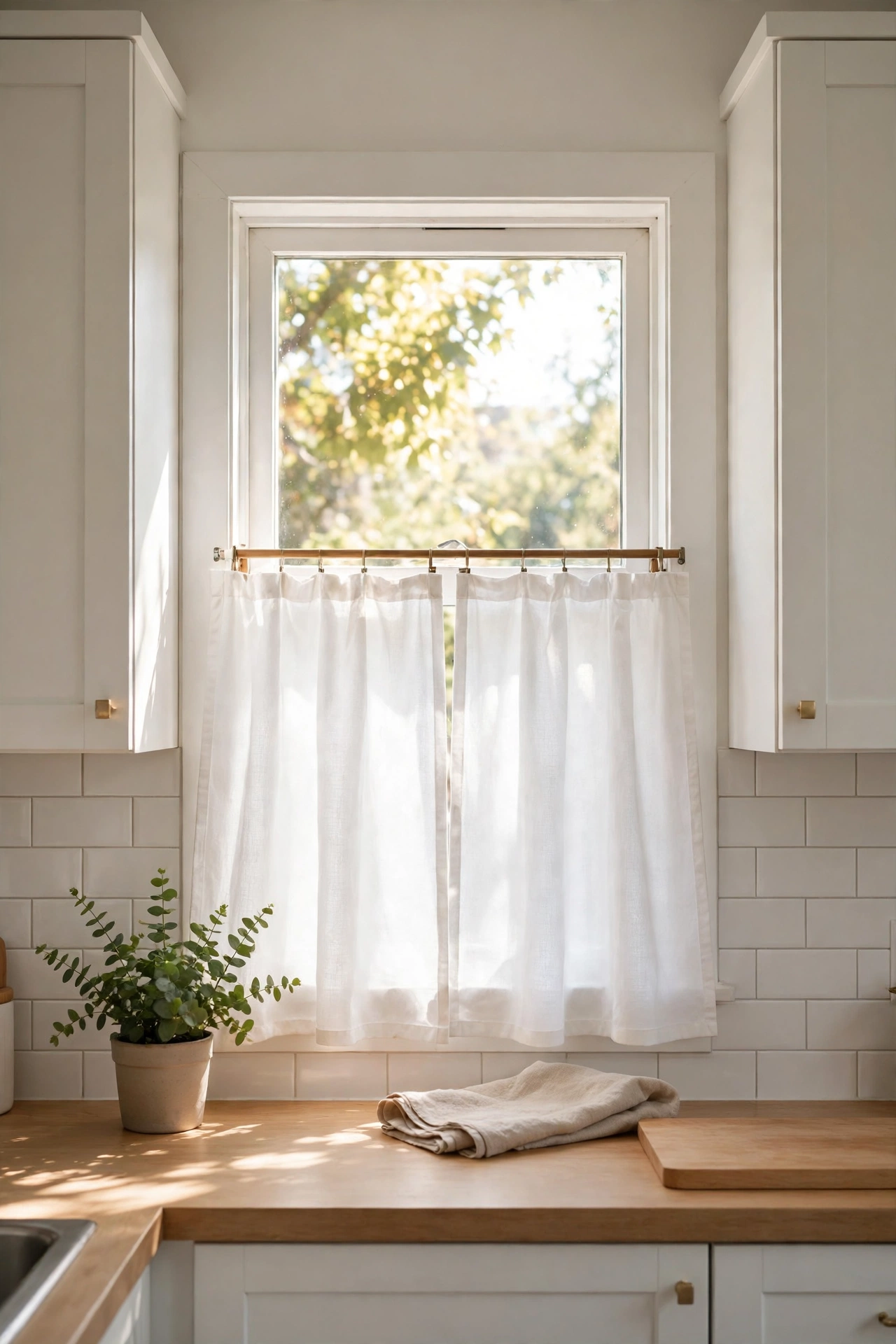
Hang café curtains on the lower half of the kitchen window, and you gain privacy without losing daylight. Full curtains darken a small room and heavy blinds add another hard surface, while a light cotton café curtain covers the sightline from outside and leaves the top half open to the sky. Choose a plain white or natural linen panel on a slim tension rod, so the window needs no drilling and the curtain washes easily. The soft fabric also adds the one textile note the room needs without adding an object to any surface.
Try this: hold the panel up at noon and at dusk before you hem it, since the same fabric reads lighter in direct sun than in evening light.
Cost: $$| Difficulty: easy | Time: 30 minutes
11. Glass and shine that bounce light around

Add one or two reflective surfaces, such as a glass-front cabinet door, satin paint on the trim, or a mirrored strip along the backsplash, and daylight travels further into the room. Glass shows the dishes inside, so it works best on one cabinet holding matching white bowls, while the rest stay solid. Satin paint on trim bounces light without the glare of gloss, and a mirrored strip behind the sink doubles the window light. Keep the shine to two surfaces at most, since a third starts to feel like a hall of mirrors.
Try this: swap one solid cabinet door for glass first, and live with the visible dishes for a week before you change another door.
Cost: $$| Difficulty: medium | Time: 2 hours
12. A fold-down table that disappears after meals

Fix a fold-down table to the wall, and a small kitchen gains an eating spot that vanishes when the meal ends. A 24-inch by 30-inch wall-mounted table folds flat against the wall, with two stools that tuck beneath it or stack in a nearby closet. Mount the bracket into studs, since the table must hold plates, mugs, and leaning elbows without sagging, and set the height at 30 inches to match standard chairs. The floor stays open for cooking, and the room never carries a permanent table it cannot spare.
Try this: mark the open table outline on the floor with tape for three days, and check that the walkway still clears 30 inches before you drill.
Cost: $$| Difficulty: medium | Time: 2 hours
13. One metal and one wood tone, repeated

Choose one metal and one wood tone, such as matte black with light oak, and repeat that pair on every visible item, from pulls to the rail to the stool legs. A small room shows every finish at once, so three metals and two wood tones read as clutter even when the counters are clear. When you buy a new item, check it against the pair first, and pass on anything that adds a third finish. The repetition makes old and new pieces look bought together, which is the cheapest way to make a kitchen feel designed.
Try this: photograph the kitchen, count the finishes in the photo, and remove or spray-paint the one finish that appears only once.
Cost: $| Difficulty: easy | Time: 1 hour
14. Textiles for color, kept to one palette

Let textiles carry the color, with tea towels and a small rug in one palette, such as sage green with cream, while the walls and cabinets stay light. Fabric adds warmth that hard surfaces cannot, and it swaps out with the seasons for the price of a towel set. Hang one towel on the oven handle and fold one over the rail, and lay a 2-foot by 3-foot rug by the sink, which is the one spot that needs it. Wash the set weekly so the color stays fresh, and retire any towel that has faded to a different shade.
Try this: buy the rug first, then match the towels to its darkest stripe, so the palette has one anchor instead of two competing colors.
Cost: $$| Difficulty: easy | Time: 20 minutes
15. Storage hidden inside doors and lidded baskets

Hide the working storage inside cabinet doors and lidded baskets, so the kitchen looks decorated while the supplies stay close. Slim racks inside doors hold spices, lids, and cleaning cloths without changing how the room feels, and a lidded basket on top of the fridge holds the items you use monthly. Measure the door clearance before you buy a rack, since a rack that blocks the door from closing creates a new problem. Label the basket once, and the hidden storage stays as easy to use as open storage.
Try this: fit the door racks first, move the spices off the counter the same day, and check after a week that nothing has crept back out.
Cost: $$| Difficulty: easy | Time: 1 hour
Compare the 15 ideas
| Idea | Cost | Difficulty | Time | Best for |
|---|---|---|---|---|
| One light color | about $40 | medium | one weekend | dark or choppy kitchens |
| Cabinets to the ceiling | about $25 | medium | 2 hours | low ceilings, dusty tops |
| Slim hardware | about $3 per pull | easy | 2 hours | renters, quick refresh |
| Layered light | about $20 | easy | 1 hour | dark corners, evening cooking |
| One focal point | about $30 | easy | 1 hour | rooms with competing decor |
| Open shelving, one wall | about $40 | medium | 3 hours | daily dishes, tall walls |
| Wall rail | about $15 | easy | 45 minutes | crowded drawers |
| Magnetic knife strip | about $20 | easy | 30 minutes | counter knife blocks |
| One daily tray | about $15 | easy | 20 minutes | counters that refill daily |
| Café curtains | about $20 | easy | 30 minutes | dark windows, renters |
| Glass and shine | about $30 | medium | 2 hours | rooms short on daylight |
| Fold-down table | about $60 | medium | 2 hours | no room for a table |
| One metal, one wood | about $10 | easy | 1 hour | mixed finishes |
| Textiles for color | about $25 | easy | 20 minutes | plain white kitchens |
| Hidden door storage | about $20 | easy | 1 hour | spices and small supplies |
How to pick your first change
Start with the change that fixes what bothers you most when you walk in. If the room feels dark, start with layered light. If the counters refill every day, start with the daily tray and the door racks. If the room feels busy, start with one light color and one focal point. One change, lived with for a week, tells you more than five changes made in one weekend.
For more ideas on styling a single tricky spot, see these 22 minimal kitchen corner decor ideas, which cover counter corners in detail. If the gap above your cabinets bothers you, these storage ideas for the space above kitchen cabinets show how to finish that strip. For the sink zone, these kitchen sink soap tray ideas keep one small area dry and tidy. And if the counters keep refilling no matter what you try, these 10 easy simple steps to declutter your home give the whole house a reset.
Mistakes that make a small kitchen look busier
The most common mistake is decorating every surface at once, so the eye finds no rest anywhere. A second mistake is mixing finishes, since each new metal or wood tone adds a visual category. A third is open shelving on two or more walls, which turns display into storage overflow. A fourth is buying small decor in bulk, since five tiny objects read as clutter faster than one larger piece. Fix one mistake at a time, and check the room from the doorway after each fix.
Safety notes for small kitchens
Mount shelves, rails, and fold-down tables into studs or proper wall anchors, and check the load rating before you hang cast iron or full dish sets. Keep knives on the magnetic strip out of reach of small children, and keep cords from plug-in light strips away from the sink. Hire a licensed electrician for any hardwired light or new outlet, and keep flammable textiles away from the stove. For guidance on anchoring heavy items, see the CPSC Anchor It guidance. For efficient lighting choices, see the ENERGY STAR LED lighting guide.
Frequently asked questions
Can a small kitchen have decor and still look uncluttered?
Yes, when each piece earns its place by being used daily or by serving as the one focal point. Keep counters mostly clear, group daily items on one tray, and limit wall decor to one edited wall or one framed piece. The room then reads as decorated because the few visible items look chosen, not accumulated.
What color makes a small kitchen look bigger?
One light shade across walls and cabinets, such as soft white or pale greige, makes the room read as one continuous space. Keep the trim in the same shade with a satin finish, and add contrast only through one wood tone or one textile palette. Dark accent walls and mixed cabinet colors break the room into smaller pieces.
Are open shelves a good idea in a small kitchen?
Open shelves work on one wall when they hold only daily dishes in matching colors, with one shelf partly empty. They fail when they spread to every wall or hold rarely used items, since the display then reads as storage overflow. If dust or grease is a problem near your stove, keep shelves on a wall away from cooking.
How do I keep counters clear after decorating?
Set a nightly habit of returning everything except the daily tray to its cabinet, and review the tray weekly to remove anything unused for three dinners. Door racks and wall rails give those items a home off the counter, so the clear surface lasts past the first week. When the tray fills past its edge, something in it has lost daily status.
Do I need to renovate to make a small kitchen look uncluttered?
No. Paint, hardware, layered light, textiles, and door racks change how the room reads without moving walls or replacing cabinets. Start with the cheapest change that fixes your biggest complaint, such as light strips for a dark kitchen or a daily tray for crowded counters, and renovate only if the layout itself blocks cooking.
Final thoughts
A small kitchen looks uncluttered when one light color, one focal point, and clear counters do the decorating work, and everything else hides on walls, inside doors, or in a single tray. Start with the one change that fixes your biggest complaint, live with it for a week, and let the room stay calm before you add the next idea.